Operation Marking Garden

Posted in Biographical, Education, Maynooth with tags , , on May 21, 2025 by telescoper

Posts will be a little thin for the next ten days or so here as I am preoccupied with correcting examinations and other assessments. I am spending most of the time doing that at home to avoid interruptions. I’ve also taken the opportunity afforded by this fine spell to do some laundry which I can peg out to dry outdoors. I think this is called multi-tasking. Fortunately (barring yesterday’s thunderstorms), the weather has been nice enough to do the marking outside, in my little garden.

Yesterday evening’s thunderstorms

A few years ago I posted an item about red valerian which grows in profusion around here on verges and embankments. Red valerian (aka spur valerian, kiss-me-quick, fox’s brush, devil’s beard & Jupiter’s beard among other names) is not to be confused with True Valerian, which has white (or very pale pink flowers). I mentioned in that post It’s red valerian (aka spur valerian, kiss-me-quick, fox’s brush, devil’s beard & Jupiter’s beard among other names). I mentioned in that post that I’d like to have some in my garden. Well, it seems that the seeds I planted have grown, perhaps spurred on by the rain yesterday evening:
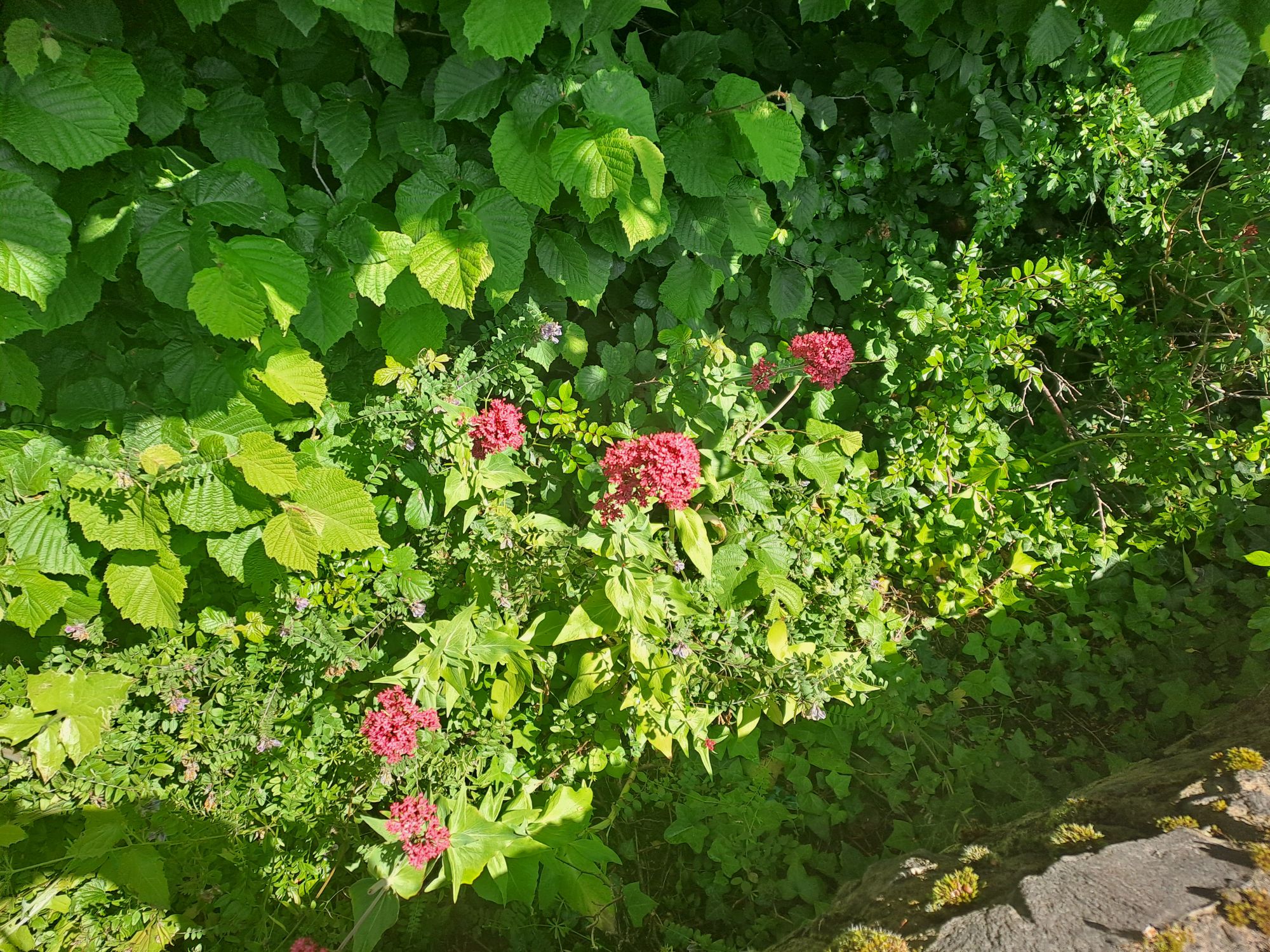
red valerian

It’s not exactly a profusion, but it’s a start.

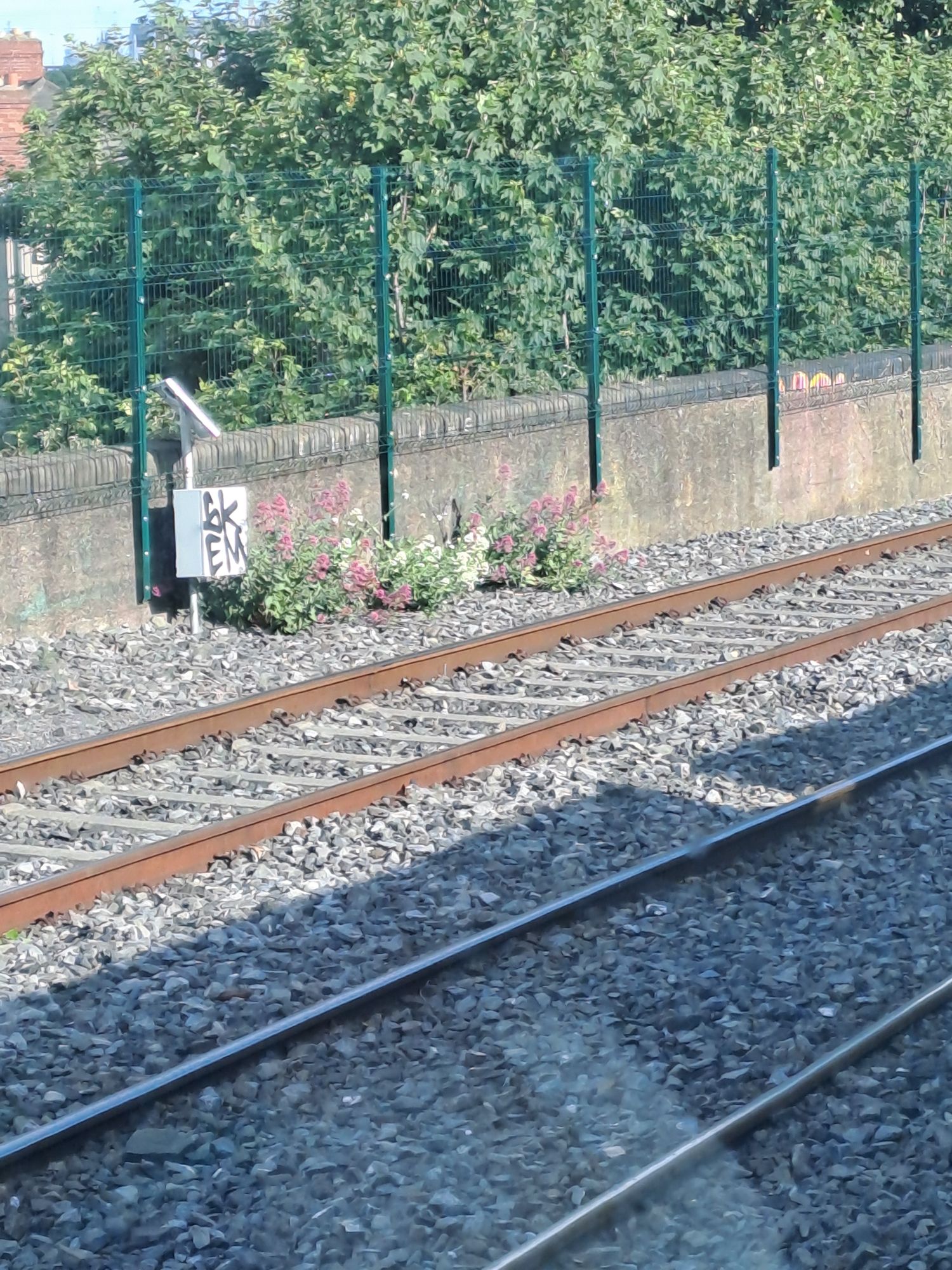
UPDATE: 31/05/25 On my way into Dublin by train I saw Red Valerian and True Valerian together by the railway tracks.
Anyway, I spent this morning marking until I remembered a couple of things I had to do on campus. That’s only 20 minutes’ walk for me so I went there at lunchtime, getting a haircut on the way. I stayed for lunch in Pugin Hall and then came back to continue with my correcting duties.

When I took a break for tea I suddenly remembered (for some reason) that the debit card on my UK bank account was about to expire and I hadn’t updated the address since I sold my house in Cardiff. Strangely, I couldn’t update my details online but instead had to use the telephone banking service. One can change to another address in the UK using the online banking app, but can’t do that if you’re moving abroad. Although it took longer to do than I had anticipated it might, the person I spoke to was very helpful. Fortunately they hadn’t yet despatched a replacement card and/or PIN so all was well.

So there you are. Another exciting day in the life of an academic has passed.
R.I.P. Jayant Narlikar (1938-2025)

Posted in Biographical, R.I.P., The Universe and Stuff with tags , , , , , , on May 20, 2025 by telescoper
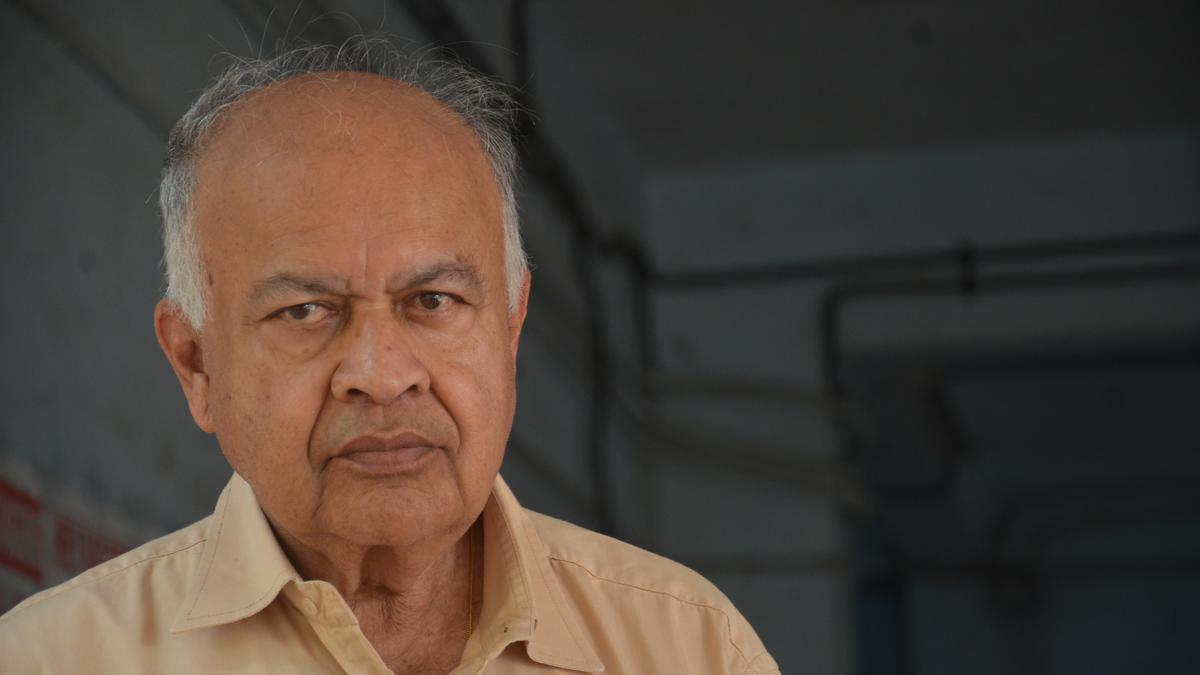
Professor Jayant Vishnu Narlikar (1938-2025)

I heard this morning of the death at the age of 86 of renowned Indian cosmologist Jayant Vishnu Narlikar. I understand he died peacefully in his sleep in Pune after a brief illness.

Scientifically, Jayant Narlikar is probably best known for his work with Fred Hoyle on a conformal gravity theory and as an advocate of the Steady State theory of cosmology. In India however his fame extended far beyond the world of research, as an educator and science popularist, as well as Founder-Director of the Inter-University Centre for Astronomy and Astrophysics (IUCAA) in Pune. Those who met him – as I was lucky enough to do – will also remember him as a kind and gracious man, and a self-effacing inspirer of young scientists. During my visit I gave a talk there, which Narlikar attended, and we had a very nice conversation afterwards from which I learnt a huge amount.

The Directorship at IUCAA came with a house which had a very nice lawn, on which I remember playing croquet with Donald Lynden-Bell and others, but that’s another story. Another random thing I remember is that I remember is that Narlikar’s username on the IUCAA email system was “jvn” and he was often referred to informally by that name.

Although he never really abandoned the Steady State cosmology, despite the weight of evidence in favour if the Big Bang, it is to Narlikar’s great credit that he didn’t try to impose his own scientific ideas on those working at IUCAA. In fact he assembled an excellent group of cosmologists and astrophysicists and encourage them to do whatever they liked.

I first visited IUCAA in 1994 to work with Varun Sahni. In those days Westerners mainly went to Pune to visit an ashram (usually the one run by the guru Rajneesh). I remember when I arrived on the train from Mumbai and tried to get a taxi to the IUCAA campus, the driver asked me “which ashram?” I had long hair and a beard at that time, so I looked a potential hippy. I said, “No ashram. Professor Narlikar”. He knew exactly where to take me; “Narlikar” was a household name in India, where the newspapers are awash with tributes today (e.g. here) and where his loss will be keenly felt.

Rest in peace Jayant Narlikar (1938-2025)

A galaxy at redshift z=14.44?

Posted in OJAp Papers, The Universe and Stuff with tags , , , , , on May 19, 2025 by telescoper

This morning’s arXiv mailing presented me with a distraction from examination marking in the form of a paper by Naidu et al. with this abstract:

This paper has been submitted to the Open Journal of Astrophysics. In the relatively recent past, papers like this about record-breaking galaxies would normally be submitted to Nature so perhaps we’re at last starting to see a change of culture?

I usually feel a bit conflicted in situations when a paper has been submitted for editorial review there. In this case I am posting it here for two reasons: one is that I am not the Editor responsible for this paper; the other is that the arXiv submission specifically says

Submitted to the Open Journal of Astrophysics. Comments greatly appreciated and warmly welcomed!

In order to generate flagging it here to encourage people to comment, either through the box below or by contacting the authors.

For reference, here is the key plot showing the spectrum from which the redshift is determined. It is rather noisy, but the Lyman break seems reasonably convincing and there are some emission lines that appear to offer corroborative evidence:

You might want to read this article (another OJAp paper) which contains this plot showing how galaxies at redshift z>10 challenge the standard model:

Please read the paper and comment if you wish!

Litotes – Paul Muldoon

Posted in Poetry with tags , , , on May 18, 2025 by telescoper
Though it wasn’t until 411 BC he took up the oar
in the Peloponnesian War
against “man-loosening” Lysander,

our hero was not unknown
to Thucydides, who’d evenhandedly intone
“What’s sauce for Aegeus is sauce for the gander.”

Despite his background
being less than sound,
he nonetheless managed to drive a phaeton

through the Spartan ranks
or, on more than one occasion, an oar-bank.
If his circumstances were quite often straitened

he couldn’t say no
to manning up and having a go
at the slightest hint of an old school oligarchy.

No scanty there, then?
Faced with the very same problem time and again
he would resort to being snide or snarky

and immediately made a dent
in it. It was no small accomplishment
that he somehow managed to claim kin with Nestor

and, since he was far
from the sharpest ray in the earthstar,
was quite likely an ancestor

of the not exactly inspiring Greek
who would eke
out an existence in the precincts of the Abbey

where he’d been married sword in hand, ye Gads,
turning out to be not half bad
or, as Thucydides would have it, “None too shabby.”

by Paul Muldoon (b. 1951).

I recently discovered the poetry of Paul Muldoon who, as once described in the New York Times, “… takes some honest-to-God reading. He’s a riddler, enigmatic, distrustful of appearances, generous in allusion, doubtless a dab hand at crossword puzzles.” This poem is from Joy in Service on Rue Tagore (2024), which is published by Faber & Faber.

International Day Against Homophobia, Biphobia and Transphobia

Posted in History, LGBTQ+ with tags , , , on May 17, 2025 by telescoper

Today is May 17th, which means that it is International Day Against Homophobia, Transphobia and Biphobia. If you’re wondering why May 17th was chosen, it’s to commemorate May 17th 1990, which is when the World Health Organisation removed homosexuality from its list of “mental illnesses”.


Attitudes in many places are more enlightened than they were decades ago. Next week, for example, sees the 10th anniversary of the equal marriage referendum in Ireland.  But the rights we have won  could easily be  (and indeed are being ) lost if we do not defend them.


The theme for IDAHOBIT2025  is “The Power of Communities”, shown above in Irish. Even if you are not a member of our community we still need your support. Here is a useful guide I posted a few years ago about how to be a good ally.

Weekly Update from the Open Journal of Astrophysics – 17/05/2025

Posted in OJAp Papers, Open Access, The Universe and Stuff with tags , , , , , , , , , , , , on May 17, 2025 by telescoper

It’s a lovely Saturday morning in May, and it’s time for the weekly  update of papers published at the Open Journal of Astrophysics. Since the last update we have published four new papers, which brings the number in Volume 8 (2025) up to 59 and the total so far published by OJAp up to 294.

In chronological order of publication, the four papers published this week, with their overlays, are as follows. You can click on the images of the overlays to make them larger should you wish to do so.

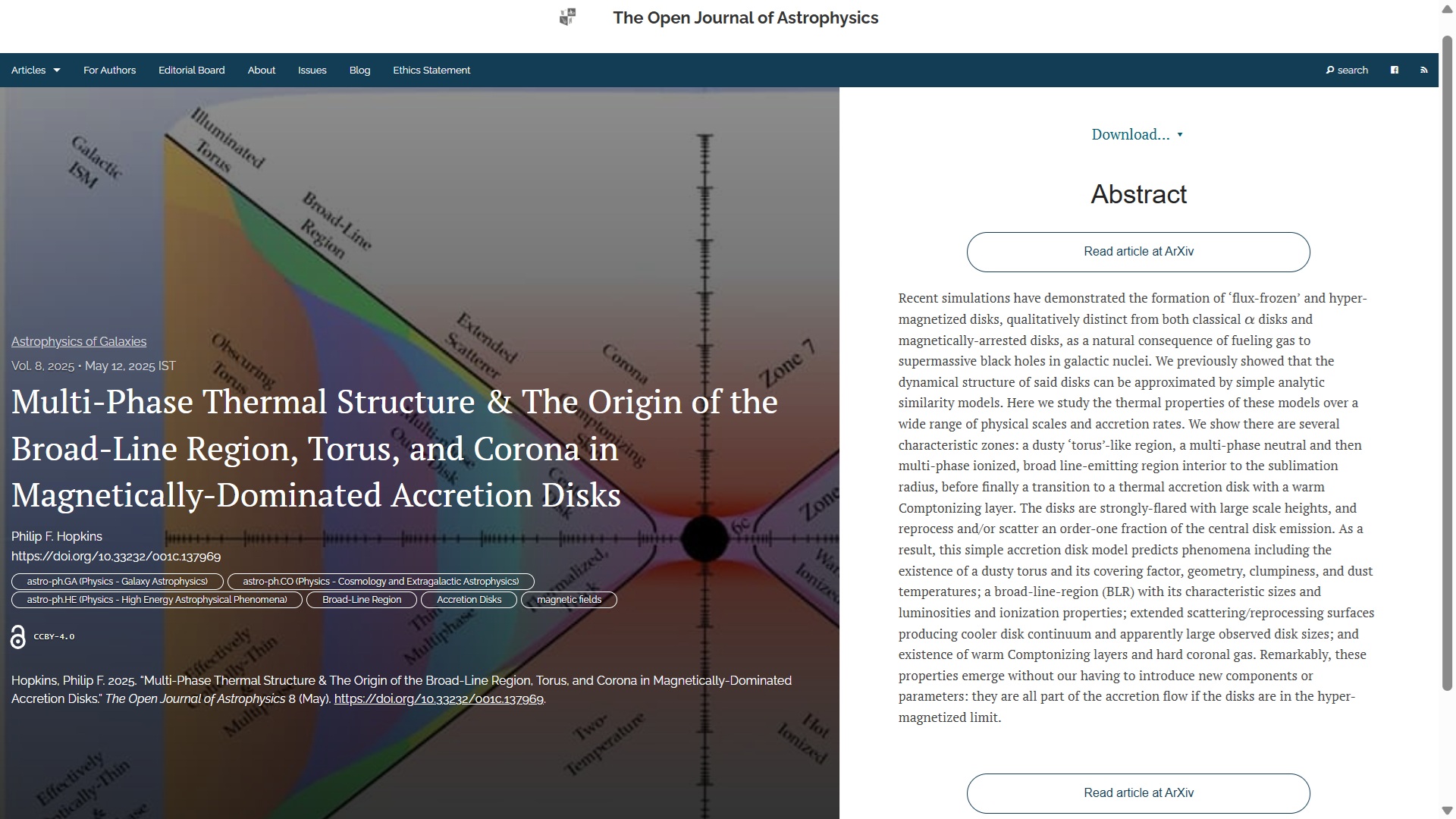
The first paper to report is: “Multi-Phase Thermal Structure & The Origin of the Broad-Line Region, Torus, and Corona in Magnetically-Dominated Accretion Disks” by Philip F. Hopkins (Caltech, USA). This was published on Monday May 12th in the folder Astrophysics of Galaxies. It presents simple accretion disk model that predicts the properties of many features including the dusty torus, broad-line region, continuum emission and coronal gas.

The overlay is here:

You can find the officially accepted version on arXiv here.

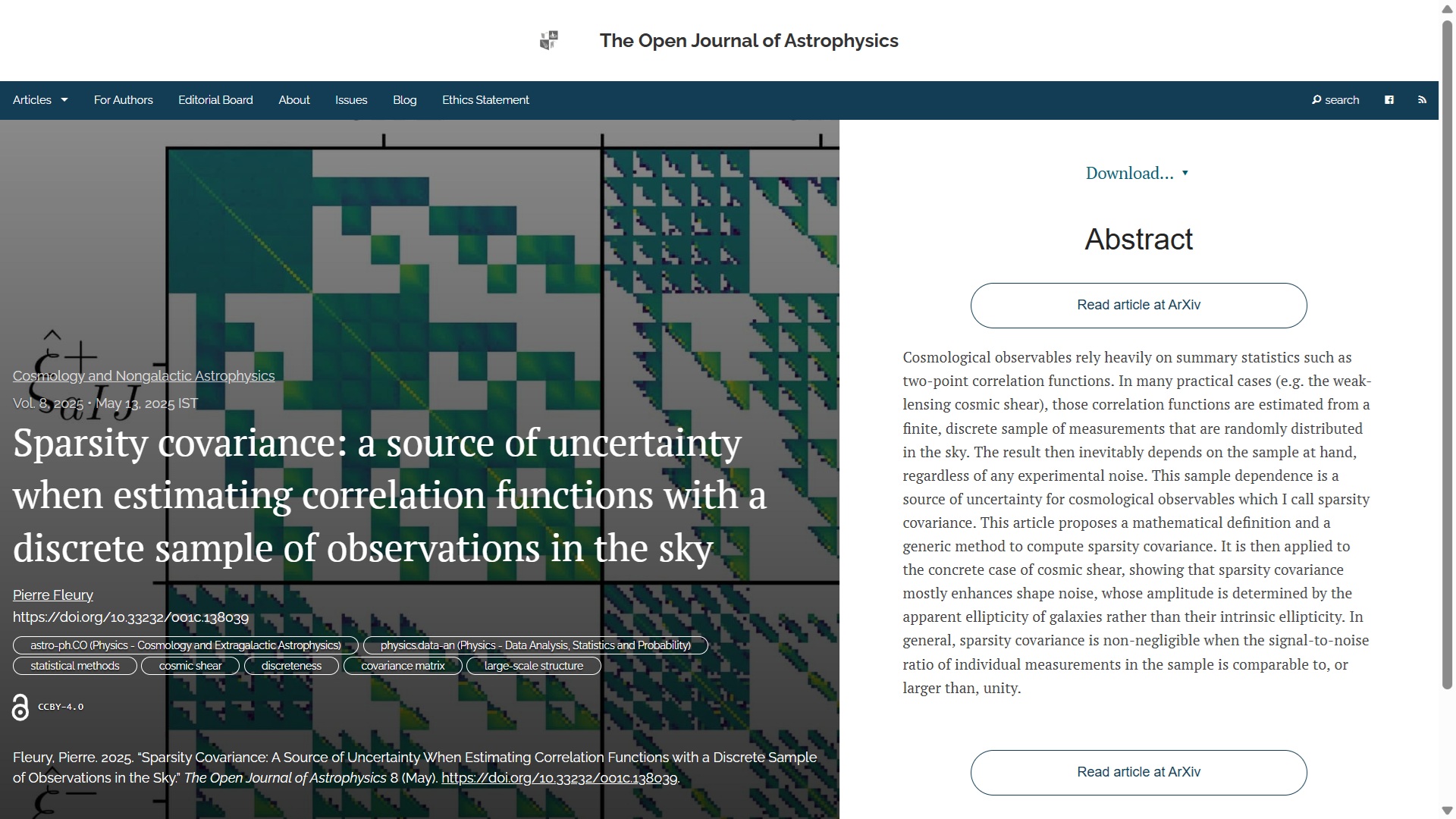
Second one up is “Sparsity covariance: a source of uncertainty when estimating correlation functions with a discrete sample of observations in the sky” by Pierre Fleury (U. Montpellier, France). This one was published on Tuesday 13th May 2025 in the folder Cosmology and NonGalactic Astrophysics.  This paper presents a discussion of the uncertainty in cosmological observables caused by discrete sampling and a method to compute the covariances resulting from this.

The overlay is here:

You can find the officially-accepted version of the paper on arXiv here.

The third paper of the week, published on Wednesday May 14th 2025,  is “Dark Matter Particle Flux in a Dynamically Self-consistent Milky Way Model” by Lucijana Stanic, Mark Eberlein, Stanislav Linchakovskyy, Christopher Magnoli, Maryna Mesiura, Luca Morf, Prasenjit Saha (University of Zurich, Switzerland) and Eugene Vasiliev (University of Surrey, UK). This one presents a study of the behaviour of dark matter in an anisotropic model for the Milky Way halo with implications for particle detection rates. It is in the folder Astrophysics of Galaxies.

Here is the overlay:

You can find the officially accepted version of this paper on arXiv here.

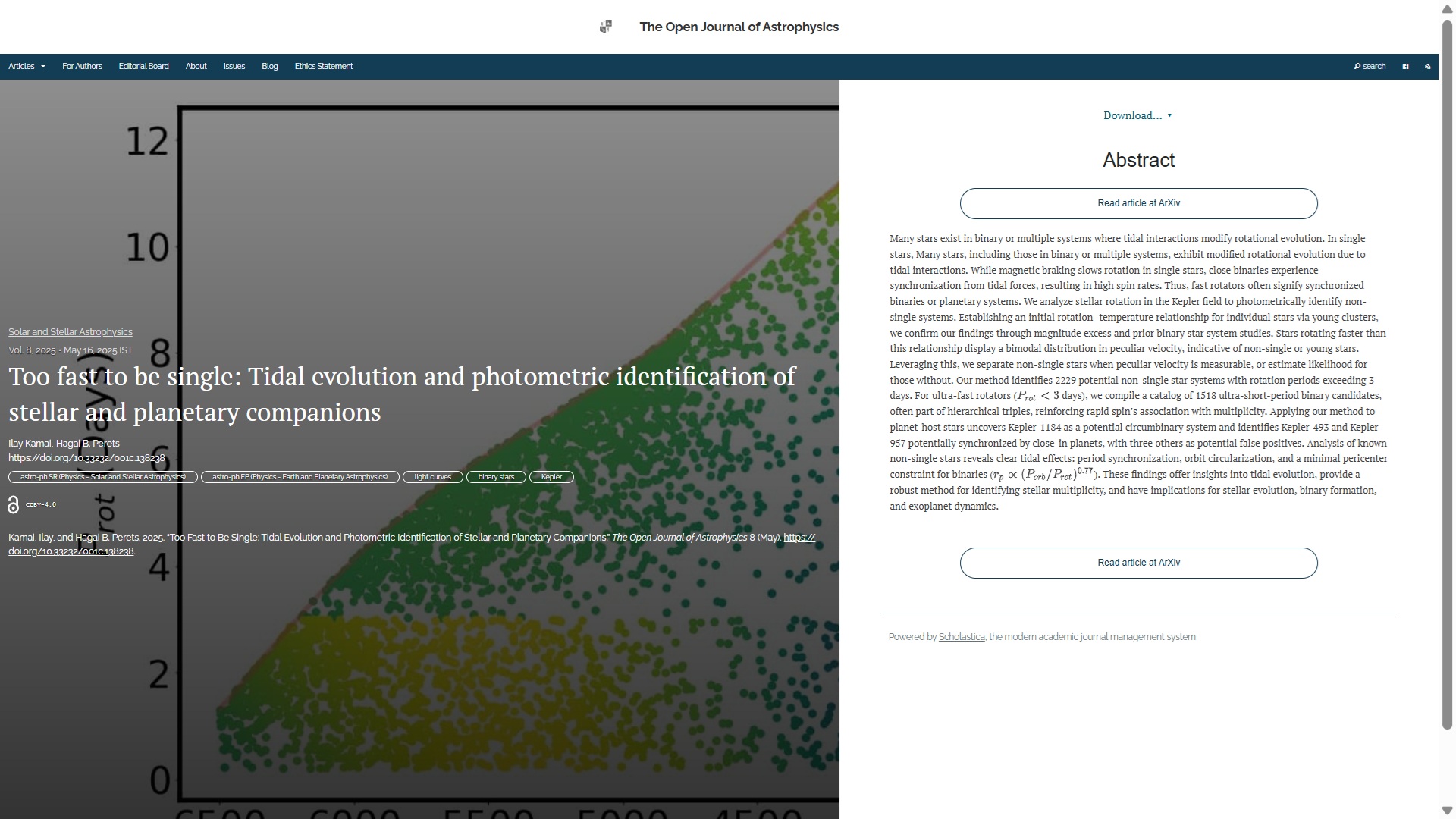
The last paper published this week is “Too fast to be single: Tidal evolution and photometric identification of stellar and planetary companions” by Ilay Kamai and Hagai B. Perets (Technion, Haifa, Israel). This one was published on Friday 16th May 2025 in the folder Solar and Stellar Astrophysics. It presents an analysis of the rotation of stars observed in the Kepler field to identify non-single systems with high spin rates resulting from tidal effects.

Here is the overlay:

The official published version can be found on the arXiv here.

That’s all the papers for this week. I’ll post another update next week.

The CosmoVerse: The White Paper

Posted in The Universe and Stuff with tags , , , on May 16, 2025 by telescoper

Newly announced on arXiv there is a review article with the title The CosmoVerse White Paper: Addressing observational tensions in cosmology with systematics and fundamental physics. The abridged form of the abstract reads:

The standard model of cosmology has provided a good phenomenological description of a wide range of observations both at astrophysical and cosmological scales for several decades. This concordance model is constructed by a universal cosmological constant and supported by a matter sector described by the standard model of particle physics and a cold dark matter contribution, as well as very early-time inflationary physics, and underpinned by gravitation through general relativity. There have always been open questions about the soundness of the foundations of the standard model. However, recent years have shown that there may also be questions from the observational sector with the emergence of differences between certain cosmological probes. In this White Paper, we identify the key objectives that need to be addressed over the coming decade together with the core science projects that aim to meet these challenges. These discordances primarily rest on the divergence in the measurement of core cosmological parameters with varying levels of statistical confidence. These possible statistical tensions may be partially accounted for by systematics in various measurements or cosmological probes but there is also a growing indication of potential new physics beyond the standard model. After reviewing the principal probes used in the measurement of cosmological parameters, as well as potential systematics, we discuss the most promising array of potential new physics that may be observable in upcoming surveys. We also discuss the growing set of novel data analysis approaches that go beyond traditional methods to test physical models.

arXiv:2504.01669v2

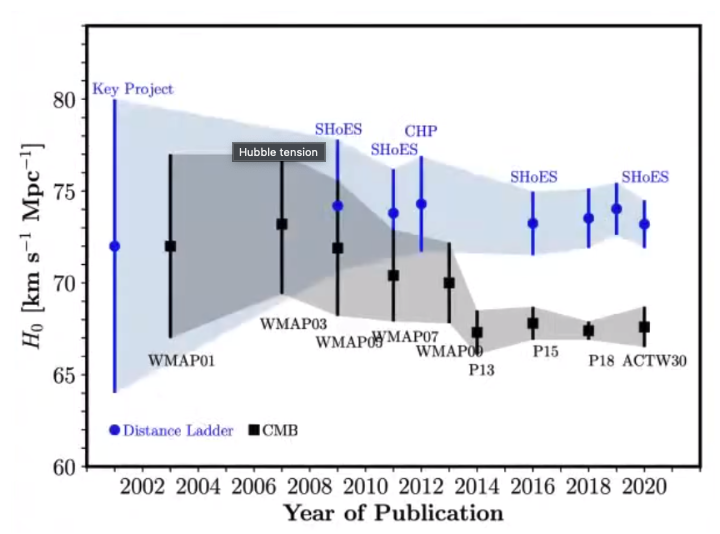
Here’s a plot demonstrating one of the tensions discussed in this paper, and widely on this blog, the Hubble Tension:


This is a very comprehensive review article consisting of over 400 pages and having over 400 authors. I expect all of you to read it over the weekend. There will be a test on Monday.

*One of whom happens to be a PhD student of mine.

After Lectures and before Examinations

Posted in Education, Maynooth, The Universe and Stuff with tags , , on May 15, 2025 by telescoper

This morning I did my last teaching session of the Academic Year 2024-5, a revision lecture/tutorial on Computational Physics. It was optional, as this is officially a study break, and was at 9am, but I had about 30% attendance which wasn’t bad in the circumstances. As is often the case with optional sessions, I think the students who came were the keenest and probably therefore those who least needed last-minute tips for the examination, but that’s always the way.

The Examination Period starts tomorrow morning, but most of the students who turned up this morning have their first examination on Monday 19th May which happens to be Computational Physics.

Anyway, now that my teaching is over I thought I’d take the opportunity to wish all students the best for their examinations:

You shouldn’t really be relying on luck of course, so here are some tips (especially for physics students, but applicable elsewhere).

  1. Try to get a good night’s sleep before the examination and arrive in plenty of time before the start. Spending all night cramming is unlikely to help you do well.
  2. Prepare well in advance so you’re relaxed when the time comes.
  3. Read the entire paper before starting to answer any questions. In particular, make sure you are aware of any supplementary information, formulae, etc, given in the rubric or at the end.
  4. Start off by tackling the question you are most confident about answering, even if it’s not Question 1. This will help settle any nerves. You’re under no obligation to answer the questions in the order they are asked.
  5. Don’t rush! Students often lose marks by making careless errors. In particular, check all your working out, including numerical results obtained your calculator, at least twice
  6. Please remember the units!
  7. Don’t panic! You’re not expected to answer everything perfectly. A first-class mark is anything over 70%, so don’t worry if there are bits you can’t do. If you get stuck on a part of a question, don’t waste too much time on it (especially if it’s just a few marks). Just leave it and move on. You can always come back to it later.

An Archive for arXiv

Posted in Open Access with tags , , , on May 14, 2025 by telescoper

A few weeks ago I mentioned the concerning news that arXiv was changing the way it works and moving all of its content into cloud storage. Related to this was a decision made last year to shut down the previously existing arXiv mirror sites. At the time arXiv explained that

The arXiv mirror network served a role – acting as a backup for the corpus, allowing some degree of load distribution, and providing improved access for users who were geographically closer to a mirror – that is no longer necessary. arXiv now has multiple backups for the arXiv corpus in place, and the Fastly CDN (Content Delivery Network) that we use to deliver content provides excellent service throughout the world.

This decision, which puts all the eggs in one basket, is looking very questionable after in the Trump era. The already oppressive restrictions on academic freedom in the United States are expected to escalate further. These developments will affect research infrastructures worldwide. In other words, the USA has become a single-point failure. This ongoing and escalating risk can only be mitigated by moving to a more decentralized and thus more resilient infrastructure.

One move in this direction has been made by the German National Library for Science and Technology which, in German, is the Technische Informationsbibliothek or TIB for short; their website is here. As explained here, TIB is in the process of creating a “dark archive” of the arXiv, i.e. a backup of all the arXiv content. According to TIB,

The establishment of a “dark archive” is an expression of our long-standing commitment to reliable, international scientific provision and as a partner of arXiv. Even though the “dark archive” currently only operates in the background, it is a crucial building block for the long-term safeguarding of digital research content, because in the event of a crisis, we can open the archive.

In other words, there will be a backup that can be activated if the arXiv main site collapses.

I think this is a valuable precaution, and there should probably be more dark mirrors of this kind around the world. As well as this specific measure I also endorse the general philosophy of creating a “more decentralized and thus more resilient infrastructure”. Yesterday I did an interview with a journalist about the Open Journal of Astrophysics at the end of which I said that I thought the future of academic publishing was a federated system of overlays over a wide range of institutional and/or subject repositories. That’s the only way to spread the cost of maintaining the infrastructure in a reasonable way as well as reducing the clear vulnerability of the current system.

Maynooth University Library Cat Update

Posted in Maynooth with tags , on May 14, 2025 by telescoper

I was on a mission to the South Campus just now and found Maynooth University Library Cat behind bars. He’s actually just resting in the semi-shade behind the gate to conserve energy before the exams start on Friday morning, at which time he will need to make himself available for last-minute consultations and therapeutic petting.