University Pension Differences

Posted in Education, Finance, Maynooth with tags , , , , , , , , on January 26, 2018 by telescoper

Following a ballot of members of the University and College Union (UCU), the UK university sector is gearing up for strike action over proposed changes to the USS pension scheme. Unless the dispute is resolved in the meantime (which I think is highly unlikely) the first strike lasting two days will place on 22nd and 23rd February. Thereafter strikes will escalate to cover three days, four days and five days in subsequent weeks.  I’ll actually be in Maynooth for the first 48 hour block so won’t have to worry about crossing a picket line initially, but will have to later if it drags on. It looks set to be a bitter dispute which will not be easily resolved.

When I joined USS (in 1988) it was a simple `Final Salary Scheme’. Both employer and employee contributed and the benefits accrued were an index-linked pension of 1/80 of the final salary for each year of contributions and a (tax-free) lump sum of 3/80 for each year of contributions. I joined at age 25 so I expected to accrue 40 years of pension if I retired at 65, namely a pension of half my final year’s salary and a lump sum of three-halves. It looked a good deal and was a significant factor mitigating the relatively low starting salary for academics in those days.

Over the years it became apparent that this scheme is actuarially unsound because (a) people are living longer, increasing the scheme’s liability and (b) investment growth achieved by the USS fund managers has decreased, with a negative impact on asset growth. Moreover, the USS fund is not underwritten by the government, so if it collapses completely members could be left with no benefits at all.

The USS Final Salary scheme was closed to new entrants some years ago and replaced by a less generous defined benefit scheme. A couple of years ago it was closed to existing members too, though the benefits accrued are retained; I will now only be able to get 28/80 of my final salary from that scheme when I actually retire. The scheme was replaced by a hybrid of an even less generous defined benefit scheme and a defined contribution scheme (where the pension benefit is dependent on the fund valuation at retirement, as most private pensions). Now the proposal is to remove the defined benefit component entirely. The loss of pension benefits will be substantial.

I don’t see any easy settlement of this dispute so I’m glad that it won’t affect me very much. I’ll be leaving the UK Higher Education system this summer and relocating to Ireland. Quite a few people have asked me how the pension scheme works here so I thought I’d point out the differences.

The first thing to say is as a professor in the National University of Ireland at Maynooth I am treated as a public servant so my future pension benefits here are covered by the Single Public Service Pension scheme. This resembles the final salary scheme that USS used to be, but with the important difference is that it is integrated with the State Pension to which everyone is entitled if they pay social insurance contributions. This – called the SPC – is similar to the old State Earnings-Related Pension Scheme (SERPS). Since public employees benefit from this as well as the public service pension scheme, the accrual rate in the latter is lower than the old USS scheme – just 0.58% per year – on salaries up to €45,000. For salaries above this figure the amount above the  limit generates an accrual rate 0f 1/80, just as the USS version. There is also a lump sum which accrues at 3.75% per annum, the same as the USS scheme.

In summary, then, the big difference is that in Ireland the public service pension is integrated with the state pension, whereas in the UK the latter is entirely separate. It’s also the case that in Ireland the pension is guaranteed by the government (which, of course, can change the rules…)

In my opinion the pension scheme for University staff in Ireland is significantly better value than the diminishing returns provided by the USS scheme, yet another reason why I made the decision to move here.


A Man’s a Man for a’ that – Robert Burns

Posted in Poetry with tags , , , , on January 25, 2018 by telescoper

Is there for honest Poverty
That hings his head, an’ a’ that;
The coward slave-we pass him by,
We dare be poor for a’ that!
For a’ that, an’ a’ that.
Our toils obscure an’ a’ that,
The rank is but the guinea’s stamp,
The Man’s the gowd for a’ that.

What though on hamely fare we dine,
Wear hoddin grey, an’ a that;
Gie fools their silks, and knaves their wine;
A Man’s a Man for a’ that:
For a’ that, and a’ that,
Their tinsel show, an’ a’ that;
The honest man, tho’ e’er sae poor,
Is king o’ men for a’ that.

Ye see yon birkie, ca’d a lord,
Wha struts, an’ stares, an’ a’ that;
Tho’ hundreds worship at his word,
He’s but a coof for a’ that:
For a’ that, an’ a’ that,
His ribband, star, an’ a’ that:
The man o’ independent mind
He looks an’ laughs at a’ that.

A prince can mak a belted knight,
A marquis, duke, an’ a’ that;
But an honest man’s abon his might,
Gude faith, he maunna fa’ that!
For a’ that, an’ a’ that,
Their dignities an’ a’ that;
The pith o’ sense, an’ pride o’ worth,
Are higher rank than a’ that.

Then let us pray that come it may,
(As come it will for a’ that,)
That Sense and Worth, o’er a’ the earth,
Shall bear the gree, an’ a’ that.
For a’ that, an’ a’ that,
It’s coming yet for a’ that,
That Man to Man, the world o’er,
Shall brothers be for a’ that.

by Robert Burns (1759-1796)


R.I.P. Ursula Le Guin (1929-2018)

Posted in Biographical, Literature with tags , , on January 24, 2018 by telescoper

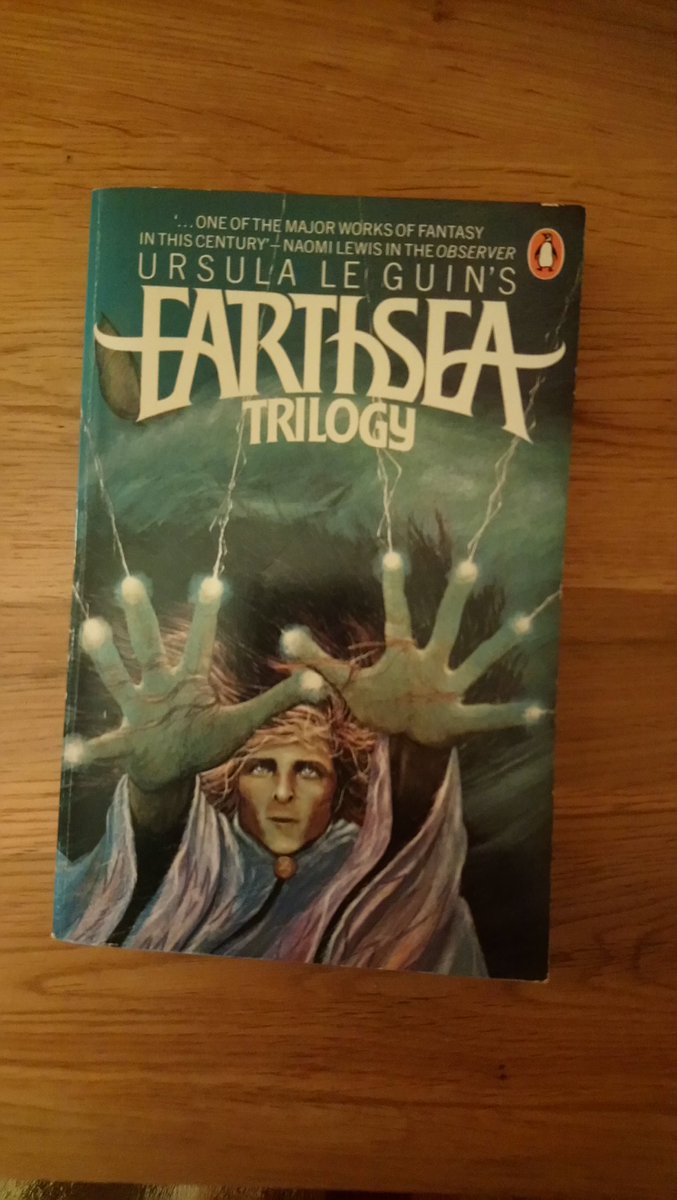
I heard some more very sad news this morning: that Ursula K. Le Guin passed away on Monday at the age of 88. She was a great writer of science fiction and fantasy literature who was highly original and also highly influential. When I heard the news this morning I went through my bookshelves. I haven’t kept all the books I devoured as a teenager, but I kept this one:

I must have had this for 40 years or more. A Wizard of Earthsea vies with Tolkien’s The Lord of the Rings and Mervyn Peake’s Gormenghast as the best books I have read in this genre, way above the standard fare of the Swords and Sorcery genre. I must read this again in memory of the author, as I suspect will many others of my age who read it in their teenage years.

R.I.P. Ursula K. Le Guin (1929-2018)

R.I.P. Hugh Masekela (1939-2018)

Posted in Jazz with tags , , on January 23, 2018 by telescoper

I woke up this morning to the very sad news that South African jazz trumpeter Hugh Masekela had lost the long and courageous battle he had been fighting against cancer and has passed away at the age of 78. Hugh Masakela did a huge amount to establish a uniquely South African jazz tradition and much of his music was a response to the struggle against apartheid. Although some “serious” jazz fans have criticised him for `selling out’ in his forays into pop – for which he simplified his playing style considerably – this approach definitely succeeded in bringing many new people to his music. His was exactly the same approach as Louis Armstrong, actually, and I for one don’t begrudge either his commercial success.

I was fortunate to hear Hugh Masekela live many years ago at Ronnie Scott’s Club. He had a wonderful stage presence, and played a typically eclectic mix of music and it was a wonderful night that I’ll remember for the rest of my life.

Here’s a clip of him playing and singing that gives an idea of what the man and his music were like and just how much he will be missed.

R.I.P. Hugh Masekela (1939-2018).

Light, I know, treads the ten million stars

Posted in Poetry, The Universe and Stuff with tags , on January 22, 2018 by telescoper

Light, I know, treads the ten million stars,
And blooms in the Hesperides. Light stirs
Out of the heavenly sea onto the moon’s shores.
Such light shall not illuminate my fears
And catch a turnip ghost in every cranny.
I have been frightened of the dark for years.
When the sun falls and the moon stares,
My heart hurls from my side and tears
Drip from my open eyes as honey
Drips from the humming darkness of the hive.
I am a timid child when light is dead.
Unless I learn the night I shall go mad.
It is night’s terrors I must learn to love,
Or pray for day to some attentive god
Who on his cloud hears all my wishes,
Hears and refuses.
Light walks the sky, leaving no print,
And there is always day, the shining of some sun,
In those high globes I cannot count,
And some shine for a second and are gone,
Leaving no print.
But lunar night will not glow in my blackness,
Make bright its corners where a skeleton
Sits back and smiles, A tiny corpse
Turns to the roof a hideous grimace,
Or mice play with an ivory tooth.
Stars’ light and sun’s light will not shine
As clearly as the light of my own brain,
Will only dim life, and light death.
I must learn night’s light or go mad.

by Dylan Thomas (1914-1953)

Newsflash: New Chair at STFC

Posted in Science Politics, The Universe and Stuff with tags , , , on January 22, 2018 by telescoper

As a quick piece of community service I thought I’d pass on the news of the appointment of a new Executive Chair for the Science and Technology Facilities Council (STFC), namely Professor Mark Thomson of the University of Cambridge. Developments at STFC will cease to be relevant to me after this summer as I’m moving to Ireland but this is potentially very important news for many readers of this blog.

Professor Thomson is an Experimental Particle Physicist whose home page at Cambridge describes his research in thuswise manner:

My main research interests are neutrino physics, the physics of the electroweak interactions, and the design of detectors at a future colliders. I am co-spokesperson of the DUNE collaboration, which consists of over 1000 scientiests and engineers from over 170 institutions in 31 nations across the globe. The Cambridge neutrino group splits its acivities between MicroBooNE and DUNE and is using advanced particle flow calorimetry techniques to interpret the images from large liquid argon TPC neutrino detector.

I’ve added a link to the DUNE collaboration for those of you who don’t know about it – it’s a very large neutrino physics experiment to be based in the USA.

On the announcement, Prof. Thomson stated:

I am passionate about STFC science, which spans the smallest scales of particle physics to the vast scales of astrophysics and cosmology, and it is a great honour be appointed to lead STFC as its new Executive Chair. The formation of UKRI presents exciting opportunities for STFC to further develop the UK’s world-leading science programme and to maximise the impact of the world-class facilities supported by STFC.

This appointment needs to be officially confirmed after a pre-appointment hearing by the House of Commons Science and Technology Committee but, barring a surprise offer of the position to Toby Young, he’s likely to take over the reins at STFC in April this year. He’ll have his work cut out trying to make the case for continued investment in fundamental science in the United Kingdom, in the face of numerous challenges, so I’d like to take this opportunity to wish him the very best of luck in his new role!

Hirsute cosmologist Peter Coles joins Beard of Winter poll after ‘write-in’ votes

Posted in Beards, Biographical on January 22, 2018 by telescoper

I see that, despite popular demand, Keith Flett, on behalf of the Beard Liberation Front, has at the last minute decided to give me another chance to fail to win a beard award. I’m currently in second place in the poll as it enters its final week…

kmflett's avatarKmflett's Blog

Beard Liberation Front

PRESS RELEASE 20th January

Contact Keith Flett      07803 167266

Hirsute cosmologist Peter Coles joins Beard of Winter poll after ‘write-in’ votes

The Beard Liberation Front, the informal network of beard wearers, has said that leading hirsute cosmologist Peter Coles has joined the Beard of Winter poll after write-in votes for him broke the threshold of 1% of the total poll

Mr Coles, based at Cardiff University and also at Maynooth in Ireland was a contender for Beard of the Year in 2014.

The Beard of Winter is the first of four seasonal awards that lead to the Beard of the Year Award in December 2018.

It focuses both on fuller organic beards, suitable for winter weather but also on beards that have made an early New Year impact in the public eye.

BLF Organiser Keith Flett said, Peter Coles has one of the most distinguished of scientific…

View original post 70 more words

Come Sunday

Posted in Jazz with tags , , on January 21, 2018 by telescoper

I can’t believe that I’ve been sharing music on this blog for almost a decade and haven’t yet posted this. It’s a beautiful Duke Ellington song Come Sunday, written for the extended concert suite Black, Brown and Beige, later appeared in the Duke Ellington concerts of sacred music, and eventually became a jazz standard. It was written for solo voice along with the full Ellington band, but this almost entirely a cappella version featuring the great gospel singer Mahalia Jackson with a few bits of Duke Ellington on piano is my favourite version. It’s a hauntingly elusive melody, but Mahalia Jackson fills it with her entire soul…

Cosmology: The Professor’s Old Clothes

Posted in Education, The Universe and Stuff with tags , , , , , , , on January 19, 2018 by telescoper

After spending  a big chunk of yesterday afternoon chatting the cosmic microwave background, yesterday evening I remembered a time when I was trying to explain some of the related concepts to an audience of undergraduate students. As a lecturer you find from time to time that various analogies come to mind that you think will help students understand the physical concepts underpinning what’s going on, and that you hope will complement the way they are developed in a more mathematical language. Sometimes these seem to work well during the lecture, but only afterwards do you find out they didn’t really serve their intended purpose. Sadly it also  sometimes turns out that they can also confuse rather than enlighten…

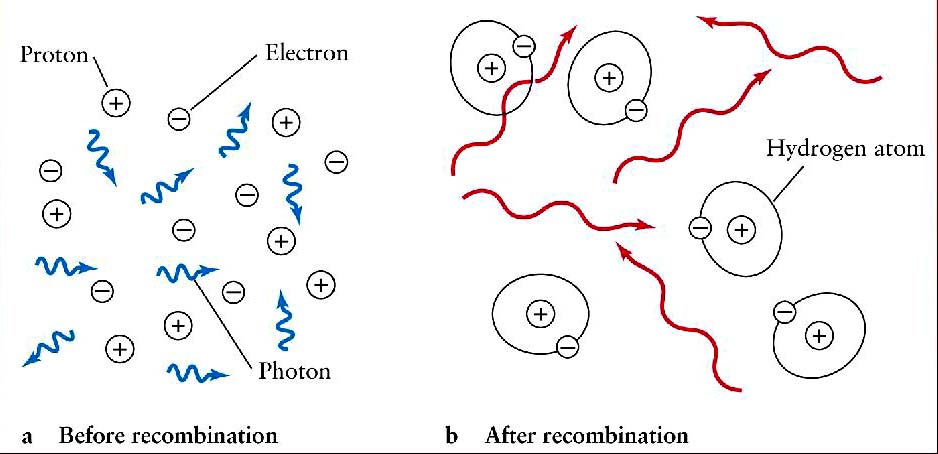
For instance, the two key ideas behind the production of the cosmic microwave background are recombination and the consequent decoupling of matter and radiation. In the early stages of the Big Bang there was a hot plasma consisting mainly of protons and electrons in an intense radiation field. Since it  was extremely hot back then  the plasma was more-or-less  fully ionized, which is to say that the equilibrium for the formation of neutral hydrogen atoms via

p+e^{-} \rightarrow H+ \gamma

lay firmly to the left hand side. The free electrons scatter radiation very efficiently via Compton  scattering

\gamma +e^{-} \rightarrow \gamma + e^{-}

thus establishing thermal equilibrium between the matter and the radiation field. In effect, the plasma is opaque so that the radiation field acquires an accurate black-body spectrum (as observed). As long as the rate of collisions between electrons and photons remains large the radiation temperature adjusts to that of the matter and equilibrium is preserved because matter and radiation are in good thermal contact.


Image credit: James N. Imamura of University of Oregon.

Eventually, however, the temperature falls to a point at which electrons begin to bind with protons to form hydrogen atoms. When this happens the efficiency of scattering falls dramatically and as a consequence the matter and radiation temperatures are no longer coupled together, i.e. decoupling occurs; collisions can longer keep everything in thermal equilibrium. The matter in the Universe then becomes transparent, and the radiation field propagates freely as a kind of relic of the time that it was last in thermal equilibrium. We see that radiation now, heavily redshifted, as the cosmic microwave background.

So far, so good, but I’ve always thought that everyday analogies are useful to explain physics like this so I thought of the following.

When people are young and energetic, they interact very extensively with everyone around them and that process allows them to keep in touch with all the latest trends in clothing, music, books, and so on. As you get older you don’t get about so much , and may even get married (which is just like recombination, not only that it involves the joining together of previously independent entities, but also in the sense that it dramatically  reduces their cross-section for interaction with the outside world).  As time goes on changing trends begin to pass you buy and eventually you become a relic, surrounded by records and books you acquired in the past when you were less introverted, and wearing clothes that went out of fashion years ago.

I’ve used this analogy in the past and students generally find it quite amusing even if it has modest explanatory value. I wasn’t best pleased, however, when a few years ago I set an examination question which asked the students to explain the processes of recombination and decoupling. One answer said

Decoupling explains the state of Prof. Coles’s clothes.

Anyhow, I’m sure there’s more than one reader out there who has had a similar experience with an analogy that wasn’t perhaps as instructive as hoped or which came back to bite you. Feel free to share through the comments box…

Hair from Bayeux

Posted in Beards, History with tags , , , , on January 18, 2018 by telescoper

Since the Bayeux Tapestry (which, being stitched rather than woven, is an embroidery rather than a tapestry) is in the news I thought I’d share some important information about the insight this article gives us into 11th century hairstyles.

As you know the Bayeux Tapestry Embroidery concerns the events leading up to the Battle of Hastings between the Saxons (who originated in what is now a part of Germany) led by Harold Godwinson (who had relatives from Denmark and Sweden) and the Normans (who lived at the time in what is now France, but who came originally from Scandinavia).

Most chronicles of this episode leave out the important matter of the hair of the protagonists, and I feel that it is important to correct this imbalance here.

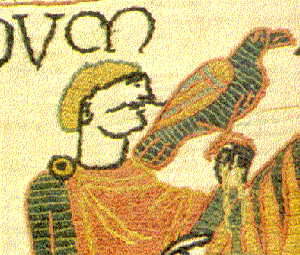
Throughout the Bayeux Untapestry, the Saxons are shown with splendid handlebar moustaches, exemplified by Harold Godwinson himself:

This style of facial hair was obviously de rigueur among Saxons. The Normans on the other hand appeared to be clean-shaven, not only on their front of their heads but also on the back:

This style of coiffure looks like it must have been somewhat difficult to maintain, but during the Battle of Hastings would mostly have been hidden under helmets.

With a decisive advantage in facial hair one wonders how the Saxons managed to lose the battle, but I can’t help thinking the outcome would have been different had they had proper beards.