Thelonious Monk, Genius of Modern Music

Posted in Jazz with tags , , , on November 21, 2017 by telescoper

I was delighted to discover that this week’s Composer of the Week on BBC Radio 3 is none other than the great Thelonious Monk, who thoroughly deserves the honour as he was enormously influential as a composer as well as a bandleader and piano soloist. Many of Monk’s highly original compositions – such as Blue Monk, Straight No Chaser, In Walked Bud and ‘Round Midnight– have become jazz standards, but his unique approach to composition really changed the entire evolution of jazz in the immediate post-war era. In fact, Monk is the second-most recorded jazz composer ever, after Duke Ellington (a man he admired enormously and whose piano style influenced Monk’s).

The series of radio programmes about him is particularly timely as this year marks the centenary of his birth (10th October 1917).

In my top 50 jazz albums there would probably be about half a dozen by Thelonious Monk. I’ve loved his music since I heard the very first track by him way back when I was a teenager. Although he has often been given the nickname `The High Priest of Bop’, I’ve never really thought of him as fitting neatly in the bebop style – the archetypal bebop pianist was surely Bud Powell – but he was clearly a profound influence on others of that era, such as Charlie Parker and Dizzy Gillespie. I should add that he was entirely self-taught, which is probably how he managed to get that instantly recognisable sound. You only need to hear one note to know that it’s Monk.

I think the word `genius’ is extremely overused these days, and I tend to reserve it for those who show such an astonishing level of creativity that you think to yourself `Where on Earth did that come from?’. In my opinion it is no exaggeration to apply the word `genius’ to Thelonious Monk. He was a very special artist. Indeed when he was signed up by the fledgling Blue Note label in 1947, they called his first albums Genius of Modern Music..

Anyway, when I listened to yesterday’s programme on iPlayer I remembered this, a compilation of Monk’s advice to band members (as collected by saxophonist Steve Lacy in 1960). As well as being in places very funny, it also contains a great deal of very sound advice for young musicians (especially the first, `Just because you’re not a DRUMMER, doesn’t mean that you don’t have to KEEP TIME’.

I also like `Don’t play the PIANO PART. I’m playing that.’. I’m sure there’s a story behind every one of these tips!

By way of my own little tribute to Thelonious Monk here’s one of my favourite Monk tunes, as recorded with Milt Jackson on vibes way back in 1948. It’s typically offbeat Monk composition, and also provides great examples of him as a soloist and accompanist. Just listen to what he does behind Milt Jackson’s solo on I Mean You, which appeared on Genius of Modern Music Vol. 1…


Antikythera, the Green Island of Science

Posted in History, The Universe and Stuff with tags , , , on November 20, 2017 by telescoper

You’ve probably all heard of the Antikythera Mechanism, a sophisticated device that was used about 2000 years ago by the Greeks to predict astronomical positions and eclipses for calendar and astrological purposes and found in 1902 at the site of a shipwreck near the island of Antikythera. You may not know that there is a strong connection between the study of this amazing piece of machinery and my current employer, Cardiff University, especially through our own Emeritus Professor Mike Edmunds.

Well, it seems that another episode in the story of Antikythera is about to open up as a result of a new initiative of the National Observatory of Athens, in collaboration with the Prefecture of Attica and the Municipality of the island of Kythira. This will lead to the creation of an Observatory of Climate Change and Centre of Geosciences at the island of AntiKythera, where the famous ancient mechanism was found and which is currently almost deserted.

Here is a little video about this project. The dialogue is in Greek, but with subtitles. I should also point out that the first person you see and hear is Manolis Plionis, who is Director of the National Observatory of Athens, a very old friend of mine who I first met at Sussex when I started my graduate studies in the Astronomy Centre there in 1985.

GW170608—The underdog

Posted in The Universe and Stuff with tags , , on November 20, 2017 by telescoper

Interesting post from a gravitational wave researcher, telling the inside story of the latest gravitational wave detection (a binary black hole merger) announced last week.


CPLB's avatarChristopher Berry

Detected in June, GW170608 has had a difficult time. It was challenging to analyse, and neglected in favour of its louder and shinier siblings. However, we can now introduce you to our smallest chirp-mass binary black hole system!

Family of adorable black holes The growing family of black holes. From Dawn Finney.

Our family of binary black holes is now growing large. During our first observing run (O1) we found three: GW150914, LVT151012 and GW151226. The advanced detector observing run (O2) ran from 30 November 2016 to 25 August 2017 (with a couple of short breaks). From our O1 detections, we were expecting roughly one binary black hole per month. The first same in January, GW170104, and we have announced the first detection which involved Virgo from August, GW170814, so you might be wondering what happened in-between? Pretty much everything was dropped following the detection of our first…

View original post 1,790 more words

Workie Ticket 

Posted in Biographical with tags , , on November 19, 2017 by telescoper

As part of a (very) occasional series of posts relating to words or phrases originating in the North, I thought today I would introduce you to the Geordie expression “workie ticket” (or “worky ticket”), which means a troublemaker or disruptive or otherwise irritating person. 

I believe the expression derives from members of the armed forces who would be deliberately insubordinate or incompetent or misbehave in some other way in order to get themselves discharged and sent home, ie to work their ticket home. 

This phrase was particularly applied to people on National Service, many of whom would rather have been elsewhere and some of whom did their best to get thrown out. It was also used when I was at school in reference to stroppy or disruptive pupils.

I haven’t heard the phrase used in anger (so to speak) for many years, and I don’t know if it is still in common use in Newcastle, but it has popped into my mind on a number of occasions in reference to University staff or students. I couldn’t possibly mention any names…

The threads of an old life

Posted in Biographical, Film with tags on November 18, 2017 by telescoper


And then there were five….

Posted in The Universe and Stuff with tags , , , , , , on November 17, 2017 by telescoper

…black hole mergers detected via gravitational waves, that is. Here are the key measurements for Number 5, codename GW170608. More information can be found here.

Here is the abstract of the discovery paper:

On June 8, 2017 at 02:01:16.49 UTC, a gravitational-wave signal from the merger of two stellar-mass black holes was observed by the two Advanced LIGO detectors with a network signal-to-noise ratio of 13. This system is the lightest black hole binary so far observed, with component masses 12+7-2 M⊙ and 7+2-2 M⊙ (90% credible intervals). These lie in the range of measured black hole masses in low-mass X-ray binaries, thus allowing us to compare black holes detected through gravitational waves with electromagnetic observations. The source’s luminosity distance is 340 +140-140Mpc, corresponding to redshift 0.07+0.03-0.03. We verify that the signal waveform is consistent with the predictions of general relativity.

This merger seems to have been accompanied by a lower flux of press releases than previous examples…

Where The North Begins

Posted in Uncategorized with tags , , on November 17, 2017 by telescoper

I see that, once again, questions are being raised in the English media about where The North begins. I see it as symptomatic of the decline of educational standards that this issue is still being discussed, when it was settled definitively several years ago.  Let me once again put an end to the argument about what is The North and what isn’t.

For reference please consult the following map:


I think this map in itself proves beyond all reasonable doubt that`The North’  actually means Northumberland: the clue is in the name, really. It is also abundantly clear that Manchester, Leeds, Liverpool, etc, are all much further South than The North. North Yorkshire isn’t in the North either, as any objective reading proves.  All these places are actually in The Midlands.

If you’re looking for a straightforward definition of where The North begins, I would suggest the most sensible choice is the River Tyne, which formed the old Southern boundary of Northumberland. The nameless County shown on the map between Northumberland and Durham is `Tyne  & Wear’, a relatively recent invention which confuses the issue slightly, as including all of it in The North would be absurd.  Surely everyone knows that Sunderland is in the Midlands?

If this cartographical evidence fails to convince you, then I refer to a different line of argument. Should you take a journey by car up the A1 or M1 or, indeed, the A1(M) you will find signs like this at regular intervals:

This particular one demonstrates beyond any doubt that Leeds is not in The North. If you keep driving in a northerly direction you will continue to see signs of this type until you cross the River Tyne at Gateshead, at which point `The North’ disappears and is replaced by `Scotland’. It therefore stands to reason that The North begins at the River Tyne, and that the most northerly point of the Midlands is at Gateshead.

I rest my case.

Convergence

Posted in Art with tags , on November 16, 2017 by telescoper

Jackson Pollock, Convergence, 1952 oil on canvas; 93.5 inches by 155 inches. Albright-Knox Art Gallery, Buffalo, NY, US.

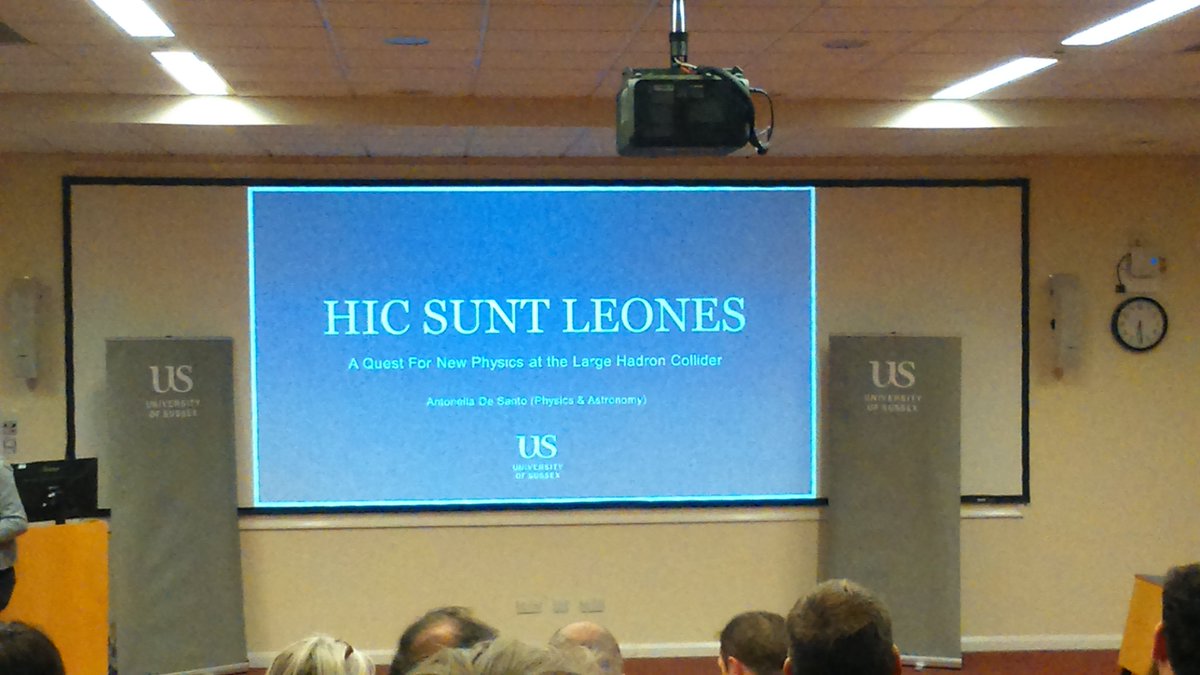
Hic Sunt Leones

Posted in The Universe and Stuff with tags , , , , , , on November 15, 2017 by telescoper

Just time for a very quick post, as today I travelled to Brighton to attend an inaugural lecture by Professor Antonella De Santo at the University of Sussex.

Antonella was the first female Professor of Physics at the University of Sussex and I’m glad to say she was promoted to a Chair during my watch as Head of the School of Mathematical and Physical Sciences, at Sussex. That was about four years ago, so it has taken a while to arrange her inaugural lecture, but it was worth the wait to be able to celebrate Antonella’s many achievements.

The lecture was about the search for physics beyond the standard model using the ATLAS experiment at the Large Hadron Collider, with a focus on supersymmetry and possibly candidates for dark matter. It was a very nice lecture that told a complex story through pictures and avoiding any difficult mathematics, followed by a drinks reception during which I got to have a gossip with some former colleagues.

The title, by the way, stems from the practice among mediaeval cartographers of marking terra incognita with `Here be lions’ or `Here be dragons‘. I hasten to add that no lions were harmed during the talk.

Anyway, it was nice to have an excuse to visit Brighton again. The last time I was here was over a year ago. It was nice to see some familiar faces, especially in the inestimable Miss Lemon, with whom I enjoyed a very nice curry after the talk!

Now for a sleep and the long journey back to Cardiff tomorrow morning!

Merging Galaxies in the Early Universe

Posted in The Universe and Stuff with tags , , , , on November 14, 2017 by telescoper

I just saw this little movie circulated by the European Space Agency.

The  source displayed in the video was first identified by European Space Agency’s now-defunct Herschel Space Observatory, and later imaged with much higher resolution using the ground-based Atacama Large Millimeter/submillimeter Array (ALMA) in Chile. It’s a significant discovery because it shows two large galaxies at quite high redshift (z=5.655) undergoing a major merger. According to the standard cosmological model this event occurred about a billion years after the Big Bang. The first galaxies are thought to have formed after a few hundred million years, but these objects are expected to have been be much smaller than present-day galaxies like the Milky Way. Major mergers of the type seen apparently seen here are needed if structures are to grow sufficiently rapidly, through hierarchical clustering, to produce what we see around us now, about 13.7 Gyrs after the Big Bang.

The ESA press release can be found here and for more expert readers the refereed paper (by Riechers et al.) can be found here (if you have a subscription to the Astrophysical Journal or for free on the arXiv here.

The abstract (which contains a lot of technical detail about the infra-red/millimetre/submillimetre observations involved in the study) reads:

We report the detection of ADFS-27, a dusty, starbursting major merger at a redshift of z=5.655, using the Atacama Large Millimeter/submillimeter Array (ALMA). ADFS-27 was selected from Herschel/SPIRE and APEX/LABOCA data as an extremely red “870 micron riser” (i.e., S_250<S_350<S_500<S_870), demonstrating the utility of this technique to identify some of the highest-redshift dusty galaxies. A scan of the 3mm atmospheric window with ALMA yields detections of CO(5-4) and CO(6-5) emission, and a tentative detection of H2O(211-202) emission, which provides an unambiguous redshift measurement. The strength of the CO lines implies a large molecular gas reservoir with a mass of M_gas=2.5×10^11(alpha_CO/0.8)(0.39/r_51) Msun, sufficient to maintain its ~2400 Msun/yr starburst for at least ~100 Myr. The 870 micron dust continuum emission is resolved into two components, 1.8 and 2.1 kpc in diameter, separated by 9.0 kpc, with comparable dust luminosities, suggesting an ongoing major merger. The infrared luminosity of L_IR~=2.4×10^13Lsun implies that this system represents a binary hyper-luminous infrared galaxy, the most distant of its kind presently known. This also implies star formation rate surface densities of Sigma_SFR=730 and 750Msun/yr/kpc2, consistent with a binary “maximum starburst”. The discovery of this rare system is consistent with a significantly higher space density than previously thought for the most luminous dusty starbursts within the first billion years of cosmic time, easing tensions regarding the space densities of z~6 quasars and massive quiescent galaxies at z>~3.

The word `riser’ refers to the fact that the measured flux increases with wavelength from the range of wavelengths measured by Herschel/Spire (250 to 500 microns) and up 870 microns. The follow-up observations with higher spectral resolution are based on identifications of carbon monoxide (CO) and water (H20) in the the spectra, which imply the existence of large quantities of gas capable of fuelling an extended period of star formation.

Clearly a lot was going on in this system, a long time ago and a long way away!