Jasper Johns, Painting with Two Balls, 1960 Encaustic and collage on canvas with objects, 65 x 54 in, on display at the Royal Academy until December 10th 2017.
Follow @telescoper
Jasper Johns, Painting with Two Balls, 1960 Encaustic and collage on canvas with objects, 65 x 54 in, on display at the Royal Academy until December 10th 2017.
Follow @telescoperI found this letter by accident yesterday while I was searching for something else. Apparently, it’s very famous but I had never seen it before, and it struck me as unbearably moving. It was written by Sir William Waller to his friend Sir Ralph Hopton on 16th June 1643, during the (First) English Civil War and it is the last known communication between the two men. The former was a General in the Parliamentarian army, the latter held the same rank in the Royalist army.
This one heartbreaking letter reveals the tragedy that was unfolding all over the country at the time, as friends and families were torn apart by forces not of their making but that proved impossible to to resist. It seems that countries are doomed to do this from time to time.
To my noble friend Sir Ralph Hopton at Wells
Sir,
The experience I have of your worth and the happiness I have enjoyed in your friendship are wounding considerations when I look at this present distance between us. Certainly my affection to you is so unchangeable that hostility itself cannot violate my friendship, but I must be true wherein the cause I serve. That great God, which is the searcher of my heart, knows with what a sad sense I go about this service, and with what a perfect hatred I detest this war without an enemy; but I look upon it as an Opus Domini and that is enough to silence all passion in me. The God of peace in his good time will send us peace. In the meantime, we are upon the stage and must act those parts that are assigned to us in this tragedy. Let us do so in a way of honour and without personal animosities.
Whatever the outcome I will never willingly relinquish the title of Your most affectionated friend.
William Waller
Following the eventual defeat of the Royalist cause Sir Ralph Hopton fled to the Continent with the young Prince Charles. He died of fever in Bruges in 1651. Sir William Waller served as a Member of Parliament but became increasingly disillusioned with the new Commonwealth and subsequently worked for the Restoration of the Monarchy, which began in 1660 with Charles II. Waller died in 1668.
Follow @telescoper
Here’s a nice problem I remember hearing in the pub on Friday and figured out this afternoon.
A water tank or sink is open to the air at the top where it can be filled using a tap connected to an infinite reservoir. Water can be drained from the container through an opening at the bottom by removing a stopper. The effects of viscosity on the outflow from the tank can be neglected.
The time taken for the tank to fill when the tap is fully open and the stopper in place is the same as the time taken for it to empty from full when the tap is closed and the stopper is removed.
If the tank is initially empty, the stopper removed and the tap turned full on, how full is the tank when a steady state is reached?
Last night I went with a group of friends and colleagues to St David’s Hall in Cardiff for concert that I had been looking forward to for some time, featuring the Orchestra of Welsh National Opera under the baton of WNO’s Music Director Tomáš Hanus in a programme of music by Mahler and Shostakovich. It turned out to be no disappointment!
Before the interval the Orchestra was joined by young mezzo-soprano Tara Erraught for the song-cycle Lieder eines fahrenden Gesellen by Gustav Mahler, featuring settings of four poems written by the composer (though clearly influenced by other sources). The four pieces are of contrasting mood, with the second being the most upbeat and the third the most despairing (as well as the most operatic in style) and they were written in response to an unrequited passion. I thought Tara Erraught sang very beautifully indeed, bring out the emotional depths of this piece. Unusually for Mahler, the orchestra for this work was not excessively large, and a good balance with the solo voice was achieved that allowed the subtleties of both vocal and orchestral parts to be enjoyed to full effect.
After the interval the stage was much fuller as the orchestral forces required for the second work were much larger. Symphony No. 7 by Dmitri Shostakovich (“Leningrad”) is a piece that evokes particular memories for me as I first heard it about thirty years ago on the radio while sitting in a car that was driving through a torrential downpour in the middle of the night from Kansas City to Lawrence. The repeating theme and snare drum figures in the 1st Movement that represent the remorseless advance of the invading army had even more powerful affect when accompanied by the incessant driving rain. I’ve heard this piece on recordings and live broadcasts on many occasions since then, but have never heard it performed live until last night.

Shostakovich in a fireman’s uniform in Leningrad, 1941
What can I say about this work? Well, not much that hasn’t been said before. It was dedicated to the city of Leningrad where the composer lived, until he was evacuated during the siege, and where he wrote most of the 7th Symphony. He served as a volunteer fireman in Leningrad during the early part of the Second World War (see above), having been turned down for military service owing to his poor eyesight. Leningrad was besieged by German forces for almost 900 days, from September 1941 until January 1944, and it’s impossible not to see the work in this historical context.
Though the four movements have themes – `War’, `Memories’, `My Native Field’ and `Victory’ – this is not really a programmatic piece. It does, however, succeed in invoking the terror and brutality of armed conflict in a manner that is so compelling that it’s almost overpowering. Many symphonies have as a theme some kind of struggle between light and dark, or between good and evil, but it always seemed to me that this work is not so much like that as it is a representation of a struggle simply for survival against annihilation. Even the end of the intense fourth movement, when the music finally resolves into the key of C Major, suggesting a kind of `victory’, echoes of the previous conflict persist, suggesting (to me) that this particular battle does not intend in any kind of triumph but in a sense of grim endurance that is more resignation than resolution.
Musicologists tend not to like this Symphony and its reputation dwindled in the West in the post-War period. Maybe it is true that it has defects when thought of as an exercise in composition, but fortunately I am not a professional critic so I am quite content to say that for me, personally, this work has an emotional impact like few others and it is one of my favourites in the whole symphonic repertoire. Last night the Orchestra of Welsh National Opera delivered an impassioned performance that confirmed everything I felt about this work but with the added dimensions that you can only get from a live performance.
From the immaculately controlled crescendo representing the advancing invaders that erupts into a nightmarish depiction of the ensuing battle right through to the last movement with its ending in resolution tempered in bitterness and regret, this performance had me gripped. The Orchestra of Welsh National Opera played as if their lives depended on it, and the climactic moments were authentically terrifying and, it goes without saying, wonderfully loud. Many congratulations to Tomáš Hanus for inspiring his musicians to such heights. He looked absolutely drained at the end, as he acknowledged the applause of a very appreciative audience in St David’s Hall.
It’s a shame that there were so many empty seats. That often seems to be the case when the music is relatively `modern’. The Cardiff audience does seem to have rather conservative tastes in that way. On the way out of the Hall after the performance all the comments I heard – and those afterwards on Twitter – were overwhelmingly enthusiastic. I feel privileged to have been among those present at this thrilling event.
UPDATE: I didn’t realise it was being broadcast live on BBC Radio 3 and is now available on iPlayer here for you to share the experience!
Follow @telescoperThis morning I was looking through my collection of old books about general relativity and related things, and found this page as part of a `simplified presentation’:
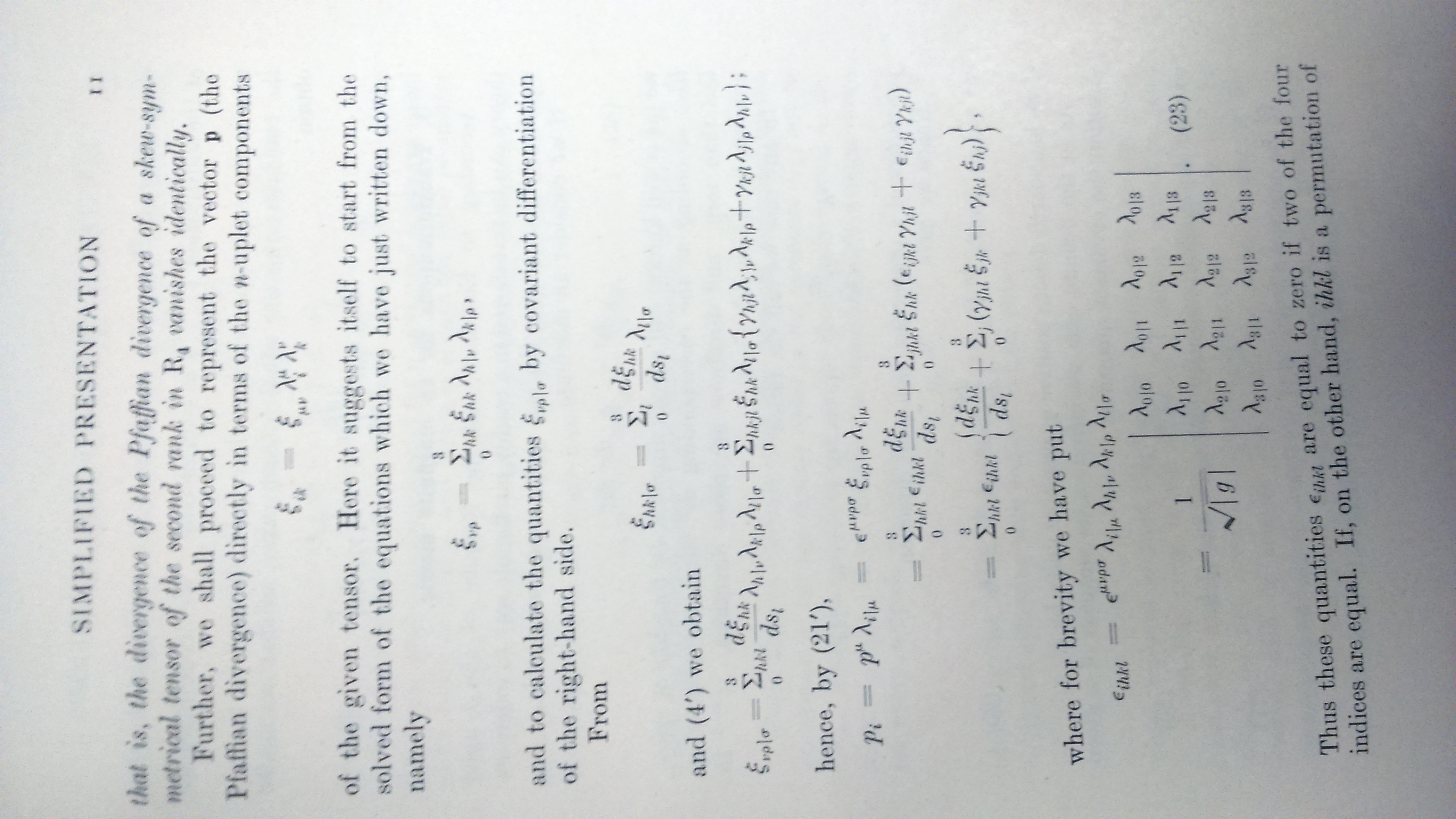
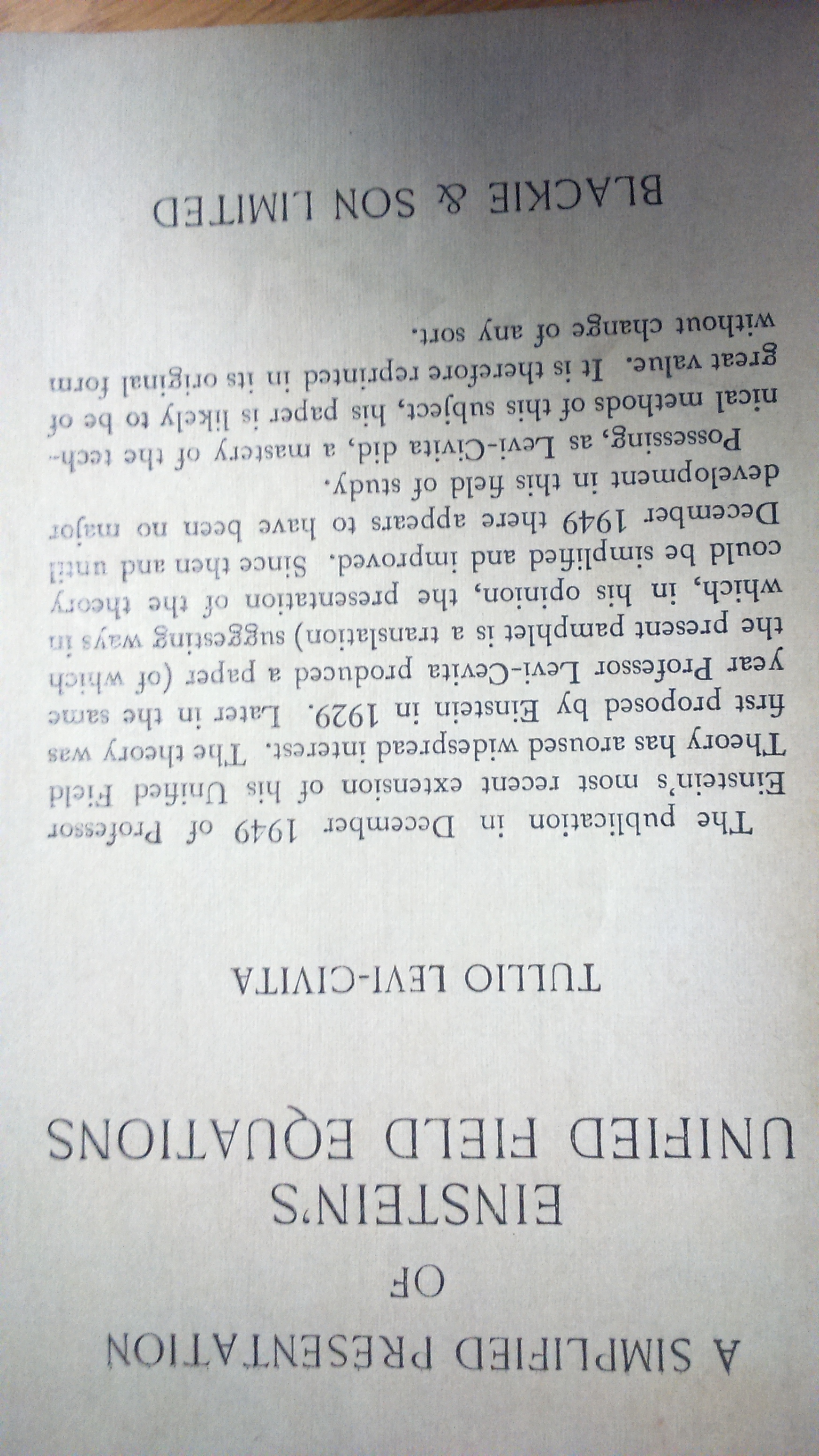
I wonder if you can guess the name of author of the little book in which I found this page, and what it is a `simplified presentation’ of?
The answer is on the front cover:
Follow @telescoper
This post makes some very important points about how research is so underfunded in UK universities that it can only be sustained by cross-subsidy from teaching income mainly generated by other subjects, especially from overseas students who are charged extremely high fees. This is particularly true for experimental science subjects, for which the cost of research activity far exceeds the funds available from government agencies. I don’t think it will be long until this leads to a crisis. In fact, I think it’s happening already.

 A recent HEPI report exposes the confidence trick that sustains British higher education. Research excellence leads to high international status; this in turn leads to high numbers of international students; and these students underwrite the research. Simple, but maybe not sustainable, especially in the current climate. Indeed an examination of this creaky merry-go-round exposes the risks that face UK universities.
The report, How much is too much? Cross-subsidies from teaching to research in British universities, by University of Oxford MPhil student Vicky Olive, grabbed headlines for its calculation that international students contribute, on average, £8,000 per year to research funding. The author used Transparent Approach to Costing (TRAC) data (imperfect, yes, but the best information we have) to track income and expenditure, working largely at institutional level. Unsurprisingly, she found that teaching subsidises research. However, it’s almost entirely the surplus value from international students…
View original post 826 more words
It’s been a while since I posted a problem in the folder for cute physics problems so here’s a nice little one for you to have a go at:
A vertical cylindrical tube of height 12cm and radius 6cm, sealed at the bottom and open at the top, is two-thirds filled with a liquid and set rotating with a constant angular velocity ω about a vertical axis. Neglecting the surface tension of the liquid, estimate the greatest angular velocity for which the liquid does not spill over the edge of the tube.
Answers through the comments box please!
Follow @telescoper

Oh, what happened to you?
Whatever happened to me?
What became of the people we used to be?
Tomorrow’s almost over
Today went by so fast
The only thing to look forward to is the past?
Rest in Peace, Rodney Bewes, also known as Bob Ferris of Whatever Happened to the Likely Lads?, who died yesterday.
Follow @telescoperI was delighted to discover that this week’s Composer of the Week on BBC Radio 3 is none other than the great Thelonious Monk, who thoroughly deserves the honour as he was enormously influential as a composer as well as a bandleader and piano soloist. Many of Monk’s highly original compositions – such as Blue Monk, Straight No Chaser, In Walked Bud and ‘Round Midnight– have become jazz standards, but his unique approach to composition really changed the entire evolution of jazz in the immediate post-war era. In fact, Monk is the second-most recorded jazz composer ever, after Duke Ellington (a man he admired enormously and whose piano style influenced Monk’s).
The series of radio programmes about him is particularly timely as this year marks the centenary of his birth (10th October 1917).
In my top 50 jazz albums there would probably be about half a dozen by Thelonious Monk. I’ve loved his music since I heard the very first track by him way back when I was a teenager. Although he has often been given the nickname `The High Priest of Bop’, I’ve never really thought of him as fitting neatly in the bebop style – the archetypal bebop pianist was surely Bud Powell – but he was clearly a profound influence on others of that era, such as Charlie Parker and Dizzy Gillespie. I should add that he was entirely self-taught, which is probably how he managed to get that instantly recognisable sound. You only need to hear one note to know that it’s Monk.
I think the word `genius’ is extremely overused these days, and I tend to reserve it for those who show such an astonishing level of creativity that you think to yourself `Where on Earth did that come from?’. In my opinion it is no exaggeration to apply the word `genius’ to Thelonious Monk. He was a very special artist. Indeed when he was signed up by the fledgling Blue Note label in 1947, they called his first albums Genius of Modern Music..
Anyway, when I listened to yesterday’s programme on iPlayer I remembered this, a compilation of Monk’s advice to band members (as collected by saxophonist Steve Lacy in 1960). As well as being in places very funny, it also contains a great deal of very sound advice for young musicians (especially the first, `Just because you’re not a DRUMMER, doesn’t mean that you don’t have to KEEP TIME’.

I also like `Don’t play the PIANO PART. I’m playing that.’. I’m sure there’s a story behind every one of these tips!
By way of my own little tribute to Thelonious Monk here’s one of my favourite Monk tunes, as recorded with Milt Jackson on vibes way back in 1948. It’s typically offbeat Monk composition, and also provides great examples of him as a soloist and accompanist. Just listen to what he does behind Milt Jackson’s solo on I Mean You, which appeared on Genius of Modern Music Vol. 1…
Follow @telescoper

 In the Dark