Homes from Home in Pune

Posted in Biographical, History, The Universe and Stuff with tags , , , on October 16, 2017 by telescoper

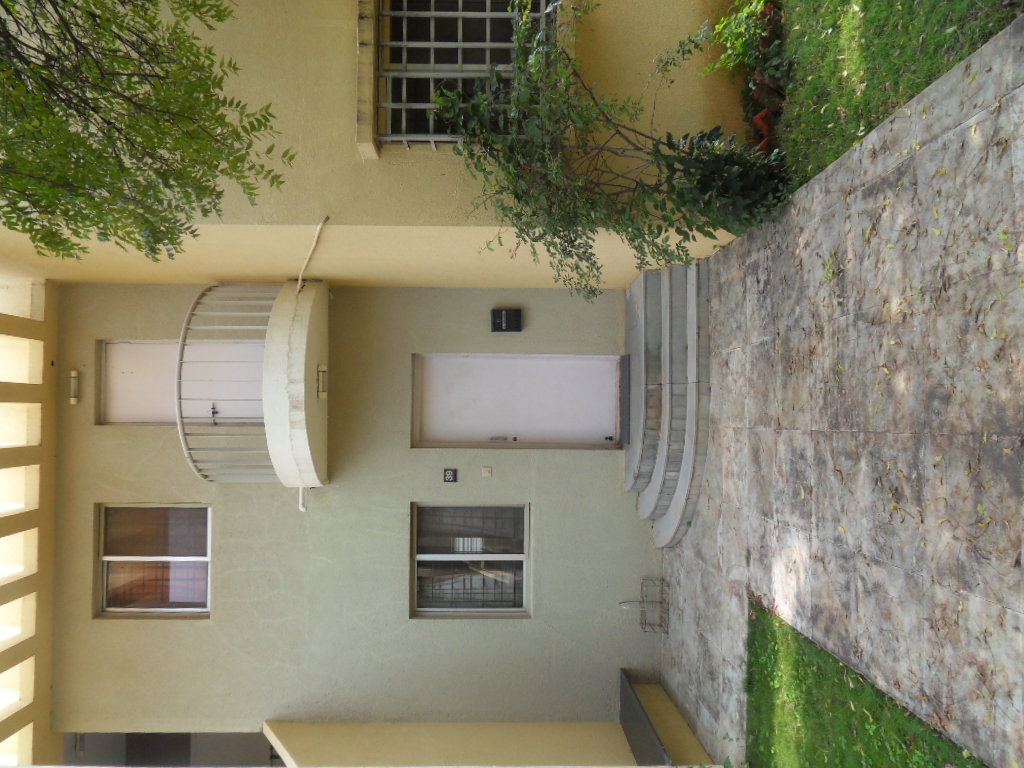
Since I’m coming back tomorrow I thought I’d wander around this morning and take a few pictures of where I’ve been staying most of the last 10 days or so. First, this is a snap of the housing complex which contains my guest apartment.

I’m actually in the first building on the right. Here is the front door.

The faculty at both IUCAA (Pune) and TFIR (Mumbai) live in housing areas provided by their respective institutions, so they form quite a close-knit community. Some of the senior staff in IUCAA are housed just round the corner from my place.

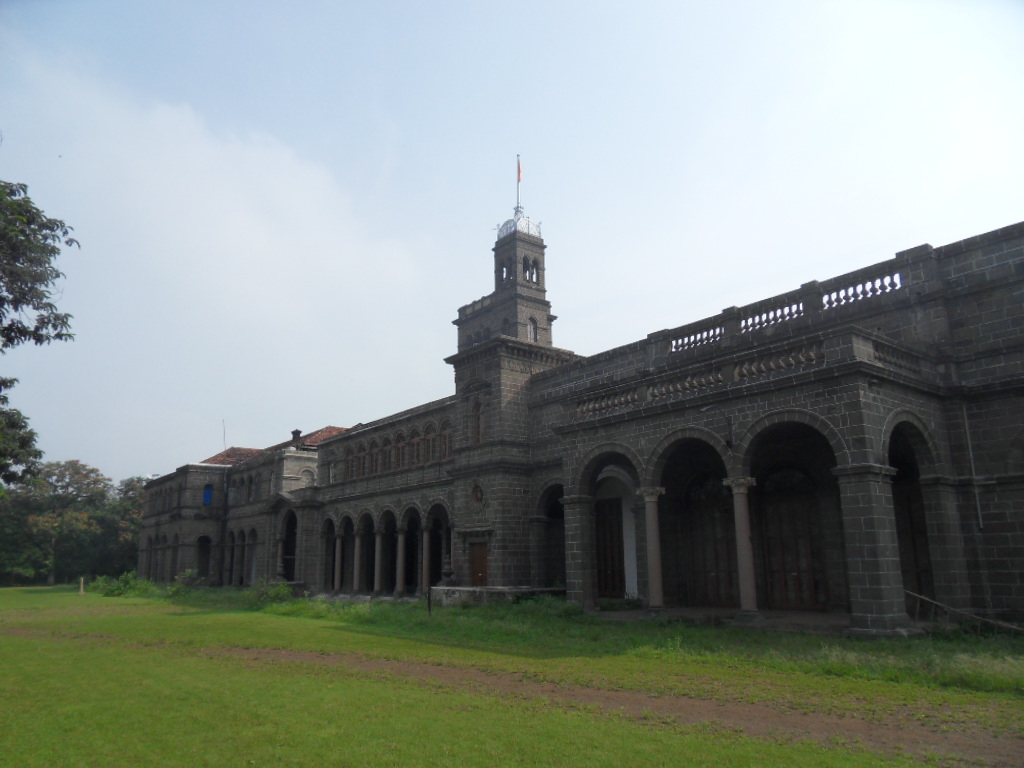
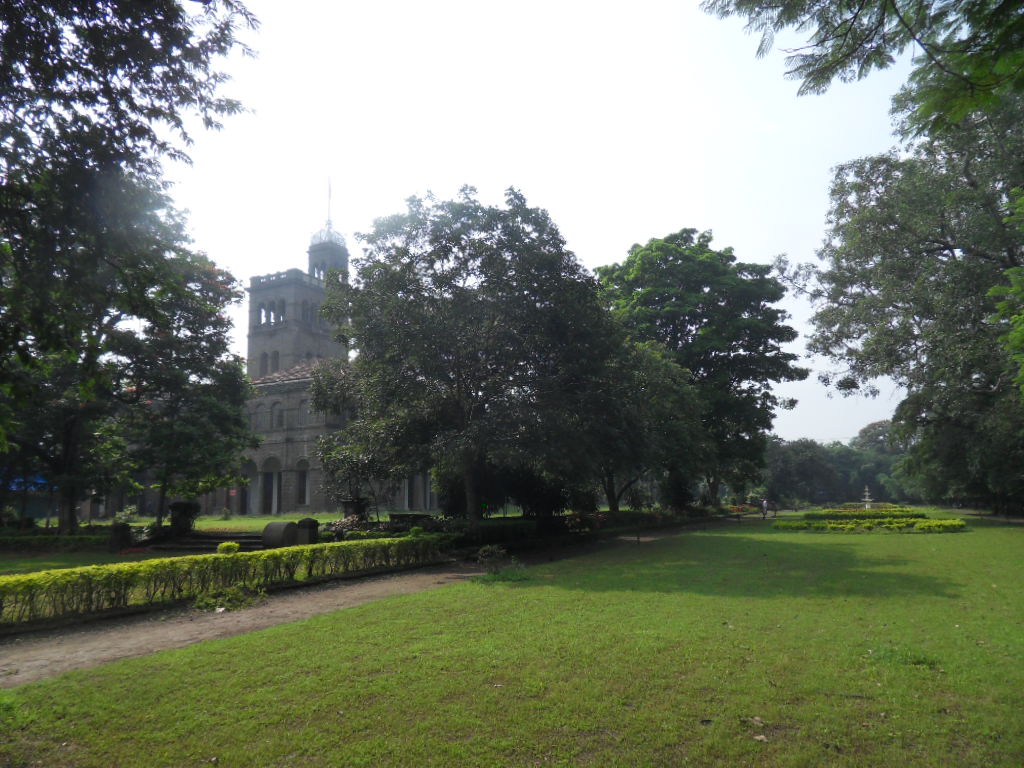
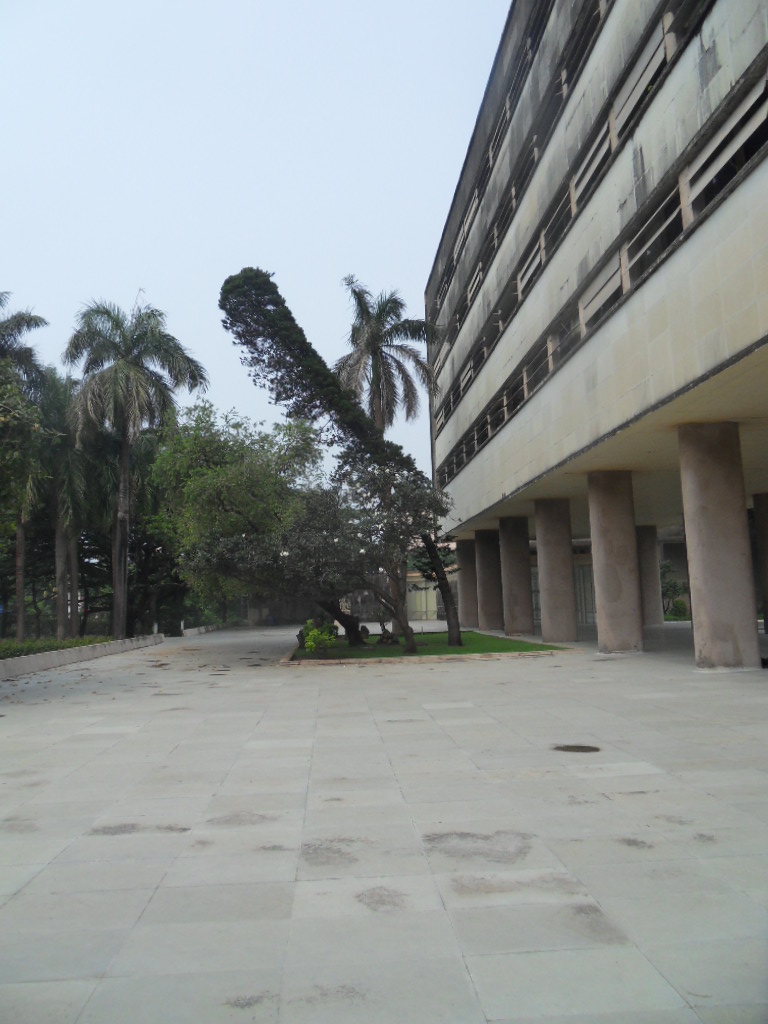
IUCAA is on the Pune University Campus (except that it has its own entrance from the main road that runs along the Northern edge of the campus, where there is a security post. There are a few of these around the IUCAA site itself, so it is very secure and quite private. The campus is large with many tree-lined roads. At its heart, on a small hill, you can find this building:

This is (or was) the Raj Bhavan (`Government House’) and it was essentially the Governor of Maharashtra’s residence during the Monsoon season. Built in 1866, it was a sort of home-from-home when Bombay (the state capital) became too unbearable.

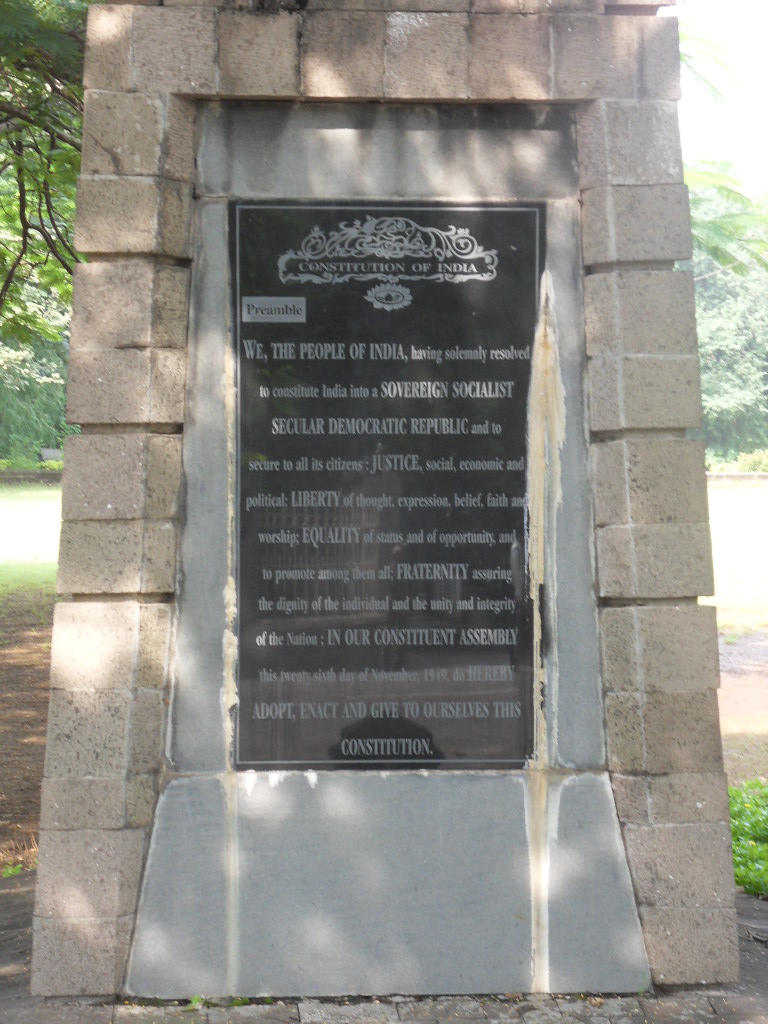
When I was last here in 1994, this was the Main Building of the University and was quite busy. Now, however, it seems to be disused and is in a state of some disrepair, the gardens also need a bit of love and attention. There are many new buildings around the University of Pune campus (including a modern administration block nearby). Since this building is a relic of the old colonial days it may be that it will be demolished to make way for something that better suits modern India. By the way, there’s a stone slab just next to the site of this building that displays the preamble to the Constitution of India, as adopted in 1949.

Anyway, this afternoon and evening promise to be quite busy. There is a press conference at IUCAA at 6.30pm about the gravitational waves discovery I mentioned a few days ago. There will be presentations before a viewing of the live feed from Washington DC then there’ll be a panel answering questions from the press. They’ve asked me to be on the panel, so I might appear in the India media, but as I’m leaving first thing tomorrow morning I probably won’t see any of the coverage!

Before the Storm…

Posted in Biographical, History with tags , , , , on October 16, 2017 by telescoper

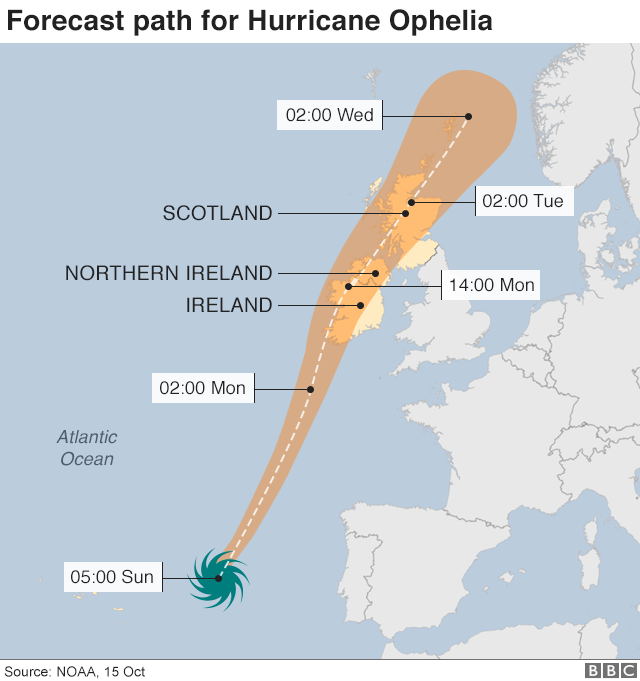
Nearly at the end of my short visit to India I find myself checking on the UK news. Home thoughts from abroad and all that. Anyway, it’s quite a coincidence that Hurricane Ophelia is arriving,  exactly on the thirtieth anniversary of the famous `Great Storm‘ that wrought destruction across the South-East of England in 1987. The path of Ophelia is rather different from that of the 1987 `Hurricane’, and it looks like Ireland will bear the brunt over the next day or two, as the storm will weaken as it encounters land, though there will be strong winds far outside the path denoted in this map:


I hope the damage from this storm  isn’t too bad and that people in its path stay safely out of harm’s way, especially in Ireland. It’s possible the winds may affect my current home in Wales too. I hope I don’t get back tomorrow evening to find the roof has blown off!

Thirty years ago today I was living in Brighton as a graduate student at the University of Sussex. On October 16th 1987 (a Friday) I woke up to find the electricity had been cut off. Without breakfast I struggled out to find the street lined with fallen trees, smashed cars and houses with broken windows. I got to the railway station to get the train to Falmer (where the University of Sussex is located) only to find that no trains were running. I walked home and went back to bed. It took several days for normal service to resume. When I did get up to campus the following week, I found that almost all the trees in Stanmer Park had come down and were combed flat on the top of the hill.

The Great Storm of 1987 , according to weather forecaster Michael Fish, was “not a hurricane” had nevertheless caused enormours destruction. And I had slept through the whole thing…

Here’s the infamous weather forecast broadcast on the Thursday evening:

and here is the BBC News from the following day:


Farewell to TIFR

Posted in Art, Biographical with tags , , , on October 15, 2017 by telescoper

I got up early again this morning to travel back to Pune for the final few days of this trip. Last night I had a pleasant dinner with my host Subha Majumdar at the Indigo Deli to round off my short stay in Mumbai. The food was nice, but it was a tad overpriced in my opinion. We passed by the Leopold Cafe on the way home; that was the scene of a terrorist atrocity in 2008 I remember having tea there in 1994, after returning from a boat trip to Elephant Island.

I went sightseeing yesterday morning but forgot to take my camera with me then. I left reasonably early so that I could wander around before it got too hot – the afternoon was sweltering on Friday – but when I arrived at my main destination (the National Gallery of Modern art) I found it didn’t open until 11am, so I had to find somewhere for a cup of tea (which wasn’t difficult). When it opened I found a pricing strategy that is common in India: 20 rupees for Indians and 500 rupees for foreigners! Still, 500 rupees is only about £6 and though small the gallery is well worth seeing.

When I returned to the TIFR `Colony’ I picked up my camera and took a few snaps of the Tata Institute for Fundamental Research before spending the afternoon in the office. As you can see, TIFR is set in lovely grounds with some gorgeous trees. It’s also right next to the sea, but the view wasn’t great yesterday as it was misty. Later on there were heavy thunderstorms.

Now I think I’ll take a short nap. It’s just after 10am, but I was up before 5am after just a few hours sleep. I hope I wake up in time for lunch!

A Note on the recently attended International Conference on Cosmology called the “Post-Planck Cosmology: Enigma, Challenges and Visions” conducted at my institute IUCAA, Pune, India

Posted in Uncategorized on October 14, 2017 by telescoper

Here’s a very nice review of last week’s conference by a student working at IUCAA…

Going Doolally

Posted in Biographical, History with tags , , on October 14, 2017 by telescoper

Yesterday evening, after my seminar and discussions I went with members of the cosmology group at the Tata Institute for Fundamental Research to a place called the Doolally Tap Room which is not far from TIFR. Thundery clouds had gathered and rain was in the air so we took a taxi there and back.

It’s a nice, modern-looking bar with a range of craft beers and food. The Belgian Witbier and Abbey Tripel went down well, but I wasn’t tempted to try Mango Cider. It was a very pleasant evening, but I was dog tired after it and crashed out as soon as I got back to the TIFR guesthouse.

The name Doolally Tap Room is a very clever name for a bar. The word Doolally (or sometimes Dolally), as it is used in English especially in `going Doolally’ etc, generally means `deranged’ or `crazy’ (often as a result of being confined somewhere involuntarily, rather like cabin fever), is thought to derive from Deolali a place in Maharashtra (the state which contains both Mumbai and Pune). Deolali was used as a transit camp for British Army soldiers waiting to be deployed, many of whom became extremely bored stuck there in the heat.

Interestingly though the original phrase describing the madness induced by such boredom was `Deolali Tap’ (the latter word from a Hindhi word meaning `fever’). Doolally Tap Room therefore works rather well as a play on words.

There are of course many words in contemporary English that have their origins in Indian languages: here are 50 of them, which may or may not surprise you: atoll, avatar, bandana, bangle, bazaar, Blighty, bungalow, cashmere, catamaran, char, cheroot, cheetah, chintz, chit, chokey, chutney, cot, cummerbund, curry, dinghy, doolally, dungarees, guru, gymkhana, hullabaloo, jodhpur, jungle, juggernaut, jute, khaki, kedgeree, loot, nirvana, pariah, pashmina, polo, pukka, pundit, purdah, pyjamas, sari, shampoo, shawl, swastika, teak, thug, toddy, typhoon, verandah, and yoga.

Reminded by the above old British Army connection with doolally I can’t resist mentioning the phrase `When I was in Poona…‘. One doesn’t hear it much these days but aficianados of older humorous novels and radio comedy will recognize it as a kind of catchphrase introducing a boring old ex-soldier. It appears thus in Eric Patridge’s Dictionary of Catch Phrases (2003):

The legacy of Pune’s past as a large British Army base is still apparent: a large area in the centre is still called `Camp’ and there is still a tendency among some to refer to non-vegetarian restaurants as `Military’ (though I’m told this is more the case in Southern India, where the traditional local food is entirely vegetarian). In Maharashtra the diet is very mixed, but I’ve eaten relatively little meat since I came here.

All of which rambling might suggest that I’ve gone Doolally, or indeed that I’m turning into an old bore, but I’m actually enjoying this trip very much indeed. It’s fascinating not only to see what has changed in India in the 23 years since I was last here, but also what has remained the same. Moreover, everyone I have met here has been so friendly and hospitable that it’s been an absolute pleasure all round.

Gravitational Waves Flash!

Posted in The Universe and Stuff with tags , , , , on October 13, 2017 by telescoper

I got up early this morning to hitch a ride in a car to Mumbai so that I can give a talk this afternoon. We left Pune about 6am and got here about 8.30 so the trip was a quite a bit quicker than coming here! I’ll post about that and include some pictures when I get a moment, but first I’ll post a quick announcement.

There will be an announcement on Monday 16th October at 10am EDT (3pm BST; 7.30pm in Pune) by `the National Science Foundation (NSF) as it brings together scientists from the Laser Interferometer Gravitational-Wave Observatory (LIGO) and Virgo collaborations, as well as representatives for some 70 observatories’. Further details can be found here. The European Southern Observatory has also announced that it will be holding a press conference on Monday about an `unprecedented discovery’.

The fact that it involves LIGO, Virgo and representatives of other observatories strongly suggests that this announcement will address the subject of the rumours that were flying around in August. In other words, it’s likely that on Monday we will hear about the first detecting of a coalescing binary neutron star system with an optical counterpart. Exciting times!

I’ll be back in Pune by Monday and will probably be able to watch the announcement and will update if and when I can.

Post-Planck Cosmology: Day 4

Posted in Talks and Reviews, The Universe and Stuff with tags , on October 12, 2017 by telescoper

So here we are at the end of the meeting, after a fourth and final day of wide-ranging cosmology talks. I did the first presentation at 9am. I won’t summarize my own lecture because you can find the slides here:

Here are two pictures of me in action:

me_2

me_1

After that we had, amongst others, invited talks by Subhabrata Majumdar on the eROSITA all-sky X-ray survey and Somak Raychaudhury (Director of IUCAA) on large-scale structures in the local universe, Kandu Subramanian on primordial magnetic fields and Anvar Shukurov on Probabilistic Topology and Morphology (a change to the advertised title). There were also a number of shorter talks of diverse nature mainly on the subject of large-scale structure and galaxy formation.

I have known Kandu Subramanian since I was a student at Sussex and he was a postdoc there. At that time he was working mainly on gravitational lensing. I haven’t seen him for quite a long time and was surprised to see that now his hair has gone completely white. That’s what happens to you if you work on primordial magnetic fields.

The afternoon session overran and I had an appointment for Skype call so I had to leave before the closing remarks, so let me take this opportunity to thank the conference organisers for putting together such an interesting meeting and especially for inviting me back to Pune after all this time. It has been very enjoyable.

Many of the conference guests have already left and some are leaving tomorrow. I am staying in India for a few more days, however. Tomorrow morning I’m going to Mumbai to give a talk at the Tata Institute for Fundamental Research. I have to get up early tomorrow for that trip so I think I’ll take an early night.

Post-Planck Cosmology: Day 3

Posted in The Universe and Stuff with tags , , , , on October 11, 2017 by telescoper

Before carrying on with my daily updates from this meeting on Post-Planck Cosmology I’ll just remark that this is a great venue: it has all the facilities necessary to keep a group of cosmologists happy…


At the tea break this morning I managed to find a shot that included all four of the statues in the main quadrangle too:

This morning kicked off with Roy Maartens discussing the cosmological potential of the Square Kilometre Array and other future galaxy surveys, one of his main points being the benefit of using multiple tracers to beat down some of the problems with single surveys.  The first phase of this project, SKA1,  will deliver 10 million redshifts with z<0.6. With SKA2 that will go up to 1 billion galaxies out to z<2, but many things can be done without redshifts using intensity mapping. SKA1 is some way off, but the precursor `Meerkat' consisting of 64 × 13.5 metre dishes will be hopefully starting next year in South Africa.

We then had a series of talks about reionization and the formation of the first stars, an epoch usually referred to as `Cosmic Dawn' or `First Light', taking us into lunch.

In the afternoon we had talks loosely grouped around the theme of `classical cosmology' – using geometric or other probes to study the expansion history of the Universe. This session included a talk by Chris Messenger of the LIGO collaboration about the beginnings of gravitational wave cosmology, though as the current generation of detectors is only sensitive to relatively nearby sources for the time being the main effort will be devoted to distance scale measurements, attempting to measure the Hubble constant directly without the need for the traditional distance ladder.

The last part of the day was devoted to a panel discussion, chaired by Francois Bouchet that was interesting and wide-ranging but largely motivated by responses to Paul Steinhardt's talk last night.

Now, no conference dinner to tear me away tonight – but I do have to finish my talk, which is at 9am tomorrow – so that will have to do for now. Toodle-pip!

Memories of Mumbai

Posted in Biographical with tags , , on October 11, 2017 by telescoper

My first trip to India was in early 1994 and I passed through Bombay (as it was then called) on my way to and from Poona (Pune). My flight from London to Bombay arrived at about three o’clock in the morning and I was greeted outside the immigration area by a young man holding a sign with my name on it who had my train tickets for the next leg of the journey. The train didn’t leave until 6.30am so he asked me what I wanted to do until then. I said I thought I would just go to the station if it was open and wait there. He looked surprised, but said that, yes, the station was open all night. He then kindly offered me a lift in his car as he was heading home and would be going roughly in that direction.

When we got to Bombay Victoria I realised why he had been surprised. I had assumed the station would be fairly empty and I might be able to sleep on a bench or something. When I walked into the concourse it was jam-packed with people sleeping all over the floor. I wandered in sheepishly, the only westerner to be seen, and started to look for what platform my train would be leaving from. Immediately I was surrounded by beggars – women with small babies, cripples, people with gruesome scabs and sores – all pushing me around and pleading for money. Then a teenage boy tried to lift my walkman from my pocket and I started to feel not just uncomfortable but scared.

Pretty soon, though, an official from the State Railways saw my predicament and came to my rescue. Delivering numerous clips around ears he speedily liberated me from my oppressors, took me to into a small kiosk situated on the platform, and offered me a cup of tea. It had far too much sugar in it, but I drank it gratefully anyway. He asked me where I was going, and I told him. He was initially suspicious, I think, because the primary place westerners tended to visit in Pune those days was the Ashram run by Bhagwan Shree Rasjneesh where his disciplines were encouraged to participate in unrestricted sexual activities. When I told my friend from the railways that I actually going to visit IUCAA, which at that time was run by the famous Professor Narlikar, he beamed with relief. I think he wasn’t unique amongst Indians who thought that Rasjneesh was a fraud and his disciples gullible idiots.

It turned out that the train I was to take to Pune was actually already in the station but was being cleaned. Since they cleaned the first class compartments first, I was allowed to get on the train early, about 4.30, and immediately nodded off. I only woke up when the train pulled out of the station and started on its journey up towards the Deccan plateau.

I enjoyed the journey enormously, partly because the train was slow enough to allow me to take in all the sights, and partly because I was sharing a compartment with a very friendly Indian couple (a professor of engineering and his wife). They had done the customary thing when on a long railway journey in India, which is to consult the list of passenger names posted on the platform before the train left the station. When I woke up as the train left the station, they greeted me by name and introduced themselves. It was a refreshing change from the United Kingdom, where it is apparently forbidden to talk to strangers on a train.

I stayed about a month in Pune working with a colleague, Varun Sahni, on a lengthy article for Physics Reports. When that was over I had been invited to visit the Tata Institute for Fundamental Research in Bombay for a few days on my way home, so I got the train back to Victoria. Arriving on time, I left the train to be confronted by a crowd of small boys who tried to convince me that there were no taxis but that they would arrange one for me for a price of 200 rupees. That was way over the odds for a taxi (at the time) so I laughed and said no thanks.

Proceeding out of the station to the taxi rank, I realised that they had been telling the truth. All the taxis in Bombay were on strike that day. I started to panic. How am I going to get to TIFR? Then I remembered that I was to have asked the taxi driver for “Navy Nagar Bus Stop”, which is right next to the guest house I was supposed to stay in.

I thought that if there’s a bus stop there must be a bus, so I found a policeman and asked him where the buses went from. He gave me very clear directions and told me I needed the Number 11. I found the stop without much difficulty, but then there was a hitch. The buses themselves were red double-decker Routemaster types just like those you could find in London. Unfortunately, though, the numbers were written in Marathi script which I couldn’t read. Only when a bus went past did I see that the arabic numerals “11” were written on the back. A few minutes later I was joined at the bus stop by an Indian guy so I asked him if he could tell me the numbers of the buses as they came into view. He asked me where I was going, so I told him and it turned out he was going there too. Sorted.

On the bus I sat with my luggage around me and the front of the lower saloon facing backwards. All the locals peered at me like I was an exhibit in a museum, but most of them smiled. A couple of stops into the journey an old man got on wearing a scruffy coat. He looked rather poorly and had some sort of skin condition. He sat facing me and started scratching himself through his coat. I started to feel quite uncomfortable because this performance went on for some time. Then he started to unbutton his coat as if he was going to take it off. It was then that I realised the cause of his discomfort as a chicken poked its head out.

The bus was quite slow and the journey quite long so, when I finally got to the TIFR guest house, it was quite late. When I found the building, I was pleased to see my host, a physicist called TP Singh, in the lobby talking on the phone. He had his back towards me and was in the middle of a heated conversation, so I waited until he had finished before introducing myself. After a few minutes he put the phone down and turned around, so I offered my handshake and said hello.

He had a look of complete confusion on his face which gradually gave way to relief. “Peter!”, he shouted. “How did you get here?”

I got the bus, was my answer. It turned out he had found out in the afternoon (when I had already left Pune) that there would be no taxis,  so he had sent the TIFR car and driver to meet me at the station. I hadn’t seen the driver amongst the crowds and wasn’t expecting to be met anyway. In those days I didn’t have a mobile phone so there was no way of warning me about it. After scouring the station, the driver had returned to TIFR and reported that I was missing. When I had arrived at the guest house, my host had actually been on the phone to the local police in order to report me lost.

It was during this short visit of three days or so before flying back to London that I behaved as a tourist although I was taken around by students and staff from TIFR which was nicer than the more usual guided tour. I visited the Gateway to India, had tea at the Cafe Leopold, and took a boat to Elephanta Island.

Mumbai (as it is now called) is an enormous, bustling city in which extreme wealth and abject poverty can be found in close proximity and where religious tensions are never far away. Riots are fairly commonplace and there are powerful grievances between the different social groups and claims of police corruption. The sheer scale of the place means that no casual visitor can hope to understand what it  is really like to live. But my visit there left me with an impression of a city full of energy and determination in which there is much kindness to be found not far below the surface.



Post-Planck Cosmology: Day 2

Posted in The Universe and Stuff with tags , , on October 10, 2017 by telescoper

Just finished the last session of the day and it’s only half an hour before the conference dinner begins, so I’ll just do a brief summary.

The weather in Pune continues to be `interesting’:

It’s pouring down at the moment, in fact. The session I chaired started late because we had to postpone the conference photograph because of inclement weather.

Anyway, this morning’s talks were primarily about the difficulties of measuring B-mode polarization in the cosmic microwave background. Carlo Baccigalupi gave a perspective on foregrounds from Planck and Zeeshan Ahmed updated us on Keck/BICEP progress. There are no new results from the latter – we’ll have to wait for data from the extra 220 GHz channel – but Zeeshan also spoke about a proposal for the next generation ground-based experiment, glamorously named CMB-S4 – details of which can be found here.

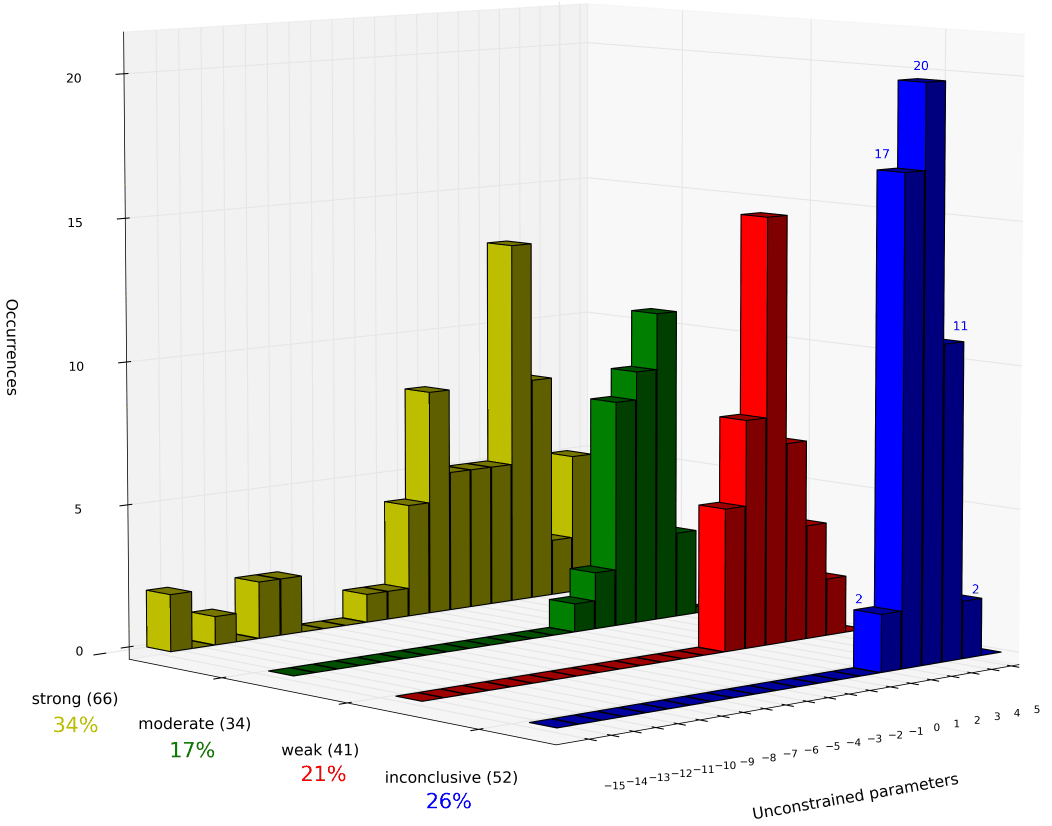
The afternoon was largely devoted to early universe physics, including inflation. We’re only two days in to the conference but already several speakers have showed this plot (from here), which shows the extent to which current cosmological data disfavours various inflationary models:

Some are disfavoured, but clearly there are still lots of viable models! Too many!

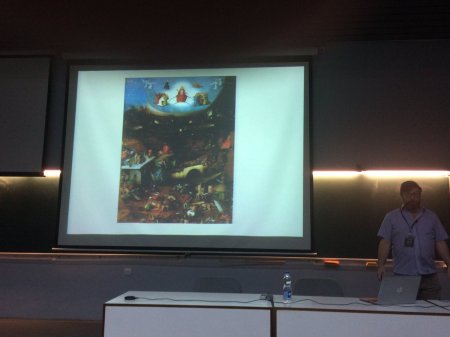
For the final session of the day we were joined by Paul Steinhardt via Skype from the USA. He gave a very cogent and stimulating talk arguing that the prevailing paradigm (i.e. inflation) was about to be overturned. I don’t have time to do a full summary of his contribution, but you can check out a previous post about some of the issues he raised, and here’s a picture of the last slide of his presentation:

Anyway, that will have to do. The conference dinner beckons.