Post-Planck Cosmology: Day 1

Posted in The Universe and Stuff with tags , , , on October 9, 2017 by telescoper

Well, I’m just back to my guest flat from a pleasant birthday party for one of the conference organizers, Tarun Souradeep, is now in the same decade as me! I don’t have time to write about all the talks today so apologies to anyone I don’t mention by name. I also got called away to have tea with an old friend so missed the final session and consequently missed the last session. I can’t do that again tomorrow as I’m chairing the last session tomorrow (including a presentation from Paul Steinhardt via Skype).

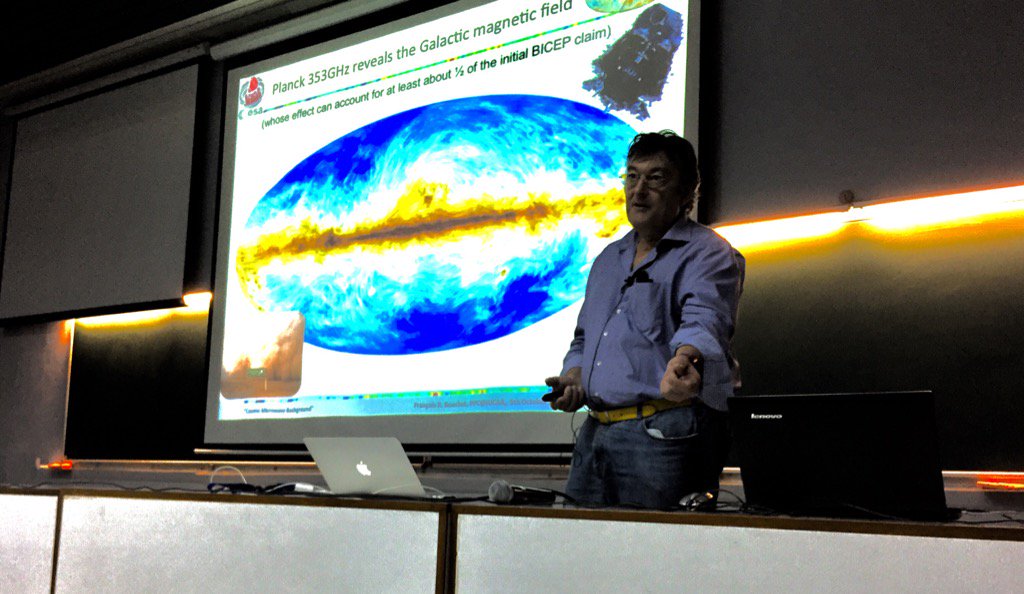
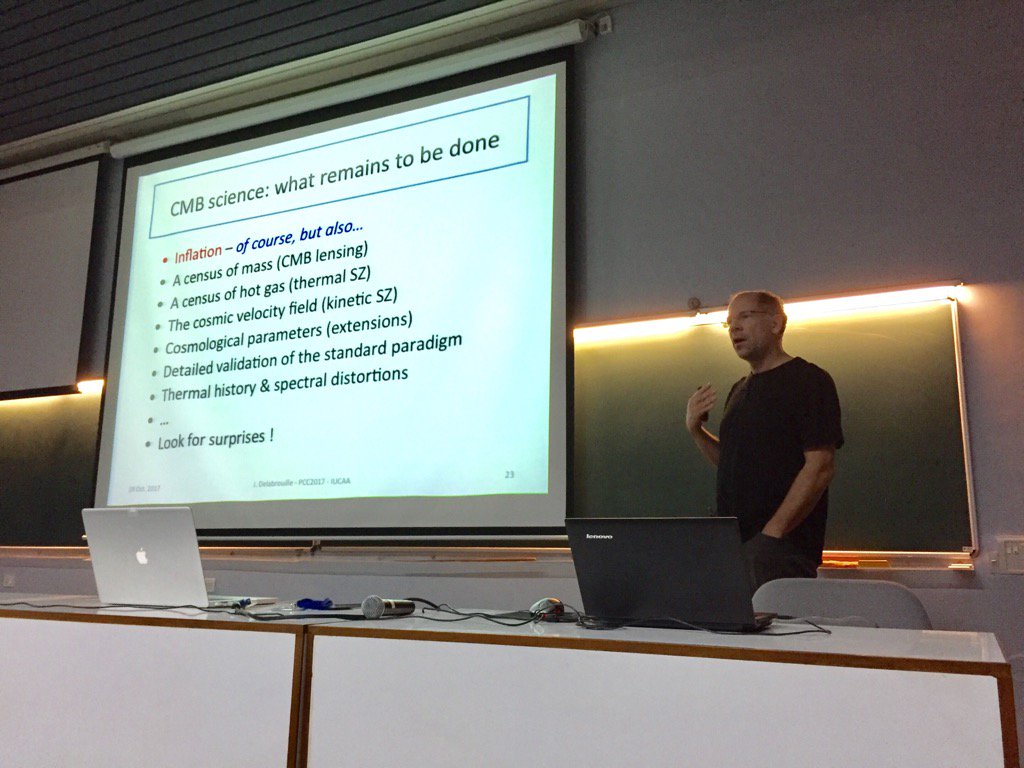
Also, I forgot to take my camera to today’s session so here are a couple of pics that I’ve stolen without permission from the Director of IUCAA, Somak Raychaudhury showing Francois Bouchet and Jacques Delabrouille who gave the first two talks.
Here are some brief notes.

Francois Bouchet delivered an expert summary on the state of cosmology up to and including the Planck mission. He started by saying out that before the discovery of the cosmic microwave background, cosmology was a `semi-crackpot subject’ and went on to show how much the field has moved on: there are no longer any semi-crackpots in cosmology. Three particularly interesting points he made on his grand tour were: (i) that the `inflationary prediction’ that the spectral index of primordial density fluctuations is not that n=1 (which was argued for before inflation by Harrison and Zeld’dovich) but n=0.96, and that the difference between these numbers is very significant; (ii) there aren’t enough independent modes in the (2D) CMB to improve current limits on non-Gaussianity by much so we will have to use (3D) galaxy clustering data; and (iii) the apparent `tension’ in measurements of the Hubble constant is not solely a problem with the CMB (he mentioned this paper in particular.

Next up, Jacques Delabrouille spoke about future CMB space missions. Unfortunately none of the three putative missions currently on the table (LiteBIRD, CORE and PIXIE) has been selected for Phase A by the relevant space agencies. Although not officially dead, any of these will need to find international partners to proceed, and none will be launched for at least a decade. The current generation of CMB scientists will therefore probably have to rely on ground-based data for the immediate future. However, he was ambitious in the science goals for future missions: `we want to measure it all!’

We then had a series of talks about various matters, including the resurgence of interest in spectral distortions of the CMB that I blogged about recently.

Anyway, that will do for this evening. I’ll try to post about Day 2 tomorrow, though it is the conference dinner in the evening so I may not be in a fit state!

Post-Planck Cosmology

Posted in The Universe and Stuff on October 9, 2017 by telescoper

I slept in a little this morning as my alarm didn’t go off. It turned out I’d set it to 7pm instead of 7am. Not a great start to the conference!

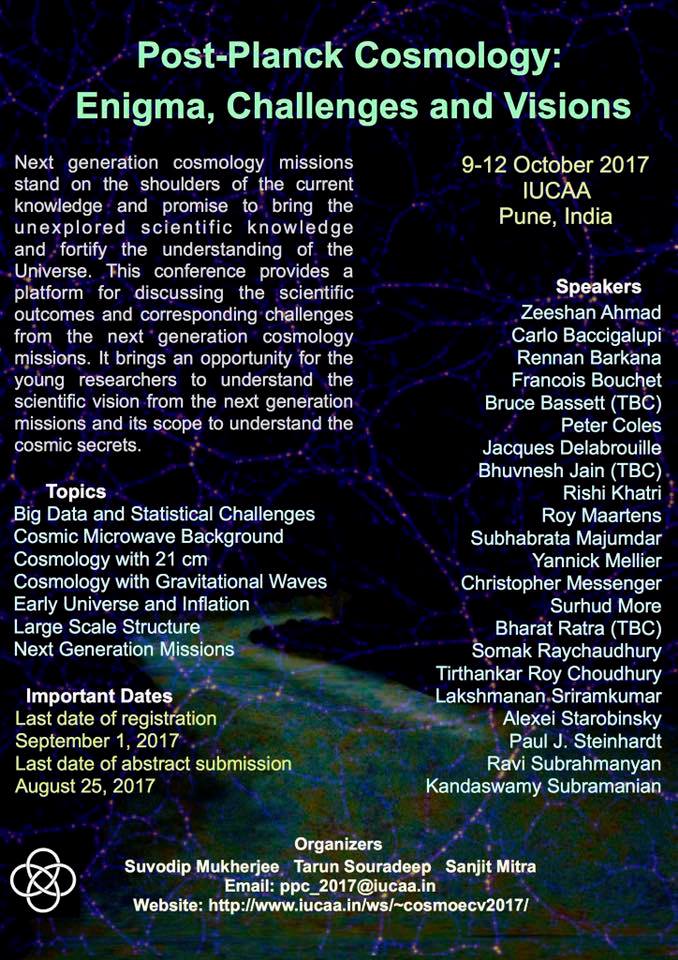
Anyway, we’ll soon be starting this meeting so I thought I’d post the conference poster.

I’ll try to post summaries of each day if I get the time in the evenings.

Now, time for breakfast!

Return to IUCAA

Posted in Biographical, The Universe and Stuff with tags , on October 8, 2017 by telescoper

This afternoon I roused myself from my slumbers and took a stroll around the campus of the Inter-University Centre for Astronomy and Astrophysics (IUCAA). You can read more about IUCAA here.

I was last here in 1994, at which time I was working with Varun Sahni on a long review article for Physics Reports. We didn’t quite get it all finished during the month or so I was here then, but it was submitted the following year.

Given that was over twenty years ago it shouldn’t really be a surprise that I don’t remember the place all that well, but in fact it has changed quite considerably with lots of new buildings. I’m not staying in the guest accommodation area I was in last time, but in a new part just round the corner. I’ve got a small apartment, actually,including a kitchen but I think I’ll be eating at the refectory most of the time.

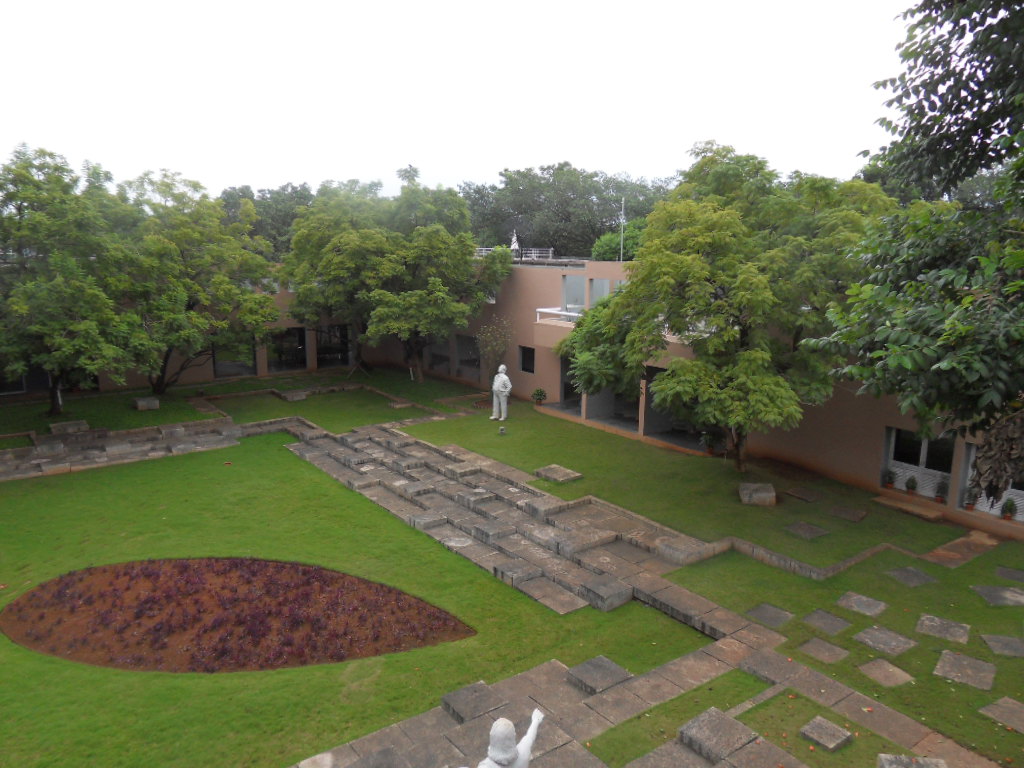
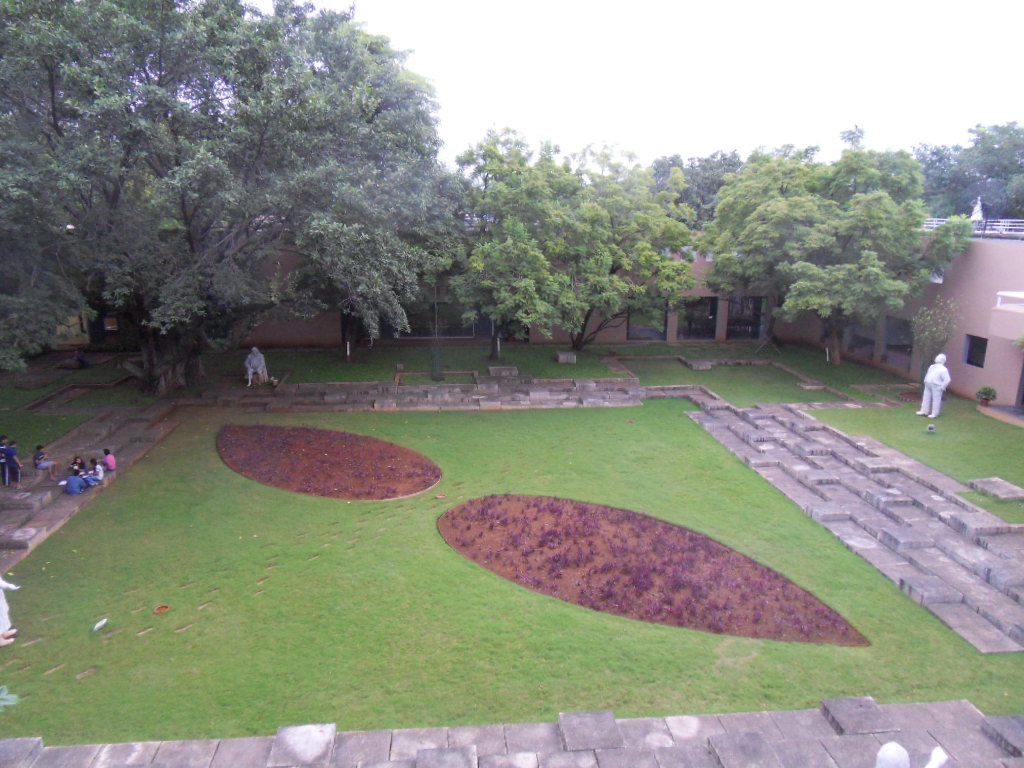
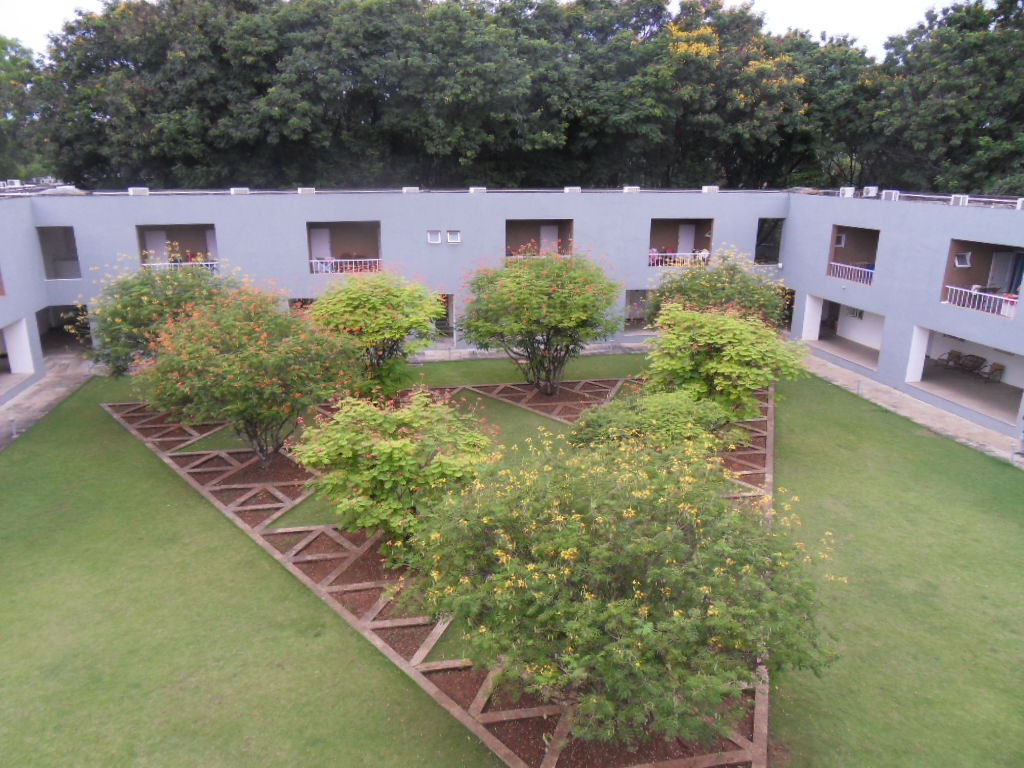
Anyway, here are some snaps of parts of the IUCAA complex I did recognize:

There are four statues in the main quadrangle which is featured in the first three pictures. These are of:  Sir Isaac Newton (seated under the tree), Albert Einstein (standing with hands in pockets); Galileo Galilei (in the robe with arms akimbo); and Aryabhata the great Indian mathematician-astronomer. It’s quite hard to get all four into one picture, even from the roof!

Anyway, there’s dinner and drinks coming up at 7.30 so that’ll do for a first post. The meeting starts tomorrow morning and I’ll try to tweet/blog about interesting bits until it finishes at the end of the week. The meeting is called Post-Planck Cosmology: Enigma, Challenges and Visions, so I’ll try tweeting with #PPCIUCAA2017 as the hashtag and see if it catches on!

A Passage to India

Posted in Biographical, Uncategorized on October 7, 2017 by telescoper

So. Here I am at Gate A10 at Heathrow Terminal 5 waiting to board a flight to Mumbai whence I shall be travelling to Pune for a conference on cosmology at which I’ll be giving an invited talk.

I’ll be back online when I get to the other side, but for the time being there will be a short interruption…

..it’s 2.30am tomorrow local time, but still 10pm today UK time. The driver who is taking me from Mumbai to Pune has stopped the car and  is having a short break as we’ve still got another couple of hours to go.

Well, I finally made it to IUCAA about 4.30 in the morning local time (midnight UK time). After doing the paperwork I was led to my guest room and then crashed out. It’s now about 12.45 and I’ve only been up an hour! My body clock must still be on UK time!

Although the Boeing 767 that brought me to Mumbai was very full, the trip was relatively smooth and on schedule. I have to admit that my heart sank when I saw how crowded the immigration hall was. That’s not really what you want to see after a long hour flight, but to be fair I’ve seen worse at Heathrow. Anyway, it took about an hour to get through the passport check etc and was then met by the driver of the car that had been sent to meet me.

It’s still monsoon time in this part of India and it was raining off and on but it was still warm when I left the terminal building, about 28 degrees in fact. It’s quite sunny today in Pune.

The car journey wasn’t quite long though mainly on an `Express Way’. At some point the volume of traffic made it quite scary, as my car dodged between heavy lorries. Lane discipline isn’t really a thing around here! I was thinking I might doze in the car but it was a bit of a white knuckle ride so I remained awake the whole time. That probably accounts for why I was so tired on arrival. Either that or I’m just getting old.

Song of India – Tommy Dorsey

Posted in Uncategorized with tags , , on October 6, 2017 by telescoper

This was a huge hit in 1937 for Tommy Dorsey’s Orchestra, featuring the great Bunny Berigan on trumpet:

Flying Visit

Posted in Biographical on October 5, 2017 by telescoper

No time for a proper post today. I’m currently sitting in Dublin Airport waiting for a flight back to Cardiff. I flew over the Irish Sea yesterday (in an aeroplane) and stayed the night here in Ireland in order to have as full a day as possible. Mission accomplished I’m now on my home.

An aeroplane of the type used to fly passengers.


“What have you been doing?”, I hear you ask. Well, you’ll just have to wait and see…

Joseph Bertrand and the Monty Hall Problem

Posted in Bad Statistics, History, mathematics with tags , , , , on October 4, 2017 by telescoper

The death a few days ago of Monty Hall reminded me of something I was going to write about the Monty Hall Problem, as it did with another blogger I follow, namely that (unsrurprisingly) Stigler’s Law of Eponymy applies to this problem.

The earliest version of the problem now called the Monty Hall Problem dates from a book, first published in 1889, called Calcul des probabilités written by Joseph Bertrand. It’s a very interesting book, containing much of specific interest to astronomers as well as general things for other scientists. Ypu can read it all online here, if you can read French.

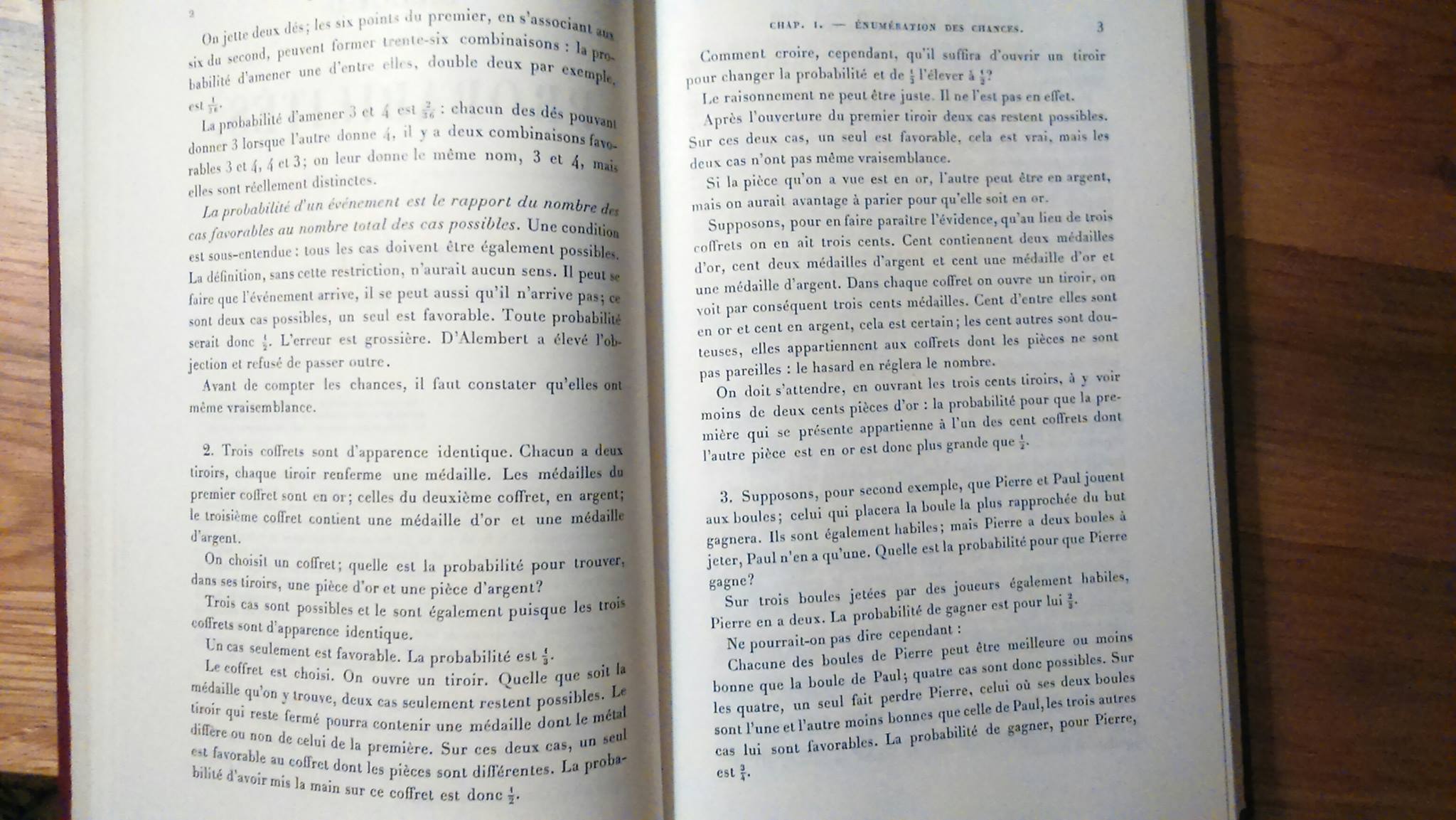
As it happens, I have a copy of the book and here is the relevant problem. If you click on the image it should be legible.

It’s actually Problem 2 of Chapter 1, suggesting that it’s one of the easier, introductory questions. Interesting that it has endured so long, even if it has evolved slightly!

I won’t attempt a full translation into English, but the problem is worth describing as it is actually more interesting than the Monty Hall Problem (with the three doors). In the Bertrand version there are three apparently identical boxes (coffrets) each of which has two drawers (tiroirs). In each drawer of each box there is a medal. In the first box there are two gold medals. The second box contains two silver medals. The third box contains one gold and one silver.

The boxes are shuffled, and you pick a box `at random’ and open one drawer `randomly chosen’ from the two. What is the probability that the other drawer of the same box contains a medal that differs from the first?

Now the probability that you select a box with two different medals in the first place is just 1/3, as it has to be the third box: the other two contain identical medals.

However, once you open one drawer and find (say) a silver medal then the probability of the other one being different (i.e. gold) changes because the knowledge gained by opening the drawer eliminates (in this case) the possibility that you selected the first box (which has only gold medals in it). The probability of the two medals being different is therefore 1/2.

That’s a very rough translation of the part of Bertrand’s discussion on the first page. I leave it as an exercise for the reader to translate the second part!

I just remembered that this is actually the same as the three-card problem I posted about here.

G.W. – Eric Dolphy

Posted in Jazz with tags , , on October 3, 2017 by telescoper

What better way to celebrate today’s announcement of the award of the 2017 Nobel Prize for Physics for the detection of Gravitational Waves, than to play this amazing Eric Dolphy track called `G.W.’ from the album Outward Bound?

This album was recorded in 1960, and the stellar personnel listening is as follows: Eric Dolphy (alto saxophone on this track but also bass clarinet and flute elsewhere on the album); Freddie Hubbard (trumpet); Jaki Byard (piano); George Tucker (bass); Roy Haynes (drums). It’s a great line-up but listen out for the opening solo by Dolphy! Wow!

The 2017 Nobel Prize for Physics goes to…

Posted in The Universe and Stuff with tags , , , , , on October 3, 2017 by telescoper

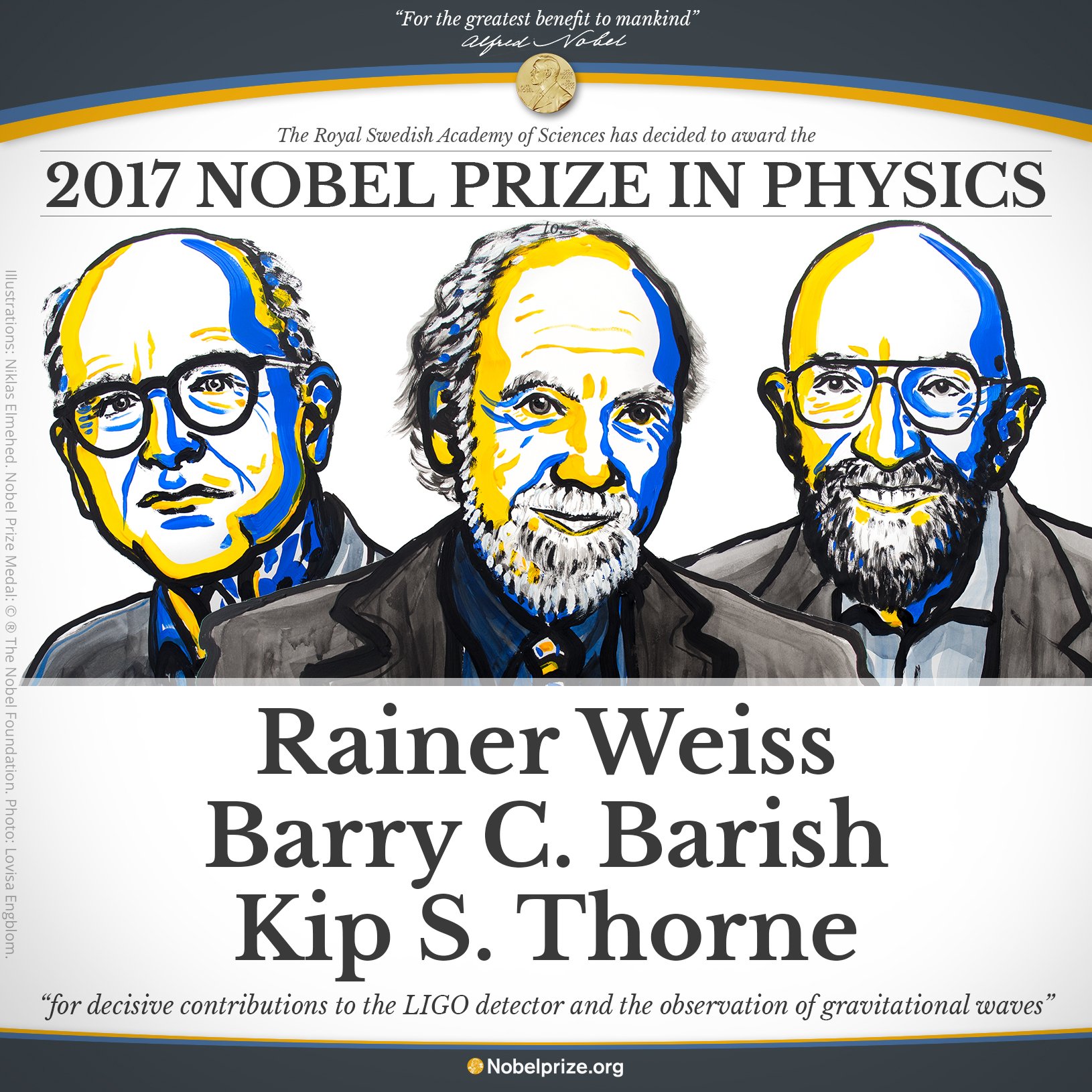
Usually at this time of year I make a point of watching the live announcement of the Nobel Prize for Physics, but this time I was otherwise engaged. On the other hand, this year was the least surprising announcement I can remember for a long time. Confirming almost everyone’s expectations, the award goes to Rainer Weiss (MIT), Barry C. Barish (Caltech) and Kip S. Thorne (Caltech) “for decisive contributions to the LIGO detector and the observation of gravitational waves”. You can see the full citation here.

Perhaps one surprise the split (50% to Weiss and 25% each to Barish and Thorne). I suppose the reason is that it divides the prize equally between MIT and Caltech. Ronald Drever, who had shared in other awards for the LIGO discovery (e.g the Gruber,  Shaw and Kavli prizes), sadly passed away earlier this year.

Anyway,  heartiest congratulations to the winners and also to all the other members of the LIGO Scientific Collaboration who collectively earned this award! That includes the Gravitational Physics group at Cardiff University who will no doubt be getting pissed celebrating in appropriate style.

Two thoughts. One is that the LIGO Collaboration is very large (the papers have over a thousand authors) but the Nobel Prize rules do not allow this award to be divided among more than three people. This is a problem for `Big Science’ which is always done by large teams. In a real sense, the Nobel Prize for physics reflects the way physics was done when it was founded, over a hundred years ago. It seems to me the limitation perpetuates the myth of the lone genius, when science doesn’t really work like that nowadays. I’m not sure it ever did, actually. I  wonder if they’ll ever change?

Another thing that struck me is that the interval between discovery and award seems to be decreasing. For example, he Cosmic Microwave Background was discovered in 1965, but Penzias and Wilson were not awarded the Nobel Prize for its discovery until 1978. I attended the Nobel Prize ceremony in 2005, when George Smoot and John Mather were award the prize for COBE which had happened over a decade earlier. This time the gap between discovery and award is just two years. I suppose that proves that we live in an accelerating universe (Nobel Prize 2011).

Anyway there are too many people in LIGO for them all to be able to attend the Prize Ceremony and Banquet in Stockholm in December, but I hope the winners don’t just give their invitations to senior members of the LIGO collaboration. Perhaps some form of lottery might be organized to allow early career researchers to attend?

As I’ve mentioned before on this blog I had the honour to be invited to the 2006 Nobel Prize ceremony. As a matter of fact, I still have this:

The chocolate has probably gone off by now, though. I stress that I attended not as a winner but as a guest of the Nobel Foundation. It was a wonderful occasion, of which I have very special memories. I’m sure everyone who does get to attend will have a ball! (Geddit?)

Although the Nobel Prize has its limitations as a true reflection of scientific contributions, I still has value in that for once the news media are talking about a great human achievement which contrasts with much of the stuff we have to hear about these days.

The State of Catalonia

Posted in Politics with tags , , on October 2, 2017 by telescoper

I’m sure I’m not the only one who was appalled by the scenes of violence yesterday as police tried to stop voting in the `referendum’ on Catalonia. Here’s some footage from the BBC which clearly shows excessive use of force inside a polling station:

This is far from the worst example: elsewhere plastic bullets were fired at unarmed protesters. In all, about 900 people have been reported injured, though this claim is contested and  thankfully none of them – as far as I know – seriously.

Whatever you think about the rights and wrongs of the independence movement – and I’ll tell you what I think in a moment – there’s no question that the Spanish government has handled this issue very badly and in so doing has conceded a propaganda victory.  There was no need to use force to prevent the voting, as the  referendum was unlawful. The national government was undoubtedly in a difficult position, but I think it would have been far better just to let the vote go ahead in full knowledge that it had no constitutional validity. The referendum result (claimed to be about 90% for independence, on a turnout of just over 40%) means nothing even if you actually believe the numbers (which are doubtful). ‘Democracy’ means nothing without the rule of law. 

Nevertheless, it just may be that history will judge Sunday 1st October to be the day that Catalonian independence became inevitable not because of the vote per  se but because of the reaction to it.

Many seem to be either casting this as a battle between democracy and fascism, raising the spectre of Franco, or, even more absurdly, blaming all this on the European Union, ignoring the blame attached to the antics of the separatists. For a counter to the simple-minded propaganda emanating from the extremes of left and right, you might read this piece

Of course I’m just an ignorant foreigner and I encourage those with different opinions to express them through the comments box below.

The EU will of course not intervene in what is essentially an internal problem for Spain, but is right to call for a dialogue to begin quickly before things get any worse, as the Commission has made clear:

Under the Spanish Constitution, yesterday’s vote in Catalonia was not legal.

For the European Commission, as President Juncker has reiterated repeatedly, this is an internal matter for Spain that has to be dealt with in line with the constitutional order of Spain.

We also reiterate the legal position held by this Commission as well as by its predecessors. If a referendum were to be organised in line with the Spanish Constitution it would mean that the territory leaving would find itself outside of the European Union.

Beyond the purely legal aspects of this matter, the Commission believes that these are times for unity and stability, not divisiveness and fragmentation.

We call on all relevant players to now move very swiftly from confrontation to dialogue. Violence can never be an instrument in politics. We trust the leadership of Prime Minister Mariano Rajoy to manage this difficult process in full respect of the Spanish Constitution and of the fundamental rights of citizens enshrined therein.

It was wrong to proceed with the referendum, but it was also wrong to use heavy-handed tactics to try to stop it going ahead. There is blame on both sides, and both sides need to get together to sort it out. I’m not optimistic that will happen immediately, but the only way to make peace is by talking to your opponents. Let’s hope that common sense prevails, if not immediately then perhaps eventually.

So what do I think about the case for Catalonian independence? Well, I’m not qualified to talk about the specific arguments, so I’ll keep to the generalities. Let me start with a bit of autobiography that might explain why I see things the way I do. I was born in Wallsend (on Tyneside) in the North East of England. My parents were both born just before World War II started, also in the area where I was born. Of my four grandparents, one was born in England, one in Northern Ireland, one in Scotland, and one in Wales. I always smile when I get to write my nationality on a form, because I put “United Kingdom”. Of course being born in England makes me English too, but I find that less defining than “UK” or “British” or even “Geordie”. To be honest, my ancestry means that  I generally find the whole concept of nationality fundamentally silly. I find nationalism silly too, except for those occasions – regrettably frequent nowadays – when nationalism takes on the guise of xenophobia. Then it is truly sinister. Nationalism is a tool by which unscrupulous individuals whip up hatred for political gain, regardless of the human consequences.

It may be apocryphal, but Albert Einstein is reported to have said “nationalism is an infantile disease”. The obvious way to cure it is to grow up and focus on fixing the real problems facing us instead of just waving flags, shouting slogans, and blaming others for our own failings. The reality is that we depend on each other too much for independence to have any meaning, let alone be desirable.