Consider the stability of a spherical cat of mass M and radius R using tree-level perturbation theory.
Follow @telescoper
Consider the stability of a spherical cat of mass M and radius R using tree-level perturbation theory.
Follow @telescoper
It has been very hectic around here since I got back from India last week, so I’ve only just found time to do a quick review of Welsh National Opera’s production of From the House of the Dead which I saw last Friday at the Mayflower Theatre in Southampton. I was away for the two performances of this Opera in Cardiff earlier this month and when I mentioned to a couple of friends of mine from London that I was hoping to catch it while it was on tour we decided to compare diaries and see if there was any way we could go together. And so it came to pass that we all ended up in Southampton, me returning to Cardiff through Storm Brian the next day, and Joao and Kim flying off to Cape Verde for two weeks from Gatwick Airport.
Anyway, to the Opera. From the House of the Dead is by Leoš Janáček, and is based on the autobiographical novel of the same (or similar) name by Fyodor Dostoyevsky. It is set in a Siberian prison, in one such establishment Dostoyevsky himself spent four years of his life. It’s a grim story that starts with the arrival of a nobleman, Goryanchikov, to start his sentence. He is stripped of his fine clothes, beaten and tortured, then joins the wretched ensemble of captives until he is unexpectedly released at the end of the Opera. In between the prisoners take turns to describe their life stories, holding on to the past as people do who perceive that they have no future. There is little plot other than this series of narratives apart from a quasi-comic interlude provided by an Easter `show’, in the form of a pantomime. The work is in three relatively short acts which, in this production, run together without an interval. The whole performance lasts about 90 minutes. The picture above, taken during a previous run of this production in Finland, conveys the look and feel of this revival of a production by David Pountney that was first performed in 1982.
From the House of the Dead was written in the last years of Janáček’s life and was not performed until two years after his death. It opens with a prelude that reminded me a lot of his superb String Quartet No. 2 (`Intimate Letters’), written around the same time (1928) but whereas that work is about the nature of love, this Opera is about loneliness, isolation and brutality. The musical score is very rich and varied, but the vocal lines rather constricted, as if to emphasise the sense of captivity. It’s also really an ensemble piece rather than one in which the principal vocalists stand out from the chorus. This works very well for Welsh National Opera, as the chorus of WNO is exceptional. The Orchestra, under the direction of Tomas Hanus (himself a native of Brno, where Janáček lived for much of his life), played superbly, bringing out the subtleties of the orchestration by adding contrasting notes of optimism and hope to the intense, unrelenting darkness.
In short it was well worth the trip to Southampton, even if it did take me five hours to get home via two trains and a rail replacement bus service. This production has deservedly been very positively reviewed in the national media and I strongly recommend you see it during one if its remaining dates, in Oxford, Birmingham, Bristol or Llandudno.
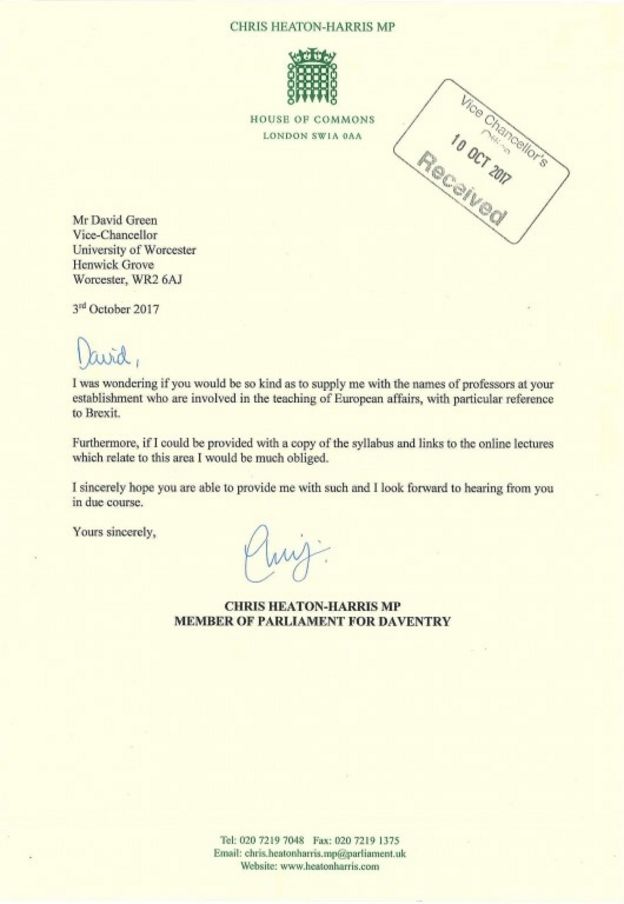
Follow @telescoperYesterday, Tory MP Christopher Heaton-Harris wrote to all Vice-Chancellors of UK universities asking them to send him the names of professors teaching about “European affairs” together with links to relevant syllabuses and course materials. There has been an overwhelmingly negative response to this sinister request, which comes from an arch-Brexiteer apparently intent on thought control.
Not wishing to fall foul of the Brexit Police, I have updated my syllabus for next term and include it here so Mr McCarthy Heaton-Harris can read it:
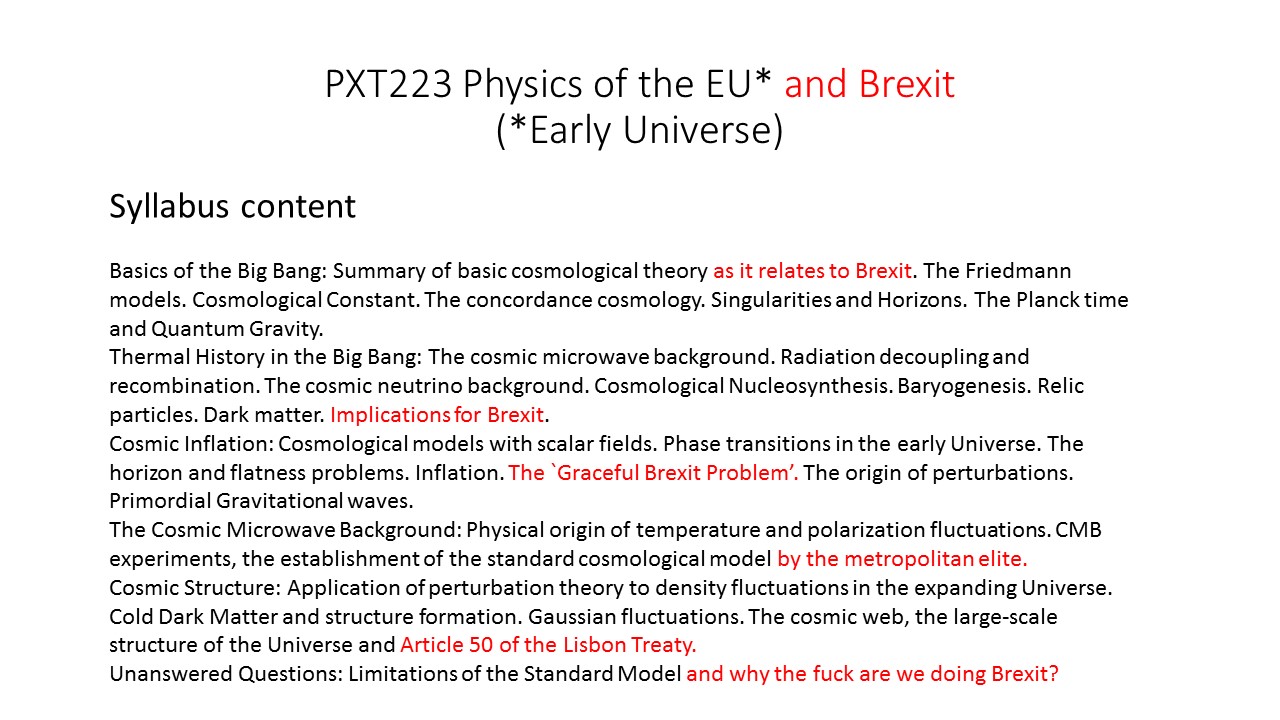
I’m afraid that, for any further information and/or course materials relating to this module, Mr Heaton-Harris will have to register and pay the requisite fee which, thanks to his government is £9250.
P.S. I posted this slide on Twitter yesterday, and it got as close as any of my tweets have ever done to going viral (with over 800 retweets).
Follow @telescoperOne of the many interesting scientific results to emerge from last week’s announcement of a gravitational wave source (GW170817) with an electromagnetic counterpart (GRB 170817A) is the fact that it provides constraints on departures from Einstein’s General Theory of Relativity. In particular the (lack of a) time delay between the arrival of the gravitational and electromagnetic signals can be used to rule out models that predict that gravitational waves and electromagnetic waves travel with different speeds. The fractional time delay associated with this source is constrained to be less than 10-17 which actually rules out many of the proposed alternatives to general relativity. Modifications of Einstein’s gravity have been proposed for a number of reasons, including the desire to explain the dynamics of the expanding Universe without the need for Dark Energy or Dark Matter (or other exotica), but many of these are now effectively dead.
Anyway, I bookmarked a nice paper about this last week while I was in India but forgot to post it then, so if you’re interested in reading more about this have a look at this arXiv paper by Baker et al., which has the following abstract:
Follow @telescoperThe detection of an electromagnetic counterpart (GRB 170817A) to the gravitational wave signal (GW170817) from the merger of two neutron stars opens a completely new arena for testing theories of gravity. We show that this measurement allows us to place stringent constraints on general scalar-tensor and vector-tensor theories, while allowing us to place an independent bound on the graviton mass in bimetric theories of gravity. These constraints severely reduce the viable range of cosmological models that have been proposed as alternatives to general relativistic cosmology.
Yesterday I came across a story about bullying in the Institute of Astronomy at the Eidgenössische Technische Hochschule Zürich in Switzerland (known universally as ETH Zürich). You can find details here (in German) or here (in English, as produced by Google translate).
The allegations contained in this piece are so serious that they have resulted in the closure of the Institute of Astronomy. Two senior members of the faculty are currently on sabbatical and have had their positions transferred to the Department of Physics. You can read the substance of this case in the link I’ve provided so I won’t elaborate further here and will restrict myself to making a couple of points.
First, while this is not the type of case of sexual harassment with which we are becoming regrettably familiar in Astronomy and elsewhere, it does seem to be a product of the same systemic problem: an excessively hierarchical management structure that places far too much power in the hands of prominent individuals at the expense of junior colleagues. Moreover, as in so many other cases, the institutional response seems to be to protect the senior staff rather than to deal with the underlying issues. The institution has allegedly taken over a decade to respond to the accusations of bullying. What compensation or other redress is being offered to those who have been bullied in the Institute of Astronomy during this time? I suspect the ETH just wants to keep the lid on this scandal and hopes it goes away by the time the individuals involved return from `gardening leave’. That is not an adequate response to a situation so serious that it necessitated the closure of an entire Institute. Ironically, just a month ago, ETH Zürich hosted a meeting on `Equal Opportunity at Work’.
That brings me to my second point. The article describing this case changes the names of the principal protagonists, perhaps for legal reasons. The allegations are directed at `Gabriella M.’ who arrived at the Institute at the same time (2002) as her British husband `Paul F.’. This information is sufficient to allow anyone working in Astronomy to identify the two immediately. Anyone not familiar with the Astronomy world could arrive at the same conclusion in a few minutes with a little bit of googling (as a non-astronomy friend of mine proved on Facebook last night). I don’t know why the report I’ve linked to felt the need to disguise the identities of these people, but I see no reason to play along with the attempted anonymity even if it were not so badly botched.
The (female) Professor against whom the allegations of bullying have been made is Marcella Carollo and her husband is Simon Lilly. You will see if you look at the Wikipedia page for Marcella Carollo that it has been edited a number of times to include the news presented in the report I linked to, but the editors have been undoing the changes on the grounds that they represent `vandalism’ of a biographical page. Nowadays telling the truth is `vandalism’, apparently.
I might get into trouble for posting this information, but I feel I’m acting in the public interest and anyway I don’t mind a reasonable amount of trouble…
UPDATE:

Lengthy but interesting post about forthcoming changes to the definition of four of the base units of the SI system.
Measurement, the simple process of comparing an unknown quantity with a standard quantity, is the essential component of all scientific endeavours. We are currently about to enter a new epoch of metrology, one which will permit the breath-taking progress of the last hundred years to continue unimpeded into the next century and beyond.
The dawn of this new age has been heralded this week by the publication of an apparently innocuous paper in the journal Metrologia. The paper is entitled:
Data and Analysis for the CODATA 2017 Special Fundamental Constants Adjustment
and its authors, Peter Mohr, David Newell, Barry Taylor and Eite Tiesinga constitute the Committee on Data for Science and Technology, commonly referred to as CODATA. In this article I will try to explain the relevance of CODATA’s paper to developments in the science of metrology.
The Past
The way human beings began to make sense…
View original post 1,920 more words
Way back in July I went to the Third Day’s Play of the Test Match between England and South Africa. On the way to the ground I bought a copy of Money Week, a publication I have never read before, as requested by my old friend and regular commenter on this blog, Anton, who got the tickets for the match. During a lull in the play we did the crossword in the magazine, which was a not-too-difficult thematic puzzle. When I got back to Cardiff I posted off the solution, as a prize of a bottle of vintage port was on offer. Not hearing any more, forgot about it.
When I got back from India this week there was a card waiting for me saying that ParcelForce had attempted to deliver a package while I was away. This morning I went to the main post office to sign for it and pick it up. This is what I got:

I don’t know why it took so long to deliver the prize but it makes a nice change from the usual dictionaries!
Follow @telescoperIn my short post about Monday’s announcement of the detection of a pair of coalescing neutron stars (GW170817), I mentioned that one of the results that caught my eye in particular was the paper about using such objects to determine the Hubble constant.
Here is the key result from that paper, i.e. the posterior distribution of the Hubble constant H0 given the data from GW170817:

You can also see latest determinations from other methods, which appear to be in (slight) tension; you can read more about this here. Clearly the new result from GW170817 yields a fairly broad range for H0 but, as I said in my earlier post, it’s very impressive to be straddling the target with the first salvo.
Anyway, I just thought I’d mention here that the method of measuring the Hubble constant using coalescing binary neutron stars was invented by none other than Bernard Schutz of Cardiff University, who works in the Data Innovation Institute (as I do). The idea was first published in September 1986 in a Letter to Nature. Here is the first paragraph:
I report here how gravitational wave observations can be used to determine the Hubble constant, H 0. The nearly monochromatic gravitational waves emitted by the decaying orbit of an ultra–compact, two–neutron–star binary system just before the stars coalesce are very likely to be detected by the kilometre–sized interferometric gravitational wave antennas now being designed1–4. The signal is easily identified and contains enough information to determine the absolute distance to the binary, independently of any assumptions about the masses of the stars. Ten events out to 100 Mpc may suffice to measure the Hubble constant to 3% accuracy.
In in the paper, Bernard points out that a binary coalescence — such as the merger of two neutron stars — is a self calibrating `standard candle’, which means that it is possible to infer directly the distance without using the cosmic distance ladder. The key insight is that the rate at which the binary’s frequency changes is directly related to the amplitude of the gravitational waves it produces, i.e. how `loud’ the GW signal is. Just as the observed brightness of a star depends on both its intrinsic luminosity and how far away it is, the strength of the gravitational waves received at LIGO depends on both the intrinsic loudness of the source and how far away it is. By observing the waves with detectors like LIGO and Virgo, we can determine both the intrinsic loudness of the gravitational waves as well as their loudness at the Earth. This allows us to directly determine distance to the source.
It may have taken 31 years to get a measurement, but hopefully it won’t be long before there are enough detections to provide greater precision – and hopefully accuracy! – than the current methods can manage!
Above all, congratulations to Bernard for inventing a method which has now been shown to work very well!
Follow @telescoperJust a brief post today to say that I got back safe and sound last night. I was up at 4am Tuesday Pune time (which was 11.30pm Monday UK time) and finally got to bed at about 11.30pm UK time last night, so apart from about 45 minutes doze on the flight I had been awake for 24 hours. Not surprisingly, I slept in this morning!
After another white-knuckle taxi ride (with the added complication of thick fog) I got Mumbai airport in good time. The flight itself was almost empty. Not only did I get a row of seats to myself in economy class, but the two rows in front in and the two rows behind were also unoccupied. I’m not entirely sure why the flight was so underbooked – as the outbound flight was absolutely crammed – but it may be that the festival of Diwali takes place this week (on Thursday or even today in some regions). Relatively few people are probably leaving India at this time compared with the many coming home to celebrate with friends and family. It’s a nice coincidence that Monday’s announcement of simultaneous detection of gravitational waves and electromagnetic radiation came so close to the Festival of Light, traditionally celebrated with fireworks and gifts of gold!
Despite liberal helpings of wine from the drinks trolley and the ability to lie down across three seats I still didn’t really sleep. I just don’t have the knack for sleeping on planes. Still, I did get to watch the film The Imitation Game which I hadn’t seen before and thought was very good.
We arrived back on schedule without the (usually) obligatory air traffic delays around Heathrow and, the arrivals hall being empty, I was out of the airport less than half an hour after landing. That’s a bit of record for me!
Anyway, I’ve various things to catch up on now that I’m back so I’ll try to get on with them. I’ll just end by thanking my hosts at IUCAA again for their hospitality and, while I’m at it, send a Happy Diwali message in Marathi to them and anyone else celebrating at this special time:

Well, it has certainly been an eventful last day in India!

Over a hundred people gathered at IUCAA to see this evening’s press conference, which basically confirmed most of the rumours that had been circulating that a Gamma Ray Burst had been detected in both GW and EM radiation. I won’t write in detail about today’s announcement because (a) a really useful page of resources has been prepared by the group at IUCAA. Check out the fact sheet and (b) I haven’t really had time to digest all the science yet.
I will mention a couple of things, however. One is that the signal-to-noise ratio of this detection is a whopping 32.4, a value that astronomers can usually only dream of! The other is that neutron star coalescence offer the possibility to bypass the traditional `distance ladder’ approaches to get an independent measurement of the Hubble constant. The value obtained is in the range 62 to 107 km s-1 Mpc-1, which is admittedly fairly broad, but is based on only one observation of this type. It is extremely impressive to be straddling the target with the very first salvo.
The LIGO collaboration is over a thousand people. Add to that the staff of no fewer than seventy observatories (including seven in space). With all that’s going in the world, it’s great to see what humans of different nations across the globe can do when they come together and work towards a common goal. Scientific results of this kind will remembered long after the silly ramblings of our politicians and other fools have been forgotten.
I took part in a panel discussion after the results were presented, but sadly I won’t be here to see tomorrow’s papers. I hope people will save cuttings or post weblinks if there are any articles!
UPDATE: Here is a selection of the local press coverage.
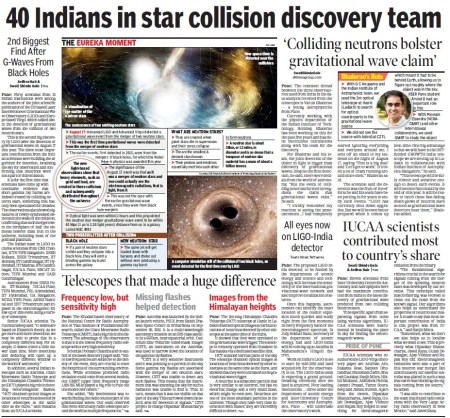
As if these thrilling science results weren’t enough I finally managed to meet my old friend and former collaborator Varun Sahni (who was away last week). An invitation to dinner at his house was not to be resisted on my last night here, which explains why I didn’t write a post immediately after the press conference. Still, of got plenty of papers to read on the plane tomorrow so maybe I’ll do something when I get back.
Tomorrow morning I get up early to return to Mumbai for the flight home, and am not likely to be online again until Wednesday UK time.
Thanks to all at IUCAA (and TIFR) for making my stay so pleasant and interesting. It’s been 23 years since I was last here. I hope it’s not so long before I’m back again!


 In the Dark