The “Pont” in Pontcanna

Posted in Cardiff, History with tags , on January 10, 2017 by telescoper

Regular readers of this blog (Sid and Doris Bonkers) will know that I currently reside in an area of Cardiff known as Pontcanna, which is part of the administrative district of the city known as Riverside.  Although Pontcanna does have a distinct identity as a community, there’s no precise definition that I can find of exactly where it is. Even Cardiff City Council doesn’t really recognize its existence: all my official mail has  “Riverside” in the address. Although I tell everyone I live in Pontcanna, I don’t have any official evidence that I do!

I’ve also often wondered about the origin of the name, as it definitely suggests a bridge of some sort (Pont is Welsh for bridge, cf  the French) and there are no bridges in the area. The name Canna is generally taken to refer to Saint Canna, whose name  is also associated with Canton, an area of modern Cardiff adjacent to Riverside but until the 19th Century a village in its own right. Since this is a very old name it’s logical to infer that the bridge is no more. However, the thing that always puzzled me is that the area of Pontcanna is actually quite small, and actually not all that close to the River Taff (the main river through Cardiff), which is even further from Canton, so there’s no obvious site for a bridge to have been, even if the bridge itself is long gone.

A chance conversation in a pub the other day however led me to a website that offers a solution to this conundrum., namely that the “Pont” in Pontcanna does not relate to a bridge over the River Taff, but over a small brook that used to run through the area shown on old maps and known (in English)  as the “White House Brook”.  This interpretation also casts doubt on the idea that “Canna” has anything to do with Saint Canna: it is possible that it derives instead from an old Welsh verb meaning “to whiten” although I’m by no means confident in that.

Here, according to my source, is the route of this brook:

cannamap

I’m sorry it’s low resolution, but it’s basically an annotated scan of a historical map. You can compare that with a modern map of the area around my house:

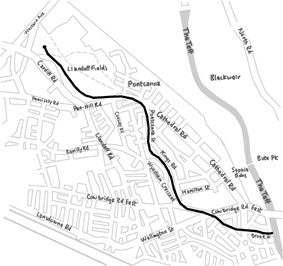
pontcanna

The River Taff can be seen to the upper right of the modern map. The White House Brook ran down what is now Cathedral Road before turning along the route of what is now Pontcanna Street. 

Construction of the  large houses on Cathedral Road, and others on surrounding streets, began around 1896, at a time when Cardiff’s population was expanding rapidly. Prior to that this area was mainly farmland, with a few cottages here and there. It is also part of the River Taff flood plain and was criss-crossed with ditches containing small streams, of which the White House Brook was the largest.

As the area became developed, water from these streams was diverted to form the sewer system for the new buildings and the White House Brook progressively dried up. What little remains of it now runs in a culvert, which eventually empties into the Taff.

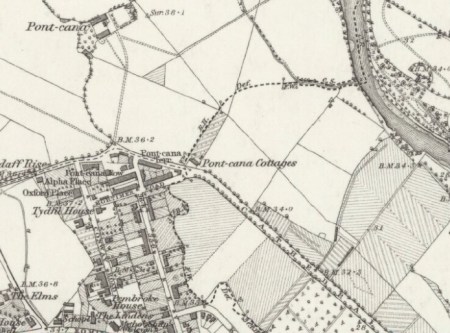
The bridge presumably disappeared at the same as the brook went underground around 1896, but the most likely candidate for it is a small bridge that stood near a row of cottages that lay between a small church (at the site of the Presbyterian Chuch on Gileston Road, marked on the modern map) and the end of what is now Teilo Street. These can be seen on this map, which  Bryn Jones directed me to (see comment below):

pontcanna_1886

The “Pont-cana cottages” (sic) were also demolished to make way for the new houses on Cathedral road and new roads either side of it. The best guess for the site of the bridge is close to the junction between Teilo Street and Cathedral Road. Note that in the first  map, Pontcanna is marked to the River Taff side of Cathedral road which is probably where the bridge was situated, very close to the end of my street. I feel more justified than ever in saying that I live in Pontcanna!

P.S. This map also shows another location marked “Pont-cana” to the North, on what are now called Llandaff Fields. I think refers to Pontcanna Farm, presumably named after the bridge. Perhaps the Pontcanna cottages may have been homes for farm workers?

P.P.S. Incidentally, I learned from this site that until 1858, Cathedral Road was only accessible by paying a toll at a booth on Cowbridge Road! Even in the old days, Pontcanna was an exlusive area!

Still Thinking of Applying for a PhD Place in Physics or Astronomy?

Posted in Education with tags , , , , , , on January 9, 2017 by telescoper

Last term I gave a short talk to interested students within the School of Physics & Astronomy here at Cardiff University about postgraduate research in which I aimed to pass on some, hopefully useful,  information about how to go about applying for PhDs  in Physics  and Astronomy. Since the time is rapidly approaching when applications need to be sent in, I thought I’d repeat here a few general remarks that might be useful to people elsewhere who are thinking of taking the plunge when they graduate. I’m aiming this primarily at UK students applying for places in the UK; special considerations apply for students wanting to do graduate research abroad.

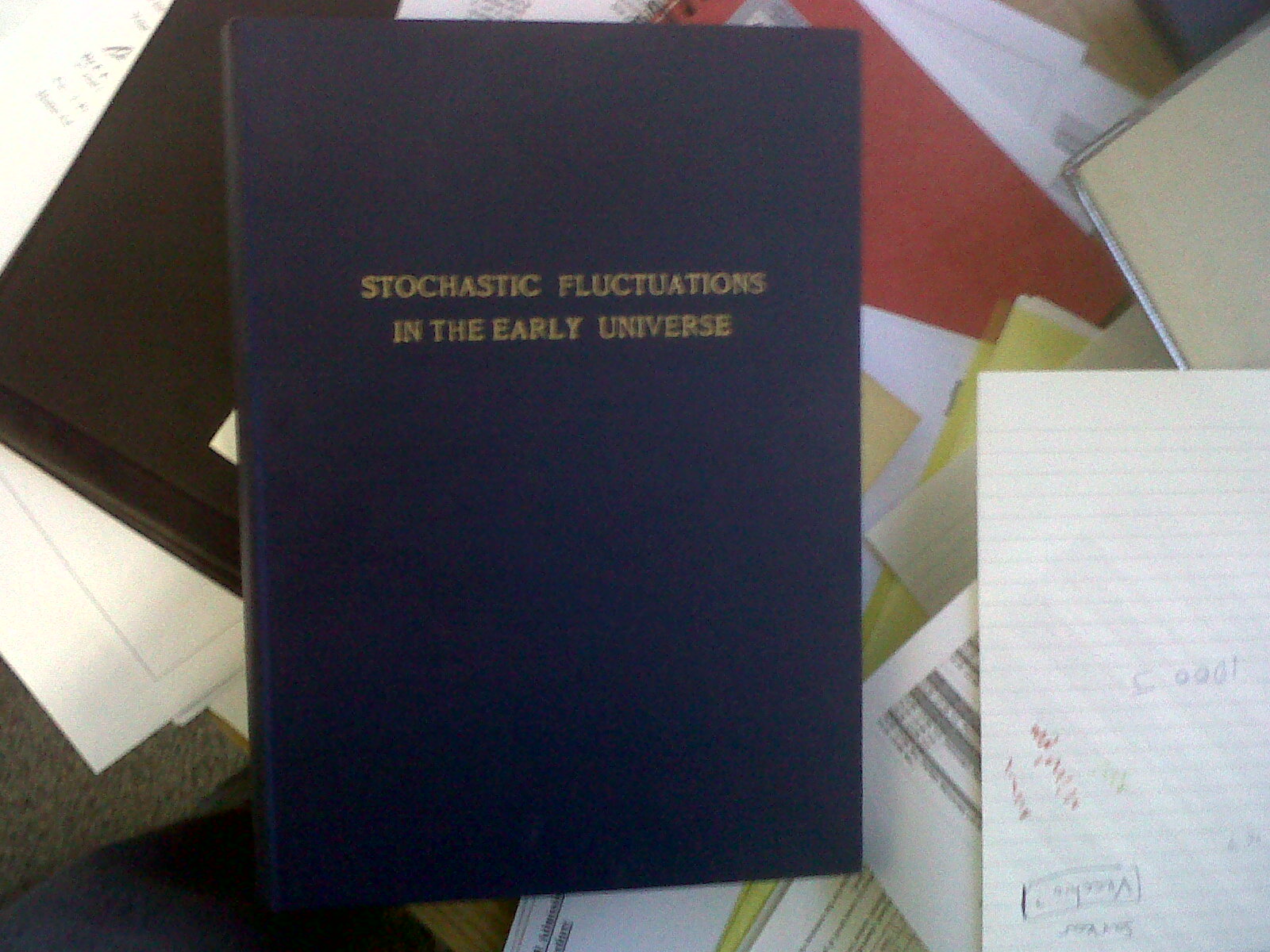
What is a PhD? The answer to that is relatively easy; it’s a postgraduate research degree. In order to obtain a PhD you have to present a thesis like that shown on the left (which happens to be mine, vintage 1988), typically in the range 100-250  pages long. A thesis has to satisfy two conditions for the award of the degree: it should contain original research, which is publishable in an academic journal; and it should present a coherent discussion of that original work within the context of ongoing work in the area of study. In Physics & Astronomy, the PhD is pretty much a prerequisite for any career in academic research, and it usually takes between 3 and 4 years to complete. After submission of the thesis you will have to undergo a viva voce examination conducted by two examiners, one internal and one external. This is quite a tough test, which  can last anywhere between about 2 and about 6 hours, during which you can be asked  detailed questions about your research and wide-ranging questions about the general area.

The Money Side. In the UK most PhDs are supported financially by the research councils, either EPSRC (most physics) or STFC (nuclear & particle physics, astronomy). These generally award quotas of studentships to departments who distribute them to students they admit. A studentship will cover your fees and pay a stipend, currently £14296 pa. That doesn’t sound like a lot, but you should at least remember that it is a stipend rather than a wage; it is therefore not taxed and there is no national insurance payable. There is a fee (currently £4121) payable for a PhD course, but that only comes into play if you are planning to fund yourself. If you receive a studentship it will normally cover the fee as an additional component. What I mean by that is you don’t need to pay it out of the stipend, it is separate. In top of that, research council funding also supplies a Research Training Grant which covers, e.g., travel and small items of equipment so you don’t need to pay for those out of your stipend either.

How do I choose a PhD? During the course of a postgraduate degree you are expected to become an expert in the area in which you specialize. In particular you should reach the point where you know more about that specific topic than your supervisor does. You will therefore have to work quite a lot on your own, which means you need determination, stamina and enthusiasm. In my view the most important criterion in your choice of PhD is not the institution where you might study but the project. You need to be genuinely excited by the topic in order to drive yourself to keep through the frustrations (of which there will be many). So, find an area that interests you and find the departments that do active research in that area by looking on the web. Check out the recent publications by staff in each department, to ensure that they are active and to have something to talk about at interview!

Qualifications. Most universities have a formal requirement that candidates for admission to the PhD should have a “good honours degree”, which basically means at least an Upper Second Class Honours degree. Some areas are more competitive than others, however, and in many disciplines you will find you are competing with a great many applicants with First Class degrees.

How to apply successfully. The application procedure at most universities is quite simple and can be done online. You will need to say something about the area in which you wish to do research (e.g. experiment/theory, and particular field, e.g. cosmology or star formation). You’ll also need a CV and a couple of references. Given the competition, it’s essential that you prepare. Give your curriculum vitae some attention, and get other people (e.g. your personal tutor) to help you improve it. It’s worth emphasizing particular skills (e.g. computing). If you get the chance, make use of your summer vacations by taking on an internship or other opportunity to get a taste of research; things like that will undoubtedly give your CV an edge.

The Interview. Good applicants will be invited for an interview, which is primarily to assess whether you have the necessary skills and determination, but also to match applicants to projects and supervisors. Prepare for your interview! You will almost certainly be asked to talk about your final-year project, so it will come across very badly if you’re not ready when they ask you. Most importantly, mug up about your chosen field. You will look really silly if you haven’t the vaguest idea of what’s going on in the area you claimed to be interested in when you wrote your  application!

Don’t be shy! There’s nothing at all wrong with being pro-active about this process. Contact academic staff at other universities by email and ask them about research, PhD opportunities. That will make a good impression. Also, don’t be afraid to ask for advice. Although we’re all keen to recruit good PhD students for our own departments, we academics are  conscious that it is also our job to give impartial advice. Ask your tutor’s opinion.

How many places should I apply for? Some research areas are more fashionable than others so the level of competition varies with field. As a general rule I would advise applying for about half-a-dozen places, chosen because they offer research in the right area. Apply to fewer than that and you might lose out to the competition. Apply to many more and you might not have time to attend the interviews.

What’s the timetable?  Most applications come in early in the new year for entry to the PhD in the following September/October. The Christmas break is therefore a pretty good time to get your applications sorted out. Interviews are normally held in February or March, and decisions made by late March. STFC runs a deadline system whereby departments can not force students to accept or decline offers before the end of March, so there should be ample time to visit all your prospective departments before having to make any decisions.

That’s all I can think of for now. I hope at least some of these comments are useful to undergraduates anywhere in the UK thinking of applying for a PhD. If there are any further questions, please feel free to ask through the comments box. Likewise if I’ve missed anything important, please feel free to suggest additions in the same manner…

Studying Physics & Astronomy at Cardiff University

Posted in Biographical, Education with tags , on January 9, 2017 by telescoper

I just came across this video (featuring, among others, my colleagues Haley Gomez, Carole Tucker and Chris North) advertising the School of Physics & Astronomy at Cardiff University. Since the annual recruitment cycle gets properly under way at this time of year I thought I’d share this here for the benefit of prospective students. We had a record intake last year, for both undergraduates and postgraduates. With outstanding successes in research over the past year (including the discovery of gravitational waves and the opening of a new venture in compound semiconductors) there’ll hopefully be a lot of interest again this year! We’re a friendly lot here, and Cardiff is a great city to live in, so why not get in touch?

Breaking Free

Posted in Art, Music with tags , , , , , , on January 6, 2017 by telescoper

I’ve been enjoy a series of fascinating programmes about music from the Second Viennese School (chiefly Arnold Schoenberg, Alban Berg and Anton Webern) on BBC Radio 3 this week gathered under the umbrella title of Breaking Free. In the period from roughly 1903 to 1925 these composers finally abandoned the traditional forms of tonality that late Romantic composers such as Gustav Mahler had struggled with in their later work. Aside from its obvious emotional intensity, one of the reasons I find music from this period absolutely absorbing because it was written in a period of highly turbulent transition; you get such a strong sense of new possibilities being opened up when you listen to some of the pioneering works. Some of them are also extremely beautiful. I often hear people say that they they think atonal music sounds ugly, but I disagree. The same people would probably agree that birdsong is beautiful, and most of that is entirely atonal..

The only problem is that I’ve now got a very long list of recordings to buy, as I don’t have any CDs or downloads of some very important pieces. I’m going to be a but poorer financially as a consequence of this educational experience, but hopefully enriched in a cultural sense.

The “breaking free” in this period wasn’t confined to music – revolutionary change was underway in other artistic fields, including painting. Last night I was listening to one of the programmes in the Breaking Free series and it inspired me to have a look in some of my art books for something appropriate to post from the time (if not the location) of the 2nd Viennese School. I decided on this, wan abstract painting by Wassily Kandinsky called Composition VII which was painted in 1913.

composition-vii-1913

The Path of the 2017 Total Solar Eclipse

Posted in The Universe and Stuff with tags , , , on January 6, 2017 by telescoper

I thought I’d share this nice NASA video showing the path of totality of the solar eclipse which will take place on 21st August 2017. This is he determined by the changing position of the shadow cast on the Earth’s surface by the Moon as the Earth rotates beneath it. As you can see the shadow will cross the United States of America from Oregon in the North West to South Carolina in the South East. It even passes over Kansas City on the way, so this promises to be a phenomenon that very many people will experience and enjoy.

Eclipses are not particularly rare: there are at least two every year, but most of these are partial rather than total and it is less common for totality to be witnessed from highly populated areas.

For much more information about the 2017 total eclipse of the sun, see the NASA page here.

R.I.P. Dick Fong 

Posted in Uncategorized on January 5, 2017 by telescoper

Just a quick post to pass on the very sad news that physicist and cosmologist Dr Richard Fong  – known to all his friends and colleagues as Dick Fong – died yesterday, on 4th January 2017.

Dick’s scientific background was in theoretical physics but he played a major part in the late 1970s and early 1980s in setting up and developing a group in cosmology and extragalactic astronomy in the Physics Department at Durham University. Dick was self-effacing about his own research but he was clearly an expert talent-spotter, bringing such luminaries as Tom Shanks, Richard Ellis and Carlos Frenk to work there. This initiative was extremely successful and Durham is now, and has been for many years, one of the world’s leading centres for cosmology research. Dick retired about fifteen years ago, but kept in touch with developments in the field. He leaves quite a legacy.

My own clearest memory of Dick was that he was on the panel that interviewed me for a research fellowship in 1992, just before the Science and Engineering Research Council (SERC) split up and spawned PPARC and STFC. Dick led the questions after my talk which I struggled mightily to answer, at least partly because I couldn’t really work out what he was asking! He was always a bit cryptic when talking about physics. Despite this I was awarded the Advanced Fellowship, which really established my own academic career and led to my first faculty position.

As well as that  very personal reason for remembering Dick, there is another which I’m sure will be shared by those who knew him and worked with him: he was a kindly and charming man who was always generous and helpful to others. He will be greatly missed by his friends and family, to whom I send heartfelt condolences.

R I.P. Richard Fong (1936-2017)

Peter Coles and Ken Colyer

Posted in Biographical, Jazz with tags , , on January 5, 2017 by telescoper

My piece just before Christmas about Clem Avery prompted me to do a bit more searching on the internet for jazz-loving family friends and acquaintances. It didn’t take me long to find this (which I got from this website):

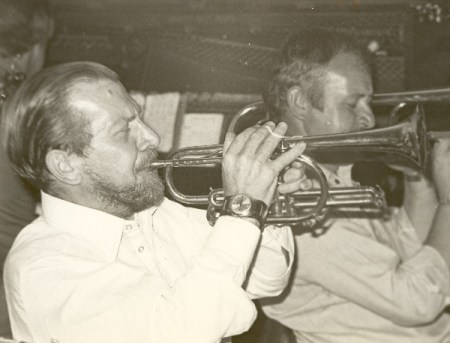
ken-colyer3-mid-1970s

The photograph was taken at the Lambton Arms in Chester-le-Street sometime during the 1970s. The gentleman on the left playing cornet is none other than “The Guvnor”, Ken Colyer. Next to him, on trombone, is Peter Coles. No, not me, but my uncle Peter!

Here’s another photo of him, taken from the same website. This also dates back to the 1970s but this one shows him with “Mighty” Joe Young’s band playing at The Honeysuckle in Gateshead. Joe Young is on bass.

mighty-joes-band


Do you have Confidence in the Teaching Excellence Framework?

Posted in Bad Statistics with tags , , , , on January 4, 2017 by telescoper

The  Teaching Excellence Framework (TEF) is, along with a number of other measures in the 2016 Higher Education and Research Bill, causing a lot of concern in academic circles (see, e.g., this piece by Stephen Curry). One of the intentions of the TEF is to use relatively simple metrics to gauge “teaching quality” in higher education institutions. On top of the fundamental questions of exactly what “teaching quality” means and how it might be measured in any reliable way, there is now another worry: the whole TEF system is to be run by people who are statistically illiterate.

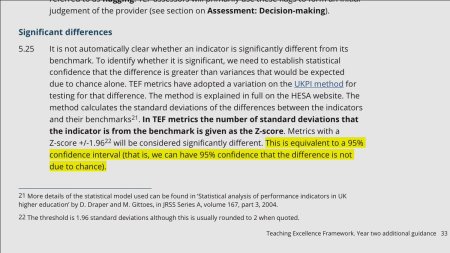
To demonstrate this assertion I refer you to this excerpt from the official TEF documentation:

tef

The highlighted “explanation” of what a confidence interval means is false. It’s not slightly misleading. It’s not poorly worded. It’s just false.

I don’t know who from HEFCE wrote the piece above, but it’s clearly someone who does not understand the basic concepts of statistics.

I can’t imagine what kind of garbled nonsense will come out of the TEF if this is the level of understanding displayed by the people running it.  That garbage will also be fed into the university league tables with potentially devastating effects on individuals, departments and institutions, so my gripe is not just about semantics – this level of statistical illiteracy could have very serious consequences for Higher Education in the UK.

Perhaps HEFCE should call in some experts in statistics to help? Oh, no. I forgot. This country has had enough of experts…


Perihelion and the Seasons

Posted in The Universe and Stuff with tags , , , , , , , on January 4, 2017 by telescoper

Today the Earth is at the point on its orbit at which it is at its closest to the Sun, i.e. at its perihelion. To be precise, this event takes place at 14.18 GMT today 4th January 2017; aphelion (the furthest distance from the Sun) is  at 20.11 GMT on July 3rd 2017. You can find a list of times and dates of perihelion and aphelion for future years  here.

It surprises me how many people think that the existence of the seasons has something to do with the variation of the Earth’s distance from the Sun as it moves in its orbit. The fact that perihelion occurs in the depth of winter should convince anyone living in the Northern hemisphere that this just can’t be the case, as should the fact that it’s summer in the Southern hemisphere while it is winter in the North.

The real reason for the existence of seasons is the tilt of the Earth’s axis of rotation, as explained in a nice little video here. I used to do a little demonstration with a torch (flashlight to American readers) to illustrate this when I taught first-year astrophysics. If you shine a torch horizontally at a piece of card it will illuminate a patch of the card. Keep the torch at the same distance but tilt the card and you will see the illuminated patch increase in size. The torch is radiating the same amount of energy but in the second case that energy is spread over a larger area than in the first. This means that the energy per unit area incident on the card is decreases when the card is tilted. It is that which is responsible for  winter being  colder than summer. In the summer the sun is higher in the sky (on average) than in winter. From this argument you can infer that the winter solstice (which passed on 21st December), not the perihelion, is the relevant astronomical indicator of winter.

That is not to say that the shape of the Earth’s orbit has no effect on temperatures. The eccentricity of the Earth’s orbit is e=0.017. Estimate the percentage difference in the flux of energy arriving at Earth from the Sun at the extremes of its orbit (i.e. at perihelion and aphelion).

I leave it as an exercise for the student that the fractional difference in distance between perihelion and aphelion in an elliptical orbit is 2e. The fractional change in flux received between the two extremes is thus 4e or about 6.8%, which is indeed a significant in the insolation at the Earth’s surface.

Assuming (for the sake of illustration only)  that the Earth behaves like a black body  then the incident flux would go as the fourth power of the temperature, which means that the temperature should change by about 1.7% between perihelion and aphelion. Taking the mean temperature to be about 300 K the difference should be around 5° C.

Ignoring any effects other than insolation this means that summer in the Southern hemisphere (when the Earth is at perihelion) should be significantly warmer than summer in the Northern hemisphere (when the Earth is at aphelion).

Things are not as simple as that, however, because the Earth’s surface possesses a significant North-South asymmetry: there is a much larger fraction of ocean in the Southern hemisphere, for example, which could be responsible for moderating. The climate is a non-linear system that involves circulating air and ocean currents that respond in complicated ways and on different timescales not just to insolation but to many other parameters, including atmospheric composition (especially water vapour).

The perihelion effect on summer temperatures can be readily verified by observations of Mars, which has no oceans and a much thinner, drier atmosphere, as well as a much more eccentric orbit (e=0.0934).


P.S. Of course, at perihelion the Earth is not only closest to the sun but also moving with its greatest orbit speed. That no doubt explains why January is often very windy…

P.P.S. That was a joke.