A gift for fellow snowflakes everywhere….
Follow @telescoperWaltz of the Snowflakes
Posted in Music with tags Ballet, Nutcracker, Piotr Ilyich Tchaikovsky, Waltz of the Snowflakes on January 17, 2017 by telescoperCotton Tail
Posted in Jazz with tags Ben Webster, Cotton Tail, Duke Ellington, Jazz, Rhythm Changes on January 16, 2017 by telescoperIt’s been a very busy and rather trying day so I’m in need of a bit of a pick-me-up. This will do nicely! It’s the great Duke Ellington band of 1940 playing Cotton Tail. This tune – yet another constructed on the chord changes to George Gershwin’s I Got Rhythm – was written by Ben Webster and arranged by Duke Ellington for his orchestra in a characteristically imaginative and inventive way. Webster’s “heavy” tenor saxophone dominates the first half of the track, but the real star of the show (for me) is the superb brass section of the Ellington Orchestra whose tight discipline allows it to punch out a series of complicated riffs with a power and precision that would terrify most classical orchestras. And no wonder! The Ellington band of this era was jam-packed with talent, including: Rex Stewart (cornet); Wallace Jones, Ray Nance, and Cootie Williams (trumpet); Juan Tizol, Joe”Tricky Sam” Nanton, and Lawrence Brown (trombones). Listen particularly to the two sequences from 1.33-1.49 and 2.35-2.59, which are just brilliant! Enjoy!
P.S. The drummer is the great Sonny Greer.
Follow @telescoperCardiff Brewery Tap wins Beard Friendly Pub of the Year title (UK)
Posted in Beards, Cardiff on January 16, 2017 by telescoperAnother important accolade for Cardiff, winner of this year’s Beard Friendly Pub of the Year in the “Outside London” category!
There’s a news item about this prestigious award in the local media here.

Beard Liberation Front
January 15th
Contact Keith flett 07803 167266
CARDIFF BREWERY TAP WINS BEARD FRIENDLY PUB OF THE YEAR TITLE
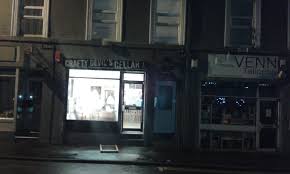
The Beard Liberation Front, the informal network of beard wearers, has said that the contest for the Beard Friendly Pub of the Year has concluded with the Crafty Devil Beer Cellar in Cardiff bearding the Cloudwater brewery tap in Manchester for the UK (outside of London) title
The Cock Tavern in Hackney won the overall poll but the result of the on-line vote saw a major new development with Brewery Taps- where drinkers socialise at the breweries themselves- coming second and third in the overall national vote.
The winners in 2016 included the Jolly Butchers in Stoke Newington, the Cock Tavern in central Hackney and the Bag of Nails in Bristol
Beard Friendly Pub, Bar, Tap 2017
UK
1 Crafty Devil Beer Cellar, Cardiff
2 Cloudwater Brewery Tap, Manchester
View original post 308 more words
Paddy’s Market
Posted in Biographical on January 14, 2017 by telescoperWhen I was a kid my Mum would use the expression “Paddy’s Market” quite often, to describe a messy, chaotic place e.g.
Tidy up your bedroom! It’s like Paddy’s Market!
Actually, that’s not so much an “e.g.” as an “invariably”.
Anyway, I always assumed that “Paddy’s Market” was a well-known term, but later began to think it wasn’t used very much at all in the Big Wide World.
The name “Paddy’s Market” clearly derives from the name of a place in Glasgow, which is perhaps testament to my family’s Scottish connections but it may be commonplace on Tyneside (where I was born) and even elsewhere. I just don’t know how widespread is its use.
Anyone out there in the blogosphere care to comment?
Follow @telescoperHow Long Blues – Jimmy Yancey
Posted in Jazz with tags How Long Blues, Jimmy Yancey on January 13, 2017 by telescoperOver the past weeks I’ve been posting tracks by the legendary pianist Jimmy Yancey. They seem to have proved quite popular, so here’s another one. This differs from the others (which were in the boogie-woogie style) in being a slow blues rather than an up-tempo boogie-woogie romp. It’s quite an old song, dating back to 1928, of which many versions have been made over the years, but this is an atmospheric masterpiece that shows what a superb interpreter of the blues Jimmy Yancey was. That gently rocking left hand and the beautiful articulation of the right hand seem to underline the sense of loss conveyed in the lyrics to the song, which is about a man whose lover who has left him:
Heard the whistle blowin’, couldn’t see no train
Way down in my heart, I had an achin’ pain
How long, how long, baby how long
You won’t hear many better – or more haunting – performances the blues than this. And who cares if there’s a bit of surface noise on the record?
Follow @telescoperLobachevksy – Tom Lehrer
Posted in Music with tags Lobachevsky, Plagiarism, Tom Lehrer on January 13, 2017 by telescoperWhy Universities should ignore League Tables
Posted in Bad Statistics, Education with tags Academic Ranking of World Universities, Higher Education Policy Institute, League Tables, QS World University Rankings, rankings, THE World University Rankings on January 12, 2017 by telescoperVery busy day today but I couldn’t resist a quick post to draw attention to a new report by an independent think tank called the Higher Education Policy Institute (PDF available here; high-level summary there). It says a lot of things that I’ve discussed on this blog already and I agree strongly with most of the conclusions. The report is focused on the international league tables, but much of what it says (in terms of methodological criticism) also applies to the national tables. Unfortunately, I doubt if this will make much difference to the behaviour of the bean-counters who have now taken control of higher education, for whom strategies intended to ‘game’ position in these, largely bogus, tables seem to be the main focus of their policy rather than the pursuit of teaching and scholarship, which is what should universities actually be for.
Here is the introduction to high-level summary:
Rankings of global universities, such as the THE World University Rankings, the QS World University Rankings and the Academic Ranking of World Universities claim to identify the ‘best’ universities in the world and then list them in rank order. They are enormously influential, as universities and even governments alter their policies to improve their position.
The new research shows the league tables are based almost exclusively on research-related criteria and the data they use are unreliable and sometimes worse. As a result, it is unwise and undesirable to give the league tables so much weight.
Later on we find some recommendations:
The report considers the inputs for the various international league tables and discusses their overall weaknesses before considering some improvements that could be made. These include:
- ranking bodies should audit and validate data provided by universities;
- league table criteria should move beyond research-related measures;
- surveys of reputation should be dropped, given their methodological flaws;
- league table results should be published in more complex ways than simple numerical rankings; and
- universities and governments should not exaggerate the importance of rankings when determining priorities.
No doubt the purveyors of these ranking – I’ll refrain from calling them “rankers” – will mount a spirited defence of their business, but I agree with the view expressed in this report that as they stand these league tables are at best meaningless and at worst damaging.
Follow @telescoperBayesian weak lensing tomography: Reconstructing the 3D large-scale distribution of matter with a lognormal prior [CEA]
Posted in Uncategorized on January 11, 2017 by telescoperBayesian and Lognormal! How could I resist a reblog of this arXiver post?

http://arxiv.org/abs/1701.01886
We present a Bayesian reconstruction algorithm that infers the three-dimensional large-scale matter distribution from the weak gravitational lensing effects measured in the image shapes of galaxies. The algorithm assumes that the prior probability distribution of the matter density is lognormal, in contrast to many existing methods that assume normal (Gaussian) distributed density fields. We compare the reconstruction results for both priors in a suite of increasingly realistic tests on mock data. We find that in cases of high noise levels (i.e. for low source galaxy densities and/or high shape measurement uncertainties), both normal and lognormal priors lead to reconstructions of comparable quality. In the low-noise regime, however, the lognormal model produces significantly better reconstructions than the normal model: The lognormal model 1) enforces non-negative densities, while negative densities are present when a normal prior is employed, 2) better traces the extremal values and the skewness of the true underlying…
View original post 66 more words
Status of Dark Matter in the Universe [CEA]
Posted in The Universe and Stuff with tags Cosmology, dark matter on January 11, 2017 by telescoperCourtesy of arXiver, here’s a nice review article if you want to get up to date with the latest ideas and evidence about Dark Matter…
http://arxiv.org/abs/1701.01840
Over the past few decades, a consensus picture has emerged in which roughly a quarter of the universe consists of dark matter. I begin with a review of the observational evidence for the existence of dark matter: rotation curves of galaxies, gravitational lensing measurements, hot gas in clusters, galaxy formation, primordial nucleosynthesis and cosmic microwave background observations. Then I discuss a number of anomalous signals in a variety of data sets that may point to discovery, though all of them are controversial. The annual modulation in the DAMA detector and/or the gamma-ray excess seen in the Fermi Gamma Ray Space Telescope from the Galactic Center could be due to WIMPs; a 3.5 keV X-ray line from multiple sources could be due to sterile neutrinos; or the 511 keV line in INTEGRAL data could be due to MeV dark matter. All of these would require further confirmation in other experiments…
View original post 92 more words
Collapse at Sophia Gardens
Posted in Cardiff, History with tags Cardiff, Sophia Gardens, Sophia Gardens Pavilion on January 10, 2017 by telescoperIf the title of this post attracted the attention of cricket fans then I apologize, because it’s not about goings-on at the SWALEC Stadium in Cardiff but at the Sophia Gardens Pavilion which no longer exists (for reasons which will become obvious) but was an entertainment and exhibition venue built in 1951 as part of the Festival of Britain celebrations. You can see a (rather hilarious) Pathé News item about a fashion show held there in 1952 here. It was also the venue in 1958 for the Empire and Commonwealth Games, held between July 18 and 26th, for boxing and wrestling matches. Owing to post-war austerity, the supply of building materials was heavily controlled so it was necessary to adapt a war surplus aeroplane hangar to provide the framework for the Pavilion. The hangar was obtained from Stormy Down aerodrome near Pyle, Bridgend in late 1949. The cost of dismantling and transporting it was £3,400 and rebuilding it in Sophia Gardens was estimated to cost £40,000. The Pavilion when completed seated approximately 2,500 people, and the final cost of construction was £80,000. It was opened officially on Friday 27th April 1951.
I was about to leave the office just now when I was reminded – by Derek The Weather – that at this time of year in 1982 (i.e. 35 years ago) Cardiff was in the grip of exceptionally severe weather. In fact it started snowing heavily on 7th January and carried on for 48 hours without a pause. It snowed so heavily, in fact, that the weight of snow caused the roof of the Sophia Gardens Pavilion to collapse:
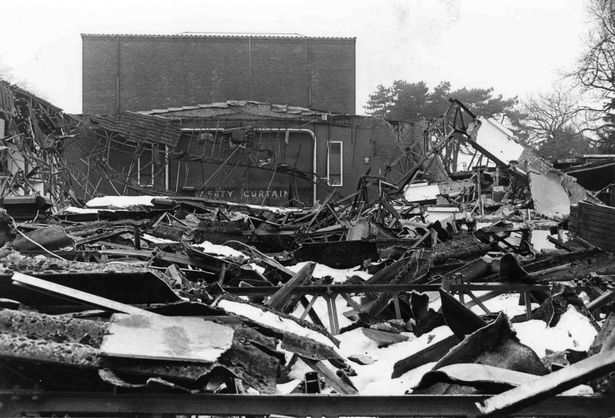
Fortunately no-one was inside. After the roof collapsed the Pavilion was demolished and the land it stood on is now a car park (a little way South of the cricket ground). I don’t know precisely when this event occurred, but it had happened by 13th January 1982. I know this because he collapse of the building led to the cancellation of a concert due to take place there on 13th January 1982 by Black Sabbath, which is apparently a popular beat combo of some sort.
Anyway, it looks like we’re due for some snow in the UK over the next few days although perhaps not in Cardiff and perhaps not heavy as 1982. Strangely, I have no memory of 1982 being a particularly severe winter. I was living in Newcastle at the time, but the weather maps suggest the severe conditions covered most of the country.
Follow @telescoper
 In the Dark