Fascinating insight into Cardiff’s international heritage..
Cyfarchion yr Ŵyl
Posted in Uncategorized on December 23, 2016 by telescoperWell, Cardiff University is about to close down for the Christmas break, and I’ll also be going offline for a while from this afternoon.
I’d just like to take this opportunity to thank everyone who has taken the trouble to read, comment on, correct, and otherwise engage with this blog over the past year.
I can’t say it’s been a great year, but let’s cling to the hope that 2017 will be better than 2016 however unlikely that may seem at the moment.
Anyway, I hope you have a peaceful and enjoyable festive season!
Cyfarchion yr Ŵyl i chi gyd!
(That’s Welsh..)
Follow @telescoper
The Young Charlie Parker plays Cherokee
Posted in Jazz with tags bebop, Charlie Parker, Cherokee, Ko-ko, Musician's Strike 1942-1944 on December 22, 2016 by telescoperI came across this rare treasure on Youtube and couldn’t resist sharing it here. It features a very young Charlie Parker, with the relatively unknown Efferge Ware on guitar and Little Phil Phillips on drums, playing the jazz standard Cherokee. This track was recorded in 1941 (when he was only 21 years old) in Bird’s home town of Kansas City. There is a gap in Charlie Parker’s discography between 1942 and 1944, which was when the American Musicians Union called a strike which led to a ban on all commercial recordings. When the ban game to an end Charlie Parker’s recordings with Dizzy Gillespie, Max Roach, Bud Powell and others unleashed the new harmonic language of bebop on the general public from New York City where it had been incubating during the strike. Parker’s style had evolved greatly in the intervening two years which no doubt made his playing sound all the more revolutionary when the ban was lifted. Although this version of Cherokee is to some extent a pre-bebop recording, you can hear the originality and beauty of Bird’s improvisation (complete with cheeky quotation from the “Popeye” theme) and it’s clear where he was heading.
The sophisticated and complex chord sequence of Cherokee (with its trademark ii-7–V7–I progressions) made it a firm favourite with bop musicians who tended to play it even faster than this earlier version.
In 1945, during what was arguably the first ever bebop recording session, Charlie Parker and Dizzy Gillespie decided to play a variation of Cherokee using the same chords but a different head. During the first take the musicians absent-mindedly played the theme from Cherokee at which point there was a cry of anguish from the control room uttered by a producer, who obviously had hoped that if they stayed off the actual tune he wouldn’t have to pay composer’s royalties. They started again, made another take, called it Ko-Ko, and it became one of the classics.
The 1941 version is valuable from a historical perspective but you don’t have to be interested in that to enjoy the wonderful fluidity and invention of Bird’s playing. Happy Christmas!
Follow @telescoperThe Winter Solstice and the Time of Sunrise and Sunset
Posted in The Universe and Stuff with tags Analemma, Equation of Time, Mean Time, Sunrise, Sunset, Winter Solstice on December 21, 2016 by telescoperYou may have missed it, but the winter solstice happened today, Wednesday 21st December 2016, at 10.44am GMT (10.44 UTC). This marks the shortest day of the year: days will get longer from now until the Summer Solstice next June. As we were discussing in the pub last night, however, this does not mean that sunrise will happen earlier tomorrow than it did this morning. In fact, sunrise will carry on getting later until the new year. This is because there is a difference between mean solar time (measured by clocks) and apparent solar time (defined by the position of the Sun in the sky), so that a solar day does not always last exactly 24 hours. A description of apparent and mean time was given by Nevil Maskelyne in the Nautical Almanac for 1767:
Apparent Time is that deduced immediately from the Sun, whether from the Observation of his passing the Meridian, or from his observed Rising or Setting. This Time is different from that shewn by Clocks and Watches well regulated at Land, which is called equated or mean Time.
The discrepancy between mean time and apparent time arises because of the Earth’s axial tilt and the fact that it travels around the Sun in an elliptical orbit in which its orbital speed varies with time of year (being faster at perihelion than at aphelion).
In fact if you plot the position of the Sun in the sky at a fixed time each day from a fixed location on the Earth you get a thing called an analemma, which is a sort of figure-of-eight shape whose shape depends on the observer’s latitude. Here’s a photographic version taken in Edmonton, with photographs of the Sun’s position taken from the same position at the same time on different days over the course of a year:
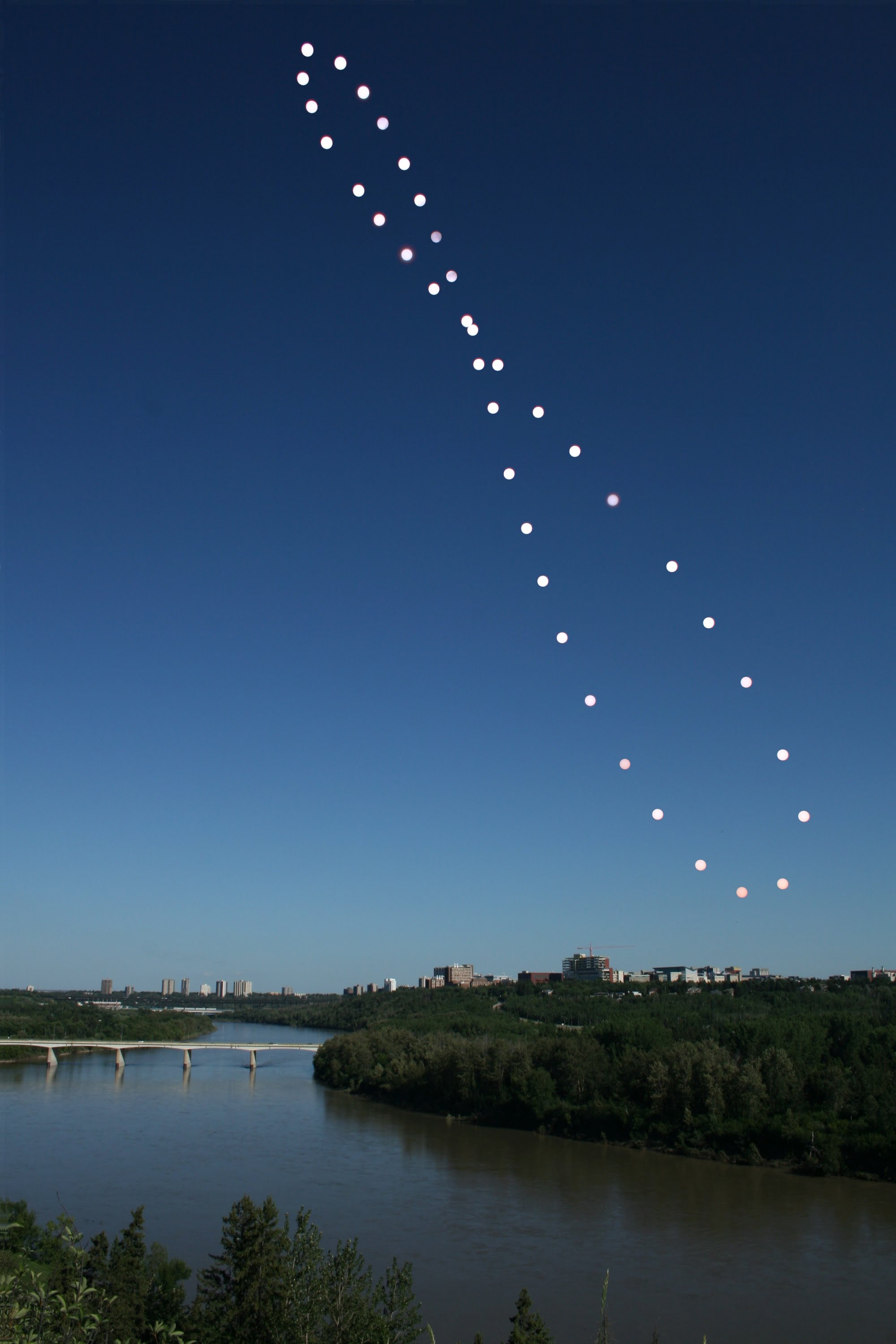
The winter solstice is the lowermost point on this curve and the summer solstice is at the top. The north–south component of the analemma is the Sun’s declination, and the east–west component is the so-called equation of time which quantifies the difference between mean solar time and apparent solar time. This curve can be used to calculate the earliest and/or latest sunrise and/or sunset.
Using a more rapid calculational tool (Google), I found a table of the local mean times of sunrise and sunset for Cardiff (where I live) around the 2016 winter solstice. The table shows that today is indeed the shortest day (with a time between sunrise and sunset of 7 hours 49 minutes and 55 seconds). The duration of the shortest day this year is 8 hours and 48 minutes shorter than the longest day (the summer solstice). The table also shows that sunset already started occurring later in the day before the winter solstice (although the weather has been too overcast to notice this), and sunrise will continue to happen later for a few days after the solstice. In fact the earliest sunset this year in Cardiff was on 12th December, and the latest sunrise will be on 30th December.
I hope this clarifies the situation.
Follow @telescoperStraw Poll on Statistical Computing
Posted in Bad Statistics, The Universe and Stuff with tags Python, R, statistical computing on December 20, 2016 by telescoperThe abstract of my previous (reblogged) post claims that R is “the premier language of statistical computing”. That may be true for the wider world of statistics, and I like R very much, but in my experience astronomers and cosmologists are much more likely to do their coding in Python. It’s certainly the case that astronomers and physicists are much more likely to be taught Python than R. There may well even be some oldies out there still using other languages like Fortran, or perhaps relying on books of statistical tables!
Out of interest therefore I’ve decided to run the following totally biased and statistically meaningless poll of my immense readership:
If you choose “something else”, please let me know through the comments box what your alternative is. I can then add additional options.
Follow @telescoper
The changing landscape of astrostatistics and astroinformatics [IMA]
Posted in Uncategorized on December 20, 2016 by telescoperHere’s a nice review article about the fields of astrostatistics and astroinformatics. The author, Eric Feigelson, points out that training for astronomers in these areas is relatively weak, and that’s why we at Cardiff are going to launch a couple of new Masters courses in the New Year to provide specialist postgraduate education in these and related topics!

http://arxiv.org/abs/1612.06238
The history and current status of the cross-disciplinary fields of astrostatistics and astroinformatics are reviewed. Astronomers need a wide range of statistical methods for both data reduction and science analysis. With the proliferation of high-throughput telescopes, efficient large scale computational methods are also becoming essential. However, astronomers receive only weak training in these fields during their formal education. Interest in the fields is rapidly growing with conferences organized by scholarly societies, textbooks and tutorial workshops, and research studies pushing the frontiers of methodology. R, the premier language of statistical computing, can provide an important software environment for the incorporation of advanced statistical and computational methodology into the astronomical community.
E. Feigelson
Tue, 20 Dec 16
14/88
Comments: 7 pages, to appear in ‘Astroinformatics’, IAU Symposium #325, M. Brescia et al. (eds.), Cambridge University Press (2017)
Meaning, by Czeslaw Milosz
Posted in Poetry with tags Czeslaw Milosz, Meaning, Poetry on December 19, 2016 by telescoperWhen I die, I will see the lining of the world.
The other side, beyond bird, mountain, sunset.
The true meaning, ready to be decoded.
What never added up will add Up,
What was incomprehensible will be comprehended.
– And if there is no lining to the world?
If a thrush on a branch is not a sign,
But just a thrush on the branch? If night and day
Make no sense following each other?
And on this earth there is nothing except this earth?
– Even if that is so, there will remain
A word wakened by lips that perish,
A tireless messenger who runs and runs
Through interstellar fields, through the revolving galaxies,
And calls out, protests, screams.
by Czeslaw Milosz (1911-2004)
This poem was read during yesterday’s excellent Words and Music on BBC Radio 3, which was on the theme “Encoded”, which is available on iPlayer.
Follow @telescoper
Memories of Clem Avery
Posted in Biographical, Jazz with tags Clem Avery on December 19, 2016 by telescoperAll the talk about trumpets last week reminded me of an old family friend by the name of Clem Avery. There’s a very nice tribute to Clem on a website run by guitarist Roly Veitch (whence I got the photographs).
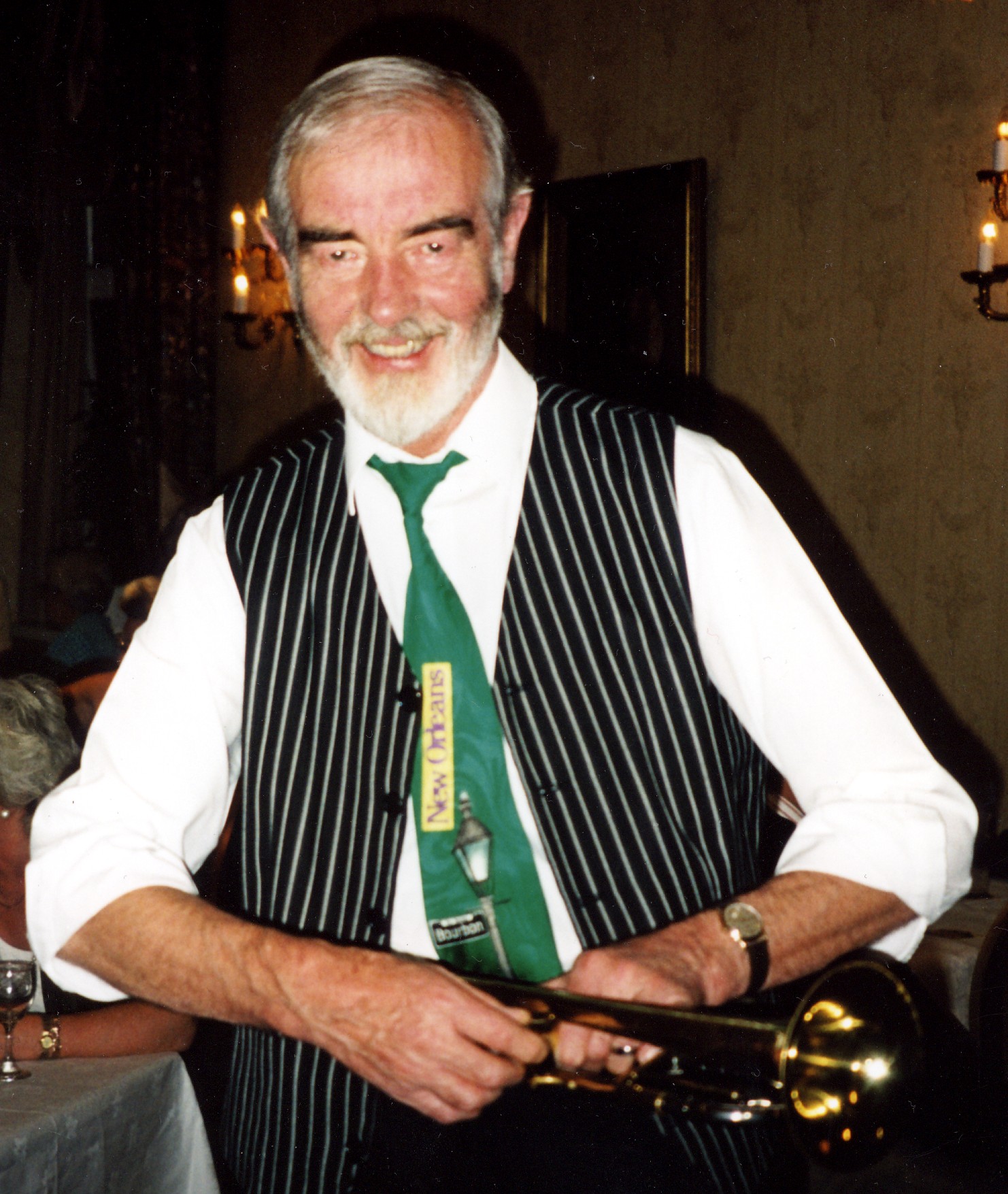
Clem Avery (1933-2008)
Clem, who passed away in November 2008, was a very close friend of my father who died just a year earlier in 2007. They had known each other since at least the early 60s and had played music together on many occasions (Clem on trumpet and, in later years, bass and my father on drums). That they remained good friends for such a long time is a bit surprising since at one point Clem actually sacked my Dad from his band for being too heavy-handed on the cymbals. Having heard my father play on a few occasions I think Clem probably had a point. But Clem wasn’t the sort of person you could really fall out with for long, and their friendship survived this musical falling-out.
We did try to get Clem to come to my Dad’s funeral but he couldn’t make it. I think it was because he was already suffering from the cancer that would eventually take him.
Roly’s web tribute mentions a long-term residency at the Golden Lion pub in Winlaton during the 70s and 80s in which my Dad (real name Alan) is mentioned under his nickname “Chas”. I heard the band play there on a couple of occasions and they were really good, the presence of Roly Veitch’s (electric) jazz guitar giving them a refreshingly different sound to many other traditional bands.
I can’t add much to Roly’s piece other than to endorse what he wrote about Clem. Firstly that he was a very accomplished musician who had a far better technique than many much more famous trumpeters. His style was very firmly based on that of Bunk Johnson, though he appreciated good music of many other kinds. As well as playing the jazz that he loved, he also worked as a music teacher and, from time to time, as a session musician. I even saw him on The Tube once (the TV programme, not the London Underground)! When he played trumpet his eyebrows had a tendency to move up and down in coordination. When they were at maximum elevation he looked a lot like Stan Laurel (at least in younger years before he grew a beard). Here is an old picture that makes that comparison a bit easier to imagine:

What I remember most about Clem, however, was just that he was an extraordinarily nice man. He was tall and rather thin with a thoughtful disposition, a wonderfully laid back attitude to life and a fine dry sense of humour. He was very knowledgeable about many things besides music too. I often sat talking with him in my Dad’s shop in Benwell (where Clem worked on a part-time basis for a while). History (especially local history) was a speciality of his and he was never short of stories to tell.
Follow @telescoperA Bit of Hummel Again
Posted in Music with tags Johann Nepomuk Hummel, Tine Thing Helseth, trumpet on December 16, 2016 by telescoperSince I was recently wittering on about trumpets I thought I’d share again my favourite bit from my favourite trumpet work. It’s the central Andante movement of a Trumpet Concerto by Johann Nepomuk Hummel which was written in 1803 and was one of the first major works to be composed for the (then) recently-invented keyed trumpet. The piece was originally written in E major, but is often performed nowadays in E-flat major, as in this recording, which makes the fingering less difficult on modern E-flat and B-flat trumpets.
In his own lifetime Hummel was every bit as famous as Haydn and Beethoven; he was a pallbearer at the latter’s funeral, in fact. He died in 1837 with his musical reputation apparently secure, but was quickly forgotten. Always a bit overshadowed by Mozart, when the romantic era dawned Hummel’s classical style was considered extremely old-fashioned. It’s just another illustration of a fact that applies not only in music but also in many different spheres of activity: popularity in one’s own lifetime is by no means certain to turn into renown thereafter.
I have posted this piece of music before but listening to it today something struck me that hadn’t done so before, namely that parts of the writing for strings in this movement are very reminiscent of the second (Andante) movement of Mozart’s Piano Concerto No. 21 in C Major (known to many as the “Elvira Madigan” music).
I don’t usually like the sound of the classical trumpet that much- I prefer the broader and more expressive way the instrument is used in Jazz, whether it’s the brassy brilliance of Dizzy Gillespie or the moody melancholia of Miles Davis – but this piece is really lovely, especially when played with beautiful clarity by Norwegian trumpeter Tine Thing Helseth.
Follow @telescoper

 In the Dark