Dunes on Mars

Posted in Art, The Universe and Stuff with tags , , , , on November 21, 2016 by telescoper

dunes

This isn’t a new picture, but I hadn’t seen it before a friend put in on their Facebook page at the weekend. It isn’t what I first thought it was – a wonderful piece of abstract art – but is, in fact, an equally wonderful photograph of the inside of the Bunge crater on Mars, where a complex pattern of dunes has formed through wind action. The area covered by the image is about 14 kilometers wide.

According to the official NASA webpage: “This image was taken in January 2006 by the Thermal Emission Imaging System instrument on NASA’s Mars Odyssey orbiter and posted in a special December 2010 set marking the occasion of Odyssey becoming the longest-working Mars spacecraft in history.”

Magnets, Data Science and the Intelligent Pig

Posted in Biographical, The Universe and Stuff with tags , , , , , on November 18, 2016 by telescoper

The other day I was talking to some colleagues in the pub (as one does). At one point the subject of conversation turned to the pressure we academics are under these days to collaborate more with the world of industry and commerce. That’s one of the things that the Cardiff University Data Innovation Research Institute – which currently pays half my wages  – is supposed to do, but there was general consternation when I mentioned that I have in the past spent quite a long time working in industry. I am, after all, Professor of Theoretical Astrophysics. Of what possible interest could that be to industry?

My time in industry was spent at one of the research stations of British Gas, called the On-Line Inspection Centre (“OLIC”) which was situated in Cramlington, Northumberland. I started work there in 1981, just after I’d finished my A-levels and the Cambridge Entrance Examination and I worked there for about 9 months, before leaving to start my undergraduate course in 1982. At that time British Gas was still state-owned, and one of the consequences of that was that I had to sign the Official Secrets Act when I joined the staff. Among other things that forbade me from making “unauthorized disclosures” of what I was working on for thirty years. I feel comfortable discussing that work now, partly because the thirty years passed some time ago and partly because OLIC no longer exists. I’m not sure exactly what happened to it, but I presume it got flogged off on the cheap when British Gas was privatized during the Thatcher regime.

The main activity of the On-Line Inspection Centre was developing and exploiting techniques for inspecting gas pipelines for various forms of faults. The UK’s gas transmission network comprises thousands of kilometres of pipelines, made from steel in sections joined together by seam welds. I always thought of it as like a road network: the motorways which were made of 36″ diameter pipes; the A-roads were of smaller, 24″, diameter; and the minor roads were generally made of 12″ pipes. It’s interesting that despite the many failings of my memory now that I’ve reached middle age, I can still remember the names of some of the routes: “Huddersfield to Hopton Top” and “Seabank to Frampton Cotterell” spring immediately to mind.

Anyway, as part of the Mathematics Group at OLIC my job was to work on algorithms to analyse data from various magnetic inspection vehicles. These vehicles – known as “pigs” – were of different sizes to fit snugly  in the various pipes. The term “pig” had originally been applied to simple devices used to clean the gunk from inside of a pipe. They were just put in one end of the line and  gas pressure would push them all the way to the other end, often tens of kilometres away. The pipeline could thus be cleaned without taking it out of service.

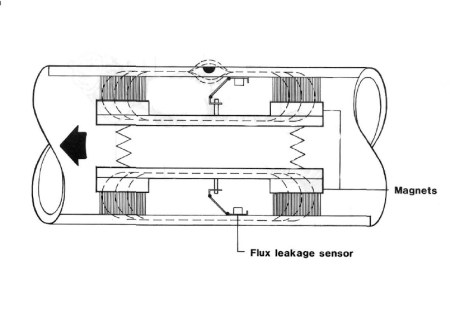
This basic idea was modified to produce the much more sophisticated “intelligent pig” which produced the data I worked on. You can read much more about this here. This looked very similar to the cleaning pig, but had a complicated assembly of magnets and sensors, shown schematically here:
pig

The two sets  of magnets are connected to the pipe wall by steel brushes to maintain good contact. The magnetic field applied by the front set of magnets is contained within the pipe wall forms a kind of circuit with the rear set as shown, unless there is a variation in the thickness of the material. In that case magnetic flux leaks out and is detected by the sensors. The magnets and sensors are deployed in rings to cover the whole circumference of the pipe. A 24″ diameter pig would have 240 sensors, each recorded as a separate channel on the vehicle.

The actual system is fairly complicated so some of the work was experimental. Sections of pipe were made with defects of various sizes machined into them. The pig would then be pulled through these sections and the signals studied to build up an understanding of how the magnetic field would respond in different situations.

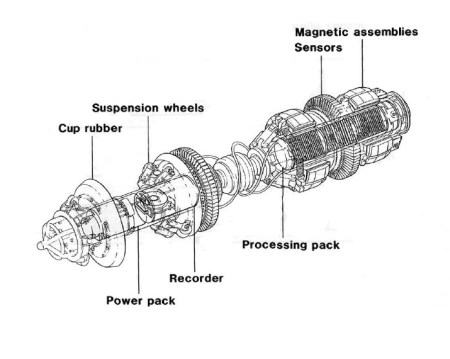
The actual pig (which could be several metres long and weighing a couple of tonnes) looks like this:
pig2

I always thought they looked a bit like spacecraft.

The pig usually travels at something like walking pace along the pipeline, and the sampling rate of the sensors was such that a reading would be taken every few millimetres. That sampling rate was necessary because corrosion pits as small as 1cm across could be dangerous.  The larger vehicles had “on-board thresholding” so that recordings of quiescent sections were discarded. Even so pipe surfaces (especially those of smaller bore) could be uneven for various reasons to do with their production rather than the effects of corrosion. Moreover, every few metres there would be a circumferential seam weld where two sections of pipe were joined together; these features would produce a large signal on all channels which the thresholding algorithm did not suppress.  The net result was that a lot of data had to be stored on the vehicle. When I say “a lot”, I mean for that time. A full run might produce about 5 × 107 readings. That seems like nothing now, but it was “Big Data” in those days!

So how was all this data processed back at the station? You probably won’t believe this, but it was printed out on Versatec printers in the form of a chart recording for each channel. Operators then identified funny-looking signals by eye and we then pulled down the data from tape and had a further look, usually comparing the patterns visually with those obtained from “pull-through” experiments.

Among the things I worked on was an algorithm to recognize seam weld signals automatically. That was quite easy actually – because it just requires looking for simultaneous activity on all channels – although it had to be made robust enough to deal with the odd dead channel and other instrumental glitches. This algorithm proved to be useful because sometimes the on-board telemetry would go wrong and we had to locate the pig by counting the number of welds it had passed since the start of the run.

A far more difficult challenge was dealing with data from 12″ diameter pipe. These are manufactured in a way that’s completely different from that used to make pipes of larger diameter, which are made of rolled steel. The 12″ pipes were made from a solid plug of molten steel, the centre of which is bored out by a device that rotates as it goes along. The effect of this is that it imposes a peculiar form of variation on the pipe wall, in the form of a spirally modulated “noise”. Annoyingly, the pitch and amplitude of the spiral varied from one section of pipe to another. After many failed attempts, the group finally came up with an algorithm that used the weld detector as a starting point to establish the vehicle had entered a new section of pipe. It then used data from the start of each section to estimate the parameters of the spiral pattern for that section, and then applied a filter to remove it from the rest of the section. It wasn’t particularly elegant, but it certainly cleaned up the data massively and made it much easier to spot significant features.

You might ask why I’ve written at such length about this when it’s got nothing to do with my current research (or indeed, anything else I’ve done since I graduated from Cambridge in 1985). One reason is that, although I didn’t know it at the time, my time at OLIC was going to prepare me very well for when I started my PhD. That was the case because all the programming I did used VAX computers, which turned out to be the computers used by STARLINK.  When I started my life as a research student I was already fluent in the command language (DCL) as well as the database software DATATRIEVE, which was a great advantage. Another reason is that working in this environment I had to learn to make my code (which, incidentally, was all in Fortran-77) conform to various very strict standards. I didn’t like some of the things we were forced to do, but I was shouted at sufficiently often that I gave up and did what I was told. I have never been particularly good at doing that in general, but in the context of software it is a lesson I’m glad I learned. Above all, though, I think working outside academia gave me a different perspective on research.  As academics were are very lucky to be able- at least some of the time – to choose our own research problems, but I believe that in the long run it can be very for your intellectual development to do something completely different every now and then.

We’re currently discussing a scheme whereby Physics and Astrophysics research students can interrupt their PhD for up to 6 months to undertake a (paid) work placement outside academia. I suspect many graduate students will not be keen on this, as they’ll see it as a distraction from their PhD topic, but I think it has many potential advantages as I hope I’ve explained.


November 18th 1916: The End of the Somme Offensive

Posted in History with tags , , , on November 18, 2016 by telescoper

If you think a lot has happened between this summer and now, it is perhaps worth reflecting on the fact that the Battle of the Somme, which started on July 1st 1916, only came to an end on November 18th 1916, i.e. one hundred years ago today. The last phase of the Somme Offensive was the Battle of the Ancre which lasted from November 13th until November 18th. Though the key objective (of eliminating a German salient) was not met, and casualties were heavy, this battle is considered a qualified success for the British Army, who secured the key position of Beaumont Hamel, though the village itself was almost completely destroyed during the fighting:


beaumont-hamel

The battlefield at Beaumont-Hamel, taken in November 1916

Incidentally, Beaumont-Hamel had seen fighting since the very first day of the Battle of the Somme. On July 1st 1916, 700 men of the Newfoundland Regiment gave their lives there as they went “over the top” and were promptly mown down by machine guns. There is an important memorial to their sacrifice there.

The statistics of the Somme Offensive are truly horrific. In total well over a million men were killed or seriously wounded during the 141 day campaign. By the time it finished the British, French and Commonwealth armies had advanced a maximum of about 6 miles. Most historians describe the outcome as “inconclusive”, largely on the grounds equal numbers of soldiers were slaughtered on each side.  It was a stalemate, but the price paid in blood was appalling.

The carnage didn’t end with the Somme. As the “Great War” stumbled on, battle after battle degenerated into bloody fiasco. Just a year later the Third Battle of Ypres saw another 310,000 dead on the British side as another major assault on the German defences faltered in the mud of Passchendaele. By the end of the War on 11th November 1918, losses on both sides were counted in millions.


Cardiff: Centre of Gravity

Posted in The Universe and Stuff with tags , , , on November 17, 2016 by telescoper

It’s a very busy period for me as the Cardiff University Data Innovation Research Institute (DII) gears up for some exciting new activities in both teaching and research (of which more in due course) and embarks on is strategy for promoting and fostering interdisciplinary research across Cardiff University and beyond.

Yesterday, however, I attended an informal meeting in the School of Physics & Astronomy at which we had an update about other strategic developments in the Gravitational Physics Group, some of whose members work in the DII Following on from the first-ever detection of gravitational waves earlier this year the group has ambitious plans to build on its involvement in this discovery. Here’s a nice short video produced by Cardiff University that discusses this discovery:


Cardiff University has supported research on gravitational waves for a very long time, and it is important that it reaps the benefit now that its investment is starting to pay off. To rest on laurels at this stage would be to risk losing the benefits of that sustained investment. It was very exciting to hear about the group’s plans for further sustained expansion, which will make the Cardiff one of the leading centres of gravitational wave research  in the world.

I’ve already mentioned on this blog that a couple of new positions have already been advertised, one in gravitational wave astronomy (to consolidate existing activities in theory and data analysis) and the other in a completely new area of Gravitational Wave Experimentation. Those advertisements have now closed and the process of filling the vacancies is under way.

However, yesterday we heard of even more expansion of gravitational physics research, in the form of a new academic position in Time Domain Astronomy with particular emphasis on transient sources of electromagnetic radiation that could be associated with gravitational wave production (such as gamma-ray bursts). I’ll post the advertisement on this blog when it is available. And that’s just the start: further positions will be released over the next few years which will turn Cardiff into a true Centre of Gravity.

Exciting times!

Roopa Panesar – Raga Puriya Gat

Posted in Music with tags , , , , , , , on November 16, 2016 by telescoper

Last night I listened to an absolutely fascinating live concert of Indian Classical Music on BBC Radio 3. I know very little about this kind of music, but was captivated by the energy, spontaneity and sense of excitement – not to mention the extreme virtuosity – of the playing. I wish I knew more so I’ve decided to enlist the help of the blogosphere to suggest recordings suitable for the education of an ignorant person like myself. Please offer your suggestions through the comments box below.

In the meantime, though, here is a clip featuring one of the musicians from last night’s concert, Roopa Panesar on sitar (the large stringed instrument) with the amazing Sukhwinder Singh on tabla (the small drums) and Gunwant Kaur on the tanpura. There’s a lot of improvisation in a Raga such as this, which gives it a lot of the freewheeling flavour of Jazz (complete with audience applause at particularly exciting moments) but it inhabits a sound world all of its own and is underpinned by wonderfully fluid rhythmic pulse.

Does the fine structure constant vary?

Posted in The Universe and Stuff with tags , , on November 16, 2016 by telescoper

No.

Your Molecular Structure – R.I.P. Mose Allison

Posted in Jazz on November 16, 2016 by telescoper

R.I.P. Mose Allison (1927-2016)

Midnight Blues

Posted in Jazz with tags , , on November 15, 2016 by telescoper

It’s amazing what you can find on Youtube…

This extraordinary recording of a slow blues was made in 1944. It’s extraordinary for two reasons.

One is that it is far longer than most discs of the time, and was recorded at 33 1/3 rpm rather than the 78 rpm that was usual for the time. The reason why that is extraordinary is that the long-playing record wasn’t introduced until 1948 so this track had to wait about five years until it was released commercially. The sound quality is unusually good for the period and it’s great to hear the musicians stretch out in a way that wasn’t possible on a 78rpm record. Notice also that it’s not just a string of solos, there are duets and ensemble passages , all very characteristic of authentic New Orleans music.

The other extraordinary thing is the band: Bunk Johnson (tpt) Jim Robinson (tmb); George Lewis (clt); Alcide “Slow Drag” Pavegaeu (bss); Lawrence Marrero (bjo); and Warren “Baby” Dodds (dms). Most of these musicians who had grown up in New Orleans but had not joined the mass exodus of great musicians (including  Louis Armstrong) who left for Chicago when Storyville was closed down in 1917. Most of the jazzmen who stayed behind fell into obscurity compared to those who left. Bandleader on this occasion,   Bunk Johnson was a case in point. He was born way back in 1879 and played with some of the legends of early New Orleans Jazz, a connection with history which was enough to make him a sort of “patron saint” of the revivalist movement when he was rediscovered in the 1940s.

One musician who had moved to Chicago (with his brother, clarinettist Johnny Dodds) was Baby Dodds, the first really great Jazz drummer, who had played alongside his brother and Louis Armstrong in  King Oliver’s Band as well as on the glorious Hot Fives and Hot Sevens. His playing is barely audible on most of those old records, but he is heard to good effect on this track.

Anyway, I think it’s a superb performance, dripping with nostalgia for an era of music that would have been lost had it not been for these priceless recordings…


A Question of Morality

Posted in History, Politics with tags , , on November 14, 2016 by telescoper

I floated the following hypothetical question on Twitter yesterday and was quite surprised at the response, so I thought I’d repeat it here and see what the reaction is.

Please make your choice before reading my opinion below the line.

Continue reading

Beard of the Year 2016 poll: Gary Lineker leads longlist of contenders named

Posted in Uncategorized on November 12, 2016 by telescoper

I voted for Moeen, but there’s still time to nominate your favourite for Beard of the Year 2016!

kmflett's avatarKmflett's Blog

Beard Liberation Front

Media Release

11th November

Contact Keith Flett 07803 167266

Beard of the Year 2016 poll: Gary Lineker leads longlist of contenders named

lineker

The Beard Liberation Front the informal network of beard wearers has announced the longlist for the Beard of the Year 2016 poll.

Broadcaster Gary Lineker leads the longlist of contenders

In 2015 Weird Beard brewer Bryan Spooner won the vote.

The campaigners say that the award is specifically not about who has the best or most magnificent beard. Rather it focuses on the beard wearer who has made the most positive hirsute public impact during the year.

With the rise in hirsuteness there is now a longlist poll to prune down the contenders to 10 for the final vote which starts on 25th November. The winner is announced on 29th December.

BLF Organiser Keith Flett said, there is a greater diversity than ever on the…

View original post 64 more words