Archive for Transient Astronomy

Weekly Update from the Open Journal of Astrophysics – 28/03/2026

Posted in OJAp Papers, Open Access, The Universe and Stuff with tags , , , , , , , , , , , , , , , , , , , , , , , , , , , , , , , on March 28, 2026 by telescoper

Once again it’s time for the usual Saturday morning update of activity at the Open Journal of Astrophysics. Since the last update we have published a further eight papers, bringing the number in Volume 9 (2026) to 67 and the total so far published by OJAp up to 515.

I will continue to include the posts made on our Mastodon account (on Fediscience) to encourage you to visit it. Mastodon is a really excellent service, and a more than adequate replacement for X/Twitter (which nobody should be using); these announcements also show the DOI for each paper.

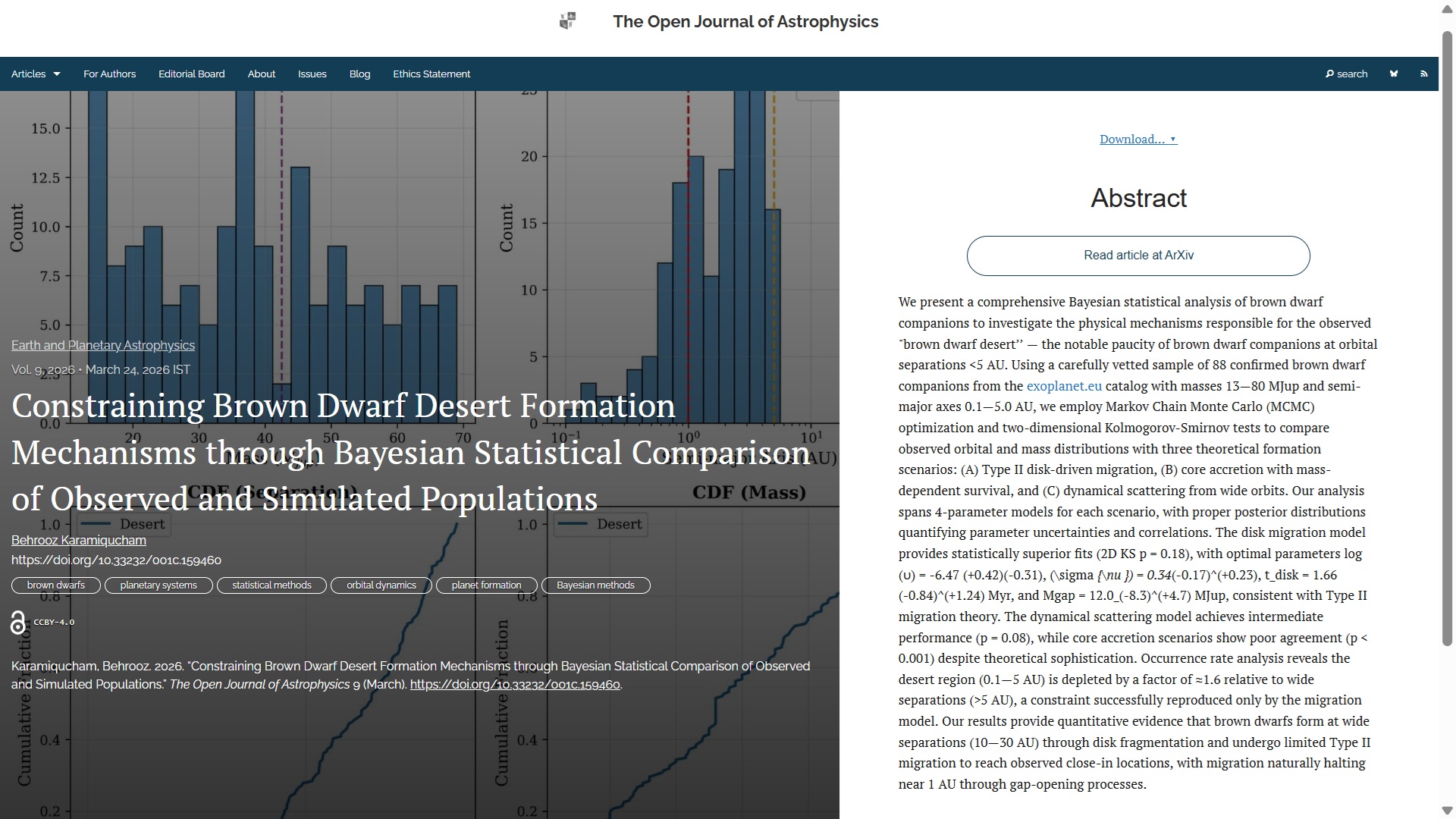
The first paper to report this week is”Constraining Brown Dwarf Desert Formation Mechanisms through Bayesian Statistical Comparison of Observed and Simulated Populations” by Behrooz Karamiqucham (College of Charleston, USA). This paper was published on Tuesday March 24th in the folder Earth and Planetary Astrophysics. It presents a Bayesian statistical analysis exploring why brown dwarf companions are rarely found at orbital separations <5 AU. The results suggest that brown dwarfs form at wider separations then migrate.

The overlay is here:
You can find the officially accepted version on arXiv here and the announcement on Fediverse here:

Open Journal of Astrophysics

New Publication at the Open Journal of Astrophysics: "Constraining Brown Dwarf Desert Formation Mechanisms through Bayesian Statistical Comparison of Observed and Simulated Populations" by Behrooz Karamiqucham (College of Charleston, USA)

doi.org/10.33232/001c.159460

March 24, 2026, 7:10 am 1 boosts 1 favorites

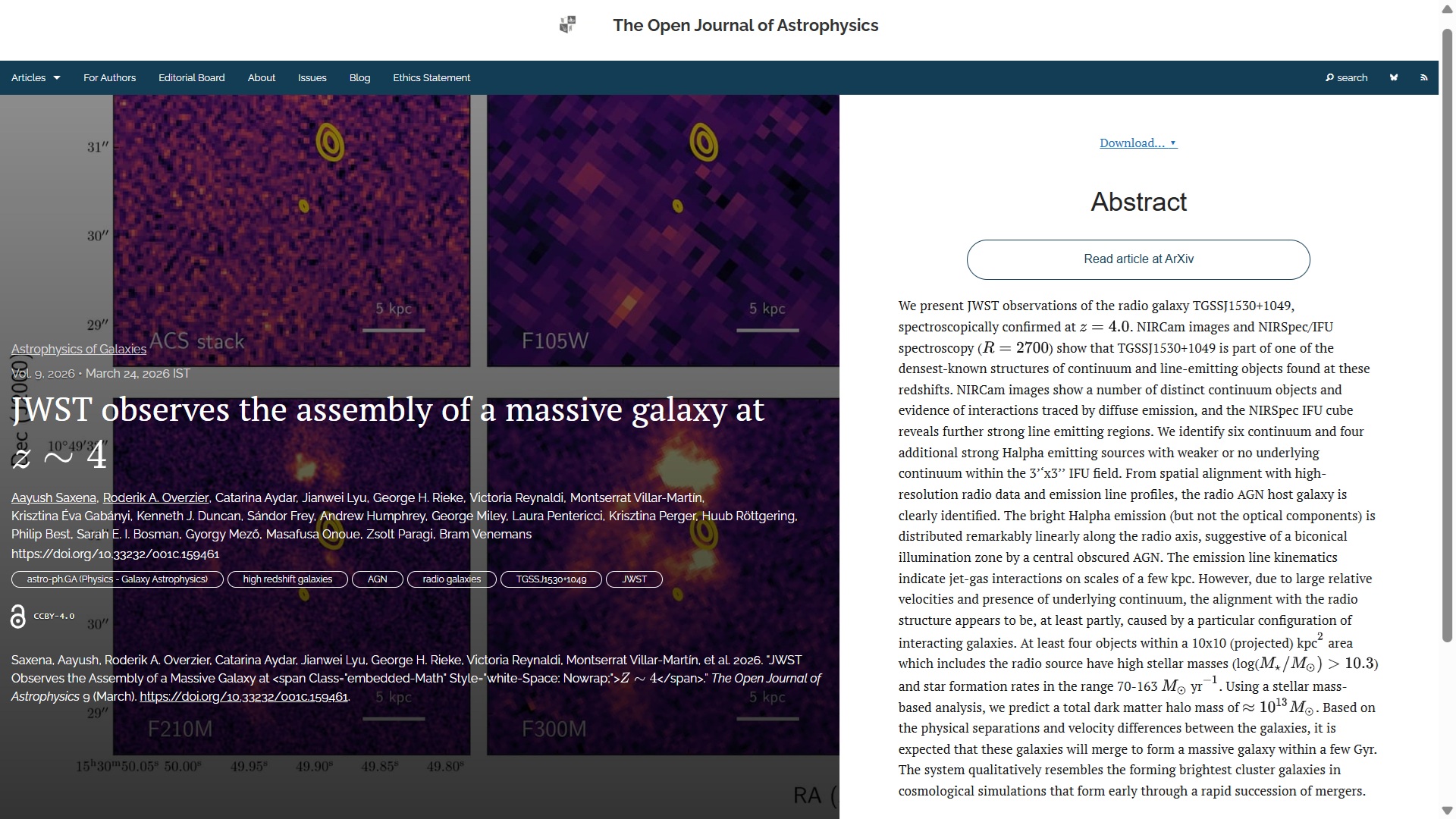
The second paper for this week, also published on Tuesday March 24th, but in the folder Astrophysics of Galaxies, is “JWST observes the assembly of a massive galaxy at z ~ 4” by Aayush Saxena (University of Oxford, UK) and 20 others (based in the UK, Europe, USA, Brazil, Japan and China). The paper presents observations of radio galaxy TGSSJ1530+1049, revealing it as part of a dense structure of emitting objects likely to merge to form a massive galaxy within a few Gyr.

The overlay for this one is here:
The official version of the paper can be found on arXiv here and the Fediverse announcement here:

Open Journal of Astrophysics

New Publication at the Open Journal of Astrophysics: "JWST observes the assembly of a massive galaxy at z ~ 4" by Aayush Saxena (University of Oxford, UK) and 20 others (based in the UK, Europe, USA, Brazil, Japan and China)

doi.org/10.33232/001c.159461

March 24, 2026, 7:25 am 1 boosts 1 favorites

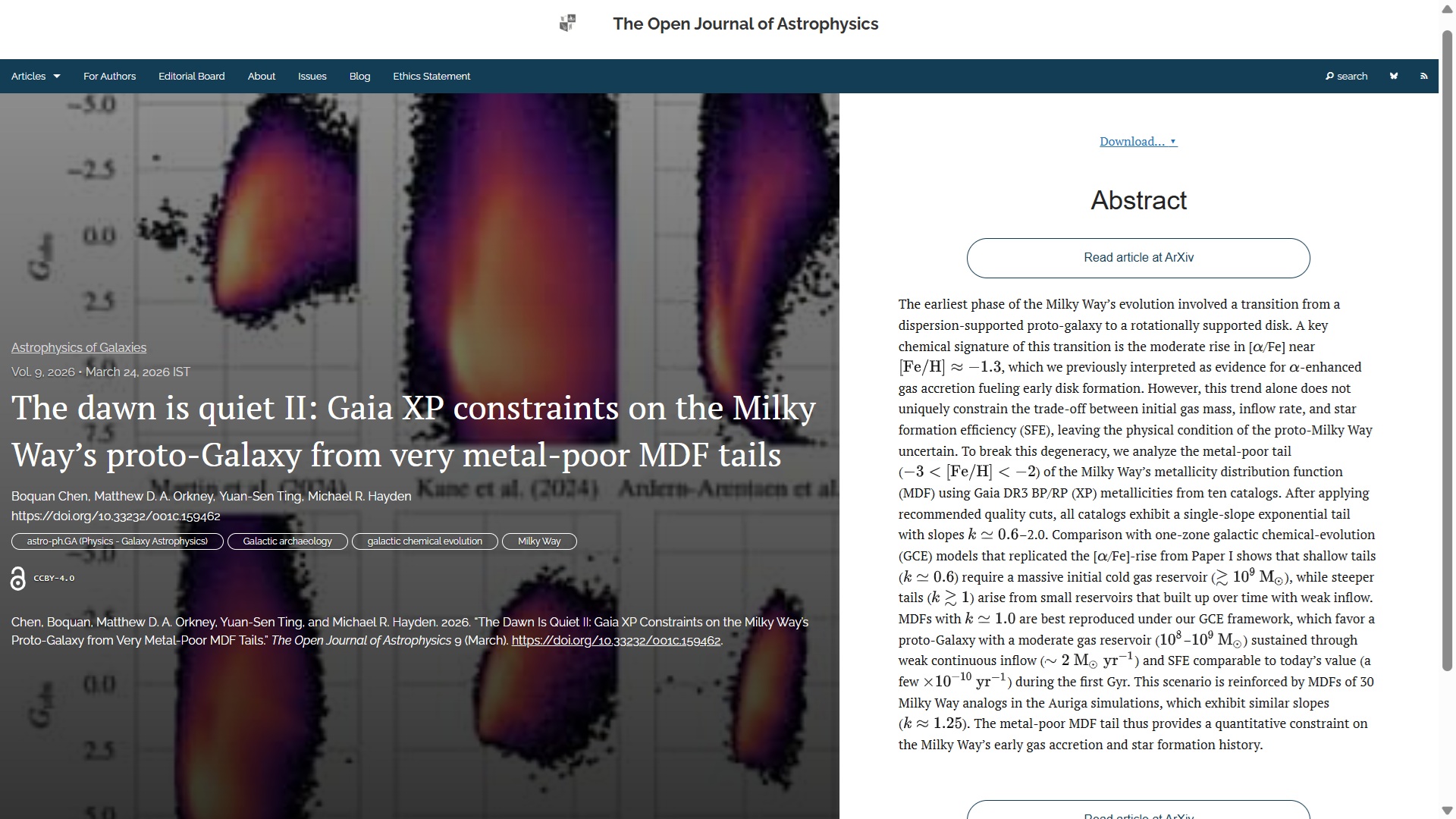
Next one up, the third paper of the week, also published on Tuesday March 24th in the folder Astrophysics of Galaxies, is “The dawn is quiet II: Gaia XP constraints on the Milky Way’s proto-Galaxy from very metal-poor MDF tails” by Boquan Chen (Ohio State U., USA), Matthew D. A. Orkney (Universitat de Barcelona, Spain), Yuan-Sen Ting (Ohio State U.) & Michael R. Hayden (U. Oklahoma, USA). The paper aegues that the Milky Way’s metallicity distribution suggests that its early evolution involved a moderate gas reservoir, sustained by weak continuous inflow, and star formation efficiency similar to the present value.

The overlay for this one is here:
The final, accepted version can be found on arXiv here and the Mastodon announcement is here:

Open Journal of Astrophysics

New Publication at the Open Journal of Astrophysics: "The dawn is quiet II: Gaia XP constraints on the Milky Way’s proto-Galaxy from very metal-poor MDF tails" by Boquan Chen (Ohio State U., USA), Matthew D. A. Orkney (Universitat de Barcelona, Spain), Yuan-Sen Ting (Ohio State U.) & Michael R. Hayden (U. Oklahoma, USA)

doi.org/10.33232/001c.159462

March 24, 2026, 7:41 am 1 boosts 1 favorites

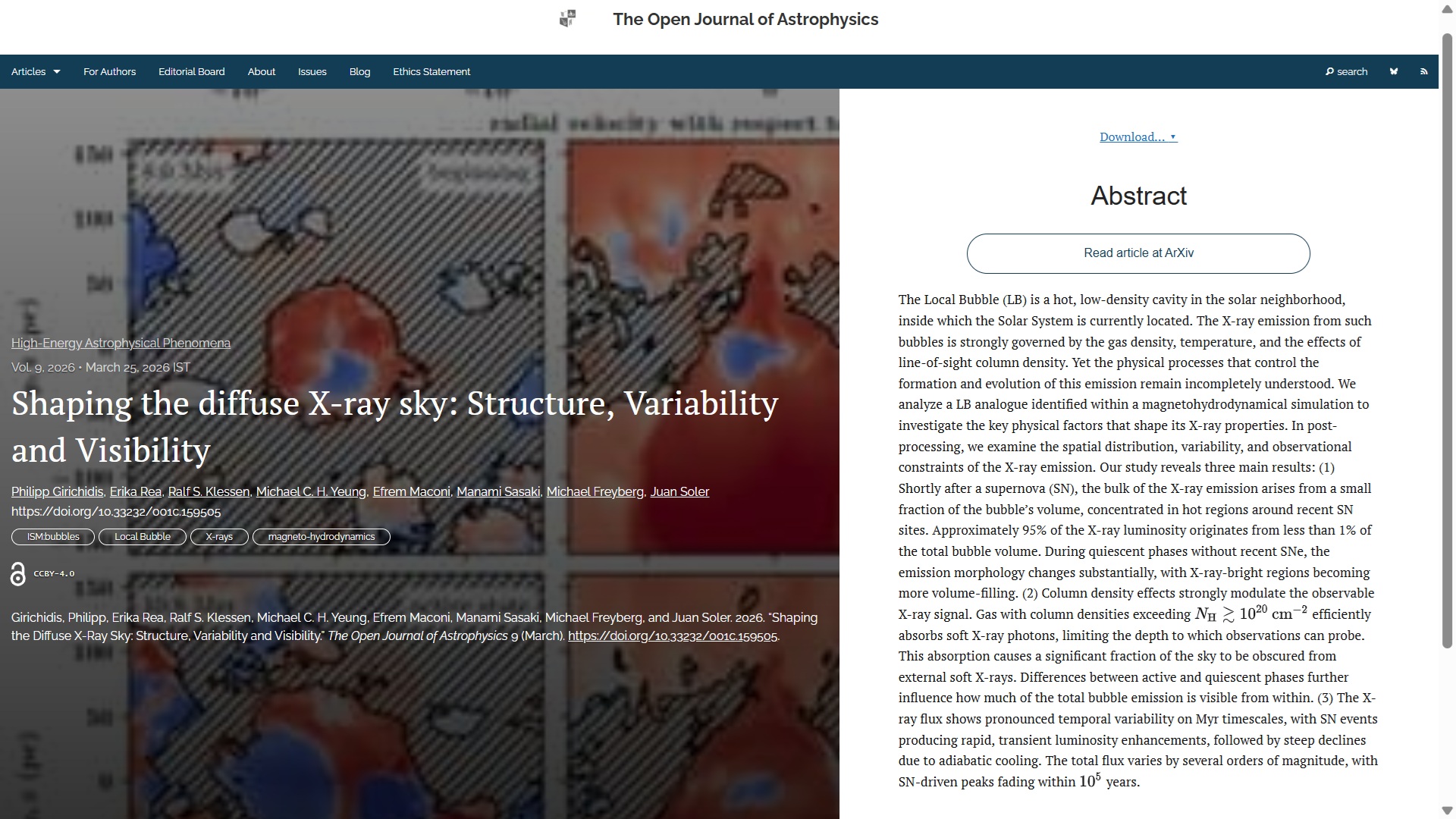
The fourth paper this week, published on Wednesday 25th March 2026 in the folder High-Energy Astrophysical Phenomena is “Shaping the diffuse X-ray sky: Structure, Variability and Visibility” by Philipp Girichidis (Heidelberg U., Germany) and 7 others based in Germany, USA, Austria and Italy. The paper argues that the X-ray properties of the Local Bubble (LB), a low-density cavity in the solar neighborhood reveal that supernova events significantly influence X-ray emissions, which show pronounced temporal variability

The overlay is here:
The finally accepted version of this paper can be found here and the Mastodon announcement is here:

Open Journal of Astrophysics

New Publication at the Open Journal of Astrophysics: "Shaping the diffuse X-ray sky: Structure, Variability and Visibility" by Philipp Girichidis (Heidelberg U., Germany) and 7 others based in Germany, USA, Austria and Italy

doi.org/10.33232/001c.159505

March 25, 2026, 8:40 am 1 boosts 0 favorites

The fifth paper this week, also published on Wednesday 25th March 2026, is “Graph-Based Light-Curve Features for Robust Transient Classification” by Jesús D. Petro-Ramos David J. Ruiz-Morales, David Sierra Porta (Universidad Tecnológica de Bolívar, Colombia). This paper, which is in the folder Instrumentation and Methods for Astrophysics, uses graph-based representations of astronomical light curves for transient classification, achieving competitive multiclass performance, highlighting the potential of visibility graphs as a survey-agnostic tool for classifying time series.

This is the overlay:
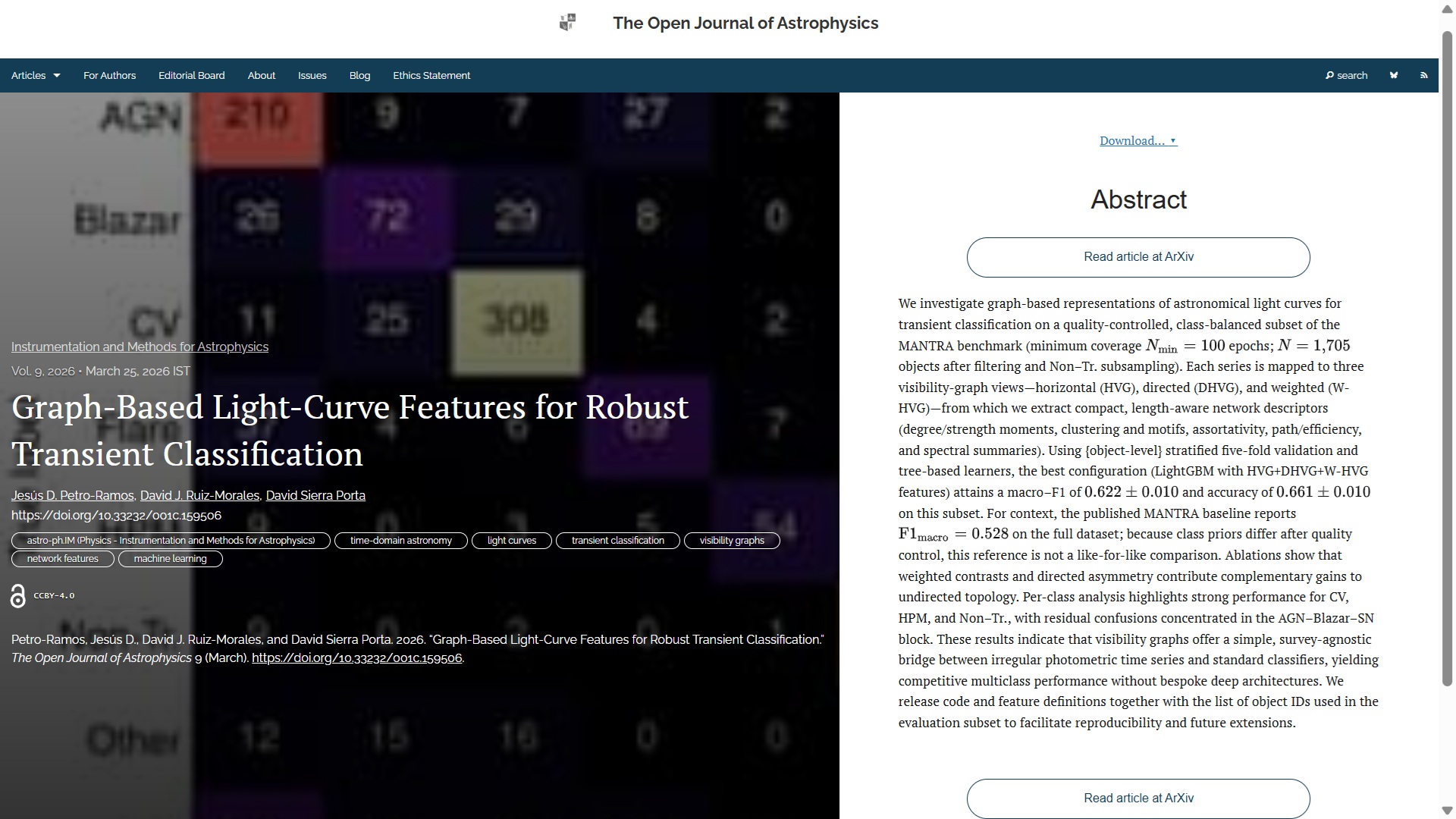
The officially accepted version can be found on arXiv here and the Mastodon announcement follows:

Open Journal of Astrophysics

New Publication at the Open Journal of Astrophysics: "Graph-Based Light-Curve Features for Robust Transient Classification" by Jesús D. Petro-Ramos David J. Ruiz-Morales, David Sierra Porta (Universidad Tecnológica de Bolívar, Colombia)

doi.org/10.33232/001c.159506

March 25, 2026, 8:57 am 1 boosts 1 favorites

The sixth paper this week is “Redshift-Frame Systematics and Their Impact on the Hubble Constant from Pantheon+ Supernovae” by Said Laaroua (Santa Rosa Junior College, USA)This was published on Thursday 26th March in the folder Cosmology and Nongalactic Astrophysics. The study analyzes redshift-frame transformations in the Pantheon+ Type Ia supernova sample, finding a negligible shift in the Hubble constant, thus limiting redshift-frame systematics.

The overlay is here:
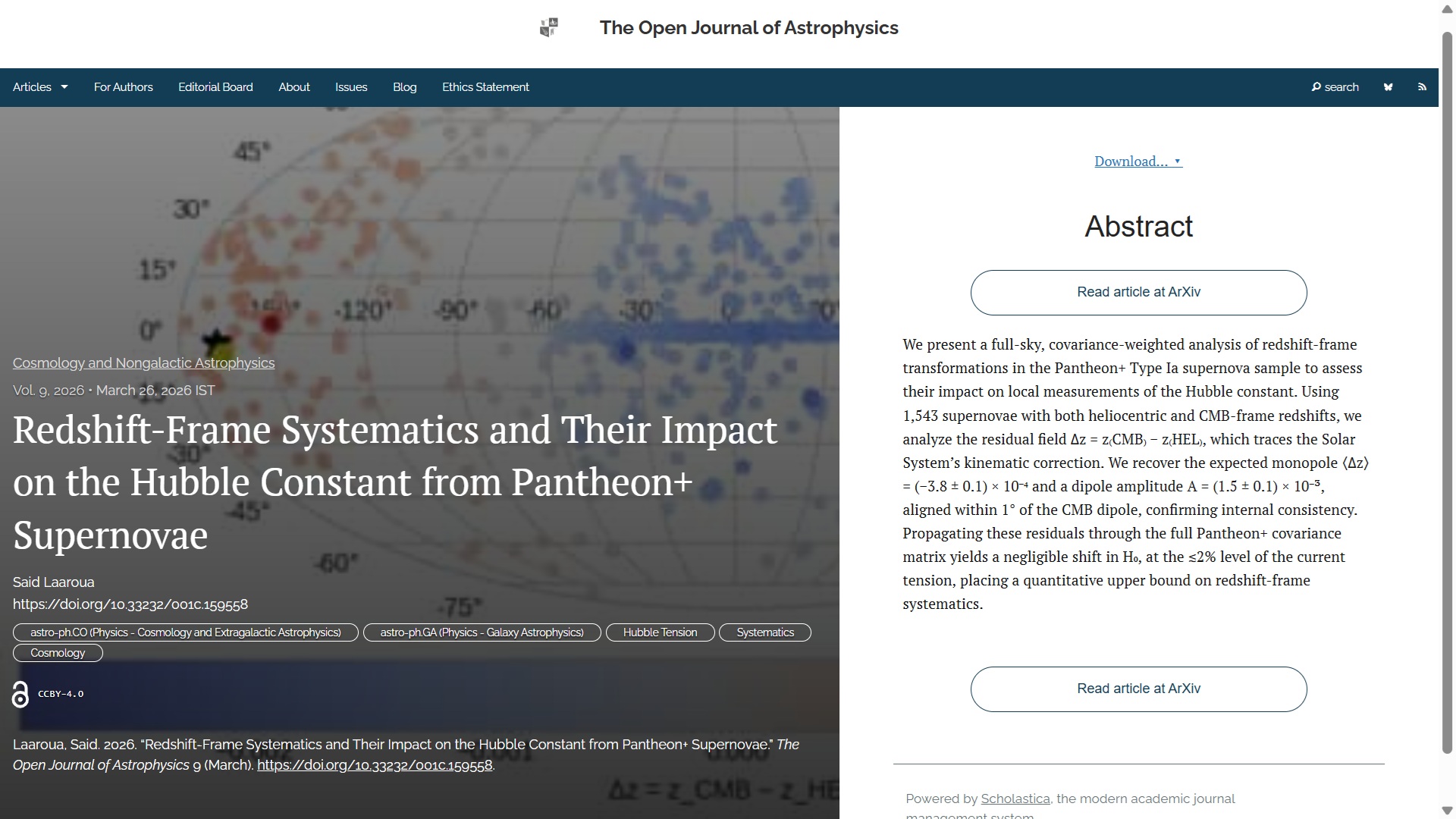
The officially accepted version of this paper can be found on arXiv here, and the Mastodon announcement is here:

Open Journal of Astrophysics

New Publication at the Open Journal of Astrophysics: "Redshift-Frame Systematics and Their Impact on the Hubble Constant from Pantheon+ Supernovae" by Said Laaroua (Santa Rosa Junior College, USA)

doi.org/10.33232/001c.159558

March 26, 2026, 7:22 am 1 boosts 0 favorites

The penultimate, that is to say the seventh, paper for this week is “Why Machine Learning Models Systematically Underestimate Extreme Values II: How to Fix It with LatentNN” by Yuan-Sen Ting (Ohio State University, USA). The paper introduces LatentNN, a method that reduces attenuation bias in neural networks by optimizing network parameters and latent input values, improving inference in low signal-to-noise astronomical data; the code is available here. This article was published on Thursday 26th March 2026 in the folder Instrumentation and Methods for Astrophysics

The overlay for this one is here:
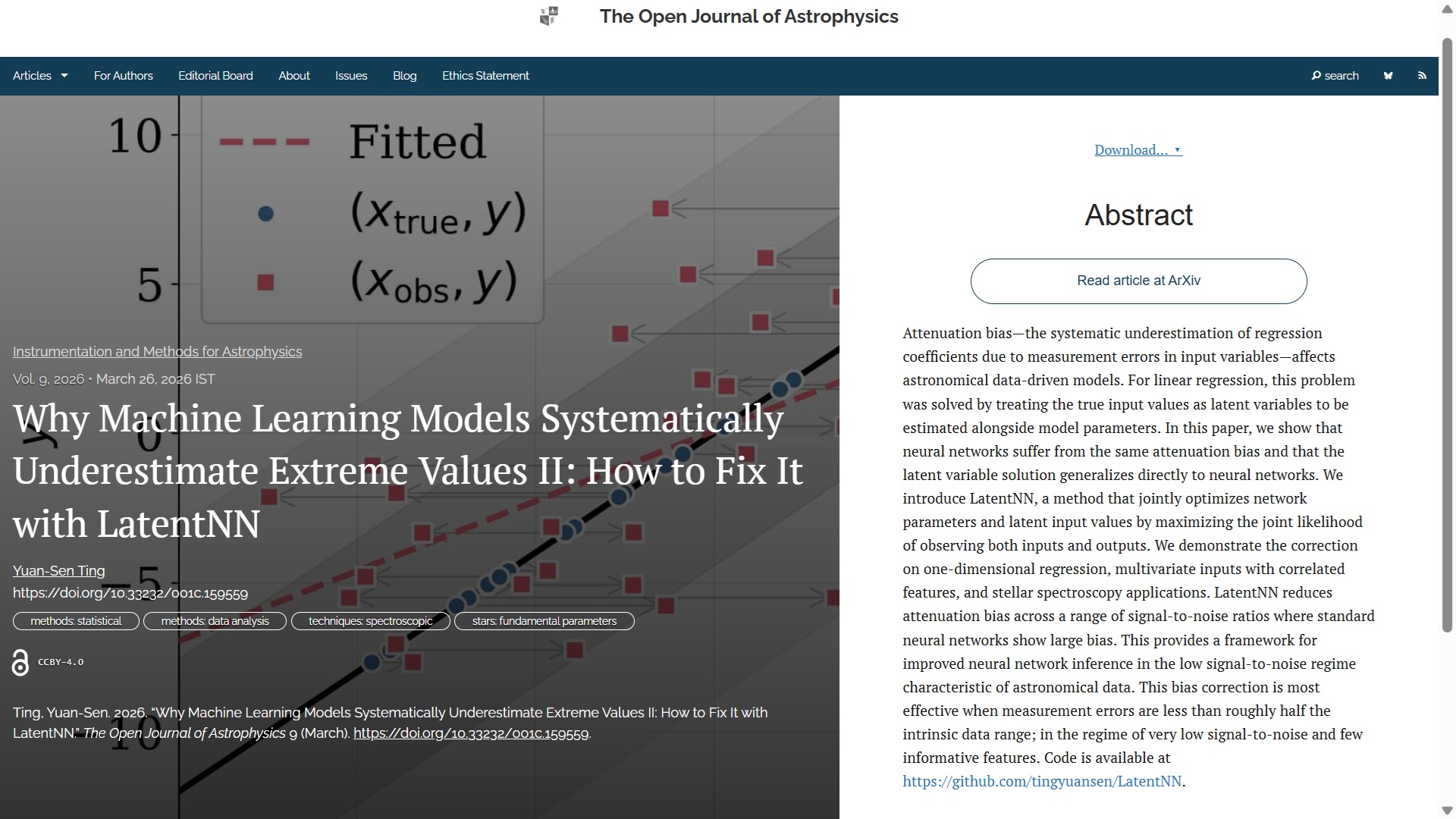
The official version of this paper can be found here. This is the Mastodon announcement:

Open Journal of Astrophysics

New Publication at the Open Journal of Astrophysics: "Why Machine Learning Models Systematically Underestimate Extreme Values II: How to Fix It with LatentNN" by Yuan-Sen Ting (Ohio State University, USA)

doi.org/10.33232/001c.159559

March 26, 2026, 7:36 am 2 boosts 1 favorites

And finally for this week, published yesterday (Friday 27th March 2026) in the folder Astrophysics of Galaxies, we have “Catalog of Mock Stellar Streams in Milky Way-Like Galaxies” by Colin Holm-Hansen, Yingtian Chen and Oleg Y. Gnedin (University of Michigan, USA).

Here is the overlay for this one:
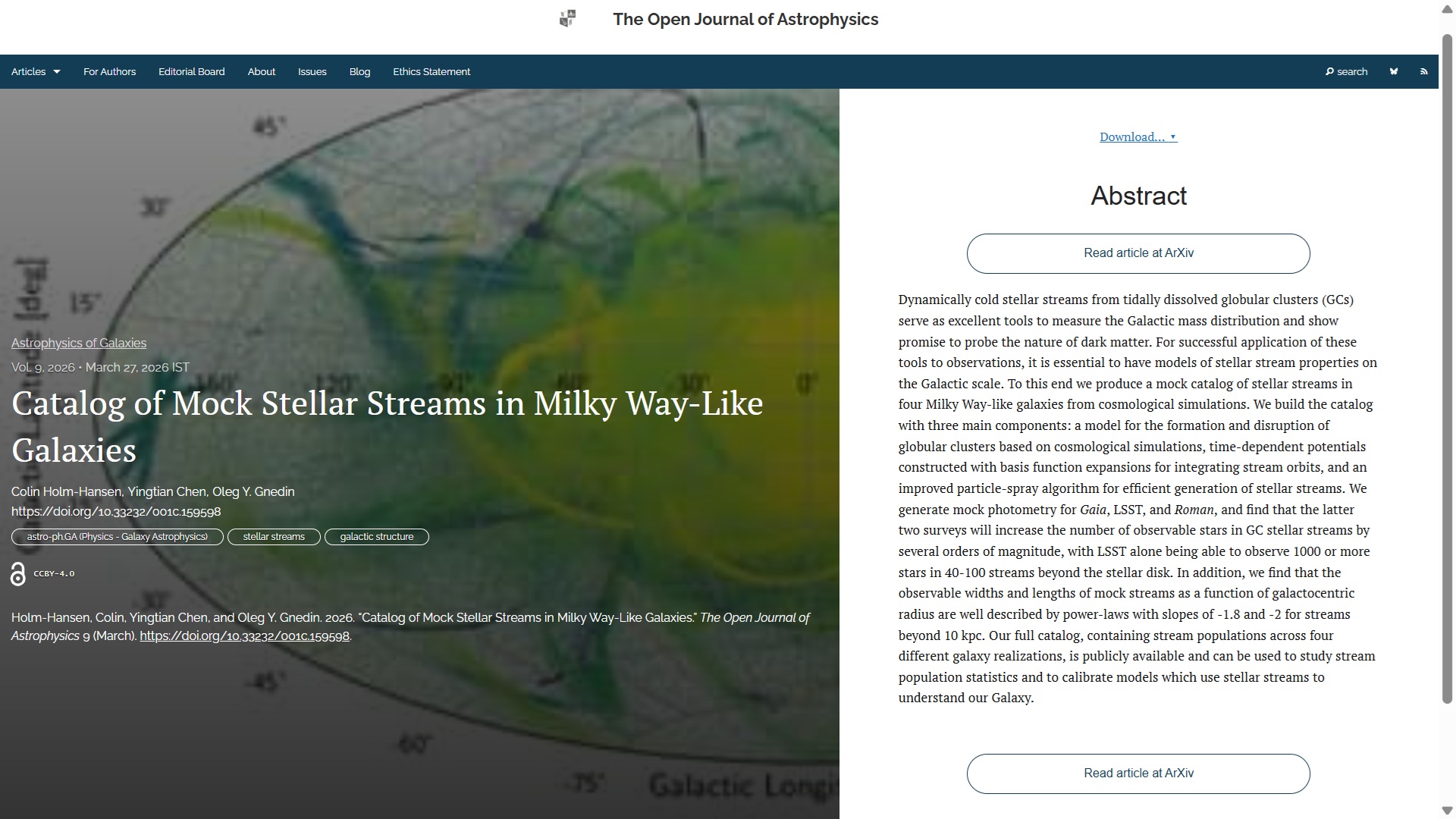
The officially accepted version can be found on arXiv here and the Mastodon announcement is here:

Open Journal of Astrophysics

New Publication at the Open Journal of Astrophysics: "Catalog of Mock Stellar Streams in Milky Way-Like Galaxies" by Colin Holm-Hansen, Yingtian Chen and Oleg Y. Gnedin (University of Michigan, USA)

doi.org/10.33232/001c.159598

March 27, 2026, 8:44 am 1 boosts 1 favorites

And that concludes the update for this week.

You will have observed that this week’s papers cover five of the six main categories on astro-ph. We haven’t yet managed to cover all six in a week – we only missed Solar and Stellar Astrophysics this time!

Weekly Update from the Open Journal of Astrophysics – 13/12/2025

Posted in OJAp Papers, Open Access, The Universe and Stuff with tags , , , , , , , , , , , , , , , , , , , , , , , , , , on December 13, 2025 by telescoper

It’s time once again for the usual Saturday morning update of the week’s new papers at the Open Journal of Astrophysics. Since the last update we have published a further five papers, which brings the number in Volume 8 (2025) up to 195, and the total so far published by OJAp up to 430.

The first paper this week is “Cosmic Rays Masquerading as Cool Cores: An Inverse-Compton Origin for Cool Core Cluster Emission” by Philip F. Hopkins (Caltech), Eliot Quataert (Princeton), Emily M. Silich, Jack Sayers, Sam B. Ponnada and Isabel S. Sands (Caltech).  This was published on Tuesday 9th December 2025 in the folder marked High-Energy Astrophysical Phenomena. It presents an argument  that cosmic-ray inverse-compton emission could contribute significantly to the X-ray surface brightness (SB) in cool-corre clusters, implying that gas densities may have been overestimated therein.

The overlay is here:

You can find the officially accepted version on arXiv here and the Fediverse announcement is here:

Open Journal of Astrophysics

New Publication at the Open Journal of Astrophysics: "Cosmic Rays Masquerading as Cool Cores: An Inverse-Compton Origin for Cool Core Cluster Emission" by

Philip F. Hopkins (Caltech), Eliot Quataert (Princeton), Emily M. Silich, Jack Sayers, Sam B. Ponnada and Isabel S. Sands (Caltech)

doi.org/10.33232/001c.154053

December 9, 2025, 7:22 am 1 boosts 0 favorites

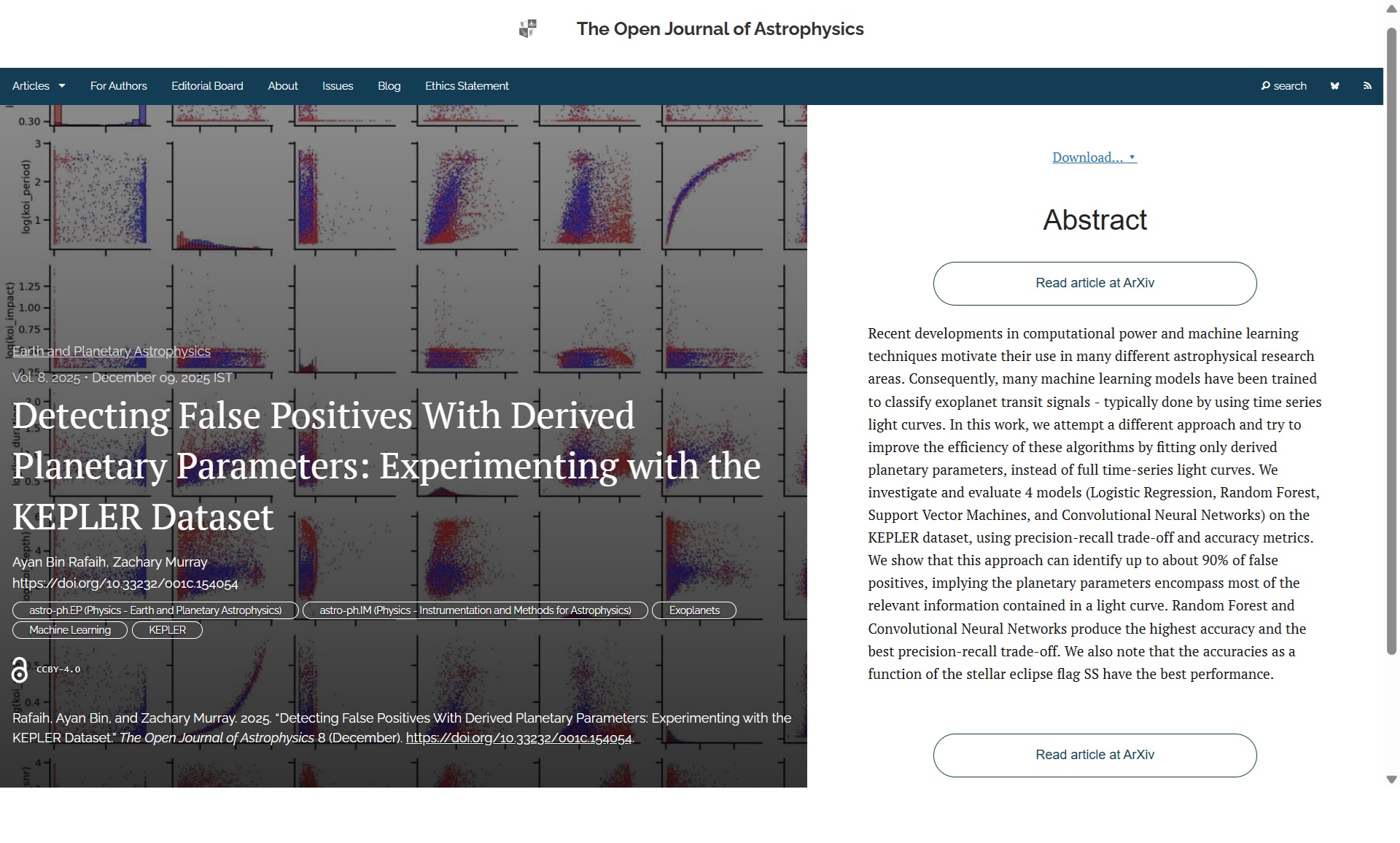
The second paper of the week is “Detecting False Positives With Derived Planetary Parameters: Experimenting with the KEPLER Dataset” by Ayan Bin Rafaih (Aitchison College, Lahore, Pakistan) and Zachary Murray (Université Côte d’Azur, France). This one was published on 9th December 2025 in the folder Earth and Planetary Astrophysics. It is an investigation into the performance of a range of machine-learning algorithms on the KEPLER dataset, using precision-recall trade-off and accuracy metrics.

The overlay is here:

You can find the official version of this one on arXiv here. The federated announcement on Mastodon is here:

Open Journal of Astrophysics

New Publication at the Open Journal of Astrophysics: "Detecting False Positives With Derived Planetary Parameters: Experimenting with the KEPLER Dataset" by Ayan Bin Rafaih (Aitchison College, Lahore, Pakistan) and Zachary Murray (Université Côte d’Azur, France)

doi.org/10.33232/001c.154054

December 9, 2025, 7:34 am 1 boosts 0 favorites

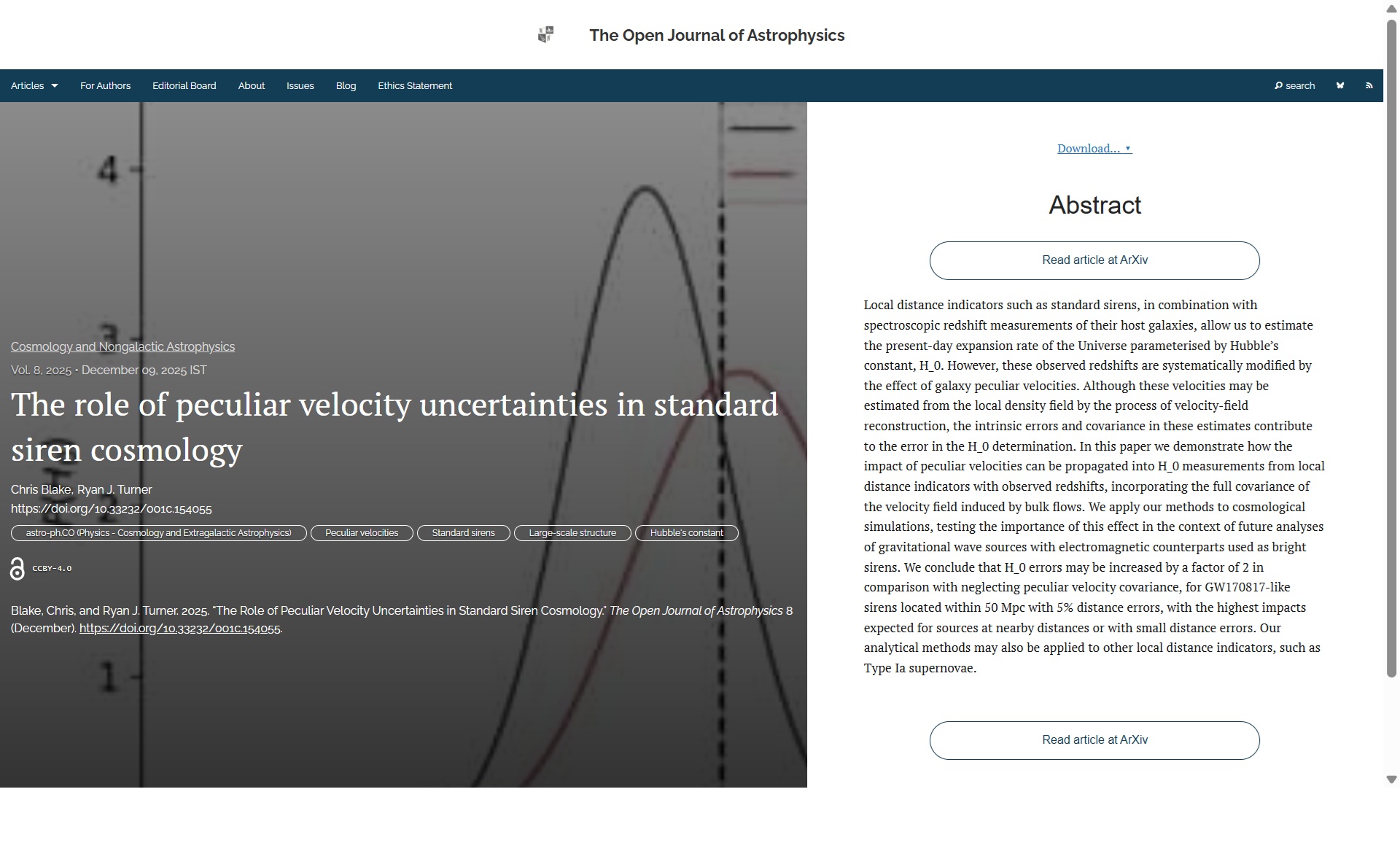
Next one up is “The role of peculiar velocity uncertainties in standard siren cosmology” by Chris Blake and Ryan J. Turner (Swinburne, Australia). This paper discusses the impact of peculiar velocities on the error in H0 determinations from local distance indicators with observed redshifts, incorporating the effect of bulk flows. It was published on Tuesday 9th December in the folder Cosmology and Nongalactic Astrophysics.

The overlay is here:

You can find the official accepted version on arXiv here. The fediverse announcement is here:

Open Journal of Astrophysics

New Publication at the Open Journal of Astrophysics: "The role of peculiar velocity uncertainties in standard siren cosmology" by Chris Blake and Ryan J. Turner (Swinburne, Australia)

doi.org/10.33232/001c.154055

December 9, 2025, 7:47 am 1 boosts 0 favorites

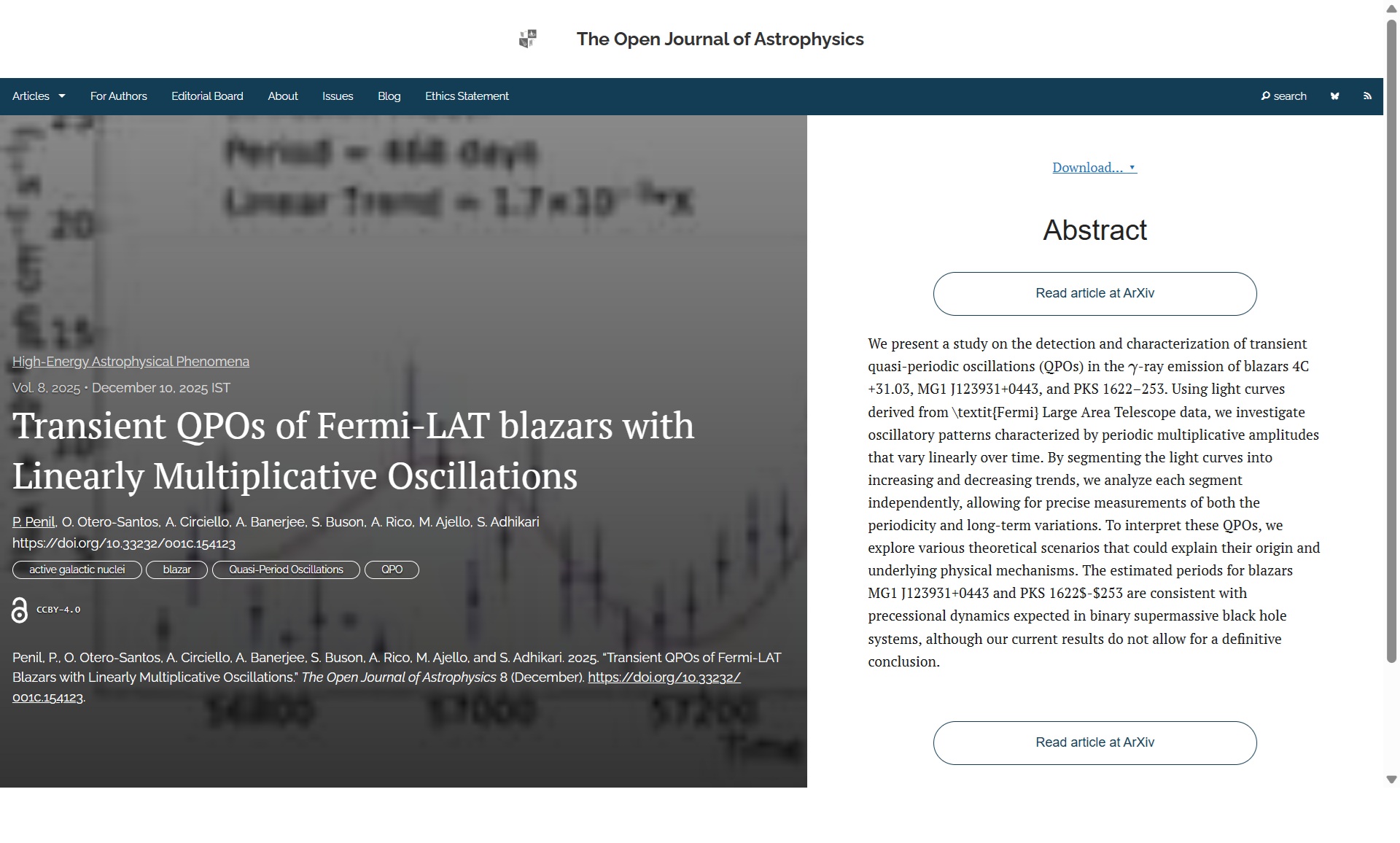
The fourth article of the week is “Transient QPOs of Fermi-LAT blazars with Linearly Multiplicative Oscillations” by P. Penil (Clemson University, USA) and 7 others based in the USA, Italy and Germany. This was published on Thursday 10th December in the folder High-Energy Astrophysical Phenomena. This paper presents an investigation of patterns of quasi-periodic oscillations in observed blazar systems characterized by periodic multiplicative amplitudes including both the periodicities and long-term variations.  The overlay is here:

You can find the official published version on arXiv here. The Fediverse announcement follows:

Open Journal of Astrophysics

New Publication at the Open Journal of Astrophysics: "Transient QPOs of Fermi-LAT blazars with Linearly Multiplicative Oscillations" by P. Penil (Clemson University, USA) and 7 others based in the USA, Italy and Germany

doi.org/10.33232/001c.154123

December 10, 2025, 12:22 pm 0 boosts 1 favorites

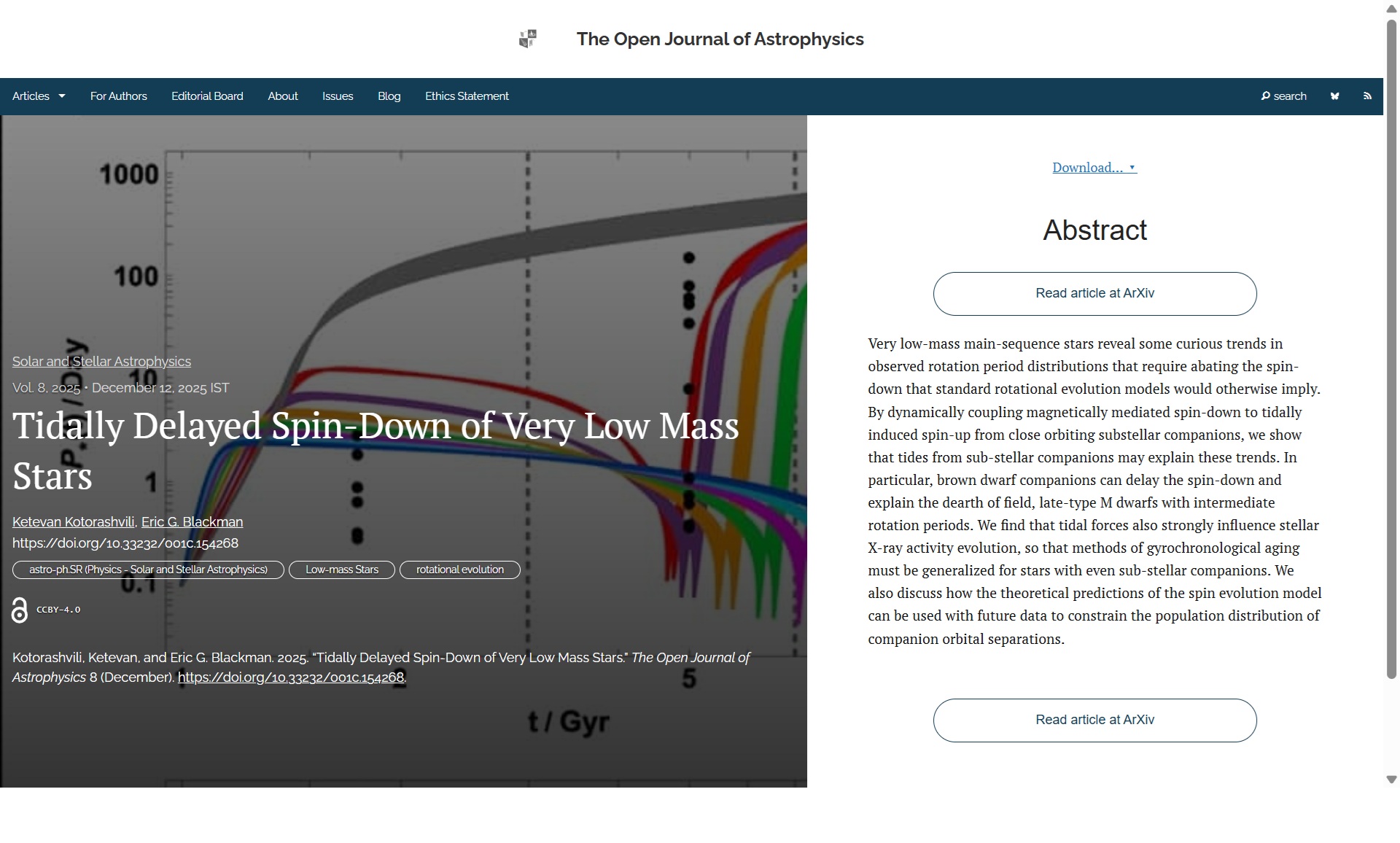
The last paper for this week is “Tidally Delayed Spin-Down of Very Low Mass Stars” by Ketevan Kotorashvili and Eric G. Blackman (U. Rochester, USA). This was published on Friday 12th December (yesterday) in the folder Solar and Stellar Astrophysics. It discusses the effect of tides from sub-stellar companions on rotational evolution of very low-mass stars, suggesting that these may explain the dearth of field, late-type M dwarfs with intermediate rotation periods.

The overlay is here:


You can find the officially-accepted version on arXiv here, and the Mastodon announcement is here:

Open Journal of Astrophysics

New Publication at the Open Journal of Astrophysics: "Tidally Delayed Spin-Down of Very Low Mass Stars" by Ketevan Kotorashvili and Eric G. Blackman (U. Rochester, USA)

doi.org/10.33232/001c.154268

December 12, 2025, 10:31 am 1 boosts 0 favorites


And that concludes the update for this week. I will do another of these regular announcements next Saturday, which will be the last such update for 2025. Will we make it past 200 for the year? Tune in next week to find out!

New Publication at the Open Journal of Astrophysics

Posted in OJAp Papers, Open Access, The Universe and Stuff with tags , , , , on November 5, 2021 by telescoper

Time to announce yet another publication in the Open Journal of Astrophysics. This one is the 14th paper in Volume 4 (2021) and the 45th in all.

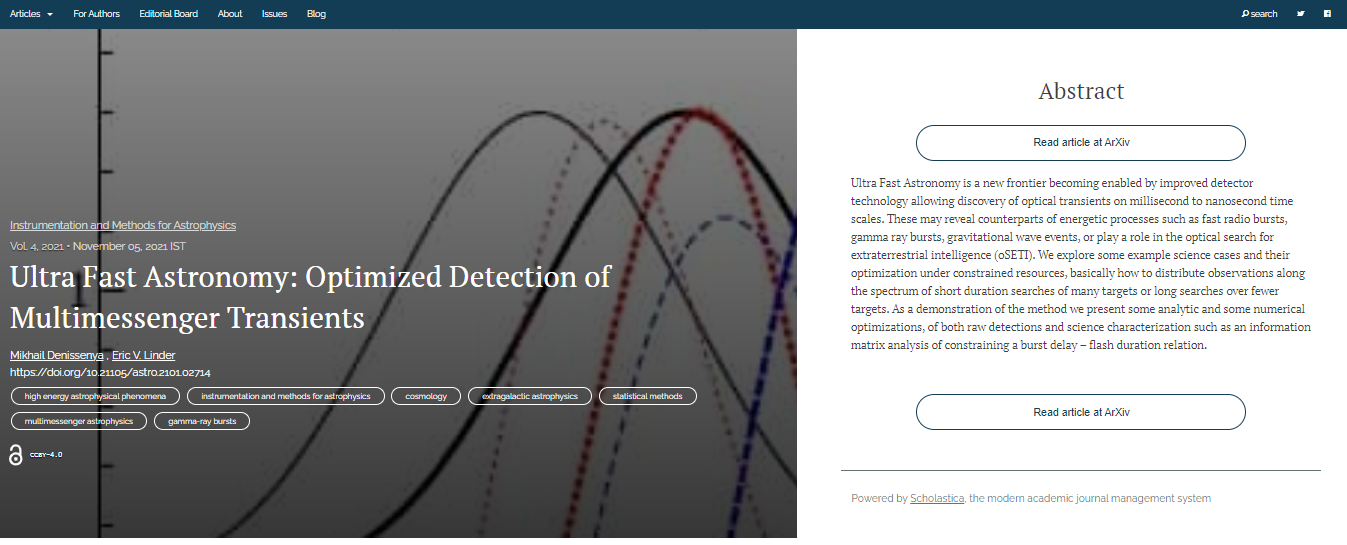
The latest publication is entitled  Ultra Fast Astronomy: Optimized Detection of Multimessenger Transients, and is in the section marked Instrumentation and Methods for Astrophysics.  The authors are Mikhail Denissenya of Nazarbayev University (Kazakhstan) and Eric V. Linder of the University of California at Berkeley (USA).

Here is a screen grab of the overlay which includes the abstract:

You can find the paper on the Open Journal of Astrophysics site here and can also read it directly on the arXiv here.

Cardiff: Centre of Gravity

Posted in The Universe and Stuff with tags , , , on November 17, 2016 by telescoper

It’s a very busy period for me as the Cardiff University Data Innovation Research Institute (DII) gears up for some exciting new activities in both teaching and research (of which more in due course) and embarks on is strategy for promoting and fostering interdisciplinary research across Cardiff University and beyond.

Yesterday, however, I attended an informal meeting in the School of Physics & Astronomy at which we had an update about other strategic developments in the Gravitational Physics Group, some of whose members work in the DII Following on from the first-ever detection of gravitational waves earlier this year the group has ambitious plans to build on its involvement in this discovery. Here’s a nice short video produced by Cardiff University that discusses this discovery:


Cardiff University has supported research on gravitational waves for a very long time, and it is important that it reaps the benefit now that its investment is starting to pay off. To rest on laurels at this stage would be to risk losing the benefits of that sustained investment. It was very exciting to hear about the group’s plans for further sustained expansion, which will make the Cardiff one of the leading centres of gravitational wave research  in the world.

I’ve already mentioned on this blog that a couple of new positions have already been advertised, one in gravitational wave astronomy (to consolidate existing activities in theory and data analysis) and the other in a completely new area of Gravitational Wave Experimentation. Those advertisements have now closed and the process of filling the vacancies is under way.

However, yesterday we heard of even more expansion of gravitational physics research, in the form of a new academic position in Time Domain Astronomy with particular emphasis on transient sources of electromagnetic radiation that could be associated with gravitational wave production (such as gamma-ray bursts). I’ll post the advertisement on this blog when it is available. And that’s just the start: further positions will be released over the next few years which will turn Cardiff into a true Centre of Gravity.

Exciting times!