After a misty morning it has turned into a lovely Spring-like afternoon here in Cardiff. I’ve been in the School of Physics & Astronomy at Cardiff University this morning, helping out with a UCAS visit day by interviewing some prospective students and then having lunch and chatting with parents and others.
As well as the weather and the admissions season, another indication of the passage of the seasons is the Six Nations rugby. Our Saturday UCAS visit days have to be arranged with the RBS Six Nations fixture list in mind because Cardiff gets incredibly busy when Wales are playing at home. The capacity of the Millennium Principality Stadium is well over 80,000 which, for a City with a population of just over 300,000 represents a huge perturbation.
Not only is there a lot of traffic and a very crowded city centre, but it’s also very difficult to find hotel accommodation at a reasonable price on match weekends. Given that we start in the morning, quite a few prospective students and their families do stay overnight beforehand so this is quite an important consideration. There are no fixtures in the RBS Six Nations this weekend. Today two of my interviewees had travelled quite a long way to get to Cardiff – one from Richmond in North Yorkshire and another from Falmouth in Cornwall – and both families stayed over last night.
Anyway, while I’m not talking about the Six Nations I can’t resist mentioning last week’s match here in Cardiff between Wales and England. I didn’t have a ticket. I’ve ever really figured out how to get tickets for these matches. They always seem to be completely sold out as soon as they go on sale.
Before the match, I thought it was going to be a close game but Wales always have tremendous home advantage at Cardiff and I thought they might just sneak it. It was a rather dour struggle to be honest, but with less than ten minutes to go Wales were leading 16-14 and my suspicions seemed about to be confirmed. However, as is often the case with close matches, it was an error that produced the decisive moment.
About five metres out, Wales turned possession over and then rucked successfully, the ball eventually going to Jonathan Davies behind his own try line. With half of his team trying to disentangle themselves from the completed ruck, it was essential for him to clear his lines by kicking into touch. Unfortunately, he kicked straight down the field where his kick was collected by George Ford. England’s counter-attack was swift and lethal: Ford to Farrell and then to Elliott Daly on the wing, who went over for the try to the sound of groans all round Cardiff. After the conversion it was Wales 16 England 21, which is how the game ended a few minutes later.
The results of the other games so far mean that the only team capable of winning a grand slam is England, as each of the other teams has lost at least one game. There’s still a long way to go, however, and England still face challenging matches against Ireland and a much-improved Scotland.
Anyway, all this UCAS malarkey means that I’m way behind on Saturday crossword duties, so I’m going home. Toodle-pip.
I’ve been meaning to do a blog post about Erik Verlinde’s very interesting “Emergent Gravity” theory since it was first aired in November 2016, but never got round to it. However, this recent paper suggests that the new theory fails badly on scales of the Solar System. And when I say “badly”, I mean by seven orders of magnitude. That’s pretty bad.
Unless there’s something wrong with this analysis, this looks pretty terminal …
It was recently proposed that the effects usually attributed to particle dark matter on galaxy scales are due to the displacement of dark energy by baryonic matter, a paradigm known as emergent gravity. This formalism leads to predictions similar to Modified Newtonian Dynamics (MOND) in spherical symmetry, but not quite identical. In particular, it leads to a well defined transition between the Newtonian and the modified gravitational regimes, a transition depending on both the Newtonian acceleration and its first derivative with respect to radius. Under the hypothesis of the applicability of this transition to aspherical systems, we investigate whether it can reproduce observed galaxy rotation curves. We conclude that the formula leads to marginally acceptable fits with strikingly low best-fit distances, low stellar mass-to-light ratios, and a low Hubble constant. In particular, some unobserved wiggles are produced in rotation curves because of the dependence of the transition on the…
Last night I went to the Wales Millennium Centre in Cardiff for the opening night of Welsh National Opera’s new production of Le Vin herbé by Swiss-born composer Frank Martin. This isn’t a work with which I was previously familiar so I wasn’t sure what to expect, but then that’s why I usually particularly hard to get to see departures from the standard repertoire. It’s not that I’m at all bored with Mozart, Puccini et al but that it’s always good to keep an ear open for new things. In fact there is only one performance of this piece in Cardiff this year before it goes on tour. Fortunately I was able to make it.
Le Vin herbé is based on the story of Tristan and Iseult ; the title refers to the potion that the two lead characters accidentally drink which makes them fall in love and thus betray King Mark of Cornwall, who is Tristan’s uncle and Iseult’s husband-to-be. Naturally tt all ends in disaster, with the two lovers both dying. But if the story makes you think of Wagner’s epic operatic telling of this legend, Tristan und Isolde then you need to think again, as this is a very different piece. Le Vin herbé is a much more intimate work, with a relatively small case and a band of just eight musicians (a piano and seven string players) who, in this production, were at centre stage throughout the performance rather than in the pit. The main characters are played by tenor Tom Randle (Tristan) and soprano Caitlin Hulcup (Iseult) – both of whom were brilliant – and some of their lines are also sung by the chorus and there are also solo storytellers to provide bits of the narrative. The set and staging is very minimal. In fact it’s more of a chamber oratorio than an Opera. Also the entire performances lasts under two hours, with no interval. Quite a lot shorter than Wagner’s version!
I think the instrumental music by Frank Martin is very fine indeed, and very well played by the musicians directed by James Southall, and the principals and chorus were in good voice. Having said that I think Martin’s writing for voices is less successful. The vocal lines consciously evokes mediaeval plainsong, which works quite well for the chorus but makes it difficult for the soloists to generate any melodic drive. It’s not helped by the libretto either, which is rather dry and undramatic. On the way home from the performance I couldn’t help wondering what it might have been like had the text been in mediaeval Latin! The staging was at times effective: some of the scenes between Tristan and Iseult were very moving, but the stage was too busy and confusing when the whole chorus got involved.
This probably sounds very critical, but I don’t mean it to be. There’s much to enjoy in this production, so I’d encourage you to go and form their own opinion. It’s on tour in Bristol, Milton Keynes, Llandudno, Plymouth and Southampton. Last night’s performance got a very warm reception from a pretty full house which, for an unusual work like this, is a very good sign.
I’m a little bit late blogging about this topic, as it relates to a paper published on 1st February 2017, but it’s a pleasure to be able to draw your attention to an important paper by a group led by a former colleague of mine from the University of Sussex, Prof. Winfried Hensinger, known to his friends as “Winni”. In essence they have constructed a practical way to build a working quantum computer.
Here is the abstract of the latest paper which explains the significance of the work:
The availability of a universal quantum computer may have a fundamental impact on a vast number of research fields and on society as a whole. An increasingly large scientific and industrial community is working toward the realization of such a device. An arbitrarily large quantum computer may best be constructed using a modular approach. We present a blueprint for a trapped ion–based scalable quantum computer module, making it possible to create a scalable quantum computer architecture based on long-wavelength radiation quantum gates. The modules control all operations as stand-alone units, are constructed using silicon microfabrication techniques, and are within reach of current technology. To perform the required quantum computations, the modules make use of long-wavelength radiation–based quantum gate technology. To scale this microwave quantum computer architecture to a large size, we present a fully scalable design that makes use of ion transport between different modules, thereby allowing arbitrarily many modules to be connected to construct a large-scale device. A high error–threshold surface error correction code can be implemented in the proposed architecture to execute fault-tolerant operations. With appropriate adjustments, the proposed modules are also suitable for alternative trapped ion quantum computer architectures, such as schemes using photonic interconnects.
It’s great to see the Ion Quantum Technology group continuing to do really well and I’m sure the investments made in physics research at the University of Sussex over the last few years will bring even more exciting developments in the near future!
I don’t seem to have had much time recently to post any lengthy pieces about music, and today is no exception, but I couldn’t resist sharing this fascinating title track from the album How Time Passeswhich was recorded in New York City in October 1960. It features Don Ellis on trumpet and Jaki Byard on piano (with Ellis doubling on piano sometimes to allow Byard to play saxophones) along with Ron Carter on bass and Charlie Persip on drums. The album is a fascinating collection of modern jazz performances informed by contemporary classical music, a blend that came to be known as Third Stream. This track is particularly unusual because of its elastic approach to tempo – it is constantly speeding up and slowing down in a way that makes you wonder how the band stays together – but it also features some beautiful work on trumpet by Don Ellis.
P.S. As well as being a superb jazz musician, Don Ellis was also a fine composer. Among other things he wrote the theme music for the film The French Connection. Not a lot of people know that.
Via arXiver, here’s a nice summary of the (strong) constraints on cosmological parameters that can be achieved from Cosmic Microwave Background experiments other than Planck. This is an important thing to do for a number of reasons, including that it might reveal interesting systematic differences between pre- and post-Planck data which merit further study.
The first author of this paper, Erminia Calabrese, will be joining us on the staff of the School of Physics & Astronomy at Cardiff University in May 2017!
We present cosmological constraints from the combination of the full mission 9-year WMAP release and small-scale temperature data from the pre-Planck ACT and SPT generation of instruments. This is an update of the analysis presented in Calabrese et al. 2013 and highlights the impact on $Lambda$CDM cosmology of a 0.06 eV massive neutrino – which was assumed in the Planck analysis but not in the ACT/SPT analyses – and a Planck-cleaned measurement of the optical depth to reionization. We show that cosmological constraints are now strong enough that small differences in assumptions about reionization and neutrino mass give systematic differences which are clearly detectable in the data. We recommend that these updated results be used when comparing cosmological constraints from WMAP, ACT and SPT with other surveys or with current and future full-mission Planck cosmology. Cosmological parameter chains are publicly available on the NASA’s LAMBDA data archive.
Something there is that doesn’t love a wall,
That sends the frozen-ground-swell under it,
And spills the upper boulders in the sun;
And makes gaps even two can pass abreast.
The work of hunters is another thing:
I have come after them and made repair
Where they have left not one stone on stone,
But they would have the rabbit out of hiding,
To please the yelping dogs. The gaps I mean,
No one has seen them made or heard them made,
But at spring mending-time we find them there.
I let my neighbor know beyond the hill;
And on a day we meet to walk the line
And set the wall between us once again.
We keep the wall between us as we go.
To each the boulders that have fallen to each.
And some are loaves and some so nearly balls
We have to use a spell to make them balance:
“Stay where you are until our backs are turned!”
We wear our fingers rough with handling them.
Oh, just another kind of outdoor game,
One on a side. It comes to little more:
He is all pine and I am apple-orchard.
My apple trees will never get across
And eat the cones under his pines, I tell him.
He only says, “Good fences make good neighbors.”
Spring is the mischief in me, and I wonder
If I could put a notion in his head:
“Why do they make good neighbors? Isn’t it
Where there are cows? But here there are no cows.
Before I built a wall I’d ask to know
What I was walling in or walling out,
And to whom I was like to give offence.
Something there is that doesn’t love a wall,
That wants it down!” I could say “Elves” to him,
But it’s not elves exactly, and I’d rather
He said it for himself. I see him there,
Bringing a stone grasped firmly by the top
In each hand, like an old-stone savage armed.
He moves in darkness as it seems to me,
Not of woods only and the shade of trees.
He will not go behind his father’s saying,
And he likes having thought of it so well
He says again, “Good fences make good neighbors.”
Last night I was listening to a broadcast of a concert performance of Haydn’s “Creation” on BBC Radio 3, featuring the London Philharmonic under the direction of Sir Roger Norrington. During the interval (between Parts I and II) the presenter Sara Mohr-Pietsch cast doubt in the story (which I’ve heard quite often), that Joseph Haydn was at least partly inspired to write The Creation by a trip he took during a stay in England to see the observatory of astronomer William Herschel. This story is repeated in a number of places around the web, including here, from which source I quote:
On 15 June 1792. Joseph Haydn visited William Herschel – basoonist, composer, astronomer – at his observatory near Slough. Herschel introduced Haydn to the Milky Way and, quite possibly, the planet Uranus, which he’d discovered ten years earlier. Some say Haydn took this glimpse of the infinite as the inspiration for his oratorio The Creation. Seems plausible.
It does indeed seem plausible. It is a matter of record that Haydn did visit the Observatory House in Slough on 15th June 1792, which is where William Herschel lived with his sister Caroline at the time. (Interestingly, the day before this visit Haydn was at Ascot watching the horse-racing.)
However, according to William Herschel’s own records he wasn’t at the Observatory House on this day. In fact he had been away since May 1792 visiting various locations in England and Wales, before eventually arriving in Glasgow to receive an honorary degree. The notion that Herschel provided Haydn with the inspiration to write The Creation is therefore false.
Or is it?
William Herschel may not have been at home when Haydn called on 15th June 1792, but Caroline certainly was: Haydn’s name is recorded in her visitor’s book on that date. In his diary Haydn makes a note of the dimensions of the telescope (40ft) but does not mention actually looking through it, which is not surprising if he was there during the day. There’s no other record of this visit of which I’m aware that says for sure what happened on that day, but Caroline certainly could have described what she had observed during her career as an astronomer, both on her own and with William, and also shown Haydn drawings, catalogues and star charts. Caroline Herschel was an extremely accomplished astronomer in her own right, so who’s to say it was not she rather than her brother who provided Haydn with the inspiration for his oratorio?
So it could well be that it was Herschel that inspired The Creation after all, but Caroline rather than William…
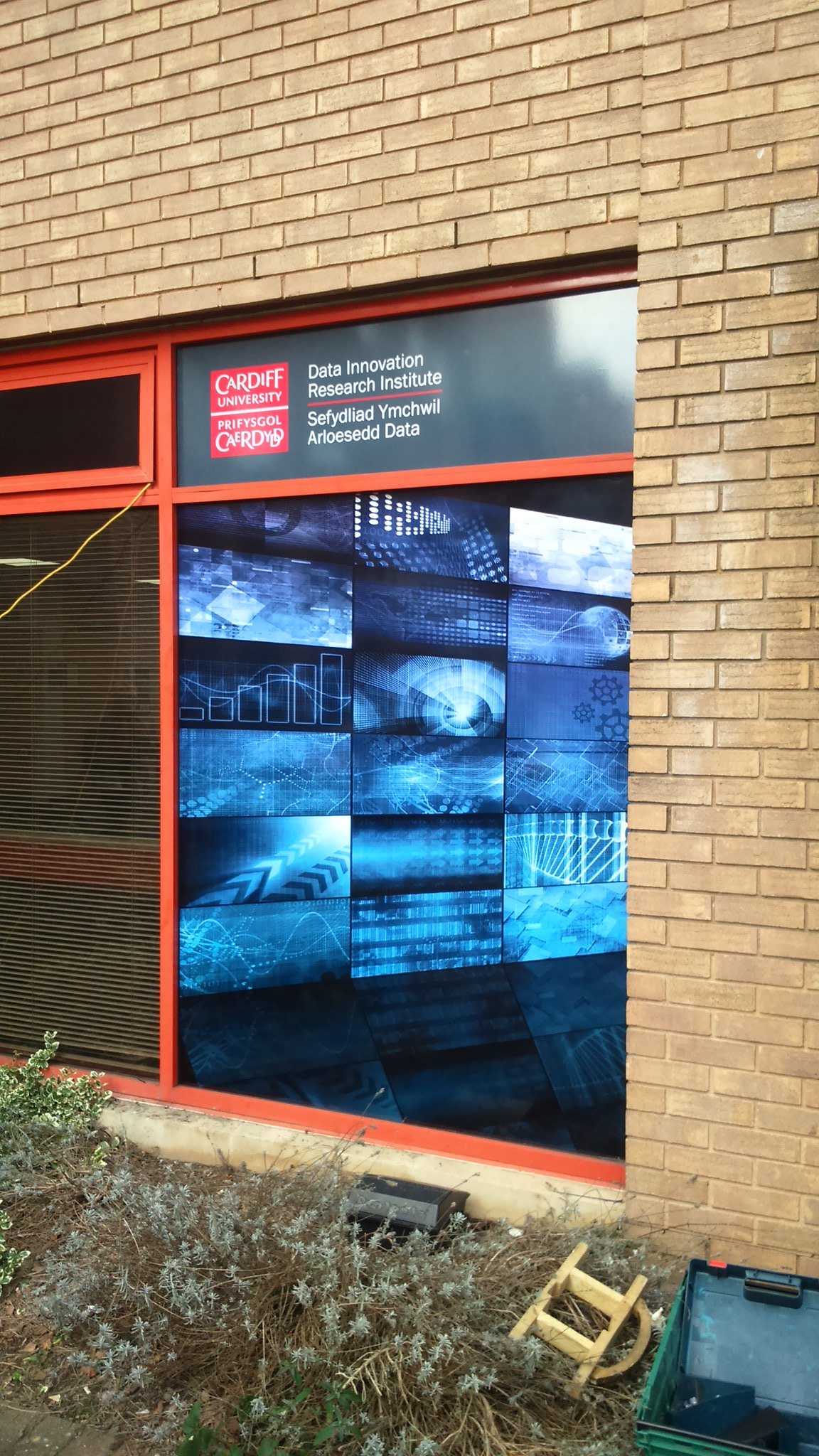
I’ve only been in my new office in the Data Innovation Research Institute for 5 months so it came as a big surprise to see that they’ve already started putting up the signs telling people where we are. In fact a couple of chaps came this morning to do the necessary, and now we look very professional. It’s hard to tell that this used to be a chip shop.
Please don’t tell the Health & Safety people about the power cable trailing through the window!
The views presented here are personal and not necessarily those of my employer (or anyone else for that matter).
Feel free to comment on any of the posts on this blog but comments may be moderated; anonymous comments and any considered by me to be vexatious and/or abusive and/or defamatory will not be accepted. I do not necessarily endorse, support, sanction, encourage, verify or agree with the opinions or statements of any information or other content in the comments on this site and do not in any way guarantee their accuracy or reliability.



 In the Dark