Cardiff: City of the Unexpected

Posted in Cardiff, Literature with tags , , on September 18, 2016 by telescoper

It’s been an extraordinary weekend in Cardiff as the city indulged in huge celebrations of the centenary of the birth of writer Roald Dahl, who was born in Llandaff.

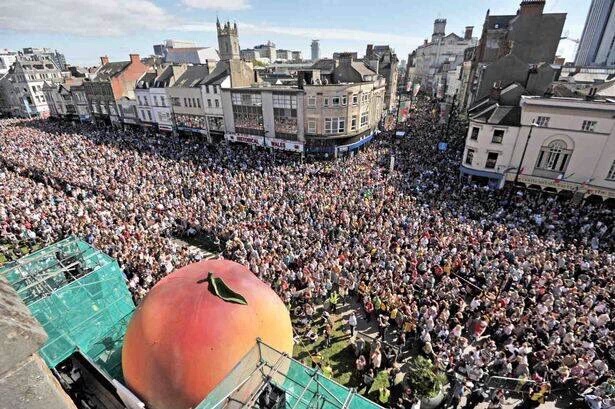
I’ve been too busy with other things to see many of the events organised under the banner of City of the Unexpected, but to give you an idea of the scale here’s a shot of the crowds in front of Cardiff Castle watching the James and the Giant Peach episode.

image

The picture was taken by a member of the South Wales Fire service who were assisting at the event.

This happens also to be the welcome weekend for new students at Cardiff University, and I suspect many were a bit bemused by the goings-on!

It’s also worth mentioning that, as well as being a prolific author of children’s books, Road Dahl was the son of Norwegian immigrants. He was also a fighter pilot in the RAF during World War 2 who served with great distinction in North Africa and Greece, despite being seriously injured when his plane crashed while attempting to land.

Anyway, we’ll done to the organisers of this remarkable event which has put a big smile on the face of this great city.

Ninio’s Extinction Illusion

Posted in Uncategorized on September 17, 2016 by telescoper

This fascinating visual paradox has been doing the rounds on social media so I thought I’d share it here.

The twelve  black dots cannot be seen at the same time:

image

Reference: Ninio, J. and Stevens, K. A. (2000) Variations on the Hermann grid: an extinction illusion. Perception, 29, 1209-1217.

Verdi’s Macbeth at Welsh National Opera

Posted in Opera with tags , , , on September 16, 2016 by telescoper

csacfbuwgaa6mew

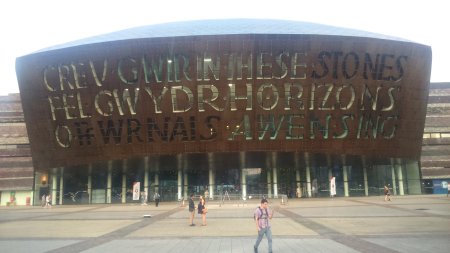
Last night I saw the new Welsh National Opera production of The Scottish Opera Macbeth by Giuseppe Verdi at the wonderful Wales Millennium Centre (above), resplendent in the sunshine of a late summer evening.

The original version of this opera was first performed in 1847, quite early in Verdi’s career, but was signicantly revised for a revival about twenty years later. Verdi’s two other Shakespeare-inspired operas, Falstaff and his masterpiece Otello, were written after a gap of about forty years after Macbeth, perhaps because Verdi discovered in Macbeth how difficult it is to adapt an entire play, especially one by Shakespeare, into an opera. The basic problem is that the text is far too long, so has to be drastically abridged to create a workable libretto. Macbeth is one of Shakespeare’s shorter plays in terms of word count, but it does have many changes of location. You can see the problems this posed for Verdi and his librettist Francesco Maria Piave, because the opera sometimes feels rather disjointed. Watching last night I sometimes felt that it was like watching the plot unfold on fast-forward. Another problem is that Macbeth is that many famous speeches have be truncated or cut out altogether. I’m quite familiar with the play, having studied it at school, but until last night had never seen the Opera, so it was a bit of disappointment to find Macbeth’s great soliloquy after the death of Lady Macbeth chopped to only a couple of lines. The same is the case with Lady Macbeth’s great speech upon the arrival of Duncan (“the Raven himself is hoarse…).

On the other hand, there is Verdi’s music, which provides a dramatic landscape of its own and smooths over some of the limitations imposed by the operatic form.

But enough of the problems with the Opera as compared to Shakespeare’s play and back to last night’s performance. This production had its first night last Saturday to relatively mixed reviews. I have to say that I thought it was superb. The action is set in the modern Scotland of a dystopian parallel universe, with a governing elite dressed in kilts and smart tweeds kept in power by armed paramilitaries in body armour, and assorted ruffians in shell suits and bobble hats. The Three Witches who prophesy that Macbeth is to be King are in this production actually three groups of seven or eight, each group having its own distinctive costume, their multiplicity producing a disturbingly scary effect. They also sang wonderfully, as did the rest of the truly outstanding Chorus of Welsh National Opera who were on blistering form.

wno-macbeth-wno-chorus-witches-photo-credit-richard-hubert-smith-9482

Members of the WNO Chorus as one of the three groups of Witches

Some reviewers found the staging unnecessarily brutal, which seems to me to be a rather silly view to take. This is Macbeth, not Mary Poppins! But in any case this isn’t the gorefest that I’ve seen in some theatrical versions of the play. In fact, the most bloodthirsty acts happen offstage. The exception is the assassination of Banquo who is stabbed and suffocated with plastic sheeting in front of the audience; his subsequent sudden appearance as a ghost in the famous banquet scene, his head still covered with bloody plastic, is accomplished with a smart piece of theatrical misdirection, and is startlingly effective.

When I read Macbeth at school it struck me that by far the most interesting character in the play was Lady Macbeth. Although her husband is a brave warrior on the battlefield he’s in many ways a bit of a drip. She has power over him and it is her that drives him on to his ultimate destruction. In this production Lady Macbeth (played by Mary Elizabeth Williams) is portrayed as a kind of cross between Imelda Marcos and Elena Ceaușescu (complete with a vast collection of fur coats and expensive shoes), the wife of a tyrannical leader unaware of the inevitability of his downfall. The staging of Acts III and IV plays on the obvious parallels with other historical dictatorships.

Mary Elizabeth Williams as Lady Macbeth dominated the first two acts of the play, her very fine voice (great power and lovely mezzo tones) matched by a powerful stage presence. That she overshadowed baritone Luis Cansino as Macbeth is not a criticism – I think it should be that way. Lady Macbeth does not appear at all in Act III and only once in Act IV when we see she has already lost the plot along with her marbles, sleepwalking and possessed by hallucinations. Soon after that, she dies (offstage), aand Macbeth himself surrenders to his fate at the hands of Macduff. At the very end, though, after his death aria, and just before the curtain falls, it is Fleance (the young son of the murdered Banquo and the future King) who cuts the throat of the dying Macbeth.

Anyway, if you have read the reviews of this production then don’t let them put you off. I thought it was a very provocative and interesting take on a familiar story and well worth going to see unless you only like your opera bland and formulaic.
Indian Summer, by Emily Dickinson

Posted in Poetry with tags , , on September 15, 2016 by telescoper

These are the days when birds come back,
A very few, a bird or two,
To take a backward look.

These are the days when skies put on
The old, old sophistries of June, —
A blue and gold mistake.

Oh, fraud that cannot cheat the bee,
Almost thy plausibility
Induces my belief,

Till ranks of seeds their witness bear,
And softly through the altered air
Hurries a timid leaf!

Oh, sacrament of summer days,
Oh, last communion in the haze,
Permit a child to join,

Thy sacred emblems to partake,
Thy consecrated bread to break,
Taste thine immortal wine!

by Emily Dickinson (1830-1886).


Eight Years In The Dark

Posted in Biographical with tags on September 15, 2016 by telescoper

8th-birthday-badge-pink
When I logged onto WordPress today  I received a message that it was the 8th anniversary of my registration with them as a blogger, which is when I took my first step into the blogosphere; that was way back on 15th September 2008. I actually wrote my first post that day too. Unfortunately I didn’t really know what I was doing on my first day at blogging – no change there, then –  and I didn’t actually manage to figure out how to publish this earth-shattering piece. It was only after I’d written my second post that I realized that the first one wasn’t actually visible to the general public because I hadn’t pressed the right buttons, so the two appear in the wrong order in my archive.

I’d like to take this opportunity to send my best wishes, and to thank, everyone who reads this blog, however occasionally. According to the WordPress stats, I’ve got readers from all round the world, including one in the Vatican! If you’re interested in statistics then, as of 14.00 BST today, I have published 3,343 blog posts, and have received 2,853,105 hits altogether; I get an average of about 1200 per day, but this varies in a very erratic fashion. The greatest number of hits I have received in a day is 8,864 (at the peak of the BICEP2 controversy). There have been 24,907 comments published on here and 1,556,259  rejected. Most of the rejected comments were from automated spam bots, but a small number have been removed for various violations, usually for abuse of some kind. Yes, I do get to decide what is published. It’s my blog!

While I am on the subject of comments, I’ll just repeat here my comments policy as stated on the home page of this blog:

Feel free to comment on any of the posts on this blog but comments may be moderated; anonymous comments and any considered by me to be abusive will not be accepted. I do not necessarily endorse, support, sanction, encourage, verify or agree with the opinions or statements of any information or other content in the comments on this site and do not in any way guarantee their accuracy or reliability.

It does mean a lot to me to know that there are people who find my ramblings interesting enough to look at, and sometimes even to come back for more, so I’d like to take this opportunity to send my best wishes to all those who follow this blog and especially those who take the trouble to comment on it in such interesting and unpredictable ways!


!Happy Birthday GW150914!

Posted in The Universe and Stuff with tags , , on September 14, 2016 by telescoper

A birthday message to the first gravitational wave source to be detected, from my new office mate, Bernard Schutz!

bfschutz's avatarThe Rumbling Universe

Just a year ago today, after travelling some 1.4 billion years, the gravitational wave chirp we christened GW150914 passed through Earth. It disturbed the two gravitational wave detectors of the LIGO observatory enough for us to notice it, to get excited about it, and to get a large fraction of the general public excited about it! But GW150914 just kept on going and is now one further year along in its journey through the Universe. And it will keep going, spreading out and getting weaker but not otherwise being much disturbed, forever. Literally forever.

And GW150914 hardly noticed us! When we observe the Universe with our telescopes, detecting light or radio waves or gamma rays from the enormous variety of luminous objects out there, we capture the energy that enters our telescopes. The photons from a distant star terminate their journeys in our telescopes, leaving a tiny hole in the…

View original post 982 more words

New: Top Ten Gaia Facts!

Posted in Astrohype, The Universe and Stuff with tags , , , on September 14, 2016 by telescoper

After today’s first release of data by the Gaia Mission, as a service to the community, for the edification of the public at large, and by popular demand, here is a list of Top Ten Gaia Facts.

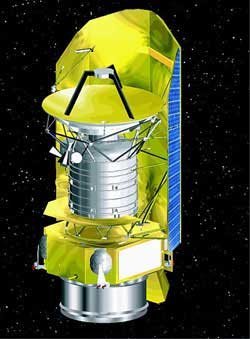
Gaia looks nothing like the Herschel Space Observatory shown here.

Gaia looks nothing like the Herschel Space Observatory shown here.


  1. The correct pronunciation of GAIA is as in “gayer”. Please bear this in mind when reading any press articles about the mission.
  2. The GAIA spacecraft will orbit the Sun at the Second Lagrange Point, the only place in the Solar System where the  effects of cuts in the UK science budget can not be felt.
  3. The data processing challenges posed by GAIA are immense; the billions of astrometric measurements resulting from the mission will be analysed using the world’s biggest Excel Spreadsheet.
  4. To provide secure backup storage of the complete GAIA data set, the European Space Agency has commandeered the world’s entire stock of 3½ inch floppy disks.
  5. As well as measuring billions of star positions and velocities, GAIA is expected to discover thousands of new asteroids and the hiding place of Lord Lucan.
  6. GAIA can measure star positions to an accuracy of a few microarcseconds. That’s the angle subtended by a single pubic hair at a distance of 1000km.
  7. The precursor to GAIA was a satellite called Hipparcos, which is not how you spell Hipparchus.
  8. The BBC will be shortly be broadcasting a new 26-part TV series about GAIA. Entitled WOW! Gaia! That’s Soo Amaazing… it will be presented by Britain’s leading expert on astrometry, Professor Brian Cox.
  9. Er…
  10. That’s it.

Gaia’s First Data Release!

Posted in The Universe and Stuff with tags , , , on September 14, 2016 by telescoper

It seems like only yesterday that I was blogging excitedly about the imminent launch of the European Space Agency’s Gaia Mission. In fact it was almost three years ago – 1000 days to be precise – and today the world of astronomy is a-flutter with excitement because we’ve just seen the first release of data from the mission. You can find an overview with links to all the yummy data here. I can’t resist pointing out the adoption of a rigorously Bayesian method for dealing with partial or incomplete data when a full astrometric solution is not possible due to insufficient observations. If you want to go straight to the data archive you go here or you could try one of the other data centres listed here. It’s great that all this data is being made freely available, but this is only the first set of data. It’s just a hint of what the mission overall will achieve.

If you would prefer some less technical background to the mission have a look here.

Here’s a summary (courtesy of ESA) of what Gaia has achieved so far:

cstyyenwgaa7fa

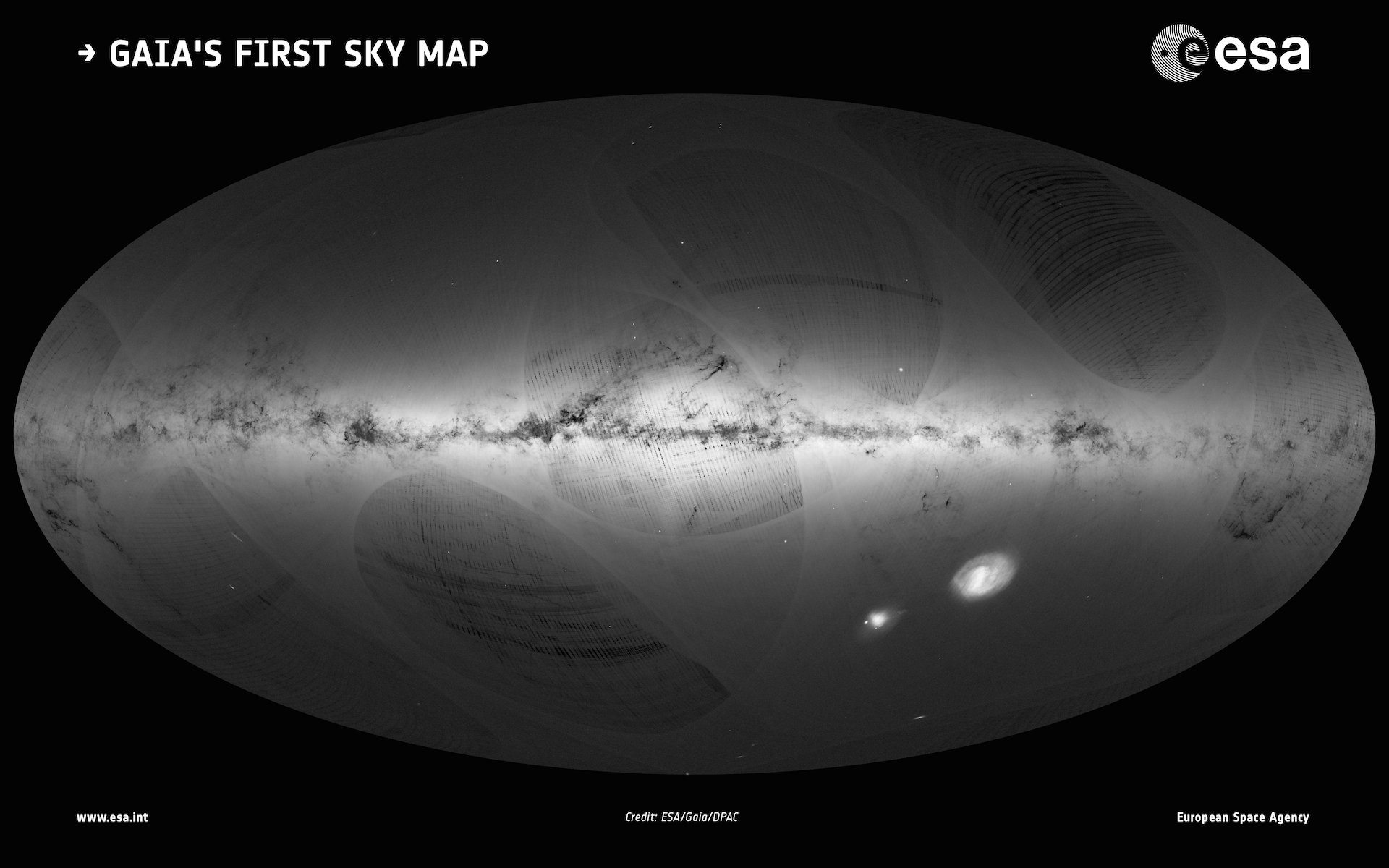
There’s much more to Gaia than pictures, but here’s the first map of the sky  it produced:

cstpe32weaeiwmw

I remember first hearing about Gaia about 15 years ago when I was on a PPARC advisory panel and was immediately amazed  by the ambition of its objectives. As I mentioned above, Gaia is a global space astrometry mission, which will make the largest, most precise three-dimensional map of our Galaxy by surveying more than a billion stars; DR1 is really just a taster as the measurements will become more complete and more accurate as the mission continues.

In some sense Gaia is the descendant of the Hipparcos mission launched in 1989, but it’s very much more than that. Gaia monitors each of its target stars about 70 times over a five-year period. It is expected to discover hundreds of thousands of new celestial objects, such as extra-solar planets and brown dwarfs, and observe hundreds of thousands of asteroids within our own Solar System. The mission is also expected to yield a wide variety of other benefits, including new tests of the  General Theory of Relativity.

Gaia will created an extraordinarily precise three-dimensional map of more than a thousand million stars throughout our Galaxy (The Milky Way) and beyond, mapping their motion, luminosity, temperature and chemical composition as well as any changes in such properties. This huge stellar census will provide the data needed to tackle an enormous range of important problems related to the origin, structure and evolutionary history of our Galaxy. Gaia will do all this by repeatedly measuring the positions of all objects down to an apparent magnitude of 20. A billion stars is about 1% of the entire stellar population of the Milky Way.

For the brighter objects, i.e. those brighter than magnitude 15, Gaia  measures their positions to an accuracy of 24 microarcseconds, comparable to measuring the diameter of a human hair at a distance of 1000 km. Distances of relatively nearby stars are measured to an accuracy of 0.001%. Even stars near the Galactic Centre, some 30,000 light-years away, have their distances measured to within an accuracy of 20%.

It’s an astonishing mission that will leave an unbelievably rich legacy not only for the astronomers working on the front-line operations of Gaia but for generations to come.


George’s Marvellous Medicine

Posted in History, Literature with tags , , , on September 13, 2016 by telescoper

Today is the 100th anniversary of the birth of author Roald Dahl, who was born in Llandaff, Cardiff, on 13th September 1916.  To celebrate this occasion, Cardiff University’s School of Chemistry has tried to recreate some of the phenomena described in one of Dahl’s children’s books, George’s Marvellous Medicine. Enjoy!


Cardiff Boundary Changes

Posted in Politics with tags , , , on September 13, 2016 by telescoper

There’s been a lot of discussion in the news about changes to electoral constituencies in the United Kingdom proposed by the Boundary Commissions for England, Wales, Scotland and Northern Ireland. These proposals are intended to achieve two goals: (a) to reduce the total number of constituencies (and hence Members of Parliament) from 650 to 600; and (b) to ensure that the resulting constituencies contain roughly the same number of votes (within 5% either way of the mean number).

In a bit more detail: each constituency in the UK should contain roughly the same number of eligible voters, the so-called “electoral quota” which is reached by dividing the total electorate of the UK by the number of required constituencies, except for the Isle of Wight and two Scottish island constituencies. The quota is then 74,769, based on the electoral register as it stood on 1 December 2015.

The purported aim of (a) is to reduce the running cost of Parliament. I’d be more convinced of that if the previous Prime Minister hadn’t appointed no fewer than 260 Members to the House of Lords, at considerably greater expense than the saving incurred by losing 50 MPs from the House of Commons. The intention of (b) is more reasonable, but it does threaten the rationale of the constituency-based system as it creates some larger and less homogeneous constituencies.

The Boundary Commisssion for Wales has proposed that the Welsh MPs be reduced from 40 to 29, which means the loss of some historically important constituencies altogether and a significant rearrangement of many others.  In fact there isn’t a seat in Wales that isn’t changed in some way. Here’s what the proposals mean for Cardiff, with the existing constituencies on the left and the proposed boundaries on the right:

slide1

I reside in Cardiff West (marked 12 on the left). You will see that the proposal involves extending this constituency on the western side of the River Taff down towards Cardiff Bay. This splits the former constituency Cardiff South and Penarth (11) into two, the western part (mainly Penarth) being absorbed into a new constituency called Vale of Glamorgan East (20 on the right). The other big change is that Cardiff Central (9 on the left) is eliminated entirely, absorbed by an enlarged Cardiff North (18 on the right, formerly 10 on the left) and a new Cardiff South and East (19) on the right. The net change is the loss of one seat in the City of Cardiff, which is currently held by Labour MP Jo Stevens.

I’m sure there’ll be quite a strong reaction to these changes, not least because they are based on the electoral register as it was on December 1st 2015 because the switch to individual electoral registration meant that 770,000 names dropped off the list before this date. The list also does not reflect those who registered to vote ahead of the EU referendum in June.

Going back to Wales for a moment, I think it’s unfair that while Scotland excluded two island constituencies from the quota formula to reflect their specific character, the same did not happen for Ynys Môn (Anglesey), a constituency which has been around since 1536, but which is now to be enlarged into a new entity called Ynys Môn and Arfon.  I’m sure someone will comment on that!

Anyway, these are proposals and there is now a period of consultation. The final boundaries will not be determined until 2018.