Back On Green Dolphin Street

Posted in Biographical, Jazz with tags , , , , , on September 12, 2016 by telescoper

I was listening to this wonderful track yesterday and couldn’t resist reposting a piece I wrote I wrote about it over 7 years  ago. If I were ever to be asked on one of those programmes where you have to pick examples of your favourite music, this would probably be the first I’d write on my list.

Years ago in 1980, when the great pianist Bill Evans passed away suddenly, Humphrey Lyttelton paid tribute to him on his radio programme “The Best of Jazz” by playing a number of tracks featuring him. I didn’t really know much about Bill Evans at the time – I was only 17 then – but one track that Humph chose has been imprinted on my mind ever since, and it’s one of those pieces of music that I listen to over and over again.

The track is On Green Dolphin Street, as recorded in 1958 by the great Miles Davis sextet of the time that featured himself on trumpet, John Coltrane on tenor sax, Julian “Cannonball” Adderley on alto sax, Jimmy Cobb on drums, Paul Chambers on bass and Bill Evans on piano. This is the same band that played on the classic album Kind of Blue, one of the most popular and also most innovative jazz records of all time, which was recorded a bit after the recording of On Green Dolphin Street.  I love Kind of Blue, of course, but I think this track is even better than the many great tracks on that album (All Blues, Flamenco Sketches, Blue in Green, etc). In fact, I’d venture the opinion – despite certainty of contradiction – that this is the greatest Jazz recording ever made.

On Green Dolphin Street was suggested to Miles Davis the band’s leader by the saxophonist Cannonball Adderley. It was the theme tune from a film from the late 1940s. It’s also the title of a more recent very fine novel by Sebastian Faulks.

I think the Miles Davis version demonstrates his genius not only as a musician himself but also as a bandleader. On Green Dolphin Street definitely bears the Miles Davis hallmark, but it also manages to accommodate the very different styles of the other musicians and allows them also to impose their personality on it. This is done by having each solo introduced with a passage with the rhythm section playing a different, less propulsive, 3/4 time behind it. This allows each musician to set out their stall before the superb rhythm section kicks into a more swinging straight-ahead beat  (although it still keeps the 3/4 feel alongside the 4-4, courtesy of brilliant drumming by Jimmy Cobb) and they head off into their own territory. As the soloists hand over from one to the other there are moments of beautiful contrast and dramatic tension, especially – and this is the reason why Humph picked this one in 1980 – when Bill Evans takes over for his solo from Cannonball Adderley. He starts with hesitant single-note phrases before moving into a richly voiced two handed solo fully of lush harmonies. It’s amazing to me to hear how the mood changes completely and immediately when he starts playing, and it always sends shivers down my spine.

Not that the other soloists play badly either. After Bill Evans’s short but exquisite prelude, Miles Davis takes over on muted trumpet, more lyrical and less introspective than in Kind of Blue but still with a moody,  melancholic edge. He’s followed by John Coltrane’s passionately virtuosic solo which floods out of him in an agonized stream which contrasts with Miles’ poised simplicity. By contrast, Cannonball Adderley is jaunty and upbeat, sauntering through his solo up to that wonderful moment where he hands over to the piano. Then Miles Davis takes over again to take them to the conclusion of the piece.

I’m not into League tables for music, but this is definitely fit to put up alongside the greatest of them all…

Bayes Factors via Savage-Dickey Supermodels [IMA]

Posted in Bad Statistics, The Universe and Stuff on September 12, 2016 by telescoper

How could I possibly resist reblogging an arXiver post about “Savage-Dickey Supermodels”?

arxiver's avatararXiver

http://arxiv.org/abs/1609.02186

We outline a new method to compute the Bayes Factor for model selection which bypasses the Bayesian Evidence. Our method combines multiple models into a single, nested, Supermodel using one or more hyperparameters. Since the models are now nested the Bayes Factors between the models can be efficiently computed using the Savage-Dickey Density Ratio (SDDR). In this way model selection becomes a problem of parameter estimation. We consider two ways of constructing the supermodel in detail: one based on combined models, and a second based on combined likelihoods. We report on these two approaches for a Gaussian linear model for which the Bayesian evidence can be calculated analytically and a toy nonlinear problem. Unlike the combined model approach, where a standard Monte Carlo Markov Chain (MCMC) struggles, the combined-likelihood approach fares much better in providing a reliable estimate of the log-Bayes Factor. This scheme potentially opens the way to…

View original post 53 more words

Flag

Posted in Poetry with tags , , , on September 11, 2016 by telescoper

What’s that fluttering in a breeze?
Its just a piece of cloth
that brings a nation to its knees.

What’s that unfurling from a pole?
It’s just a piece of cloth
that makes the guts of men grow bold.

What’s that rising over a tent?
It’s just a piece of cloth
that dares the coward to relent.

What’s that flying across a field?
It’s just a piece of cloth
that will outlive the blood you bleed.

How can I possess such a cloth?
Just ask for a flag my friend.
Then blind your conscience to the end.

by John Agard (b. 1949)

Cosmology: Galileo to Gravitational Waves – with Hiranya Peiris

Posted in The Universe and Stuff with tags , , , on September 9, 2016 by telescoper

Here’s another thing I was planning to post earlier in the summer, but for some reason forgot. It’s a video of a talk given at the Royal Institution earlier this year by eminent cosmologist Prof. Hiranya Peiris of University College London. The introduction to the talk goes like this:

Modern fundamental physics contains ideas just as revolutionary as those of Copernicus or Newton; ideas that may radically change our understanding of the world; ideas such as extra dimensions of space, or the possible existence of other universes.

Testing these concepts requires enormous energies, far higher than what is achievable by the Large Hadron Collider at CERN, and in fact, beyond any conceivable Earth-bound experiments. However, at the Big Bang, the Universe itself performed the ultimate experiment and left clues and evidence about what was behind the origin of the cosmos as we know it, and how it is evolving. And the biggest clue is the afterglow of the Big Bang itself.

In the past decade we have been able to answer age-old questions accurately, such as how old the Universe is, what it contains, and its destiny. Along with these answers have also come many exciting new questions. Join Hiranya Peiris to unravel the detective story, explaining what we have uncovered, and how we know what we know.

Hiranya Peiris is Professor of Astrophysics in the Astrophysics Group in the Department of Physics and Astronomy at University College London. She is also the Principal Investigator of the CosmicDawn project, funded by the European Research Council

She is also a member of the Planck Collaboration and of the ongoing Dark Energy Survey, the Dark Energy Spectroscopic Instrument and the Large Synoptic Survey Telescope. Her work both delves into the Cosmic Microwave Background and contributes towards the next generation galaxy surveys that will yield deep insights into the evolution of the Universe.

I’ve heard a lot of people talk about “Cosmic Dawn” but I’ve never met her…

Anyway, here is the video. It’s quite long (almost an hour) but very interesting and well-presented for experts and non-experts alike!

Update: I’ve just heard the news that Hiranya is shortly to take up a new job in Sweden as Director of the Oscar Klein Centre for Cosmoparticle Physics. Hearty congratulations and good luck to her!


Horowitz plays Schubert

Posted in Music with tags , , on September 9, 2016 by telescoper

This was doing the rounds on Facebook earlier this summer and I meant to post it on here, but forgot. Anyway, better late than never.  This is the great Vladimir Horowitz playing the Impromptu No. 3  in G flat major D899  by Franz Schubert. It’s a stunning performance to watch as well as listen to, despite – or maybe because of – the fact that he was an old man at the time and this was to be his last concert in Vienna. I love the way he takes his time to settle at the start, and then all of a sudden, his hands apparently almost still, he starts to caress the keyboard with his fingers and this beautiful music comes to life, almost as if it’s coming directly from another world. Take a few minutes off, and let some beauty into your heart..


Rank Nonsense

Posted in Bad Statistics, Education, Politics with tags , , , , , on September 8, 2016 by telescoper

It’s that time of year when international league tables (also known as “World Rankings”)  appear. We’ve already had the QS World University Rankings and the Shanghai (ARWU) World University Rankings. These will soon be joined by the Times Higher World Rankings, due out on 21st September.

A lot of people who should know a lot better give these league tables far too much attention. As far as I’m concerned they are all constructed using extremely suspect methodologies whose main function is to amplify small statistical variations into something that looks significant enough to justify constructing  a narrative about it. The resulting press coverage usually better reflects a preconceived idea in a journalist’s head than any sensible reading of the tables themselves.

A particularly egregious example of this kind of nonsense can be found in this week’s Guardian. The offending article is entitled “UK universities tumble in world rankings amid Brexit concerns”. Now I make no secret of the fact that I voted “Remain” and that I do think BrExit (if it actually happens) will damage UK universities (as well as everything else in the UK). However, linking the changes in the QS rankings to BrExit is evidently ridiculous: all the data were collected before the referendum on 23rd June anyway! In my opinion there are enough good arguments against BrExit without trying to concoct daft ones.

In any case these tables do not come with any estimate of the likely statistical variation from year to year in the metrics used to construct them, which makes changes impossible to interpret. If only the compilers of these tables would put error bars on the results! Interestingly, my former employer, the University of Sussex, has held its place exactly in the QS rankings between 2015 and 2016: it was ranked 187th in the world in both years. However, the actual score corresponding to these two years was 55.6 in 2015 and 48.4 in 2016. Moreover, Cambridge University fell from 3rd to 4th place this year but its score only changed from 98.6 to 97.2. I very much doubt that is significant at all, but it’s mentioned prominently in the subheading of the Guardian piece:

Uncertainty over research funding and immigration rules blamed for decline, as Cambridge slips out of top three for first time.

Actually, looking closer, I find that Cambridge was joint 3rd in 2015 and is 4th this year. Over-interpretation, or what?

To end with, I can’t resist mentioning that the University of Sussex is in the top 150 in the Shanghai Rankings for Natural and Mathematical Sciences this year, having not been in the top 200 last year. This stunning improvement happened while I was Head of School for Mathematical and Physical Sciences so it clearly can not be any kind of statistical fluke but is entirely attributable to excellent leadership. Thank you for your applause.


Theory of Gravitational Waves [CL]

Posted in The Universe and Stuff with tags on September 8, 2016 by telescoper

Since gravitational waves are quite the thing these days I thought I’d reblog this arXiver post of a nice review article that covers all the basics for the benefit of anyone interested in finding about a bit more about the subject.

arxiver's avatararXiver

http://arxiv.org/abs/1607.04202

The existence of gravitational radiation is a natural prediction of any relativistic description of the gravitational interaction. In this chapter, we focus on gravitational waves, as predicted by Einstein’s general theory of relativity. First, we introduce those mathematical concepts that are necessary to properly formulate the physical theory, such as the notions of manifold, vector, tensor, metric, connection and curvature. Second, we motivate, formulate and then discuss Einstein’s equation, which relates the geometry of spacetime to its matter content. Gravitational waves are later introduced as solutions of the linearized Einstein equation around flat spacetime. These waves are shown to propagate at the speed of light and to possess two polarization states. Gravitational waves can interact with matter, allowing for their direct detection by means of laser interferometers. Finally, Einstein’s quadrupole formulas are derived and used to show that nonspherical compact objects moving at relativistic speeds are powerful gravitational wave…

View original post 44 more words

Glamorgan versus Gloucestershire

Posted in Cricket with tags , , on September 7, 2016 by telescoper

image

As this eventful summer draws to a close I thought I’d make the most of my part-time status and take a day off to sample the last game of County Cricket at the Swalec Stadium in Sophia Gardens.

This was the second day of Glamorgan’s match against Gloucestershire. Day 1 had seen Glamorgan bowled out for 220 and Gloucestershire reach 62-3 in reply at stumps.

Glamorgan’s bowlers strained for the early wickets they needed but they didn’t create enough pressure to precipitate a collapse, and Gloucestershire ended on 347 for 8. Young legspinner Carlson bowled particularly well, but didn’t have much luck.

County Cricket is very relaxing. Neither a tense as Test cricket nor as hectic as  limited-overs, it has its own kind of atmosphere and goes at its own tempo, absorbing in its own modest way.

Glamorgan look like losing this game, and run a risk of finishing at the bottom of the County Championship. Still, there’s always next year…

UPDATE: Gloucestershire were all out for 363 on the morning of Day 3. Glamorgan then predictably struggled with the bat yet again, and were bowled out for 232 leaving Gloucestershire 90 to win. Their openers rattled off the runs in fewer than 20 overs by 5pm. Gloucestershire won by 10 wickets.

250 Years of Dalton

Posted in History, The Universe and Stuff with tags , on September 6, 2016 by telescoper

Having a quick look at Twitter this morning as I drank my coffee I discovered that today is the 250th anniversary of the eminent English scientist John Dalton, who was born on 6th September 1766. Dalton is most famous in the United Kingdom for his work on chemistry and physics, and somewhat less so for his pioneering studies of colour blindness. I didn’t know until quite recently, in fact, that the birthday of John Dalton, who was himself colour blind, is also  Colour Blindness Awareness Day so I thought I’d do a quick post to mark the occasion. You might also be interested in this old guest post on the subject of colour and colour perception.

Here’s a test for some of the main types of colour blindness – can you read the numbers?

Colour_Blind

Colour blindness comes in different forms and affects a significant fraction of the population, with a much higher rate of occurence in males (up to 1 in 10 in some groups) than in females (about 1 in 200). It also varies significantly across different populations, with particularly low rates for, e.g., Fijian males (0.8 %) and much higher frequencies among, e.g. Russian males (9.2%). I am not colour-blind myself, but I know several colleagues who are. In fact at the meeting I was at last week, when one speaker decided to show two different sets of results on a graph by plotting one in red and the other in green, there were howls from several in the audience who couldn’t tell them apart. It’s very easy to make careless mistakes like this in preparing lecture materials when it takes only a small effort to make them suitable for all. I urge colleagues who teach to remember that if they are 100 men in the audience the likelihood is that there will be around 8 to 10 who are colour blind.

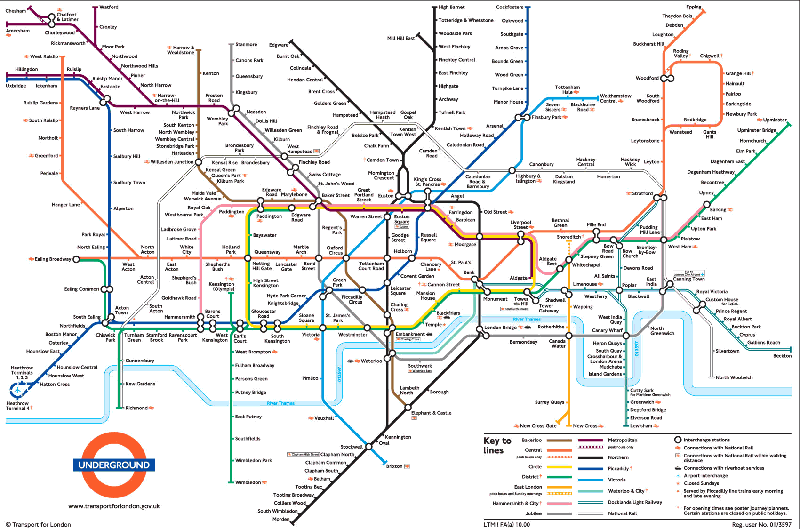
Thinking about this makes you realise how many maps and other designs rely on full colour perception for their effect. I’ve previously celebrated the London Underground map as an excellent example of graphic design, but it must be a nightmare to a person who is colour blind!

tube_map


It’s also worth mentioning that standard instructions at many institutions for marking examination papers is that the first marker should do  them in red ink and the second marker in green….

This all reminds me of the late Professor Francesco Lucchin, who first invited to Italy to work with the  astronomy group in Padova back in the early 1990s. Francesco and I ended up writing a book together and during the course of working on that he told me that he was “daltonic”. I later found out that this word does exist in English, but it is not in common usage as a word meaning “colour blind”. The standard word in Italian for “colour blind” is “daltonico” and there are many other variants in other European languages, such as the French “daltonien”. It’s very curious that Dalton’s name is so strongly associated with colour blindness across the European continent but not in the country of his birth. I wonder why this is?

By the way, if I understand correctly, the English word “daltonic” refers to a specific form of red/green colour blindness called deuteranopia, whereas the foreign variants can refer to any form of colour blindness.

P.S. You would have thought that the 25oth anniversary of Dalton’s birth would at least have warranted a Google doodle, but apparently not.

A Diſcourſe upon the “Long s”

Posted in Uncategorized on September 5, 2016 by telescoper

image


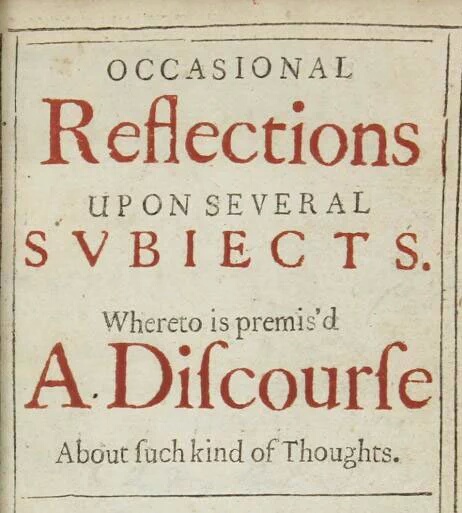
Yesterday I posted the endearingly vague book title shown above (which is actually from a book by Robert Boyle). When it appeared on Facebook I got some predictably rude comments about “fuch kind of thoughts”, etc, so I thought I’d post a little comment about the symbol “ſ'” which appears in the above. This character is sometimes called the “long s”. There’s a full Wikipedia article on this which there’s no point in repeating here, but I will just mention that the long s was used widely in manuscripts after the distinction arose better upper case and lower-case letters (which was around about the end of the 8th Century) where in the lower-case form, the “short s” (i.e. s) was used exclusively at the end of words or before an elision, and the long s everywhere else. It survived into the era of printing, not just in English but also in other languages including German. In fact “ſ” forms the left-hand element of the ligature “Eszett”, written  “ß”, of which the other part is “z”.

The long s fell increasingly out of favour in typography, partly because of the potential confusion with “f”, and partly because using the same “s” throughout a word is clearly tidier and easier to read: “sinfulness” is a lot easier on the eye than “”ſinfulneſs”. By the start of the 19th Century the long s had become a rarity; The Times phased out “ſ” in 1803.

Oh, and the long s is also the original form of the integral sign, introduced to mathematics by Leibniz to stand for “summa” (sum), which he wrote “ſumma”.