Cricket, Lovely (5-day Test) Cricket

Posted in Cricket with tags , , on August 7, 2016 by telescoper

Just spent a lazy Sunday pottering about, clearing a backlog of crosswords, and listening on the wireless to the final day of the Third Test between England and Pakistan taking place at Edgbaston (in the Midlands).

It turned out to be an eventful day, to say the least! England had overcome a first-innings deficit of 103 to finish Day 4 on 414 for 5, a lead of 311. As I suspected, they continued to bat on the morning of Day 5 but the declaration came earlier than expected, after they added just 31 runs in four overs. Pakistan needed to score 343 to win, a stiff but not impossible challenge.

I must be getting a bit cautious in my old age, but I would probably have wanted 30  more runs in so to be sure Pakistan had no chance of winning, but it seems Alastair Cook is getting a bit bolder in his captaincy…

Anyway, Pakistan lost an early wicket but otherwise proceeded fairly comfortably, a draw looking increasingly likely. Suddenly, though, some reverse swing started to appear, and wickets began to tumble. In no time at all they were 125 for 7, four wickets falling in as many overs. They limped to 151 for 9 but with 25 overs to survive with only one wicket left, Pakistan looked doomed.

The last pair, Rahat Ali and Sohail Khan decided to have a go, Sohail in particular throwing the bat to good effect and enjoying a sizeable chunk of good fortune. The overs passed. The England bowlers started to look tired. Could this pair do what Jimmy and Money had done for England against Australia at Cardiff all those years ago?

But no. All of a sudden it was over, as Man of the Match Moeen Ali took the final wicket (caught and beard) with 14 overs to spare. England won by 141 runs, with about an hour’s play left, and so take a 2-1 lead in the series with one match to play.

There has been some talk about reducing Test Matches to four days, to try to force a faster tempo which will appeal more to the public. I think that would be a shame. It is true that some passages of play in this series, and indeed in this match, have been slow, but the games have been absorbing precisely because of the tension generated by the shifting tactical situation.

So I hope we keep the 5-day format for Test cricket. I love it!

Vitae Summa Brevis Spem Nos Vetat Incohare Longam

Posted in Poetry with tags , , on August 6, 2016 by telescoper

The title of this poem by Ernest Dowson, Vitae Summa Brevis Spem Nos Vetat Incohare Longam, can be translated from my half-remembered schoolboy Latin as something like “the brief span of Life forbids us from conceiving an enduring hope”. It’s a quotation from one of the Odes of Horace (Book I, Ode 4, line 15):

They are not long, the weeping and the laughter,
Love and desire and hate:
I think they have no portion in us after
We pass the gate.

They are not long, the days of wine and roses:
Out of a misty dream
Our path emerges for a while, then closes
Within a dream.

by Ernest Dowson (1867-1900)

Last Day in Brighton

Posted in Biographical on August 5, 2016 by telescoper

Here I am in the flat I’ve been renting for the past three and a half years. I’m just packing the last of my belongings ready to take back to Cardiff. I’ll be handing back the keys this afternoon and then heading for the railway station.

I left my job at Sussex at the end of last week, but the tenancy of the flat doesn’t expire until tomorrow so I thought I might as well make the most of it.

Tomorrow is the annual Pride celebration in Brighton, which I’ve decided to miss for logistical reasons. I hope it goes well though, especially for the weather.

It’s a warm sunny day and I may go for a stroll along the promenade before I leave. I still think that Brighton would have been a nice place to live, if only I’d been able to find the time to enjoy it, but I have no regrets about returning to Cardiff. When you start to dread going into work every morning it’s definitely time to make a change. It was an immense relief when I removed the Sussex University email account from my mobile phone!

But this isn’t really a time for looking back. I am looking forward to the next few weeks because I’m not actually starting work at Cardiff until September. I’m going to spend most of August pottering about the house, though I do have a (hopefully short) stay in hospital scheduled for routine maintenance.

It will probably feel quite strange when I do get back to work at Cardiff, but at least there will be some familiar faces!

Update: courtesy of Southern Rail I had to stand all the way from Brighton to Victoria. They could only muster four coaches for a peak time train. I won’t miss Southern Fail that’s for sure..

The Brexit vote wasn’t democracy in action. It was populist ignorance on a grand scale.

Posted in Uncategorized on August 4, 2016 by telescoper

I agree 100% with this, and will also continue to campaign for the United Kingdom to remain a full member of the European Union. As the grim economic reality starts to bite, I think many will wake up and stop the madness before it’s too late.

Tom Pride's avatarPride's Purge

No-one else seems to be saying this, so I will.

Way back in 1988 – when the Thatcher government passed the infamous anti-homosexual law known as Section 28 – a majority of the UK population supported it.

I was one of the minority who was against it.

Even as late as 2000, polls showed around 52% of the UK population were against the Blair government repealing the law.

Despite being in the minority – I was never in any doubt that the majority were wrong.

These days, of course, everyone claims they know Section 28 was wrong. David Cameron – a strong supporter of Section 28 at the time it was introduced – has even apologised for it.

So we – the minority who were always against Section 28 – were in the end proven to be right.

That’s why Remain supporters need to get their balls back. Because being in a minority doesn’t make us wrong.

Politicians are too afraid…

View original post 412 more words

Leonard Cohen pays tribute to woman who inspired ‘So Long Marianne’ who died last week

Posted in Uncategorized on August 3, 2016 by telescoper

“Now so long, Marianne, it’s time that we began
To laugh and cry and cry and laugh about it all again..”

Ian's avatarShuffle Radio

Leonard Cohen has paid tribute to Marianne Ihlen, the woman who inspired ‘So Long Marianne’ who died last week.

Writing on Facebook, Cohen asked that this letter to him from Jan Christian Mollestad be used in his memorial. Jan Christian Mollestad is currently completing a biographical film about Marianne.

“Marianne slept slowly out of this life yesterday evening. Totally at ease, surrounded by close friends,” the letter began. “Your letter came when she still could talk and laugh in full consciousness. When we read it aloud, she smiled as only Marianne can. She lifted her hand, when you said you were right behind, close enough to reach her.”

Getty

It continued, “It gave her deep peace of mind that you knew her condition. And your blessing for the journey gave her extra strength. Jan and her friends who saw what this message meant for her, will all thank you in…

View original post 146 more words

High-resolution Observation of the Sunyaev-Zel’dovich Effect With ALMA

Posted in The Universe and Stuff with tags , , on August 1, 2016 by telescoper

I just saw a very interesting paper (by Kitayama et al.) on the arXiv, which I’m pretty sure presents the highest-ever resolution observations of the (Thermal) Sunyaev-Zel’dovich Effect in a galaxy cluster taken with the Atacama Large Millimetre Array (ALMA). This is basically a distortion of the spectrum of the cosmic microwave background seen in the direction of the cluster caused by scattering of CMB photons off electrons in the extremely hot plasma that pervades such an object. The key parameter to be measured along each line of sight is the Compton y-parameter, which is defined as

y = \tau \frac{kT}{m_ec^2},

where \tau the optical depth of the cluster (which in this case is essentially the fraction of CMB photons that get scattered) and T is the plasma temperature; for a more technical discussion of the process see here.
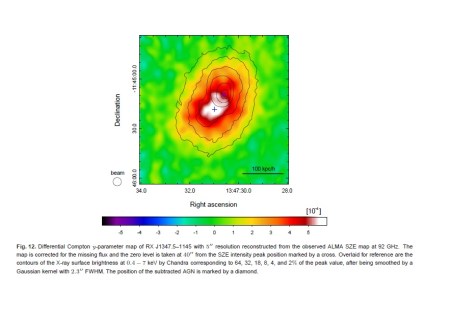
Here is the abstract of the paper:

We present the first image of the thermal Sunyaev-Zel’dovich effect (SZE) obtained by the Atacama Large Millimeter/submillimeter Array (ALMA). Combining 7-m and 12-m arrays in Band 3, we create an SZE map toward a galaxy cluster RXJ1347.5-1145 with 5 arc-second resolution (corresponding to the physical size of 20 kpc/h), the highest angular and physical spatial resolutions achieved to date for imaging the SZE, while retaining extended signals out to 40 arc-seconds. The 1-sigma statistical sensitivity of the image is 0.017 mJy/beam or 0.12 mK_CMB at the 5 arc-second full width at half maximum. The SZE image shows a good agreement with an electron pressure map reconstructed independently from the X-ray data and offers a new probe of the small-scale structure of the intracluster medium. Our results demonstrate that ALMA is a powerful instrument for imaging the SZE in compact galaxy clusters with unprecedented angular resolution and sensitivity. As the first report on the detection of the SZE by ALMA, we present detailed analysis procedures including corrections for the missing flux, to provide guiding methods for analyzing and interpreting future SZE images by ALMA.

And here is the key image, a map of the variation of the Compton y-parameter across the cluster:

SZ

It’s not at all easy to isolate the Sunyaev-Zeld’dovich effect, so this is an impressive result and the paper is well-worth reading. Observations at such high resolution will help greatly to understand the behaviour of hot gas in rich clusters, especially when combined with observations of the emission from the cluster plasma itself, which is hot enough to radiate in the X-ray part of the spectrum.

Henry Draper’s Photograph of M42

Posted in History, The Universe and Stuff with tags , , , , on July 29, 2016 by telescoper

I just remembered that last night I happened across an interesting episode of The Essay on Radio 3. It was about the first ever photograph of an astronomical nebula, which happened to be of the Orion Nebula (M42). The programme features Omar Nasim, a lecturer in History at Kent University, and is available on iPlayer or as a download here. It’s only 15 minutes long, but absolutely fascinating.

Here is the photograph concerned, taken by Henry Draper in 1880:

Henry_Drape_Orion_nebula_1880_inverted

The stars of the constellation Orion are clearly over-exposed in order to reveal the much fainter light from the nebula, and the resolution is poor compared to, e.g., this glorious Hubble Space Telescope image:

Hubble's sharpest view of the Orion Nebula

The Orion Nebula seen by Hubble. Credit: ESA/NASA/Hubble Space Telscope

Nevertheless the Draper photograph is of great historical importance, as it changed the way astronomers made images of such objects (by photography rather than by drawing) and ushered in a new era of scientific research.

Hat’s off to Henry Draper!

Sussex versus Glamorgan

Posted in Biographical, Cricket with tags , , , on July 29, 2016 by telescoper

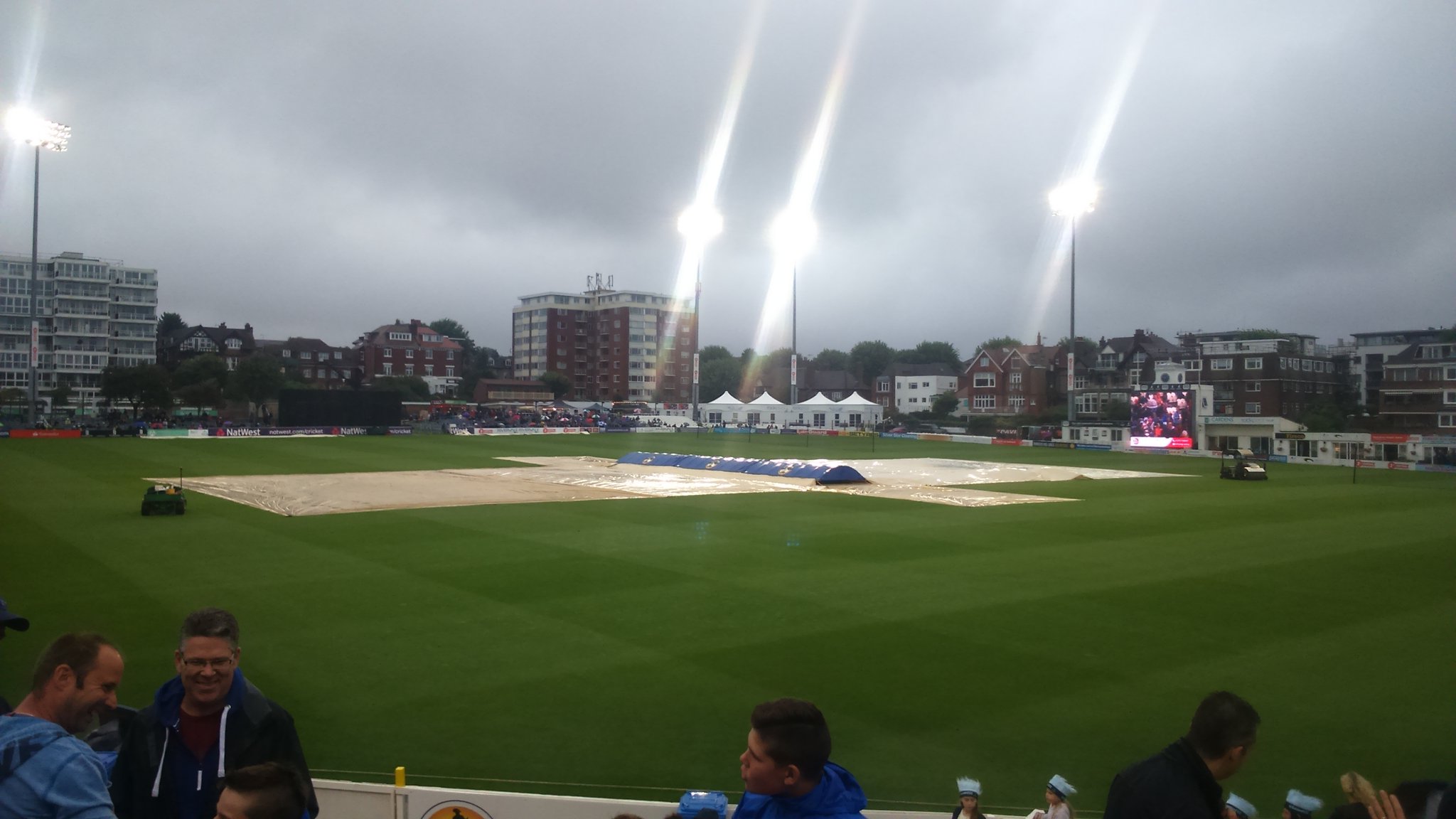
It was an interesting coincidence that, last night, on the eve of my last day working at the University of Sussex before moving to Cardiff University, there was a game of cricket between Sussex and Glamorgan at the County Ground in Hove. Naturally I decided to go along and was fortunate to have Dorothy Lamb along for company. To be precise this wasn’t “proper cricket”, but a Natwest T20 “Blast”. Unfortunately the weather dampened the squib considerably. Yesterday’s weather forecast predicted rain in the afternoon clearing by the time the game started (at 18.30), but when we got to the ground it was still drizzling:

Cricket_1

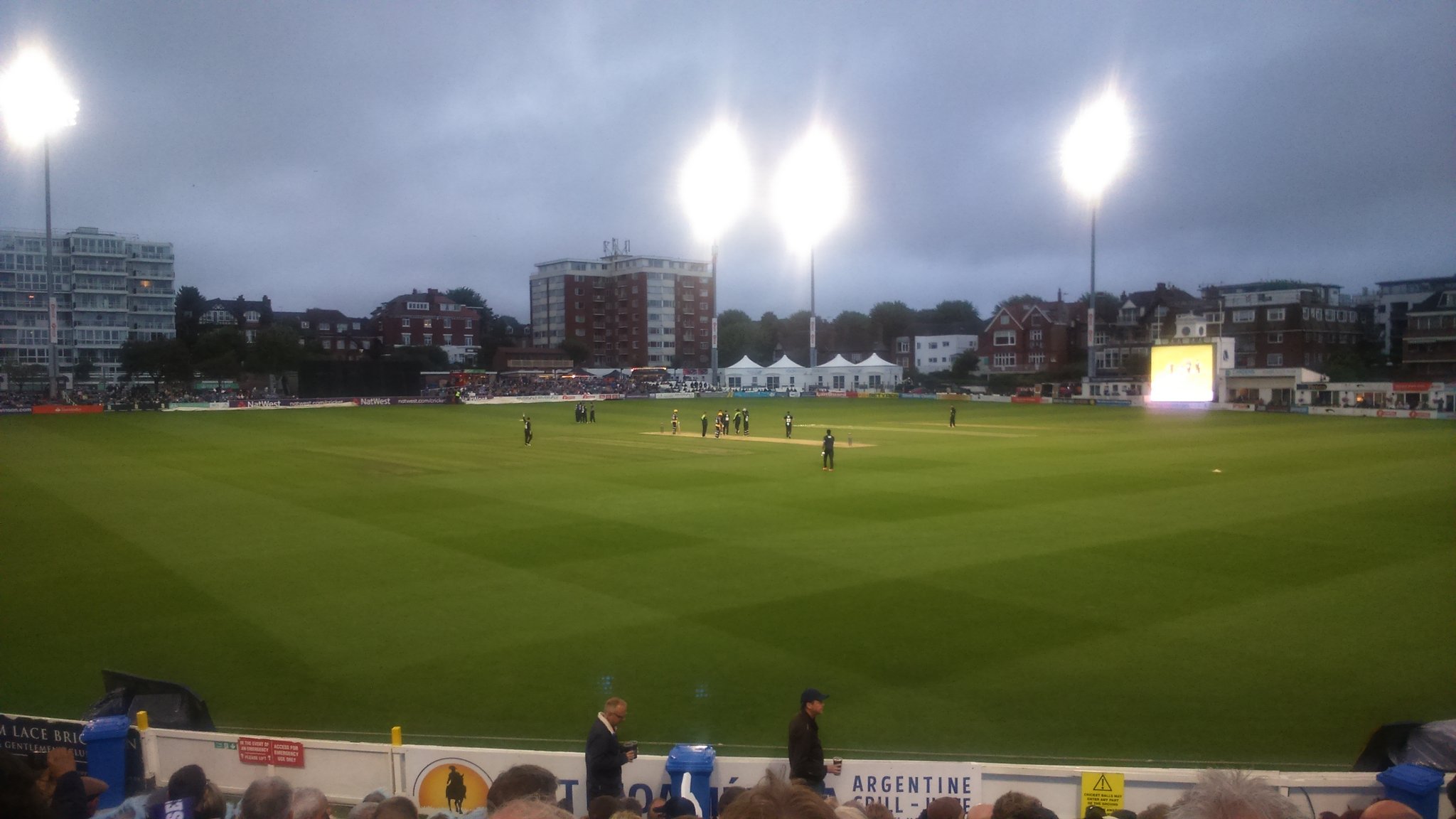
After a lot of faffing about play did actually get under way at about 19.50, the match to be reduced to 14 overs a side because of the late start.

Cricket_2You can see the full scorecard here. Glamorgan batted first, struggling right from the start despite some wayward bowling from Sussex.  Having been 62 for 8 at one point they were probably relieved to get into three figures, though they only just managed this: they were all out for 101 in the last over. Sussex batted and got off to a much better start, but then the rain came back so they went off. They then came back again but only one ball was beowled before the rain (which was really just drizzle) started again so they went off again. And so on. In the end only four overs and one ball were possible before the rain came back for good and the match was abandoned with no result. The upshot of this was that Glamorgan qualified for the Quarter Finals and Sussex didn’t. Glamorgan were lucky. Sussex were 30-1 when play was halted but a minimum of five overs have to be bowled for a result to be declared. A few minutes more play and Sussex would almost certainly have won. Such is life.


Stern Response

Posted in Science Politics with tags , , on July 28, 2016 by telescoper

The results of the Stern Review of the process for assessing university research and allocating public funding has been published today. This is intended to inform the way the next Research Excellence Framework (REF) will be run, probably in 2020, so it’s important for all researchers in UK universities.

Here are the main recommendations, together with brief comments from me (in italics):

  1. All research active staff should be returned in the REF. Good in principle, but what is to stop institutions moving large numbers of staff onto teaching-only contracts (which is what happened in New Zealand when such a move was made)?
  2. Outputs should be submitted at Unit of Assessment level with a set average number per FTE but with flexibility for some faculty members to submit more and others less than the average.Outputs are countable and therefore “fewer” rather than “less”. Other than that, having some flexibility seems fair to me as long as it’s not easy to game the system. Looking it more detail at the report it suggests that some could submit up to six and others potentially none, with an average of perhaps two across the UoA. I’m not sure precise  numbers make sense, but the idea seems reasonable.
  3. Outputs should not be portable. Presumably this doesn’t mean that only huge books can be submitted, but that outputs do not transfer when staff transfer. I don’t think this is workable, but that what should happen is that credit for research should be shared between institutions when a researcher moves from one to another.
  4. Panels should continue to assess on the basis of peer review. However, metrics should be provided to support panel members in their assessment, and panels should be transparent about their use. Good. Metrics only tell part of the story.
  5. Institutions should be given more flexibility to showcase their interdisciplinary and collaborative impacts by submitting ‘institutional’ level impact case studies, part of a new institutional level assessment. It’s a good idea to promote interdisciplinarity, but it’s not easy to make it happen…
  6. Impact should be based on research of demonstrable quality. However, case studies could be linked to a research activity and a body of work as well as to a broad range of research outputs. This would be a good move. The existing rules for Impact seem unnecessarily muddled.
  7. Guidance on the REF should make it clear that impact case studies should not be narrowly interpreted, need not solely focus on socio-economic impacts but should also include impact on government policy, on public engagement and understanding, on cultural life, on academic impacts outside the field, and impacts on teaching. Also good.
  8. A new, institutional level Environment assessment should include an account of the institution’s future research environment strategy, a statement of how it supports high quality research and research-related activities, including its support for interdisciplinary and cross-institutional initiatives and impact. It should form part of the institutional assessment and should be assessed by a specialist, cross-disciplinary panel. Seems like a reasonable idea, but a “specialisr cross-disciplinary” panel might be hard to assemble…
  9. That individual Unit of Assessment environment statements are condensed, made complementary to the institutional level environment statement and include those key metrics on research intensity specific to the Unit of Assessment. Seems like a reasonable idea.
  10. Where possible, REF data and metrics should be open, standardised and combinable with other research funders’ data collection processes in order to streamline data collection requirements and reduce the cost of compiling and submitting information. Reasonable, but a bit vague.
  11. That Government, and UKRI, could make more strategic and imaginative use of REF, to better understand the health of the UK research base, our research resources and areas of high potential for future development, and to build the case for strong investment in research in the UK. This sounds like it means more political interference in the allocation of research funding…
  12. Government should ensure that there is no increased administrative burden to Higher Education Institutions from interactions between the TEF and REF, and that they together strengthen the vital relationship between teaching and research in HEIs. I believe that when I see it.

Any further responses (stern or otherwise) are welcome through the comments box!


The Rising Stars of Sussex Physics

Posted in Bad Statistics, Biographical, Education with tags , , , , on July 28, 2016 by telescoper

This is my penultimate day in the office in the School of Mathematical and Physical Sciences at the University of Sussex, and a bit of news has arrived that seems a nice way to round off my stint as Head of School.

It seems that Physics & Astronomy research at the University of Sussex has been ranked as 13th in western Europe and 7th in the UK by leading academic publishers, Nature Research, and has been profiled as one of its top-25 “rising stars” worldwide.

I was tempted to describe this rise as ‘meteoric’ but in my experience meteors generally fall down rather than rise up.

Anyway, as regular readers of this blog will know, I’m generally very sceptical of the value of league tables and there’s no reason to treat this one as qualitatively any different. Here is an explanation of the (rather curious) methodology from the University of Sussex news item:

The Nature Index 2016 Rising Stars supplement identifies the countries and institutions showing the most significant growth in high-quality research publications, using the Nature Index, which tracks the research of more than 8,000 global institutions – described as “players to watch”.

The top 100 most improved institutions in the index between 2012 and 2015 are ranked by the increase in their contribution to 68 high-quality journals. From this top 100, the supplement profiles 25 rising stars – one of which is Sussex – that are already making their mark, and have the potential to shine in coming decades.

The institutions and countries examined have increased their contribution to a selection of top natural science journals — a metric known as weighted fractional count (WFC) — from 2012 to 2015.

Mainly thanks to a quadrupling of its physical sciences score, Sussex reached 351 in the Global 500 in 2015. That represents an 83.9% rise in its contribution to index papers since 2012 — the biggest jump of any UK research organisation in the top 100 most improved institutions.

It’s certainly a strange choice of metric, as it only involves publications in “high quality” journals, presumably selected by Journal Impact Factor or some other arbitrary statistical abominatio,  then taking the difference in this measure between 2012 and 2015  and expressing the change as a percentage. I noticed one institution in the list has improved by over 4600%, which makes Sussex’s change of 83.9% seem rather insignificant…

But at least this table provides some sort of evidence that the investment made in Physics & Astronomy over the last few years has made a significant (and positive) difference. The number of research faculty in Physics & Astronomy has increased by more than 60%  since 2012 so one would have been surprised not to have seen an increase in publication output over the same period. On the other hand, it seems likely that many of the high-impact papers published since 2012 were written by researchers who arrived well before then because Physics research is often a slow burner. The full impact of the most recent investments has probably not yet been felt. I’m therefore confident that Physics at Sussex has a very exciting future in store as its rising stars look set to rise still further! It’s nice to be going out on a high note!