I Journeyed from University to University

Posted in Poetry with tags , , on August 14, 2016 by telescoper

I journeyed from university to university, and I saw everywhere the past rebuilt before the eyes of young men and young women — Egypt, Greece, Rome; language, architecture, laws –saw the earth and sky explained, and the habits of mind and the habits of body —

Everywhere chairs of this and that, largely endowed.

But nowhere saw I a chair of the human heart.

by Max Ehrmann (1872-1945)

August, by Dorothy Parker

Posted in Poetry with tags , , on August 13, 2016 by telescoper

When my eyes are weeds,
And my lips are petals, spinning
Down the wind that has beginning
Where the crumpled beeches start
In a fringe of salty reeds;
When my arms are elder-bushes,
And the rangy lilac pushes
Upward, upward through my heart; 

Summer, do your worst!
Light your tinsel moon, and call on
Your performing stars to fall on
Headlong through your paper sky;
Nevermore shall I be cursed
By a flushed and amorous slattern,
With her dusty laces’ pattern
Trailing, as she straggles by.

by Dorothy Parker (1893-1967).

Everything is fucked: The syllabus

Posted in Uncategorized on August 12, 2016 by telescoper

The course to attend…

Sanjay Srivastava's avatarThe Hardest Science

PSY 607: Everything is Fucked
Prof. Sanjay Srivastava
Class meetings: Mondays 9:00 – 10:50 in 257 Straub
Office hours: Held on Twitter at your convenience (@hardsci)

In a much-discussed article at Slate, social psychologist Michael Inzlicht told a reporter, “Meta-analyses are fucked” (Engber, 2016). What does it mean, in science, for something to be fucked? Fucked needs to mean more than that something is complicated or must be undertaken with thought and care, as that would be trivially true of everything in science. In this class we will go a step further and say that something is fucked if it presents hard conceptual challenges to which implementable, real-world solutions for working scientists are either not available or routinely ignored in practice.

The format of this seminar is as follows: Each week we will read and discuss 1-2 papers that raise the question of whether something is fucked. Our focus…

View original post 544 more words

Uccello and the Problem of Space

Posted in Art, Television, The Universe and Stuff with tags , , , , on August 12, 2016 by telescoper

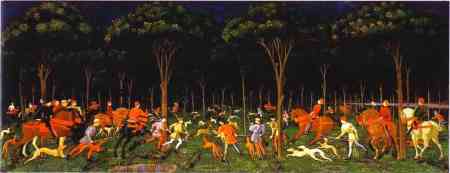
The other night I was watching an old episode of the detective series Lewis and it reminded me of something I wanted to blog about but never found the time. The episode in question, The Point of Vanishing, involves a discussion of a painting which can be found in the Ashmolean Museum in Oxford:
Uccello_TheHunt

I won’t spoil the plot by explaining its role in the TV programme, but this work – called “The Hunt in the Forest” or “The Night Hunt” or some other variation on that title –  is by one of the leading figures of the Early Renaissance, Paolo Uccello, who was born in Florence and lived from about 1396 until 1475. He was most notable for his explorations of the use of perspective in painting, and specifically in “The Problem of Space”, i.e. how to convey the presence of three dimensions when the paint is confined to only two. This picture accomplishes this not only by having a clear vanishing point in the centre of the composition, but also by the arrangement of the figures. Notice how the figures in the foreground are generally moving in the plane of the canvas, but towards the centre they are heading away from the observer. The composition thus acts like a funnel, drawing the viewer’s eye into the centre of the picture and then off into the distance, and the darkness.

Two other things are of interest here. One is that it’s not at all clear what is being hunted, or even whether there’s anything out there in the darkness at all. Is the hunt a metaphor for something else, perhaps the pursuit of something unattainable?

It’s also clear that Uccello wasn’t as interested in realism as he was in geometry and proportion. The horses, dogs and people are drawn in a rather primitive style reminiscent of mediaeval painting.  I think that suggests a metaphorical interpretation of the subject matter.

I see this painting as  a brilliant experiment in geometry rather than an attempt to depict a likeness of an actual event.  Reading about Uccello reveals him to have been somewhat obsessive about perspective – his  friend, the great artist Donatello, remarked that Uccello  spent too much time studying and not enough painting – but his contribution to the development of painting techniques during the Renaissance period was immense.

Although Uccello may have taken it to an extreme, interest in the formal, geometric, aspects of art wasn’t at all unusual in this period. I blogged a while ago about another favourite Renaissance artist, Piero della Francesca (c. 1415-1492) whose life overlapped with Uccello. He combined his work as an artist with a distinguished career as a Mathematician. It would be surprising if Uccello and Piero della Francesca never met, but a quick search didn’t find any definitive evidence that they did.

Another great example of Uccello’s art is this:

g013_uccello_rout

It is one of the three panels of The Battle of San Romano. Again, the living figures are simply drawn – the bodies, weapons and bits of armour on the ground look like they might be toys on a nursery floor – but the way the painting gives the impression that everything is receding into the distance is remarkably effective.

But the best example of Uccello’s work that I’ve seen in the flesh (so to speak) is this:
Paolo_Uccello_Deluge_web

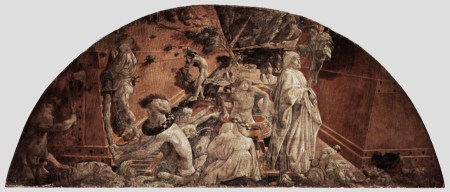
This – Flood and Waters Subsiding –  is a fresco located in the Church of Santa Maria Novella in Florence. Unfortunately it’s quite badly damaged – not only have the colours faded badly but parts of the plaster have crumbled away entirely. Fresco is a notorious fragile medium and it’s sad that so many great Renaissance works of this type have been lost over the years. However, despite the disrepair, this is still an amazing piece. Perhaps helped by the semi-circular space into which it was designed to fit, this work manages to convey a sense of vorticity; There’s not so  much a vanishing point as a point of origin and the action seems to swirl around it as well as to emerge from it. Note also that in contrast to the previous two paintings, the figures in this one are very lifelike, although the fading of the colours gives them a rather ghostly appearance. It’s also interesting that this work pre-dates The Hunt in the Forest by at least twenty years so the movement away from realism was something that happened in later life.

I’ve often wondered why I feel so intrigued by Early Renaissance Art. Of course these works are beautiful or exciting or in some other way pleasurable to look at, but there’s much more to it than that. They inspire curiosity. What is going on? Who are these figures? What is being hunted? Why is everything arranged in that particular way? And the act of looking at a painting like that , and being curious, perhaps reminds us that curiosity is so important for its own sake.


Glamorgan versus Yorkshire

Posted in Cricket with tags , , , on August 11, 2016 by telescoper

Following the Natwest T20 Blast between Sussex and Glamorgan a couple of weeks ago, I decided tonight to follow Glamorgan’s progress in the competition in their Quarter-final match in Cardiff against Yorkshire.

The SWALEC Stadium – just down the road from my house – wasn’t quite full for the match, but there was a healthy crowd of about 10,000, including lots of families with kids. Part of the reason for that must be the fact that tickets were cheap: £10 for adults and a fiver for kids. Adult tickets for the match at Hove were £26 each…

Anyway, although it was cloudy and not particularly warm, at least it stayed dry.

image

Yorkshire won the toss and batted, getting off to an excellent start largely thanks to the positive batting of David Willey. They reached 101 for 1 of just 9 overs, suggesting the  real possibility of a score of over 200. However, they lost wickets in quick succession – including that of top scorer Willey for 79 (off just 38 balls) and their innings stuttered, eventually closing on 180 for 8. That’s a good score, but Glamorgan were probably pleased to have restricted Yorkshire to nine an over.

Having watched Glamorgan’s batsmen struggle against Sussex I wasn’t exactly filled with confidence that they would reach Yorkshire’s total. They got off to a calamitous start, with opener Lloyd playing on to his first ball from Bresnan. From then on they  never looked like coping with the Yorkshire bowling and were eventually bowled out in 13 overs for 90, just half of Yorkshire’s score. And it could have been worse: at one point they were 37 for 6.

Anyway this leaves only four teams in the competition: Durham, Northants, Notts and Yorkshire. All – you will notice – from the Midlands.

Jonathan Agnew & Brian Johnston: 25 Years of the Legover – YouTube

Posted in Cricket with tags , on August 10, 2016 by telescoper

By the way, this wonderful moment in cricket history happened exactly 25 years ago today…

Brexit: Enough David Brent, this is serious!

Posted in Uncategorized on August 10, 2016 by telescoper

Interesting discussion of the complexity of the task facing BrExit negotiators. It will probably take a very long time even to work out what we want, let alone finalise the details. Perhaps in that time as the economy slides further into recession the good folk of the UK will realise it was all a very bad idea. But will we ever get the chance to reverse the referendum result?

Rick's avatarFlip Chart Fairy Tales

A few years ago, I was listening to a talk by a coach and motivational speaker who was extolling the virtues of positive thinking and the new empowered, non-hierarchical, collaborative workplace. I said that, while I loved his wonderful image of the future of work, I didn’t see much evidence of a trend in that direction. We had been talking about these things for twenty years, yet command and control was still the norm in many industries and technology was making some workplaces more regimented than ever. Not to mention the people on various forms of precarious contract at the whim of their managers.

His response was that, by choosing to focus on such things, I was displaying my negative mind-set. I was filtering information according to my preconceived ideas and refusing to allow in the positive and hopeful future. See what he did there? He turned his complete lack of supporting evidence for…

View original post 1,673 more words

Human collective intelligence as distributed Bayesian inference

Posted in The Universe and Stuff on August 9, 2016 by telescoper

And now for something completely different. I came across an interesting paper (by Krafft et al) on the arXiv and thought I would share it here. You can download the full text from the link above, but here is the abstract:

Collective intelligence is believed to underly the remarkable success of human society. The formation of accurate shared beliefs is one of the key components of human collective intelligence. How are accurate shared beliefs formed in groups of fallible individuals? Answering this question requires a multiscale analysis. We must understand both the individual decision mechanisms people use, and the properties and dynamics of those mechanisms in the aggregate. As of yet, mathematical tools for such an approach have been lacking. To address this gap, we introduce a new analytical framework: We propose that groups arrive at accurate shared beliefs via distributed Bayesian inference. Distributed inference occurs through information processing at the individual level, and yields rational belief formation at the group level. We instantiate this framework in a new model of human social decision-making, which we validate using a dataset we collected of over 50,000 users of an online social trading platform where investors mimic each others’ trades using real money in foreign exchange and other asset markets. We find that in this setting people use a decision mechanism in which popularity is treated as a prior distribution for which decisions are best to make. This mechanism is boundedly rational at the individual level, but we prove that in the aggregate implements a type of approximate “Thompson sampling”—a well-known and highly effective single-agent Bayesian machine learning algorithm for sequential decision-making. The perspective of distributed Bayesian inference therefore reveals how collective rationality emerges from the boundedly rational decision mechanisms people use.

It’s an interesting question how Bayesian inference relates to the multitude of ways in which individual humans update their understanding of and beliefs about various aspects of the world in the light of new information. This is not always a  rational process! This paper extends the discussion to how collective beliefs are shaped, and how this process relates to what happens at the level of the individual.

Get Happy!

Posted in Jazz with tags , , , on August 8, 2016 by telescoper

Back in Cardiff I was going through my collection of old LPs and found this track on a Blue Note collection. It’s standard written by Harold Arlen called Get Happy. I hadn’t listened to it for ages and I’d forgotten how great it is. It was recorded in 1953 by a six-piece band led by trombonist Jay Jay Johnson, with Clifford Brown (trumpet), Jimmy Heath (tenor saxophone), John Lewis (piano), Percy Heath (bass) and Kenny Clarke (drums). They’re all great musicians, and they make a wonderfully rich ensemble sound for a small band, but the star of the show is without doubt the great Clifford Brown , whose solo is absolutely sensational. Just listen to the way he plays the bridge on his first chorus. Superb!

“Just one more thing”: The psychology of ‘Columbo’

Posted in Uncategorized on August 8, 2016 by telescoper

I got a pingback from this piece this morning, as it links to a post on this blog, so I thought I’d share it here. I named my dear departed cat Columbo precisely because he had a habit of leaving through the catflap only to return a second later…

drmarkgriffiths's avatardrmarkgriffiths

My favourite TV detective has always been Columbo (played by Peter Falk). I have watched every single one of the 69 episodes (as my family will attest) many times. While I am working, I will often have Columbo on in the background in the way that other people have music on in the background (although I do the latter as well). For those reading this that have not come across Columbo, here is a brief synopsis from Wikiquote:

“Columbo (1968, 1971-1978, 1989-2003) was an American crime fiction television show about Lieutenant Columbo, a homicide detective with the Los Angeles Police Department. He uses his deferential and absent-minded persona to lull criminal suspects into a false sense of security, by harassing and pestering suspects non-stop – without letting them know that they’re suspects – under the pretense that he’s simply being a pesky detective, in order to spy on them and agitate…

View original post 2,213 more words