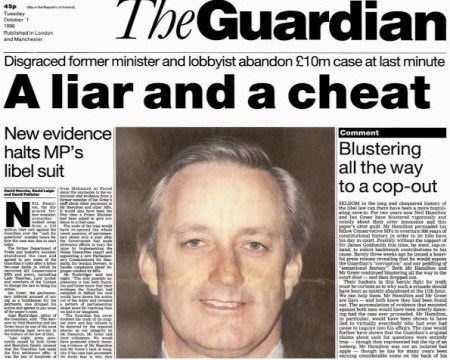
Last week’s elections to the Welsh Assembly saw the UK Independence Party winning seats in the Senedd for the very first time, although Welsh Labour remained the largest party by a comfortable margin despite losing a seat to Plaid Cymru. Among the 7 UK AMs elected was disgraced former Conservative MP Neil Hamilton who featured in this Guardian headline just 20 years ago.
Following this “Cash for Questions” scandal, he lost his seat in the 1997 General Election, at which point he left politics and joined UKIP.
Not content with merely winning a seat in the Assembly elections, Mr Hamilton then ousted former leader Nathan Gill of UKIP Wales and is now running the show. It’s been a bizarre turn of events. There’s clearly no end to his ambition (nor any beginning to his integrity).
Questions may be asked about a person such as Neil Hamilton could have been voted into power, but it’s not year clear how much it will cost to ask them.
All I can say is I hope they keep a close eye on the cutlery in the Senedd canteen.
Interesting comments on referendums authored by academics from the University of Sussex, although it seems to me that the thing that most affects the outcome of a referendum is how many people vote on each side…
Donald Rumsfeld famously talked about ‘known knowns’ and ‘known unknowns’. Looking systematically at referendums and at the experience of these in Europe, we can learn from what has happened in other European referendums to help us in looking at what may happen in the UK’s referendum on EU membership. There may be uncertainty ahead but we can know what we don’t know from previous experience. We suggest that there are six lessons we can learn
Referendum outcomes are hard to predict
The one ‘known known’ we have is the state of the polls at the outset. But early in the campaign, opinion polls tell us very little about what the outcome of the referendum will be on 23 June. Around 20% of voters are still undecided. More than that, voting behaviour in referendums is much less settled and more fluid than in general elections. This…
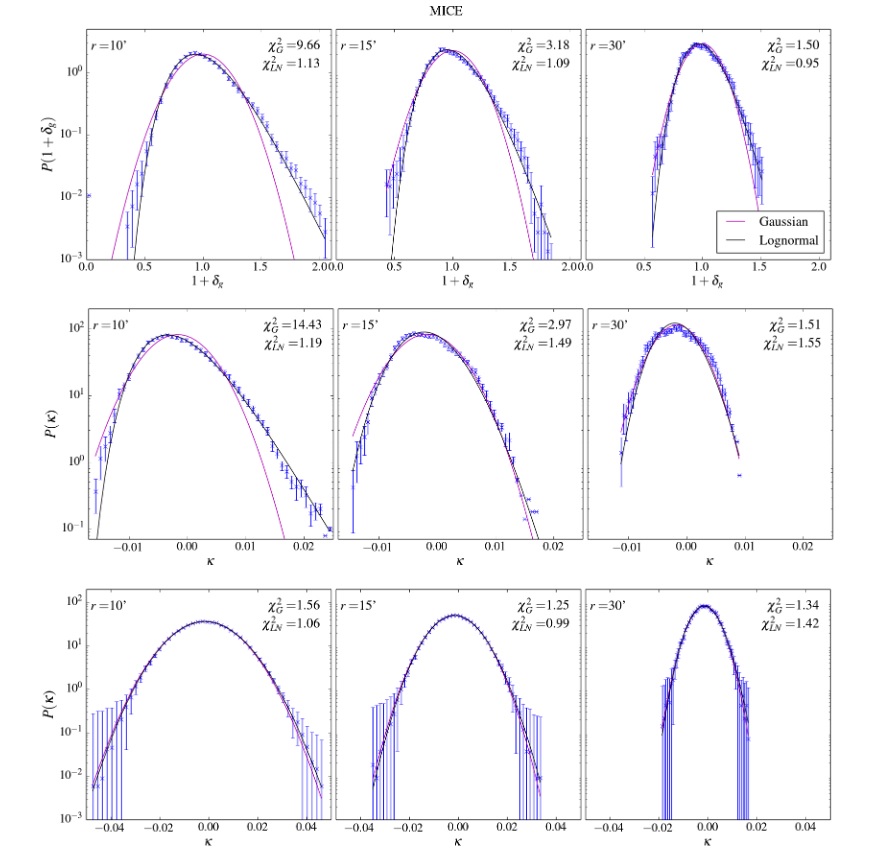
The points here are from MICE simulations. Not simulations of mice, of course, but simulations of MICE (Marenostrum Institut de Ciencies de l’Espai). Note how well the curves from a simple lognormal model fit the calculations that need a supercomputer to perform them!
The lognormal model used in the paper is basically the same as the one I developed in 1990 with Bernard Jones in what has turned out to be my most-cited paper. In fact the whole project was conceived, work done, written up and submitted in the space of a couple of months during a lovely visit to the fine city of Copenhagen. I’ve never been very good at grabbing citations – I’m more likely to fall off bandwagons rather than jump onto them – but this little paper seems to keep getting citations. It hasn’t got that many by the standards of some papers, but it’s carried on being referred to for almost twenty years, which I’m quite proud of; you can see the citations-per-year statistics even seen to be have increased recently. The model we proposed turned out to be extremely useful in a range of situations, which I suppose accounts for the citation longevity:
Citations die away for most papers, but this one is actually attracting more interest as time goes on! I don’t think this is my best paper, but it’s definitely the one I had most fun working on. I remember we had the idea of doing something with lognormal distributions over coffee one day, and just a few weeks later the paper was finished. In some ways it’s the most simple-minded paper I’ve ever written – and that’s up against some pretty stiff competition – but there you go.
The lognormal seemed an interesting idea to explore because it applies to non-linear processes in much the same way as the normal distribution does to linear ones. What I mean is that if you have a quantity Y which is the sum of n independent effects, Y=X1+X2+…+Xn, then the distribution of Y tends to be normal by virtue of the Central Limit Theorem regardless of what the distribution of the Xi is If, however, the process is multiplicative so Y=X1×X2×…×Xn then since log Y = log X1 + log X2 + …+log Xn then the Central Limit Theorem tends to make log Y normal, which is what the lognormal distribution means.
The lognormal is a good distribution for things produced by multiplicative processes, such as hierarchical fragmentation or coagulation processes: the distribution of sizes of the pebbles on Brighton beach is quite a good example. It also crops up quite often in the theory of turbulence.
I’ll mention one other thing about this distribution, just because it’s fun. The lognormal distribution is an example of a distribution that’s not completely determined by knowledge of its moments. Most people assume that if you know all the moments of a distribution then that has to specify the distribution uniquely, but it ain’t necessarily so.
If you’re wondering why I mentioned citations, it’s because they’re playing an increasing role in attempts to measure the quality of research done in UK universities. Citations definitely contain some information, but interpreting them isn’t at all straightforward. Different disciplines have hugely different citation rates, for one thing. Should one count self-citations?. Also how do you apportion citations to multi-author papers? Suppose a paper with a thousand citations has 25 authors. Does each of them get the thousand citations, or should each get 1000/25? Or, put it another way, how does a single-author paper with 100 citations compare to a 50 author paper with 101?
Or perhaps a better metric would be the logarithm of the number of citations?
The other day I came across something I’ve never seen before: an academic paper about cryptic crosswords. It’s in an open access journal so feel free to clock – it’s not behind a paywall. Anyway, the abstract reads:
This paper presents a relatively unexplored area of expertise research which focuses on the solving of British-style cryptic crossword puzzles. Unlike its American “straight-definition” counterparts, which are primarily semantically-cued retrieval tasks, the British cryptic crossword is an exercise in code-cracking detection work. Solvers learn to ignore the superficial “surface reading” of the clue, which is phrased to be deliberately misleading, and look instead for a grammatical set of coded instructions which, if executed precisely, will lead to the correct (and only) answer. Sample clues are set out to illustrate the task requirements and demands. Hypothesized aptitudes for the field might include high fluid intelligence, skill at quasi-algebraic puzzles, pattern matching, visuospatial manipulation, divergent thinking and breaking frame abilities. These skills are additional to the crystallized knowledge and word-retrieval demands which are also a feature of American crossword puzzles. The authors present results from an exploratory survey intended to identify the characteristics of the cryptic crossword solving population, and outline the impact of these results on the direction of their subsequent research. Survey results were strongly supportive of a number of hypothesized skill-sets and guided the selection of appropriate test content and research paradigms which formed the basis of an extensive research program to be reported elsewhere. The paper concludes by arguing the case for a more grounded approach to expertise studies, termed the Grounded Expertise Components Approach. In this, the design and scope of the empirical program flows from a detailed and objectively-based characterization of the research population at the very onset of the program.
I still spend quite a lot of my spare time solving these “British-style” cryptic crossword puzzles. In fact I simply can’t put a crossword down until I’ve solved all the clues, behaviour which I admit is bordering on the pathological. Still, I think of it as a kind of mental jogging, forcing your brain to work in unaccustomed ways is probably good to develop mental fitness for other more useful things. I won’t claim to have a “high fluid intelligence” or any other of the attributes described in the abstract, however. As a matter of fact I think in many ways cryptic crosswords are easier than the straight “American-style” definition puzzle. I’ll explain why shortly. I can’t remember when I first started doing cyptic crossword puzzles, or even how I learned to do them. But then people can learn languages simply by picking them up as they go along so that’s probably how I learned to do crosswords. Most people I know who don’t do cryptic crosswords tend to think of them like some sort of occult practice, although I’ve never actually been thrown off a plane for doing one!
If you’ve never done one of these puzzles before, you probably won’t understand the clues at all even if you know the answer and I can’t possibly explain them in a single post. In a nutshell, however, they involve clues that usually give two routes to the word to be entered in the crossword grid. One is a definition of the solution word and the other is a subsidiary cryptic allusion to it. Usually the main problem to be solved involves the identification of the primary definition and secondary cryptic part, which are usually heavily disguised. The reason why I think cryptic puzzles are in some ways easier than the “straight-definition” variety is that they provide two different routes to the solution rather than one definition. The difficulty is just learning to parse the clue and decide what each component means.
The secondary clue can be of many different types. The most straightforward just exploits multiple meanings. For example, take
Fleeces, things often ordered by men of rank [6]
The answer to this is RIFLES which is defined by “fleeces” in one sense, but “men of rank” (soldiers) also order their arms hence giving a different meaning. Other types include puns, riddles, anagrams, hidden words, and so on. Many of these involve an operative word or phrase instructing the solver to do something with the letters in the clue, e.g.
Port’s apt to make you steer it erratically [7]
has the solution TRIESTE, which is an anagram of STEER+IT, port being the definition.
Most compilers agree however that the very best type of clue is of the style known as “&lit” (short for “and literally what it says”). Such clues are very difficult to construct and are really beautiful when they work because both the definition and cryptic parts comprise the same words read in different ways. Here’s a simple example
The ultimate of turpitide in Lent [5]
which is FEAST. Here we have “e” as the last letter of turpitude in “fast” (lent) giving “feast” but a feast is exactly what the clue says too. Nice.
Some clues involve more than one element of this type and some defy further explanation altogether, but I hope this at least gives you a clue as to what is involved.
Cryptic crosswords like the ones you find in British newspapers were definitely invented in the United Kingdom, although the crossword itself was probably born in the USA. The first great compiler of the cryptic type used the pseudonym Torquemada in the Observer. During the 1930s such puzzles became increasingly popular with many newspapers, including famously The Times, developing their own distinctive style. People tend to assume that The Times crossword is the most difficult, but I’m not sure. I don’t actually buy that paper but whenever I’ve found one lying around I’ve never found the crossword particularly hard or, more importantly, particularly interesting.
With the demise of the Independent, source of many prize dictionaries, I have now returned to the Guardian and Observer puzzles at the weekend as well as the interesting mixture of cryptic and literary clues of the puzzle in the weekly Times Literary Supplement and the “Genius” puzzle in The Oldie. I’ve won both of these a few times, actually, including the TLS prize just last week (£40 cash).
I also like to do the bi-weekly crossword set by Cyclops in Private Eye which has clues which are not only clever but also laced with a liberal helping of lavatorial humour and topical commentary which is right up my street. Many of the answers (“lights” in crossword parlance) are quite rude, such as
Local energy source of stress for Bush [5]
which is PUBES (“pub” from “local”+ E for energy +S for “source of stress”; Bush is the definition).
I send off the answers to the Eye crossword every time but have never won it yet. That one has a cash prize of £100.
Anyway, Torquemada, who I mentioned above, was eventually followed as the Observer’s crossword compiler by the great Ximenes (real name D.S. Macnutt) who wrote a brilliant book called the Art of the Crossword which I heartily recommend if you want to learn more about the subject. One of the nice stories in his book concerns the fact that crossword puzzles of the cryptic type were actually used to select recruits for British Intelligence during the Second World War, but this had a flip side. In late May 1944 the chief crossword setter for the Daily Telegraph was paid a visit by some heavies from MI5. It turned out that in a recent puzzle he had used the words MULBERRY, PLUTO, NEPTUNE and OVERLORD all of which were highly confidential code words to be used for the forthcoming D-Day invasion. The full background to this curious story is given here.
I was wondering whether the calculation was concerned with plane geometry but that seems not to be the case. The academic concerned is an Economist and he was studying a differential equation. That surprises me. I hadn’t realised economists knew about calculus. Or about anything else, for that matter.
The physicists among you will recognize this as a representation of some of Maxwell’s Equations. I very much doubt they played a part in the work of our Economics Professor, so presumably this is just one of the BBC’s stock of generic “scary maths” images.
Other things worth noting are that this version of Maxwell’s Equations isn’t written in SI units, the standard notation in the UK and Europe. As a matter of fact it uses cgs units, which suggests it may be an American import. Nor is it really correct anyway, because the time derivative inside the brackets should surely be partial.
All of which goes to demonstrate how Mathematics is usually viewed in the media and, by extension, the public at large: like an arcane book written in an incomprehensible language that should be viewed with suspicion or ridicule by any sensible person.
There is nothing new about this, of course. I’m reminded that in 1870, during the Franco-Prussian Way, Norwegian mathematician Sophus Lie was arrested in France on suspicion of being a German spy because the authorities thought his mathematical notes were coded messages of some sort.
In reality, mathematics is the most open and universal language of all and, as such, is a powerful force for human good. Among many other things, quantitative reasoning and proper logic help to defend us against those who lie and distort the facts in order to gain power. Mathematics may not be the easiest language to learn, but it’s well worth the effort, even if you can only master the basics.
Today is the 90th birthday of one of my biggest heroes, Sir David Attenborough, so let me start by wishing him many happy returns of the day!
There has been some controversy recently about the new Polar Research ship being called the Sir David Attenborough despite overwhelming support in a public poll for it to be called Boaty McBoatface. The latter name has been retained for one of the remote-controlled submersibles carried by the larger vessel, but I’ve seen a number of complaints that this was inappropriate. Actually, I disagree. For one thing the new vessel is undoubtedly a ship rather than a boat; its prefix ‘RRS’ means ‘Royal Research Ship’ after all. For another, submarines – even the very big ones – are always known as boats. This has been the practice since the earliest days of submersible craft, presumably because the earliest ones were small enough to be carried by other vessels. A submersible Boaty McBoatface is absolutely fine by me!
Anyway I thought I’d use the occasion of Sir David Attenborough’s birthday to post one of my favourite clips from one of his many TV programmes, and the piece I wrote about it a while ago…
I wonder what you felt as you watched it? What went through your mind? Amusement? Fascination? I’ll tell you how it was for me when I first saw it. I marvelled.
Seeing the extraordinary behaviour of this marvellous creature filled me with a sense of wonder. But I also began to wonder in another sense too. How did the Lyre Bird evolve its bizarre strategy? How does it learn to be such an accurate mimic? How does it produce such a fascinating variety of sounds? How can there be an evolutionary advantage in luring a potential mate to the sound of foresters and a chainsaw?
The Lyre Bird deploys its resources in such an elaborate and expensive way that you might be inclined to mock it, if all it does is draw females to “look at its plumes”. I can think of quite a few blokes who adopt not-too-dissimilar strategies, if truth be told. But if you could ask a Lyre Bird it would probably answer that it does this because that’s what it does. The song defines the bird. That’s its nature.
I was moved to post the clip in response to a characteristically snide and ill-informed piece by Simon Jenkins in the Guardian a while ago. Jenkins indulges in an anti-science rant every now and again. Sometimes he has a point, in fact. But this article was just puerile. Perhaps he had a bad experience of science at school and never got over it.
I suppose I can understand why some people are cynical about scientists stepping into the public eye to proselytise about science. After all, it’s also quite easy to come up with examples of scientists who have made mistakes. Sadly, there are also cases of outright dishonesty. Science is no good because scientists are fallible. But scientists are people, no better and no worse than the rest. To err is human and all that. We shouldn’t expect scientists to be superhuman any more than we should believe the occasional megalomaniac who says they are.
To many people fundamental physics is a just a load of incomprehensible gibberish, the Large Hadron Collider a monstrous waste of money, and astronomy of no greater value to the world than astrology. Any scientist trying to communicate science to the public must be trying to hoodwink them, to rob them of the schools and hospitals that their taxes should be building and sacrifice their hard-earned income on the altar of yet another phoney religion.
And now the BBC is participating in this con-trick by actually broadcasting popular programmes about science that have generated huge and appreciative audiences. Simon Jenkins obviously feels threatened by it. He’s probably not alone.
I don’t have anything like the public profile of the target of Jenkins’ vitriol, Lord Rees, but I try to do my share of science communication. I give public lectures from time to time and write popular articles, whenever I’m asked. I also answer science questions by email from the general public, and some of the pieces I post on here receive a reasonably wide distribution too.
Why do I (and most of my colleagues) do all this sort of stuff? Is it because we’re after your money? Actually, no it isn’t. Not directly, anyway.
I do all this stuff because, after 25 years as a scientist, I still have a sense of wonder about the universe. I want to share that as much as I can with others. Moreover, I’ve been lucky enough to find a career that allows me to get paid for indulging my scientific curiosity and I’m fully aware that it’s Joe Public that pays for me to do it. I’m happy they do so, and happier still that people will turn up on a rainy night to hear me talk about cosmology or astrophysics. I do this because I love doing science, and want other people to love it too.
Scientists are wont to play the utilitarian card when asked about why the public should fund fundamental research. Lord Rees did this in his Reith Lectures, in fact. Physics has given us countless spin-offs – TV sets, digital computers, the internet, you name it – that have created wealth for UK plc out of all proportion to the modest investment it has received. If you think the British government spends too much on science, then perhaps you could try to find the excessive sum on this picture.
Yes, the LHC is expensive but the cost was shared by a large number of countries and was spread over a long time. The financial burden to the UK now amounts to the cost of a cup of coffee per year for each taxpayer in the country. I’d compare this wonderful exercise in friendly international cooperation with the billions we’re about to waste on the Trident nuclear weapons programme which is being built on the assumption that international relations must involve mutual hatred.
This is the sort of argument that gets politicians interested, but scientists must be wary of it. If particle physics is good because it has spin-offs that can be applied in, e.g. medicine, then why not just give the money to medical research?
I’m not often put in situations where I have to answer questions like why we should spend money on astronomy or particle physics but, when I am, I always feel uncomfortable wheeling out the economic impact argument. Not because I don’t believe it’s true, but because I don’t think it’s the real reason for doing science. I know the following argument won’t cut any ice in the Treasury, but it’s what I really think as a scientist (and a human being).
What makes humans different from other animals? What defines us? I don’t know what the full answer to that is, or even if it has a single answer, but I’d say one of the things that we do is ask questions and try to answer them. Science isn’t the only way we do this. There are many complementary modes of enquiry of which the scientific method is just one. Generally speaking, though, we’re curious creatures.
I think the state should support science but I also think it should support the fine arts, literature, humanities and the rest, for their own sake. Because they’re things we do. They make us human. Without them we’re just like any other animal that consumes and reproduces.
So the real reason why the government should support science is the song of the Lyre Bird. No, I don’t mean as an elaborate mating ritual. I don’t think physics will help you pull the birds. What I mean is that even in this materialistic, money-obsessed world we still haven’t lost the need to wonder, for the joy it brings and for the way it stimulates our minds; science doesn’t inhibit wonder, as Jenkins argues, it sparks it.
Apparently today is World Naked Gardening Day but, although it reminded me for some reason that “Orchid” is derived from the Greek word for testicle, that’s not the reason for the title of this post.
Teaching at Sussex University officially finished yesterday, and by sheer coincidence, last night saw the annual Physics Ball which, was as usual, a very enjoyable occasion.
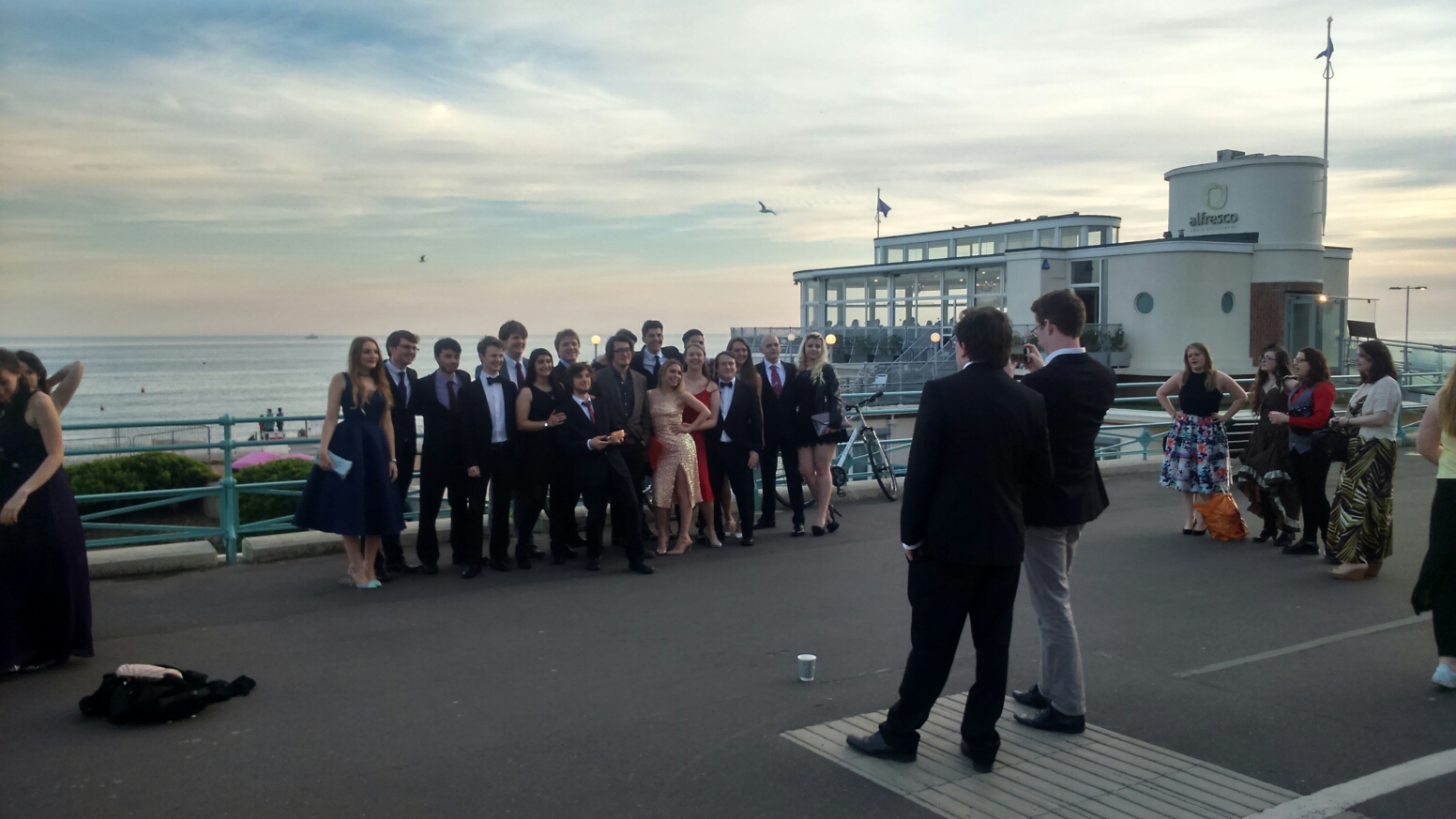
On my way to the Holiday Inn for the do I saw this group of 4th year students being photographed on the seafront.
They’re going to be graduating this summer so for many of them – apart from those staying on to do PhDs etc – this will be their last Physics Ball, which no doubt explains why they seemed so determined to have a good time despite the fact that exams start next week.
It’s amazing how the weather always turns fine for examination season. Yesterday it was beautiful. Brighton beach was busy during the day and the seafront still crowded even as I walked home at around 1am.
Anyway, at the Ball, I was seated with a group of mainly 2nd year students, some of whom are taking my Theoretical Physics module. They not only said very nice things about my lecturing but even bought me a very nice cigar which I smoked after dinner outside the hotel in the balmy evening. I couldn’t say whether all this had anything to do with the fact that I will shortly be marking their examinations.
I don’t mind admitting that I have found this year an incredible strain. I have done my best to hide it from staff and students, but my job involves a huge workload and far too many ridiculous bureaucratic frustrations. I have little time for life outside work and at times I wonder what the point is. Then I get to give a lecture to a group of bright and enthusiastic students about the amazing and beautiful thing called physics and I remember what it’s supposed to be all about.
Here’s something to end the week with: a piece from my favourite Mozart opera, The Magic Flute, in a version that’s itself very rarely heard. Fortunately. This is what Florence Foster Jenkins – the opera singer to end all opera singers – did with Der Hölle Rache kocht in meinem Herzen. For some reason Sony admits to owning the copyright of this, so you’ll have to click through to Youtube to hear it in its full glory.
I’ve been busy in London all day so haven’t had time for a proper blog post today.
However, yesterday’s post reminded me of the above attempt at humour occasioned by the thought that classical proverbs may need to be modified to include quantum phenomena…
I saw a provocative-looking paper on the arXiv the other day (by Daniela Frauchiger and Renato Renner) with the title Single-world interpretations of quantum theory cannot be self-consistent. No doubting what the authors think!
Here’s the abstract:
According to quantum theory, a measurement may have multiple possible outcomes. Single-world interpretations assert that, nevertheless, only one of them “really” occurs. Here we propose a gedankenexperiment where quantum theory is applied to model an experimenter who herself uses quantum theory. We find that, in such a scenario, no single-world interpretation can be logically consistent. This conclusion extends to deterministic hidden-variable theories, such as Bohmian mechanics, for they impose a single-world interpretation.
Since this is a subject we’ve had interesting debates about on this blog I thought I’d post a link to it here and see if anyone would like to respond through the comments. I haven’t had time to read it thoroughly yet, but I do have a bit of train travel to do tomorrow…
The views presented here are personal and not necessarily those of my employer (or anyone else for that matter).
Feel free to comment on any of the posts on this blog but comments may be moderated; anonymous comments and any considered by me to be vexatious and/or abusive and/or defamatory will not be accepted. I do not necessarily endorse, support, sanction, encourage, verify or agree with the opinions or statements of any information or other content in the comments on this site and do not in any way guarantee their accuracy or reliability.





 In the Dark