The McGurk Effect – Do you always hear what you think you hear?

Posted in Biographical, The Universe and Stuff with tags , , , , on May 19, 2016 by telescoper

I saw this clip for the first time yesterday during a training session about unconscious bias. The context then was a discussion of how we make quick decisions about things (and people) relying on contextual associations of which we are often entirely unaware. The clip illustrates how difficult it is to overrule some things your brain does automatically even when you know they are wrong.

Related to this is something I’ve noticed in a slightly different setting. Not having a TV set I do sometimes watch DVDs on my laptop, but the screen is quite small and, for a person of my advanced years, rather difficult to view comfortably for a long period. A while ago I started plugging my laptop into a monitor instead. When I do that I usually put the laptop well out of the way, which means moving the relatively small loudspeaker out of the line of sight between myself and the screen. It is however immediately noticeable that the sound immediately seems to be coming from the screen rather than the speaker. I guess this is yet another example of the visual overruling the auditory which it does in the McGurk effect.

Oh, and I just remembered this, which I heard a while ago at a public talk given by Simon Singh. I guess many of you will have come across it before, but there’s no harm in repeating it. I don’t know why it popped into my head at this particular moment, but perhaps it’s because I’ve been reading some stuff about how my colleagues in gravitational wave research use templates to try to detect specific patterns in noisy data. The method involves cross-correlating a simulated signal against the data until a match is obtained; the problem is often how to assess the probability of a “chance” coincidence correctly and thus avoid spurious detections. The following might perhaps be a useful warning that unless you do this carefully, you only get out what you put in!

This is an excerpt from the classic track Stairway to Heaven, by the popular beat combo Led Zeppelin, played backwards. I suggest that you listen to it once without looking at the words on the video, and then again with the words in front of you. If you haven’t heard/seen it before, I think you’ll find it surprising…


The Moon is Distant from the Sea

Posted in Poetry, Uncategorized with tags , , on May 19, 2016 by telescoper

The moon is distant from the sea,
And yet with amber hands
She leads him, docile as a boy,
Along appointed sands.

He never misses a degree;
Obedient to her eye,
He comes just so far toward the town,
Just so far goes away.

Oh, Signor, thine the amber hand,
And mine the distant sea, —
Obedient to the least command
Thine eyes impose on me.

by Emily Dickinson (1830-1886)


Sinister Moves by Elsevier

Posted in Open Access with tags , , , , on May 18, 2016 by telescoper

I’ve been away at yet another Awayday today so only have time for a brief post before I go home and vegetate. I felt obliged, however, to draw the attention of my readership to the fact that there’s something sinister afoot in the world of academic publishing. It seems that the notoriously exploitative academic publishing company Elsevier has acquired the Social Science Research Network (SSRN), which is  the leading social science and humanities repository and online community. The SSRN currently allows readers free access more than 500,000 academic papers for free but that is highly likely to change under Elsevier whose previous practice has always been to squeeze the academic community for every penny it can get. In particular, Elsevier has a reputation for cracking down on academic papers for which it owns licences, so these recent acquisitions look like very bad news.

The Chairman of SSRN is  trying to present this as a positive move:

SSRN announced today that it has changed ownership. SSRN is joining Mendeley and Elsevier to coordinate our development and delivery of new products and services, and we look forward to our new access to data, products, and additional resources that this change facilitates.

Like SSRN, Mendeley and Elsevier are focused on creating tools that enhance researcher workflow and productivity. SSRN has been at the forefront of on-line sharing of working papers. We are committed to continue our innovation and this change will enable that to happen more quickly. SSRN will benefit from access to the vast new data and resources available, including Mendeley’s reference management and personal library management tools, their new researcher profile capabilities, and social networking features. Importantly, we will also have new access for SSRN members to authoritative performance measurement tools such as those powered by Scopus and Newsflo (a global media tracking tool). In addition, SSRN, Mendeley and Elsevier together can cooperatively build bridges to close the divide between the previously separate worlds and workflows of working papers and published papers.

We realize that this change may create some concerns about the intentions of a legacy publisher acquiring an open-access working paper repository. I shared this concern. But after much discussion about this matter and others in determining if Mendeley and Elsevier would be a good home for SSRN, I am convinced that they would be good stewards of our mission. And our copyright policies are not in conflict — our policy has always been to host only papers that do not infringe on copyrights. I expect we will have some conflicts as we align our interests, but I believe those will be surmountable.

Until recently I was convinced that the SSRN community was best served being a stand-alone entity. But in evaluating our future in the evolving landscape, I came to believe that SSRN would benefit from being more interconnected and with the resources available from a larger organization. For example, there is scale in systems administration and security, and SSRN can provide more value to users with access to more data and resources.

On a personal note, it has been an honor to be involved over the past 25 years in the founding and growth of the SSRN website and the incredible community of authors, researchers and institutions that has made this all possible. I consider it one of my great accomplishments in life. The community would not have been successful without the commitment of so many of you who have contributed in so many ways. I am proud of the community we have created, and I invite you to continue your involvement and support in this effort.

The staff at SSRN are all staying (including Gregg Gordon, CEO and myself), the Rochester office is still in place, it will still be free to upload and download papers, and we remain committed to “Tomorrow’s Research Today”. I look forward to and am committed to a successful transition and to another great 25 years for the SSRN community that rivals the first.

Michael C. Jensen
Founder & Chairman, SSRN

It sounds like they made him an offer he couldn’t refuse…

I don’t think Elsevier’s involvement in this is likely to prove beneficial to anything other than their own profits. Elsevier is one of the biggest problems in academic publishing and can  never be part of the solution.

My main concern, however,  is  that some day Elsevier might launch a hostile takeover bid for the arXiv, which would be a major setback to the physics community’s efforts to promote the free exchange of scientific papers. That must be resisted at all costs. How did the academic community allow its publishing culture to be hijacked by such companies?


It’s Mental Health Awareness Week

Posted in Mental Health on May 17, 2016 by telescoper

image

I will just add a comment of my own. No job is worth risking your mental health for. Nor is anything else for that matter.

For further information see the Mental Health Awareness Week website.

The Thermal Syndicate

Posted in Biographical, History with tags , , , on May 16, 2016 by telescoper

image

I found the above map of the Tyne via the Tyne & Wear Archives on Twitter. It dates from the 1960s, and it caught my attention because it shows the area where I was born, between Walker and Wallsend.

I remember  the Shipyards very well, especially the famous Neptune Yard of Swan Hunter. In the early 70s the huge ESSO Northumberland loomed above the terraced streets like a monster but now shipbuilding has all but vanished. So have most of the other industries lining the river, for that matter.

The other thing this map jogged my memory about was the Thermal Syndicate building. This was the site of a glassworks and the source of large quantities of silver sand, which my Dad used to buy and sell on to schools and playgroups as part of his educational supplies business, before it went under in the 1980s. The name always intrigued me as it made me imagine it was run by gangsters pushing winter underwear.

Listening and Seeing (and Mahler)

Posted in Biographical, Music with tags , , , , on May 14, 2016 by telescoper

Three things led me to post this recording. One is that this piece (though not this performance) was one of the late Harry Kroto’s selections for Desert Island Discs. Another is that I had occasion to sort out my CD collection recently and I realised in doing so that I had more recordings of this Symphony than any other. And the third is that I heard a discussion on Radio 3 recently in which a record company executive noted that while sales of opera performances on DVD were very healthy, it was very difficult to sell DVDs of symphonic concerts. I am not particularly surprised by that but I have to say that I love the visual as well as the auditory experience of a classical concert. A large group of talented people coming together to make music is a great thing to watch, and it also helps understand the music a bit too. I’d much rather go to a live concert (even a mediocre one) than listen to a CD (even a very good one), but failing that I’d definitely go for a DVD.

All of this provides an excuse to show this film of the Vienna Philharmonic under the baton of Leonard Bernstein playing the gorgeous third moment (marked Ruhevoll) of Symphony No. 4 in G Major by Gustav Mahler. My favourite recording of this symphony is actually by Von Karajan with the Berlin Philharmonic on Deutsche Grammophon, but this is well worth watching to see the communication between Lenny and the band. And if you think Mahler is always gloomy and angst-ridden, hopefully this will make you change your mind.


David MacKay’s Last Interview

Posted in The Universe and Stuff with tags , on May 13, 2016 by telescoper

I saw an interesting news item this morning reporting that at one point last Sunday about 87% of Germany’s energy needs were supplied by renewable sources. The circumstances that led to this were relatively short-lived, but it is interesting nevertheless. I keep an eye on the UK’s national grid statistics from time to time and it rarely exceeds 20% in the form of renewables.

Anyway, all that reminded me of this, which appeared in the Guardian a couple of weeks weeks ago. It’s the last interview recorded by David Mackay before his untimely death from cancer in April. He’s characteristically direct in pointing out that the idea that the UK could be powered entirely by renewable energy is not at all practicable.


The Supreme Leader of STFC Departs…

Posted in Science Politics with tags , , on May 12, 2016 by telescoper

womersley

In case you haven’t heard yet, news has just broken that Professor John Womersley (above), currently Chief Executive of the Science & Technology Facilities Council (STFC), has been appointed Director-General of the new European Spallation Source (ESS) in Lund, Sweden, and will therefore be stepping down from his post as Chief Executive of STFC in the autumn.

John has been Supreme Leader at STFC for five years now and, in my opinion, has done an excellent job in circumstances that have not always been easy. He will be a hard act to follow. I know he’s an occasional reader of this blog, so let me take this opportunity to wish him well in his new role.

Now, perhaps I should open a book on the likely contenders for the post of next Chief Executive of STFC?


Examination Time Yet Again

Posted in Biographical, Education with tags , , , , , on May 12, 2016 by telescoper

Once again the return of glorious weather heralds the return of the  examination season at the University of Sussex, so here’s a lazy rehash of my previous offerings on the subject that I’ve posted around this time each year since I started blogging.

My feelings about examinations agree pretty much with those of  William Wordsworth, who studied at the same University as me, as expressed in this quotation from The Prelude:

Of College labours, of the Lecturer’s room
All studded round, as thick as chairs could stand,
With loyal students, faithful to their books,
Half-and-half idlers, hardy recusants,
And honest dunces–of important days,
Examinations, when the man was weighed
As in a balance! of excessive hopes,
Tremblings withal and commendable fears,
Small jealousies, and triumphs good or bad–
Let others that know more speak as they know.
Such glory was but little sought by me,
And little won.

It seems to me a great a pity that our system of education – both at School and University – places such a great emphasis on examination and assessment to the detriment of real learning. On previous occasions, before I moved to the University of Sussex, I’ve bemoaned the role that modularisation has played in this process, especially in my own discipline of physics.

Don’t get me wrong. I’m not opposed to modularisation in principle. I just think the way modules are used in many British universities fails to develop any understanding of the interconnection between different aspects of the subject. That’s an educational disaster because what is most exciting and compelling about physics is its essential unity. Splitting it into little boxes, taught on their own with no relationship to the other boxes, provides us with no scope to nurture the kind of lateral thinking that is key to the way physicists attempt to solve problems. The small size of many module makes the syllabus very “bitty” and fragmented. No sooner have you started to explore something at a proper level than the module is over. More advanced modules, following perhaps the following year, have to recap a large fraction of the earlier modules so there isn’t time to go as deep as one would like even over the whole curriculum.

In most UK universities (including Sussex), tudents take 120 “credits” in a year, split into two semesters. In many institutions, these are split into 10-credit modules with an examination at the end of each semester; there are two semesters per year. Laboratories, projects, and other continuously-assessed work do not involve a written examination, so the system means that a typical  student will have 5 written examination papers in January and another 5 in May. Each paper is usually of two hours’ duration.

Such an arrangement means a heavy ratio of assessment to education, one that has risen sharply over the last decades,  with the undeniable result that academic standards in physics have fallen across the sector. The system encourages students to think of modules as little bit-sized bits of education to be consumed and then forgotten. Instead of learning to rely on their brains to solve problems, students tend to approach learning by memorising chunks of their notes and regurgitating them in the exam. I find it very sad when students ask me what derivations they should memorize to prepare for examinations. A brain is so much more than a memory device. What we should be doing is giving students the confidence to think for themselves and use their intellect to its full potential rather than encouraging rote learning.

You can contrast this diet of examinations with the regime when I was an undergraduate. My entire degree result was based on six three-hour written examinations taken at the end of my final year, rather than something like 30 examinations taken over 3 years. Moreover, my finals were all in a three-day period. Morning and afternoon exams for three consecutive days is an ordeal I wouldn’t wish on anyone so I’m not saying the old days were better, but I do think we’ve gone far too far to the opposite extreme. The one good thing about the system I went through was that there was no possibility of passing examinations on memory alone. Since they were so close together there was no way of mugging up anything in between them. I only got through  by figuring things out in the exam room.

I think the system we have here at the University of Sussex is much better than I’ve experienced elsewhere. For a start the basic module size is 15 credits. This means that students are usually only doing four things in parallel, and they consequently have fewer examinations, especially since they also take laboratory classes and other modules which don’t have a set examination at the end. There’s also a sizeable continuously assessed component (30%) for most modules so it doesn’t all rest on one paper. Although in my view there’s still too much emphasis on assessment and too little on the joy of finding things out, it’s much less pronounced than elsewhere. Maybe that’s one of the reasons why the Department of Physics & Astronomy does so consistently well in the National Student Survey?

We also have modules called Skills in Physics which focus on developing the problem-solving skills I mentioned above; these are taught through a mixture of lectures and small-group tutorials. I don’t know what the students think of these sessions, but I always enjoy them because the problems set for each session are generally a bit wacky, some of them being very testing. In fact I’d say that I’m very impressed at the technical level of the modules in the Department of Physics & Astronomy generally. I’ve been teaching Green’s Functions, Conformal Transformations and the Calculus of Variations to second-year students this semester. Those topics weren’t on the syllabus at all in my previous institution!

Anyway, my Theoretical Physics paper is next week (on 19th May) so I’ll find out if the students managed to learn anything despite having such a lousy lecturer. Which reminds me, I must remember to post some worked examples online to help them with their revision.

A Liar and a Cheat and the Leader of UKIP Wales

Posted in Politics with tags , , , on May 11, 2016 by telescoper

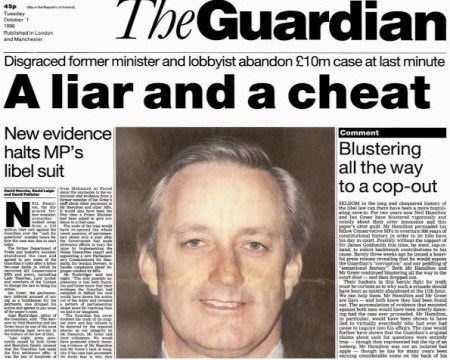
Last week’s elections to the Welsh Assembly saw the UK Independence Party winning seats in the Senedd for the very first time, although Welsh Labour remained the largest party by a comfortable margin despite losing a seat to Plaid Cymru. Among the 7 UK AMs elected was disgraced former Conservative MP Neil Hamilton who featured in this Guardian headline just 20 years ago.

hamilton

Following this “Cash for Questions” scandal, he lost his seat in the 1997 General Election, at which point he left politics and joined UKIP.

Not content with merely winning a seat in the Assembly elections, Mr Hamilton then ousted former leader Nathan Gill of UKIP Wales and is now running the show. It’s been a bizarre turn of events. There’s clearly no end to his ambition (nor any beginning to his integrity).

Questions may be asked about a person such as Neil Hamilton could have been voted into power, but it’s not year clear how much it will cost to ask them.

All I can say is I hope they keep a close eye on the cutlery in the Senedd canteen.