The Ways We Touch

Posted in Mental Health, Poetry on March 8, 2016 by telescoper

Have compassion for everyone you meet,
even if they don’t want it.
What appears bad manners, an ill temper or cynicism
is always a sign of things no ears have heard,
no eyes have seen.
You do not know what wars are going on down there where the spirit meets
the bone.

by Miller Williams (1930-2015)


A Galaxy at Redshift 11.1?

Posted in The Universe and Stuff with tags , , , on March 7, 2016 by telescoper

Back in the office after one Friday off and there’s the inevitable queue at my door and mountain of things that just have to be done immediately. Yeah, right..

Anyway, I couldn’t resit a short blogging break to mention a bit of news that made a splash last week. This is the claim that a galaxy has been observed at a redshift z=11.1 which, if true, would make it the most distant such object ever observed. When I was a lad, z=0.5 was considered high redshift!

If the current standard cosmological model is correct then the lookback time to this redshift is about 13.4 billion years, which means that the galaxy we are seeing formed just 400 million years after the Big Bang. If it is correctly identified then it has to be an object which is forming stars at a prodigious rate. You can find more details in the discovery paper (by Oesch et al.)  here.

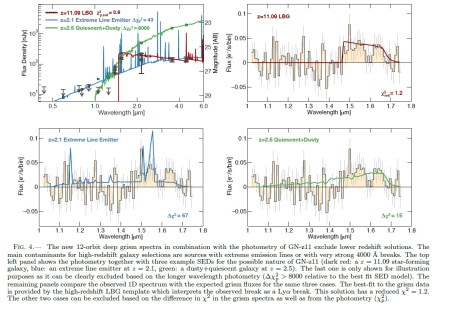
I have taken the liberty of extracting the following figure:

Grism

The claim is that the model spectrum on the top right is a much better fit to the data obtained using the Hubble Space Telescope Grism spectrograph than the two alternatives at much lower redshift. However, this depends a great deal on having a good model for the significant contamination from other sources. Moreover I’m sure the residuals are non-Gaussian and I’m not therefore convinced that a simple χ2 is the best way to assess the fit. Obviously I’d like to see a proper Bayesian model comparison!

So, as I have been on previous occasions (e.g. here), I remain not entirely convinced. But then I’m a theorist who is always excessively suspicious of data. Any experts out there want to tell me I’m wrong?


Big Cuts to UK Science Research

Posted in Science Politics with tags , , , on March 4, 2016 by telescoper

I have been off sick today, but felt a whole lot sicker when I saw that the government had unveiled its plans for UK research spending over the next few years.

At first sight the picture looks encouraging. For example, the Science and Technology Facilities Council (STFC) sees a modest increase on cash terms from 16/17 to the end of the budget period. However that picture soon changes when you note that the allocation to STFC this year (15/16) was £400M. The allocation for (16/17) is £388M, so there’s an immediate reduction of £12M in available resource corresponding to a 3% cash cut.

This is  a truly terrible result for the STFC community. It may not seem like a big cut, but so much of the STFC budget is locked up in subscriptions that cash cuts have a disproportionately damaging effect. I fear for grant funding in particular; that’s always what takes the hit when immediate savings are needed.

It seems clear to me that a deliberate decision was made in BIS to exclude the current year’s figures from their document in a cynical attempt to present a misleading picture of the settlement. It’s a shocking betrayal.

Here is a response from the Royal Astronomical Society.

The unwillingness of our own government to fund scientific research property demonstrates how vitally important it is for us to have access to European Union funding and will strengthen the determination of UK scientists to keep us in the EU.

Cosmology at MaxEnt in Ghent

Posted in Talks and Reviews, The Universe and Stuff on March 3, 2016 by telescoper

It seems I am an invited speaker at MaxEnt 2016, the 36th Workshop on Bayesian Inference and Maximum Entropy Methods:

maxent

As well as talking about some of my own research I’ve been asked to include a bit of a review in my presentation. I haven’t quite decided what background stuff to include so thought a bit of crowdsourcing was called for. Anyone got any suggestions for important Bayesian/Maximum Entropy developments in cosmology?

If so, please offer them through the comments box!

P.S. Anyone know where Ghent is?

In Praise of Student-Led Teaching Awards

Posted in Education with tags , , on March 2, 2016 by telescoper

Only time for a short post today. I was at a lunchtime meeting involving both staff and students in the School of Mathematical and Physical Sciences this lunchtime, and one item on the agenda was the University of Sussex student-led teaching awards scheme, which is run jointly by the University and the Student Union.

This reminded me of an article in last week’s Times Higher which argues that such awards are “divisive” and leave staff who don’t win such awards “demoralised”.

I suppose such awards are “divisive” in the sense that they divide staff into two categories: those that win and those that don’t. The same is true of any award. You might equally well argue that we shouldn’t award degrees to students on the grounds that some students get them and others don’t.

The negative feelings expressed about these awards seem to me to be more to do with sour grapes than with any genuine concern about the effect (or lack of effect) they might have on teaching quality. Staff who are upset that they don’t win an award would be better advised to learn from their more popular colleagues than expressing resentment towards them.

Another thing that annoys me about this criticism is that it assumes that it questions the motivations for students nominating lecturers; in particular that students pick lecturers who are “showy” or “entertaining” or who set easy examinations. In my opinion this assumption does a great disservice to students. Last year several staff in my School won such awards and it was quite clear that the students picked the staff concerned because they appreciated their approach to teaching, not that their courses were easier or for any other trivial reason. It’s more than a little arrogant for staff to assume that students aren’t qualified to comment on what teaching they like.

It’s over thirty years since I finished my undergraduate degree. In the intervening time the way students study at school and university has changed, partly because of new technology. I hear far too many lecturers demanding that students should learn the way they did when they were younger. We should always be looking for better ways of helping students learn, and I think student awards are one way of identifying examples of good practice.

So, to conclude, I think this complaint is tosh.

Feel free to disagree through the comments box!


The Great Gravitational Wave Source Follow-Up

Posted in The Universe and Stuff with tags , , , on March 1, 2016 by telescoper

I recently noticed on the arXiv  an interesting paper with 1562 authors!

Here is the abstract:

A gravitational-wave transient was identified in data recorded by the Advanced LIGO detectors on 2015 September 14. The event candidate, initially designated G184098 and later given the name GW150914, is described in detail elsewhere. By prior arrangement, preliminary estimates of the time, significance, and sky location of the event were shared with 63 teams of observers covering radio, optical, near-infrared, X-ray, and gamma-ray wavelengths with ground- and space-based facilities. In this Letter we describe the low-latency analysis of the gravitational wave data and present the sky localization of the first observed compact binary merger. We summarize the follow-up observations reported by 25 teams via private Gamma-ray Coordinates Network Circulars, giving an overview of the participating facilities, the gravitational wave sky localization coverage, the timeline and depth of the observations. As this event turned out to be a binary black hole merger, there is little expectation of a detectable electromagnetic signature. Nevertheless, this first broadband campaign to search for a counterpart of an Advanced LIGO source represents a milestone and highlights the broad capabilities of the transient astronomy community and the observing strategies that have been developed to pursue neutron star binary merger events. Detailed investigations of the electromagnetic data and results of the electromagnetic follow-up campaign will be disseminated in the papers of the individual teams.

This is interesting not so much for the result – there wasn’t really any expectation of finding an electromagnetic counterpart of a binary black-hole merger – but that it’s the first example of the kind of mass mobilisation of astronomers that will be needed when gravitational-wave astronomy gets going in earnest. Astronomers working on transient sources such as gamma-ray bursts are already used to this kind of operation, but there’s going to be a lot more of it in the future!


Discrete Analysis launched

Posted in Open Access on March 1, 2016 by telescoper

I’m reblogging this to congratulate Tim Gowers on the launch of his new arXiv overlay journal, Discrete Mathematics. I wish this venture every success!

The Open Journal of Astrophysics won’t be far behind, and hopefully this will be the start of a real change to “the absurdly expensive and anachronistic system of academic publishing” that Tim Gowers describes in his post!

gowers's avatarGowers's Weblog

As you may remember from an earlier post on this blog, Discrete Analysis is a new mathematics journal that runs just like any other journal except in one respect: the articles we publish live on the arXiv. This is supposed to highlight the fact that in the internet age, and in particular in an age when it is becoming routine for mathematicians to deposit their articles on the arXiv before they submit them to journals, the only important function left for journals is organizing peer review. Since this is done through the voluntary work of academics, it should in principle be possible to run a journal for almost nothing. The legacy publishers (as they are sometimes called) frequently call people naive for suggesting this, so it is important to have actual examples to prove it, and Discrete Analysis is set up to be one such example. Its website goes…

View original post 1,623 more words

The Three-Card Puzzle

Posted in Books, Talks and Reviews, Cute Problems on February 29, 2016 by telescoper

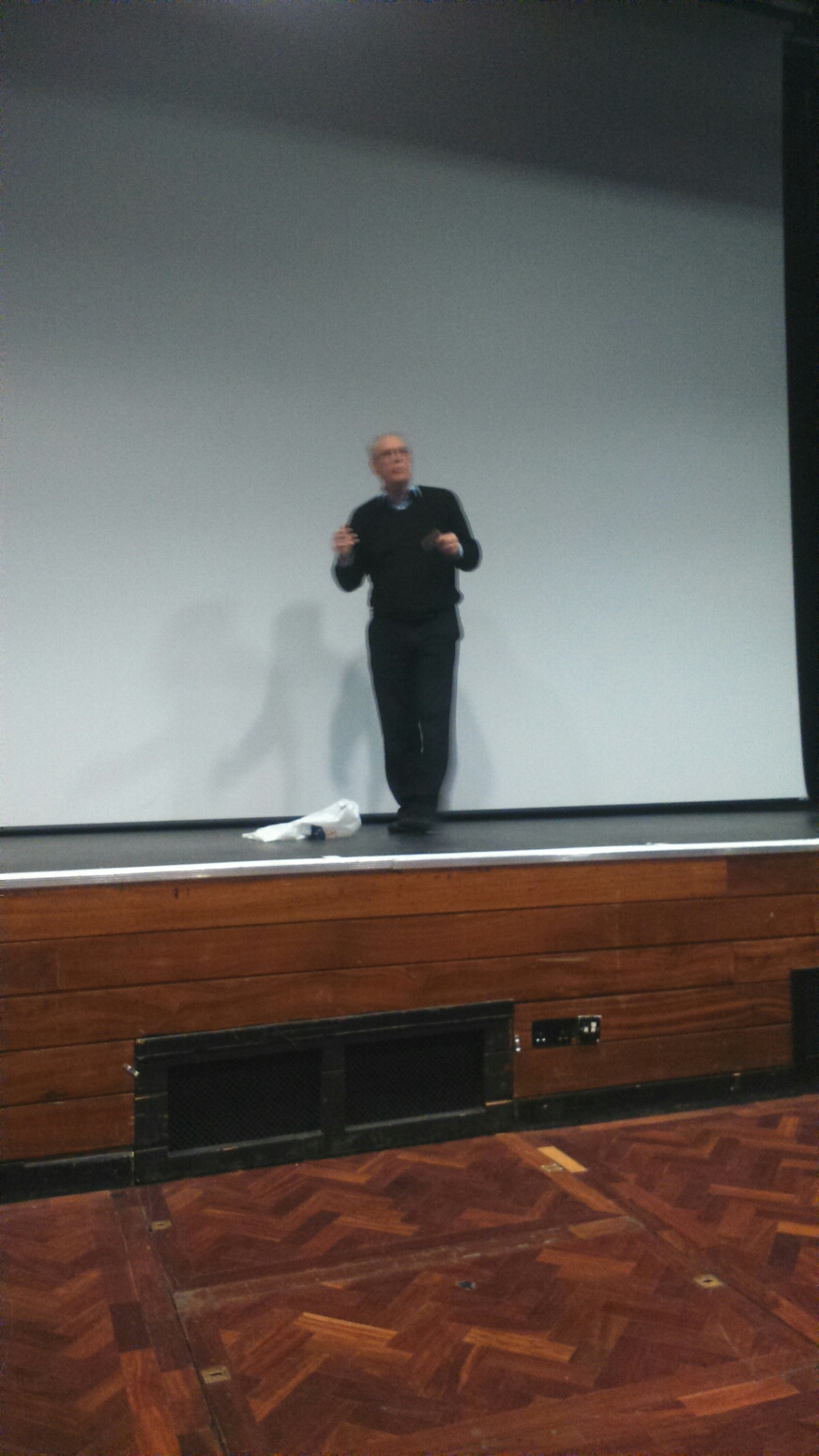
As promised I did my turn at the Brighton Science Festival yesterday. The Sallis Benney Theatre wasn’t quite full but there was a decent crowd, which was mildly surprising because the event I was involved in hadn’t really been advertised very well. If you want to know how my talk went then you should ask someone who was in the audience because I wasn’t really paying attention. However, I was preceded by John Haigh (seen below in mid-talk) whose presentation included a nice puzzle for the “Cute Problems” file:wp-1456735427335.jpeg

Imagine you have three cards. One is blue on both sides. One is pink on both sides. One is pink on one side and blue on the other. Other than the colours the cards are identical. For the demonstration John glued playing cards together, but they don’t have to be playing cards. Anyway, you put the three cards into a bag (seen on the stage in the picture), pull out one card “at random” and look at the colour of one side but not the other. If the colour you see is blue, what is the probability that the other side is also blue?

Try to answer this without googling. I’ll post the solution when there have been enough responses to the poll:


OK. Over a hundred people responded so I have now closed the voting.

As always seems to be the case with this sort of problem, the majority went for the “obvious” answer, which turns out to be wrong!

SOLUTION: If the card is blue on one side then it must be either the blue-blue or blue-pink one. I think most people voted for 1/2 because there are two possible cards. But the relevant consideration is that there are three possible sides: side 1 of the blue-blue card; side 2 of the blue-blue card; and the blue side of the blue-pink card. Each of these is equally likely and two of them result in the other side being blue. The correct answer is therefore 2/3; it is twice as likely for the other side to be blue as it is to be pink.

Land Of My Fathers – the 1931 Version

Posted in History, Rugby with tags , , on February 27, 2016 by telescoper

I’m very grateful to Anton for sending me a link to this wonderful bit of history – the first time the singing of “Land Of My Fathers” before an international rugby match was captured on a newsreel. The venue for the Wales-Scotland match was Cardiff Arms Park, which still exists, but the international games are now played at the recently-renamed Principality Stadium which is directly adjacent to the old venue. The skyline around the Arms Park is still mostly recognizable. The opening panning shot is looking North towards Bute Park, but as it moves right you can see the old Palace and Hippodrome, on Westgate Street, which is now the site of a Wetherspoon’s pub; only the facade is intact as the interior was completely gutted and rebuilt.

It seems that some sort of mechanical fault meant that the roof of the Principality Stadium was left open for last night’s match between Wales and France (which Wales won 19-10). That would have meant that the singing of Land of my Fathers could have been heard throughout the city. I remember once spending a Saturday afternoon in my garden in Pontcanna, and could hear the noise from the stadium very clearly. There’s something very special about the singing of the Welsh National Anthem on such occasions – it always sends a shiver down my spine.

Boléro sur un thème de Charles Racquet

Posted in Music with tags , on February 26, 2016 by telescoper

I’m going to be incommunicado for yet another “Awayday” today so I thought I’d post this to tide the blog over until Saturday when I’ll be back on campus for yet another Applicant Visit Day.

I heard this piece on Radio 3 a while ago and was intrigued enough to describe it on Twitter as “weird but groovy”. The presenter, Mr James Jolly, mentioned that comment live on air so I briefly felt like a celebrity. The Boléro sur un thème de Charles Racquet is a piece for organ and percussion that was actually improvised in its first performance by renowned organist and composer Pierre Cochereau in 1973, and transcribed by his son, Jean-Marc Cochereau. I think it’s a remarkably original piece of music.