The Open Journal of Astrophysics: Update

Posted in Open Access with tags on February 25, 2016 by telescoper

Just a quick post to update you all on the Open Journal of Astrophysics project. The journal was opened to submissions just before Christmas 2015 and we’ve been putting papers through our editorial processes since then. We did plan to go live in January, but we have not yet done so because we haven’t had enough publishable articles. It has taken a bit longer than we expected partly because of the relatively low numbers of papers submitted – presumably because authors are understandably nervous about submitting to a new journal – but also because editors and referees are still learning how to use the system, which has slowed us down a bit. However the submissions we have had have allowed us to test the platform and do a bit of tinkering behind the scenes. We also fixed a bug that caused a problem when the site was viewed using Safari (rather than a proper browser).

I’m always delighted when I see something like this on the daily arXiv listing:

OJ_planet

That and several other papers are already in the system but we could do with a few more to join the first batch of half-a-dozen or so we intend to publish soon. For that reason I’m appending below some information I’ve already circulated about the philosophy of the project and the practicalities of how to submit a paper.

–0–

We no longer need traditional academics journals to disseminate research in astrophysics and cosmology. We all post our research to the arXiv and read other papers there too. It’s been years since I last accessed a paper in a journal.  The only useful function that journals provide is peer review, and we in the research community do that (usually for free) anyway.  We only need journals for peer review, although we also like the prestige that is associated with them. But traditional journals have an unnecessarily slow and expensive editorial process, along with a nasty habit of placing the articles they publish behind a paywall.

The Open Journal does things differently, because we are not a publisher in the traditional sense. Instead, we are a peer-review platform, piggybacking on the arXiv for all the “publishing.” The Open Journal provides peer review for arXiv articles, making the process as fast and easy as we can. Once peer review for a particular article is successfully completed, we mark that article as accepted and send that information to the arXiv. Accepted articles will receive a DOI, and citations to them will get picked up through the CrossRef system just as they would in any other journal — but in a fraction of the time, and at a fraction of the cost. In fact, the service is provided free of charge both for authors and readers. There is no Article Processing Charge, no submission fee and no subscription is payable. The Open Journal is a service to the academic community, not a profit-making venture.

Moreover, articles published by the Open Journal are open, in that all articles  are released under a Creative Commons Attribution license. The infrastructure is open too – the code running the Open Journal is available under an MIT license. The reviewer comments can be made open too, with the agreement of both the authors and reviewer(s).  In the long run I hope  that the community will embrace the spirit of open reviewing so anonymous confidential reviews will become the exception rather than the rule, but we’ll see how that goes just for now.

Any paper that’s suitable for the astro-ph section of the arXiv can be subvmitted to the Open Journal of Astrophysics. We will consider any “traditional” papers as well as others which may find it difficult to get into other journals, such as papers on astrophysics education or outreach or technical papers relating to instrumentation, mission proposals, and other documents.

Now, to business. The best way to get an idea of how the Open Journal works is by watching the following video (which was made using a beta version of the site, but nothing much has changed except for a few layout issues being changed):

Note that the site is currently just called the Open Journal, which is so that it can be used with minimal modification to create similar journals in other fields.

If you don’t want to watch the whole thing here’s a quick summary of the steps you have to take to submit to the Open Journal.

  1.  If you don’t have one already, get an ORCID ID!
  2. Write your paper. There is latex style file you can use here, although it is not compulsory to use this and we will allow anything that produces a PDF that can be viewed easily using our mark-up tool. Single-column is strongly preferred.
  3. Submit your paper to the arXiv. You have to be registered in order to do this. Note also that you have to be prepared to submit your paper to the arXiv before it is reviewed. There is an enormous advantage in doing this, actually, as you may get more comments and suggestions than our refereeing system will generate.
  4. Log on to the Open Journal website
  5. Go to the submit tab on the left hand side of the screen.
  6. Type in the arXiv reference of your paper (you can do this in various ways)
  7. Our software will assign the paper to an editor, who will then select referee(s). Each referee makes comments by marking “issues” on the PDF, each of which needs a reply from the author. When all issues are resolved the paper is accepted. If revision is required a new version can be submitted to the arXiv which will be picked up by the software.
  8. When it us ready our software will automatically assign a DOI and write it to the appropriate field in the arXiv.
  9. That’s it! The paper is published and can be accessed either directly on the arXiv or through the Open Journal website.
  10. Go and have a beer.

One other thing is worth mentioning. Because this service is provided free we do not have the effort required to undertake extensive copy-editing or rewriting of papers that are very poorly written. If the editor or referee deems a paper to be unfit for review then we will refer the author to a professional writing and editing service who will charge a fee depending on the length and complexity of the task.

As well as submissions we are also looking for new editors. At the moment our Editorial Board is dominated by cosmologists but as word gets round we will probably need expertise in other areas of astrophysics. If you’d like to volunteer please send me an email or use the comment box below.

Well, that’s about it. I just remains for me to thank all the people without whom this project would never have got off the ground, chiefly Chris Lintott, Arfon Smith and Adam Becker, developers Stuart Lynn and Marc Rohloff, and of course the good folk of the wonderful arXiv!


Big Science Sunday in Brighton

Posted in Books, Talks and Reviews, Brighton, Uncategorized with tags , , on February 24, 2016 by telescoper

Just time for a spot of self-publicity. This Sunday, 28th February, is going to be Big Science Sunday at the Brighton Science Festival. This event is part of Big Science Weekend. The other part is called Big Science Saturday. On Big Science Saturday I’ll actually be working on campus at the University of Sussex for an Applicant Visit Day for prospective students, so the only part of Big Science Weekend I can participate in will be Big Science Sunday. I hope that clarifies the situation with respect to Big Science Saturday, Big Science Sunday and indeed Big Science Weekend as a whole… (Get On With It, Ed)

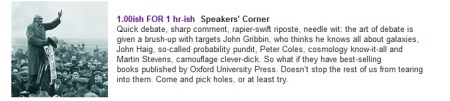
Anyway the reason for mentioning all this is that I will be taking part (on Big Science Sunday) in an event called Speaker’s Corner, which has been organized in collaboration with Oxford University Press, who no doubt hope that it will lead to some flogging of books. Here’s the blurb from the website:

SpeakersCorner

(Actually it will start at 2pm, in the Sallis Benney Theatre on Grand Parade so make sure you get the time right if you want to be sure that you  miss my contribution).

The theme that unites the contributors to this strange event is that they have all written books in the OUP series of Very Short Introductions. I wrote Cosmology: A Very Short Introduction. I will be preceded by John Haigh who wrote Probability: A Very Short Introduction . John Gribbin wrote Galaxies: A Very Short Introduction, but I understand he can’t come on Sunday…

John and I settled the batting order in an appropriate fashion, via the tossing of a coin, and have agreed that we will both do our turns without any fancy graphics or computer malarky, in the manner of a couple of ageing buskers. I hope people attending this event will feel free to ask questions as we go along to make it as informal and interactive as possible.

So if you’re in the Brighton area on Big Science Sunday as opposed to Big Science Saturday do come along!

P.S. A new edition of Cosmology: A Very Short Introduction will be out later this year so we’ll be flogging off copies of the old edition at a heavily discounted price…


Jacques Loussier Before Seven

Posted in Music with tags , on February 23, 2016 by telescoper

This morning, as usual, I was woken this morning by the breakfast programme on BBC Radio 3. There is a regular slot called Bach Before Seven which I always listen to despite the risk of harpsichords. This morning I was delighted that the choice was an arrangement of Brandenburg Concerto No. 3 by Johann Sebastian Bach played by the Jacques Loussier Trio. It might have been a much for some classical purists, but I liked it a lot.  Bach’s music is so beautifully constructed that it can stand being pulled around in all sorts of ways.

If you’re of a certain age (like) me you might  also remember that happiness is a cigar called Hamlet but not remember who played the tune. It was, fact, Jacques Loussier and his trio doing their take on the so-called Air on the G String, also by  Johann Sebastian Bach And before you get too sanctimonious and music-hysterical about this version, I’ll just add that it is well known that Bach enormously enjoyed improvisation. Many jazz musicians of my acquaintance really love Bach’s music, and I have a sneaking feeling the great man would have enjoyed this take on his composition!

Ps. Coincidentally Sunday’s Azed crossword offered this clue for 19 down:

“One re-interpreting Bach, central duo halved, more unsatisfactory (7)”


Geometry, by Rita Dove

Posted in Poetry with tags , , on February 23, 2016 by telescoper

I prove a theorem and the house expands:
the windows jerk free to hover near the ceiling,
the ceiling floats away with a sigh.

As the walls clear themselves of everything
but transparency, the scent of carnations
leaves with them. I am out in the open

and above the windows have hinged into butterflies,
sunlight glinting where they’ve intersected.
They are going to some point true and unproven.

by Rita Dove


Why the EU is Vital to UK Science

Posted in Politics, Science Politics with tags , , , on February 22, 2016 by telescoper

The EU referendum campaign may only just have started but already there have been deliberate attempts to mislead the electorate about the realitites of  EU membership. I know that people will consider a wide range of issues before casting their vote in the forthcoming referendum. I am glad there is to be a referendum because there is at least a chance that some truth will emerge as these topics are discussed publicly over the next four months.

My views on the wider questions raised by the referendum are of no greater value than anyone else’s so I am going to restrict myself here to one issue that I do know something about: the importance of continued EU membership to UK Science. Before going on I will state, for the record, that I am not in receipt of any grants or other income from the EU. Not that this should matter. I deeply resent the snide implications of the “out” campaign that  ERC or other EU grants represent some form of gravy train. They don’t. Such awards are highly competitive and subject to strict accounting rules. They are used to fund research not to generate personal wealth. Scientists are not bankers.

Anyway, I believe that it would be a disaster for science if the UK were to quit the EU. In the Department of Physics & Astronomy at Sussex around one-quarter of our research income comes via the EU. Without that cash we would have to make drastic cuts which would certainly lead to redundancies. And I don’t for one minute believe that such funding would be replaced by increases from the UK government. It has been a hard slog just to get level cash settlements for science over the last two Parliaments, and that has led to steady real-terms attrition of support for scientific research. Meanwhile, the EU has, wisely for the future of the European economy, been increasing its science budget in real terms. Many research groups are only viable because of the EU’s strategic vision. We have in front of us the very real prospect of the devastation of our science base if Brexit becomes a reality.

But it’s not just about loss of funding. It’s also about the loss of influence. The UK benefits from EU membership because it has representatives around the table when funding priorities are decided. We provide scientific leadership to many projects, which reflects well on our reputation in the world and attracts significant inward investment. This loss of influence is, of course, not only the case for science but also for other areas of policy. The “out” campaign’s desire for isolationism would leave Britain with even less influence on its own destiny than it has now.

Of course these are personal views and you are free to disregard them. On the other hand, they are also the views of most UK scientists. Here are the key conclusions of  a recent survey and report:

  • 93% of researchers asked in the CaSE and EPC survey agreed that EU membership is a major benefit to UK.
  • Some regions of the UK are more dependent than others on EU funding in maintaining research capacity and infrastructure, and as a result could suffer disproportionate adverse impacts if this source was withdrawn.
  • The ability to attract academic staff to the UK through free movement of labour is important, particularly in science and engineering.
  • The role and benefits of EU membership to UK research is considered by researchers to be broader than just the funding for research that EU projects bring to the UK. The improvement in quality, reach and impact, facilitated by EU collaboration and coordination, helps to solve “Grand Challenge” problems in a way that would be much harder for any one country to achieve alone.

My only surprise with these survey results is that the fraction quoted in the first bullet point is as low as 93%. In my experience strong support for the EU is practically universal amongst scientific researchers across the entire spectrum of disciplines.

I realise science funding is unlikely to be the decisive issue for many people when it comes to casting their vote, but it is a topic I feel strongly about and it angers me greatly when campaigners deliberately misrepresent the view of real scientists. That is one of the reasons why I am a strong supporter of Scientists for the EU and I shall be campaigning strongly for Britain to remain at the heart of a Europe committed to science for the benefit of all its citizens.


Uncompromising Expression

Posted in History, Jazz with tags , on February 21, 2016 by telescoper

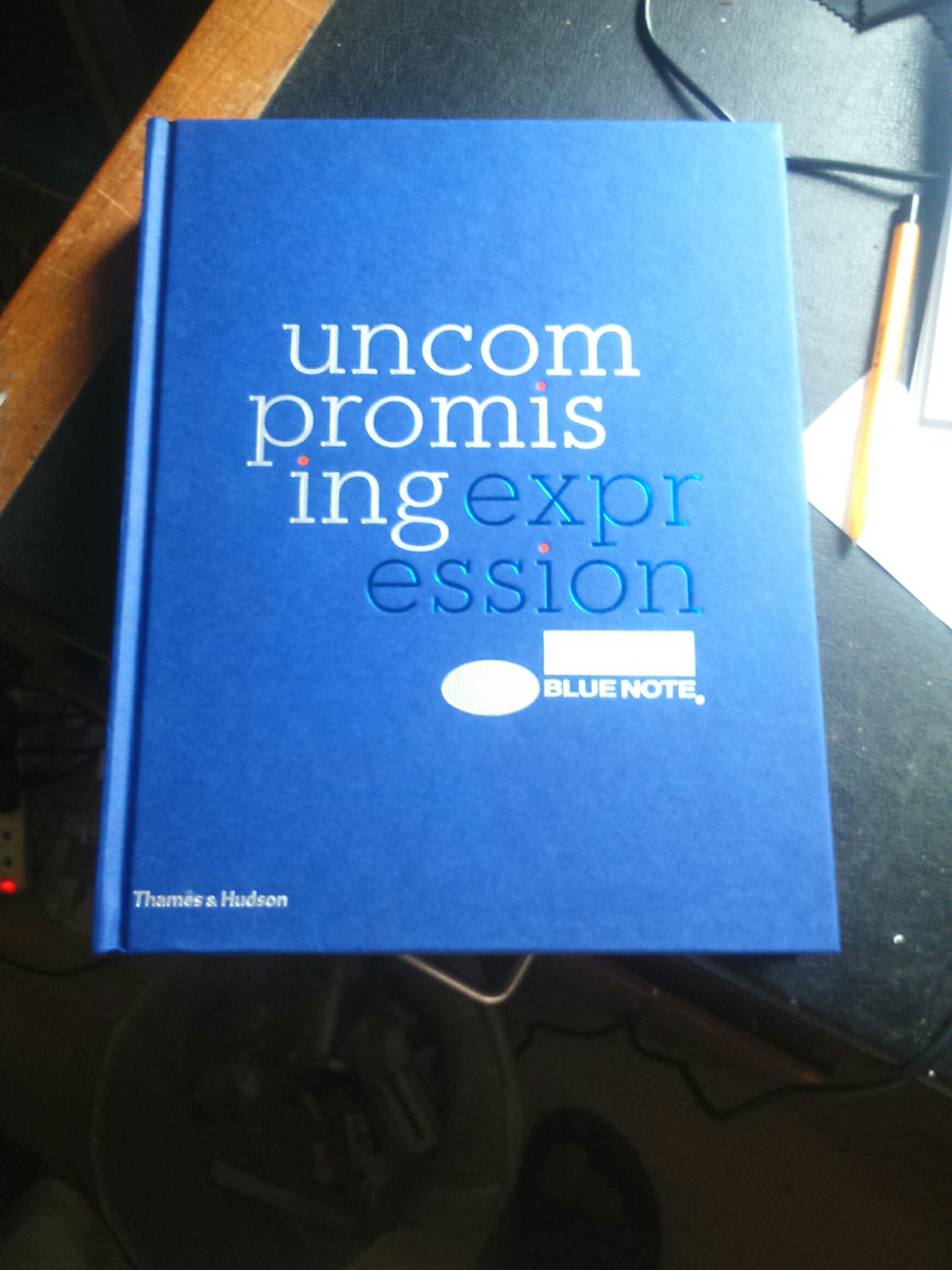
I don’t get much time for self-indulgence these days, but last week I treated myself to this book:

image

Written by Richard Havers, this is an excellent illustrated history of the legendary record label, Blue Note. Although primarily associated with post-war Jazz, Blue Note began with a number of classic recordings from the era of Sidney Bechet, Edmond Hall and Bunk Johnson.

I have only had time to dip into it so far, but what I have seen is superb, not only in terms of the text but also copious examples of the artwork that gave Blue Note albums their distinctive look.

image

Uncompromising Expression is a must- have for Jazz fans, although at just under £50 it’s not cheap. Fortunately I got a book token for Christmas!

The EU Referendum last time around (1975)

Posted in Uncategorized on February 20, 2016 by telescoper

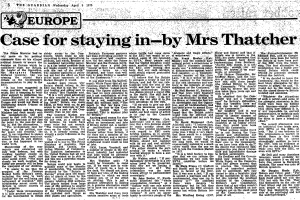
Do you remember the last time we had a referendum on Europe, in 1975? I do. Most Tories were vociferously in favour then. I was only 12 so couldn’t vote, but I would have voted No then largely on the grounds that Ted Heath had taken us in without bothering to consult. Now, 40 years on, I have grown up a bit and I am convinced that on balance our membership of the EU is a good thing for Britain and to leave now would jeopardise our economic and social wellbeing.

kmflett's avatarKmflett's Blog

The EU Referendum last time around (1975)

Thatcher 9 April 1975

______________________________________________________________________________

The Wilson Government’s Referendum on Britain’s EU membership was held 41 years ago on 5th June 1975. Given that Britain is set to have a further Referendum on the matter June 23rd you might think that the 1975 Referendum would be of some media note. However the media continues to be very bad at history. It requires things like research and fact checking, not matters there are big in the 2016 media not least because of resources.

The result in case (most likely) you are too young to remember or have simply forgotten was a fairly decisive vote to stay in the EU. The idea of a Referendum had been developed at least in part by Tony Benn. He saw it as a way in general of extending popular participation in politics and also specifically a way of getting round deep ‘no’…

View original post 517 more words

75 Years of the Maltese Falcon

Posted in Film with tags , , on February 18, 2016 by telescoper

The other day I came across the interesting news that my favourite film, The Maltese Falcon, directed by John Huston, is being shown in “movie theaters” around the United States on 21st and 24th February to celebrate the 75th anniversary of the film’s release. The choice of dates is a little odd because the film actually premiered in October 1941, but I presume the timing is dictated by business considerations. Although I have seen this film many times on TV and on DVD I have never seen it in a cinema, and I hope there is a possibility I can do so somewhere in the UK this year. Here is the original trailer as shown in cinemas back in the day. I imagine that the sizeable frame of Sidney Greenstreet made quite an impression on movie-goers as he loomed out of the darkness!


Jazz at the Pawnshop

Posted in Jazz with tags , , , , , on February 17, 2016 by telescoper

Sometime in the late Seventies I bought a vinyl LP called Jazz at the Pawnshop, which featured live performances by four veterans of the Swedish Jazz scene; Arne Domnerus (alto saxophone), Bengt Hallberg (piano), Egil Johansen (drums) and George Riedel on bass. Sadly, three of the four musicians involved are no longer with us; only George Riedel is still alive, but at least their music lives on.

The content was recorded in Stockholm over two days in December 1976 at a Jazz club on a site where a pawnshop once stood, hence the name. The album was reissued on CD in 1996 and then, just last year, somebody posted it on Youtube. That gives me an excuse to share my favourite track, which features the band not playing one of the classic bebop tunes on which  they cut their teeth when they were young, but the Lil Hardin composition from a much earlier era Struttin’ with some Barbecue which was something of a vehicle for her husband, Louis Armstrong. Not, ‘Strittin’ by the way as it says on the Youtube link.

I loved this track from the moment I first heard it, from the intriguing out-of-tempo opening through a jaunty bossa nova passage, and evolving into an extended improvised exploration by Domnerus set against typically bebop-inspired patterns from the rhythm section. Modern jazz treatments of tunes from the classic era don’t always turn out well, but this one surely did. Enjoy!


Making Massive Black Hole Binaries Merge

Posted in The Universe and Stuff with tags , , , , , on February 16, 2016 by telescoper

Many fascinating questions remain unanswered by last week’s detection of gravitational waves produced by a coalescing binary black hole system (GW150914) by LIGO. One of these is whether the fact that the similarity of the component masses (29 and 36 times the mass of the Sun respectively) is significant.

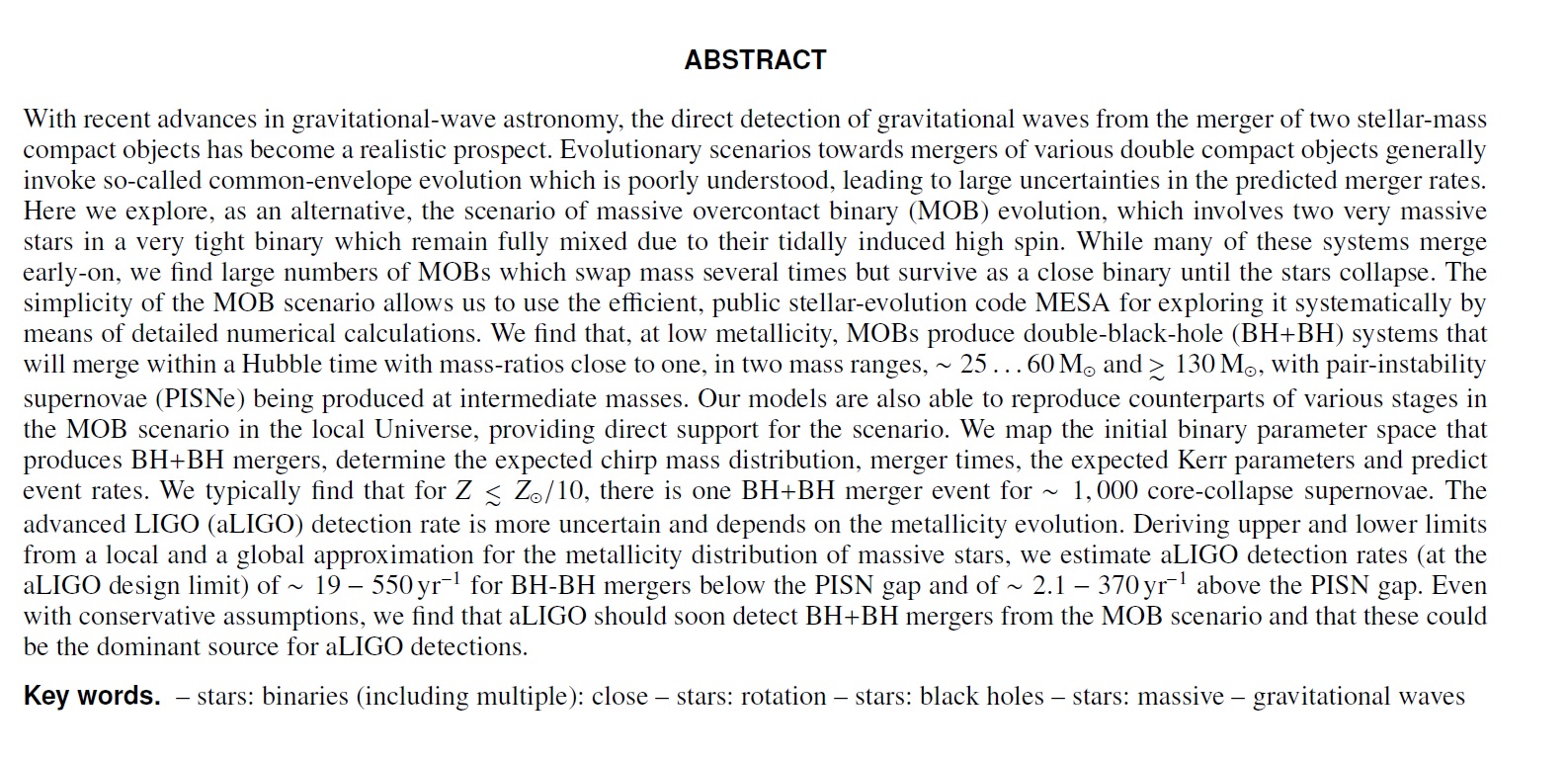
An interesting paper appeared on the arXiv last week by Marchant et al. that touches on this. Here is the abstract (you can click on it to make it larger):

BinaryBH


Although there is some technical jargon, the point is relatively clear. It appears that very masssive, very low metallicity binary stars can evolve into black hole binary systems via supernova explosions without disrupting their orbit. The term ‘low metallicity’ characteristises stars that form from primordial material (i.e. basically hydrogen and helium) early in the cycle of stellar evolution. Such material has very different opacity properties from material with significant quantities of heavier elements in it, which alters the dynamical evolution considerably.

(Remember that to an astrophysicist, chemistry is extremely simple. Hydrogen and helium make up most of the atomic matter in the Universe; all the rest is called “metals” including carbon, nitrogen, and oxygen…. )

Anyway, this theoretical paper is relevant because the mass ratios produced by this mechanism are expected to be of order unity, as is the case of GW150914.  One observation doesn’t prove much, but it’s definitely Quite Interesting…

Incidentally, it has been reported that another gravitational wave source may have been detected by LIGO, in October last year. This isn’t as clean a signal as the first, so it will require further analysis before a definitive result is claimed, but it too seems to be a black hole binary system with a mass ratio of order unity…

You wait forty years for a gravitational wave signal from a binary black hole merger and then two come along in quick succession…