Need cheering up on a rainy September afternoon? The gorgeous voice of Sarah Vaughan should do the trick!
Follow @telescoperSeptember in the Rain
Posted in Jazz with tags Jazz, Sarah Vaughan, September in the Rain on September 16, 2015 by telescoperSeven Years In The Dark
Posted in Biographical with tags Blogs on September 15, 2015 by telescoper
When I logged onto WordPress to write today’s post I received a message that it was the 7th anniversary of my registration with them as a blogger and thus took my first step into the blogosphere; that was way back on 15th September 2008. I actually wrote my first post that day too. Unfortunately I didn’t really know what I was doing on my first day at blogging – no change there, then – and I didn’t actually manage to figure out how to publish this earth-shattering piece. It was only after I’d written my second post that I realized that the first one wasn’t actually live, so the two appear in the wrong order in my archive.
I’d like to take this opportunity to send my best wishes, and to thank, everyone who reads this blog, however occasionally. According to the WordPress stats, I’ve got readers from all round the world, including one in the Vatican! If you’re interested in statistics then, as of 13.30 today, I have published 2,934 blog posts, and have received 2,460,789 hits altogether; I get an average of about 1300 per day, but this varies in a very erratic fashion. The greatest number of hits I have received in a day is 8,864 (at the peak of the BICEP2 controversy). There have been 22,482 comments published on here and 1,391,901 rejected as spam or abuse; a lot goes on behind the scenes here that you really don’t want to know about!
Anyway, the numbers don’t really matter but it does mean a lot to know that there are people who find my ramblings interesting enough to look at, and sometimes even to come back for more!
Follow @telescoper
Battle of Britain Day
Posted in Film, History with tags Battle of Britain, Ray Holmes, Spitfire, William Walton on September 15, 2015 by telescoperToday is the 75th Anniversary of the day that historians regard as the climax of the Battle of Britain. To commemorate this, a huge flypast will take place across the South of England. Unfortunately, the weather isn’t too great today, and I don’t think it will be quite the spectacle that was intended, although Purple, Brown and Black sections are due to fly over Brighton from RAF Goodwood and perhaps the clouds will have broken up by the time they get here. Normally Battle of Britain Day is commemorated on a Sunday, as 15th September 1940 lay on a Sunday.
I had a friend – now long dead – who served as a fighter pilot in the RAF during the Battle of Britain and I once asked him about the tactics they used. He explained that they didn’t really have any tactics. When scrambled they were usually lucky if they managed to get to the right altitude before the enemy were on them. And if they did, they just flew head on at the incoming planes and tried to shoot them down. There was little point in attacking a big formation from behind with a handful of planes, which was the usual situation: you might pick off one or two but the bombers would carry on to their target. You had to attack from the front in order to scatter them. He added that on a good day, if you were feeling exceptionally brave, you might even keep your eyes open as you screamed straight into the enemy at getting on for 400 mph.
Another event of 15th September 1940 exemplifies the almost insane courage of the RAF pilots. A formation of Dornier bombers penetrated the British air defencesa as central London, where it was engaged by planes from a number of RAF squadrons, including the Hurricane of Flight Sergeant Ray Holmes. Holmes got into position to shoot down one Dornier, but when attempted to fire he discovered he had run out of ammunition. In an act of amazing bravery he decided to ram the Dornier. He succeeded ins slicing off the plane’s tail and it came down on Victoria Station. Somewhat improbably, Holmes managed to bale out and, though injured, survived to fight again. He died in 2005.
The other thing that this event reminded me of was the film Battle of Britain. The movie is a bit dated now, largely because some of the special effects don’t really stand up to modern comparisons: no cgi when it was made, for example. The best thing about it for me, though, is the wonderful music written for the film by William Walton, especially in the following sequence where the dogfights are shown with only the music as soundtrack. This turns the shots of terrifying close-range combat into a something a lot more than an action movie. It’s a work of art.
The context of this sequence is, as far as I know, historically accurate. Over the summer of 1940 the Luftwaffe had sent raid after raid over to attack Britain, these raids increasing in size as time went on. Hugh Dowding, Head of Fighter Command at that time, refused to let his planes be drawn into a huge battle against numerically superior forces and instead kept most of his planes in reserve, sending up only a squadron or half a squadron to meet the incoming planes. Thanks to the breaking of the German Air Force Enigma code, Dowding knew that the Luftwaffe pilots had been handing in grossly exaggerated reports of how many planes they had been shooting down. Convinced that the RAF was on the brink of collapse, the Germans launched an enormous air raid on September 15th 1940 intended to deliver the knockout blow and prepare the way for invasion.
Dowding knew that they were coming, and put every available plane at the RAFs disposal into the air. The survival of this country was at stake during this battle. There were no reserves. When the Luftwaffe arrived over Britain their pilots were aghast to find the air filled with Spitfires and Hurricanes whose pilots, having been consistently outnumbered in the battles so far, relished the chance to fight for once with something close to numerical equality with the enemy. The RAF scored a decisive victory, convincing Hitler to abandon his plans for an invasion in 1940.
Follow @telescoperR.I.P. Brian Close
Posted in Cricket with tags Brian Close, cricket, Michael Holding on September 14, 2015 by telescoperI heard today of the death, at the age of 84, of former Yorkshire and England cricketer Brian Close. Close was an abrasive character whose personality made him more than a few enemies, but he had a very successful playing career and was a tough but effective captain both on the field an in the dressing room. Above all, he was an exceptionally brave batsman. I can think of no better example than this video of him facing Michael Holding (“Whispering Death”) at Old Trafford in 1976. He struggles to lay bat on ball and is hit several times on the body but he always gets into line. This is from an era in which batsmen didn’t wear head protection; this nearly cost him serious injury, as you will see in the clip. Even with a helmet I would have been terrified. Cricket is not a game for faint hearts…
At the age of 45 Brian Close had been brought in to open the England batting earlier in the series in an attempt to stiffen their resistance to the West Indian attack. He wasn’t the greatest player in the world nor the cricketing world’s most agreeable character, and as you can tell he wasn’t in the first flush of youth in 1976 either, but there is no denying his courage and determination. Here he is enduring a vicious battering at the hands of Michael Holding. One short-pitched delivery in this sequence came within a whisker of hitting him on the head; had it done so the consequences would have been horrendous. As it was, he “only” had to take a succession of blows to his body. He scored 20 runs at Old Trafford, off 108 balls in 162 minutes, and was dropped for the next Test, as was his opening partner John Edrich, although both had stood their ground and defended their wickets (and themselves) manfully.
R.I.P. Brian Close (1931-2015)
Follow @telescoperGamma-Ray Bursts and the Cosmological Principle
Posted in Astrohype, Bad Statistics, The Universe and Stuff with tags Cosmic Antipode, cosmological principle, Cosmology, Gamma Ray Bursts on September 13, 2015 by telescoperThere’s been a reasonable degree of hype surrounding a paper published in Monthly Notices of the Royal Astronomical Society (and available on the arXiv here). The abstract of this paper reads:
According to the cosmological principle (CP), Universal large-scale structure is homogeneous and isotropic. The observable Universe, however, shows complex structures even on very large scales. The recent discoveries of structures significantly exceeding the transition scale of 370 Mpc pose a challenge to the CP. We report here the discovery of the largest regular formation in the observable Universe; a ring with a diameter of 1720 Mpc, displayed by 9 gamma-ray bursts (GRBs), exceeding by a factor of 5 the transition scale to the homogeneous and isotropic distribution. The ring has a major diameter of 43° and a minor diameter of 30° at a distance of 2770 Mpc in the 0.78 < z < 0.86 redshift range, with a probability of 2 × 10⁻⁶ of being the result of a random fluctuation in the GRB count rate. Evidence suggests that this feature is the projection of a shell on to the plane of the sky. Voids and string-like formations are common outcomes of large-scale structure. However, these structures have maximum sizes of 150 Mpc, which are an order of magnitude smaller than the observed GRB ring diameter. Evidence in support of the shell interpretation requires that temporal information of the transient GRBs be included in the analysis. This ring-shaped feature is large enough to contradict the CP. The physical mechanism responsible for causing it is unknown.
The so-called “ring” can be seen here:
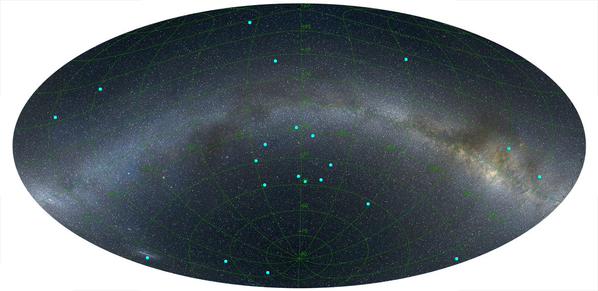
In my opinion it’s not a ring at all, but an outline of Australia. What’s the probability of a random distribution of dots looking exactly like that? Is it really evidence for the violation of the Cosmological Principle, or for the existence of the Cosmic Antipodes?
For those of you who don’t get that gag, a cosmic antipode occurs in, e.g., closed Friedmann cosmologies in which the spatial sections take the form of a hypersphere (or 3-sphere). The antipode is the point diametrically opposite the observer on this hypersurface, just as it is for the surface of a 2-sphere such as the Earth. The antipode is only visible if it lies inside the observer’s horizon, a possibility which is ruled out for standard cosmologies by current observations. I’ll get my coat.
Anyway, joking apart, the claims in the abstract of the paper are extremely strong but the statistical arguments supporting them are deeply unconvincing. Indeed, I am quite surprised the paper passed peer review. For a start there’s a basic problem of “a posteriori” reasoning here. We see a group of objects that form a map of Australia ring and then are surprised that such a structure appears so rarely in simulations of our favourite model. But all specific configurations of points are rare in a Poisson point process. We would be surprised to see a group of dots in the shape of a pretzel too, or the face of Jesus, but that doesn’t mean that such an occurrence has any significance. It’s an extraordinarily difficult problem to put a meaningful measure on the space of geometrical configurations, and this paper doesn’t succeed in doing that.
For a further discussion of the tendency that people have to see patterns where none exist, take a look at this old post from which I’ve taken this figure which is generated by drawing points independently and uniformly randomly:
 I can see all kinds of shapes in this pattern, but none of them has any significance (other than psychological). In a mathematically well-defined sense there is no structure in this pattern! Add to that difficulty the fact that so few points are involved and I think it becomes very clear that this “structure” doesn’t provide any evidence at all for the violation of the Cosmological Principle. Indeed it seems neither do the authors. The very last paragraph of the paper is as follows:
GRBs are very rare events superimposed on the cosmic
web identified by superclusters. Because of this, the ring is
probably not a real physical structure. Further studies are
needed to reveal whether or not the Ring could have been
produced by a low-frequency spatial harmonic of the large-
scale matter density distribution and/or of universal star
forming activity.
It’s a pity that this note of realism didn’t make it into either the abstract or, more importantly, the accompanying press release. Peer review will never be perfect, but we can do without this sort of hype. Anyway, I confidently predict that a proper refutation will appear shortly….
P.S. For a more technical discussion of the problems of inferring the presence of large structures from sparsely-sampled distributions, see here.
Follow @telescoperBeard Liberation Front official statement on Jeremy Corbyn’s Labour leadership victory
Posted in Uncategorized on September 12, 2015 by telescoper
Beard Liberation Front
Press release 12TH September
Contact Keith Flett 07803 167266
CAMPAIGNERS WELCOME THE AGE OF THE BEARD AS CORBYN ELECTED LABOUR LEADER

The Beard Liberation Front, the informal network of beard wearers, has welcomed the Age of the Beard with the news that Jeremy Corbyn has been elected Labour leader
Jeremy Corbyn is five times winner of the Parliamentary Beard of the Year Award and was the winner of the original award in 2001 and while his beard may be a little more restrained these days, it has been a consistent presence on the Parliamentary backbenches for over 30 years.
The campaigners say that Corbyn has faced many comments about his beard and informal appearance during the Leadership campaign but his victory underlines the growing disenchantment that there is with clean shaven politicians in suits
The 2015 Parliamentary Beard of the Year Award poll will open on…
View original post 106 more words
Discrete Analysis — an arXiv overlay journal
Posted in Open Access with tags arXiv on September 11, 2015 by telescoperGood to see this experiment getting under way. Announcements about a similar (though not identical) initiative for Astrophysics and Cosmology (currently under beta testing) will appear shortly…

This post is to announce the start of a new mathematics journal, to be called Discrete Analysis. While in most respects it will be just like any other journal, it will be unusual in one important way: it will be purely an arXiv overlay journal. That is, rather than publishing, or even electronically hosting, papers, it will consist of a list of links to arXiv preprints. Other than that, the journal will be entirely conventional: authors will submit links to arXiv preprints, and then the editors of the journal will find referees, using their quick opinions and more detailed reports in the usual way in order to decide which papers will be accepted.
Part of the motivation for starting the journal is, of course, to challenge existing models of academic publishing and to contribute in a small way to creating an alternative and much cheaper system. However, I hope that…
View original post 2,383 more words
Fish, Chips and Immigration
Posted in History, Politics with tags Chips, East End, Fish, Fish and Chips, Joseph Malin, Queen Mary, Sephardic Jews on September 10, 2015 by telescoperI’m not the biggest fan of Simon Jenkins, especially when he goes off on one of his childish anti-science rants, but there’s a powerful piece by him in today’s Guardian with which I agree totally. Reading the article on the bus, and especially the passage about the arrival of Huguenot refugees from France in the 18th Century, I decided to repost the content of an item from about 5 years ago, to demonstrate the importance of immigration to Britain’s culture and traditions, sometimes in very surprising ways.
Have you ever wondered where and when the traditional “British” dish of fish and chips originated? The answer is fascinating, and a little bit controversial too.
The practice of eating fried fish in batter started to appear in England during the fifteenth century; it was derived from the Pescado Frito cooked by Portuguese Sephardic Jews – Marranos – who had moved to Britain to escape persecution in their homeland. By the Victorian era “Fish Fried in the Jewish Fashion” was extremely popular in the working class districts of London, particularly in the East End. Dickens refers to a “fried fish warehouse” in Oliver Twist, which was first published in 1837. It seems to have become available in large quantities with the rapid development of trawler fishing in the mid 19th century.
 Incidentally, there is a prominent relic of the Spanish and Portuguese Jews who settled in the East End right next to Queen Mary, University of London in Mile End (see left). The burial ground has, I think, recently been moved but it neverthless provides a timely reminder that immigration is by no means a new phenomenon as far as the East End is concerned.
The traditional way of frying the fish involved oil and I don’t know precisely when the practice of using lard – which is what is used in many modern shops – came on the scene, but it clearly would not have met with Jewish approval and must have been a more recent development.
The origin of chips is more controversial. The first occurence of this usage of the word chip according to the Oxford English Dictionary appears in Dickens’ novel A Tale of Two Cities, dated 1859, in the phrase
Husky chips of potatoes, fried with some reluctant drops of oil
Some say the practice of frying potatoes like this originated in Belgium or France, and that chips are a British version of pommes frites or french fries. This style of cooking potatoes could have been brought to London by the Huguenots (French Protestants who settled in the East End of London after being forced out of their homeland). However, there is some controversy about how and why chips became so popular throughout Britain. Some claim the practice of eating fried potatoes was already established in the North of England before 1859. It also seems that fried chipped potatoes were served in working class eating establishments throughout Victorian London. Many working people – especially single men living in lodging houses – lacked the facilities or the ability to cook anything substantial at home, so preferred to buy their food ready made. At an Irish Ordinary you could get a filling meal of beer, meat and fried potatoes for about tuppence (in old money). Such establishments proliferated all over London during the 19th Century as the number of navvies and other itinerant Irish labourers grew in response to the demand for manual workers across the country.
I think it was most likely the presence of a nearby Irish Ordinary that led a Jewish londoner called Joseph Malin to hit upon the idea of combining fried fish with chipped potatoes. At any rate it’s reasonably well established that the very first commercial Fish-and-Chip Shop was opened by him in 1860 in Cleveland Street and business was so good that it was followed by many others across the East End of London and beyond.
There’s something rather inspiring about rediscovering that Britain is nation whose traditions and institutions have always been so reliant on foreign immigrants. Even Fish and Chips turns out to be from somewhere else. This is actually what makes me proud to be British.
Follow @telescoperWidening Participation in Physics
Posted in Education with tags education, Institute of Physics, Peter Main, Physics, widening participation on September 9, 2015 by telescoperFollowing on from a provocative post I wrote a couple of weeks ago on this blog (which was subsequently reblogged by the Times Higher), I was contacted by Paul Crowther who sent me a copy of the slides used by Peter Main of the Institute of Physics in a talk in May 2015 on the subject of Widening Participation in Physics. With Peter Main’s permission I’m sharing those slides here as a service to the Physics community. There’s a lot of interesting information in these slides, which I think many UK physicists would be interested in.
Follow @telescoper
 In the Dark