
Morning over the Marina
Posted in Brighton with tags Brighton Marina on January 19, 2016 by telescoperLigatures, Diphthongs and Supernovae
Posted in History, Pedantry, The Universe and Stuff with tags aesc, diphthong, ligature, Nova, Novae, SN1572, supernova, supernovae, Tycho Brahe on January 18, 2016 by telescoperAt the weekend I noticed a nice article by John Butterworth on his Grauniad blog about where Gold comes from. Regular readers of this blog (Sid and Doris Bonkers) know that I am not at all pedantic but my attention was drawn to the plural of supernova in the preamble:
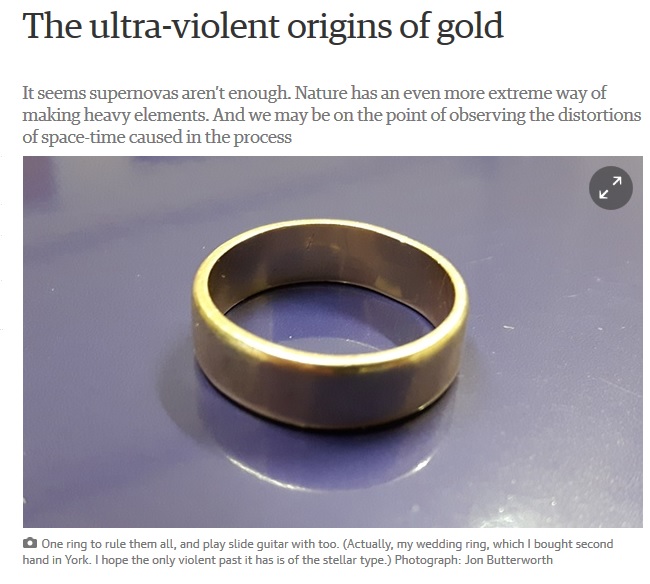
I have to confess that I much prefer the latin plural “supernovae” to the modernised “supernovas”, although most dictionaries (including the One True Chambers) give these both as valid forms. In the interest of full disclosure I will point out that I did five years of Latin at school, and very much enjoyed it…
When I tweeted about my dislike for supernovas and preference for supernovae some replied that English words should have English plurals so that supernovas was preferred (although I wonder if that logic extends to, e.g. datums and phenomenons). Others said that supernovae was fine among experts but for science communication purposes it was better to say “supernovas” as this more obviously means “more than one supernova”. That’s a reasonable argument, but I have to admit I find it a little condescending to assume that an audience can cope with the idea of a massive star exploding as a consequence of gravitational collapse but be utterly bewildered by a straightforward latin plural.
One of the reasons I prefer the Latin plural – along with some other forms that may appear archaic, e.g. Nebulae – is that Astronomy is unique among sciences for having such a long history. Many astronomical terms derive from very ancient sources and in my view we should celebrate this fact because it’s part of the subject’s fascination. That’s just my opinion, of course. You are welcome to disagree with that too.
Anyway, you might be interested to know a couple of things. One is that the first use of “super-nova” recorded in the Oxford English Dictionary was in 1932 in a paper by Swedish astronomer Knut Lundmark. This word is however formed from “nova” (which means “new” in Latin) and the first use of this term in an astronomical setting was in a book by Tycho Brahe, published in 1573:
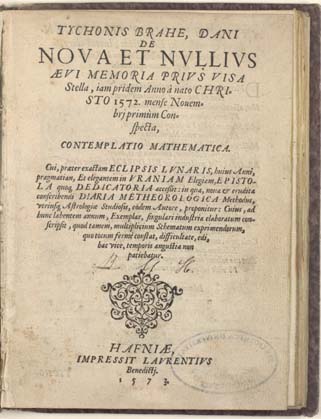 (I’ll leave it as an exercise to the student to translate the full title.)
Nowadays a nova is taken to be a much lower budget feature than a supernova but the “nova” described in Tycho’s book was was actually a supernova, SN1572 which he, along with many others, had observed the previous year. Historical novae were very often supernovae, in fact, because they are much brighter than mere novae. The real difference between these two classes of object wasn’t understood until the 20th Century, however, which is why the term supernova was coined much later than nova.
Anyway, back to pedantry.
A subsequent tweet from Roberto Trotta asserted that in fact supernovae and supernovas are both wrong; the correct plural should be supernovæ, in which the two letters of the digraph “ae” are replaced with a single glyph known as a ligature. Often, as in this case, a ligature stands for a diphthong, a sort of composite vowel sound made by running two vowels together. It’s one of the peculiarities of English that there are only five vowels, but these can represent quite different sounds depending on the context (and on the regional accent). This means that English has many hidden diphthongs. For example, the “o” in “no” is a diphthong in English. In languages such as Italian, in which the vowels are very pure, “no” is pronounced quite differently from English. The best test of whether a vowel is pure or not is whether your mouth changes shape as you pronounce it: your mouth moves as you say an English “no”, closing the vowel that stays open in the Italian “no”…
So, not all diphthongs are represented by ligatures. It’s also the case that not all ligatures represent diphthongs. Indeed some are composed entirely of consonants. My current employer’s logo features a ligature formed from the letters U and S:

The use of the ligature æ arose in Mediaeval Latin (or should I say Mediæval?). In fact if you look at the frontispiece of the Brahe book shown above you will see a number of examples of it in its upper-case form Æ. I’m by no means an expert in such things but my guess is that the use of such ligatures in printed works was favoured simply to speed up the typesetting process – which was very primitive – by allowing the compositor to use a single piece of type to set two characters. However, it does appear in handwritten documents e.g. in Old English, long before printing was invented so easier typesetting doesn’t explain it all.
Use of the specific ligature in question caught on particularly well in Scandinavia where it eventually became promoted to a letter in its own right (“aesc”) and is listed as a separate vowel in the modern Danish and Norwegian alphabets. Early word-processing and computer typesetting software generally couldn’t render ligatures because they were just too complicated, so their use fell out of favour in the Eighties, though there are significant exceptions to this rule. Latex, for example, always allowed ligatures to be created quite easily. Software – even Microsoft Word – is much more sophisticated than it used to be, so it’s now not so much of a problem to use ligatures in digital text. Maybe they will make a comeback!
Anyway, the use of æ was optional even in Mediaeval Latin so I don’t think it can be argued that supernovæ is really more correct than supernovae, though to go back to a point I made earlier, I do admit that a rambling discussion of ligatures and diphthongs would not add much to a public lecture on exploding stars.
Follow @telescoper
“Stars” by Kandinsky
Posted in Art with tags stars, Wassily Kandinsky on January 17, 2016 by telescoperNo time for a proper post so I thought I’d fill a bit of space with Stars, or at least with a picture of the lithograph of that title by Wassily Kandinsky made, I think, in 1938. It is certainly a different kind of image from that produced by astronomers, but it does put me in mind of star-forming regions such as the Orion Nebula..

Saturday Night Function
Posted in Jazz with tags Cotton Club, Duke Ellington, Saturday Night Function on January 16, 2016 by telescoperWell, it’s Saturday Night so I thought I’d post a bit of classic Jazz from the late twenties. This is from the superb Duke Ellington band, vintage 1929, which was resident at the Cotton Club in Harlem, New York City. I haven’t seen a personnel listing for this but the soloists are easy to identify: Barney Bigard on clarinet, James “Bubber” Miley on trumpet, and Joe “Tricky Sam” Nanton on trombone. The tune Saturday Night Function has become a traditional jazz standard but not many bands can get close to that unique Ellington sound, especially the growling trumpets. Enjoy!
How bad is Stormtrooper aim exactly?
Posted in Uncategorized on January 15, 2016 by telescoperHere’s a tongue-in-cheek analysis of the inaccuracy of stormtroopers’ use of firearms in the Star Wars movies.
This is just one manifestation of a general phenomenon – bad guys are always terrible shots! At least in movies…

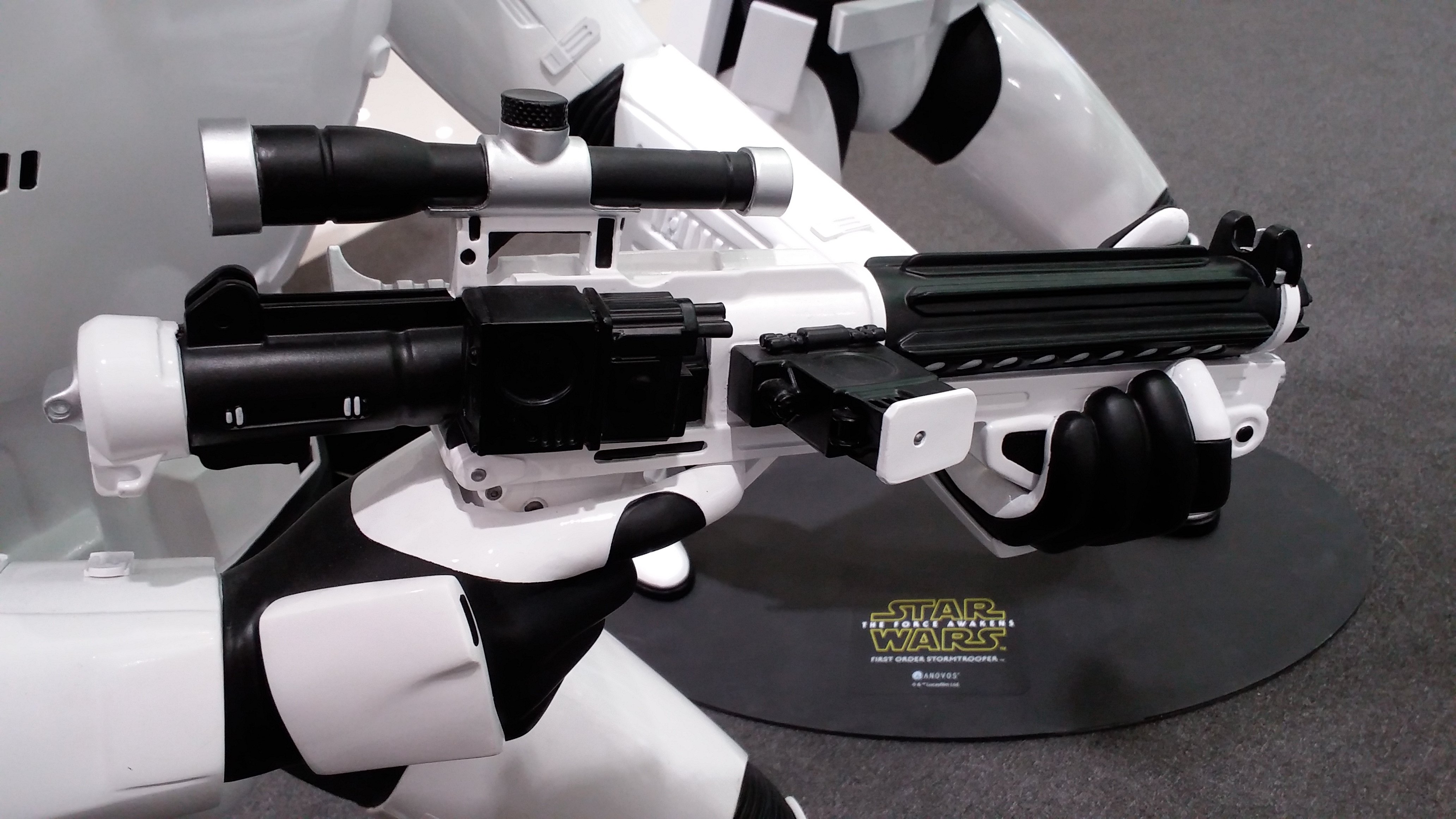 A Stormtrooper gun. It’s possible they don’t know what these are for. Photo by Roy Kabanlit.
For some unknown reason, I’ve been thinking a lot about Star Wars recently. Going forward, I’ll assume you’ll be familiar with the events and characters of at least the first six films. If not, what have you been doing? Living in a recent, recent time in a galaxy that’s very close to here? Broadly speaking, this post inevitably contains minor spoilers for Episodes II−VI of the Star Wars films. If you haven’t seen them, inexplicably want to find out about Stormtrooper aim and don’t mind knowing some plot details, then feel free to read on.
There are some characteristics of characters or groups of characters within the Star Wars register that are widely held to be fact. This may be despite them not being explicitly stated within the films. Red lightsabers are for the…
View original post 1,641 more words
Should the ‘Roast beef of Old England’ be restored as the English anthem?
Posted in Uncategorized on January 15, 2016 by telescoperHere’s an important (?) poll about what an English National Anthem should be, reblogged from Keith Flett’s blog..
I voted for Other (The Blaydon Races) …

Should the ‘Roast Beef of Old England’ be restored as English anthem
Chesterfield MP Toby Perkins may have a point in bringing a bill to the Commons to replace God Save the Queen at sporting events where the England team plays with a specifically English anthem.
The national anthem, God Save the Queen or King, first became common in the 1790s when ‘Church and King’ mobs backed by sailors were keen to oppose radicals who supported the French Revolution.
The traditional English anthem had been the Roast Beef of Old England, and the playing of the new national anthem did not always go down well. A riot took place in Sheffield in 1812 when naval officers insisted it was played at a theatrical performance.
Mr Perkins, not to be confused with Harry Perkins in Chris Mullins a Very British Coup novel, is a supporter of hard right group Progress in…
View original post 73 more words
Truly, Madly, Deeply – R.I.P. Alan Rickman
Posted in Film with tags Alan RIckman, Rest in Peace, Truly Madly Deeply on January 14, 2016 by telescoperWell, I can’t say that I’m very impressed with 2016 so far. Now the wonderful actor Alan Rickman has been taken from us. The first time I saw him act was on the small screen, in a bit part in Smiley’s People. Anyone remember who he played? It says a lot about his talent that he could make such a small role so memorable. However the first feature film I saw him in was Truly, Madly, Deeply which co-starred the marvellous Juliet Stevenson. I cried more than I’d like to admit.
Anyway, by way of a tribute here he is singing, appropriately enough, The Sun Ain’t Gonna Shine Anymore.
Rest in peace, Alan Rickman (1946-2016).
On the Theory of Gravitational Wave Rumour Sources
Posted in Astrohype, The Universe and Stuff, Uncategorized with tags gossip, gravitational waves, Rumours on January 12, 2016 by telescoperThere has been a great deal of excitement almost nowhere in the astrophysics community since it was announced recently that rumours of the detection of gravitational waves had yet again begun to circulate, so I thought I would add here a brief discussion of the theoretical background to these phenomena.
The standard theoretical model of such rumours is that they are produced from time to time during the lifetime of a supermassive science project after periods of relative quiescence. It is thought that they are associated with a perceived lack of publicity which might threaten funding and lead to financial collapse of the project. This stimulates a temporary emission of hype produced by vigorous gossip-mongering which acts to inflate the external profile of the project, resisting external pressures and restoring equilibrium. This general phenomenon is not restricted to gravitational wave detection, but also occurs across many other branches of Big Science, especially cosmology and particle physics.
However, observations of the latest outburst suggest support for a rival theory, in which rumours are produced not by the project itself but by some other body or bodies in orbit around it or even perhaps entirely independent of it. Although there is evidence in favour of this theory, it is relatively new and many questions remain to be answered. In particular it is not known what the effect of rumours produced in this way might be on the long-term evolution of the project or on the source itself.
Lawrence Krauss is 61.
Dover Beach
Posted in Poetry with tags Dover Beach, Matthew Arnold on January 12, 2016 by telescoperThe sea is calm tonight.
The tide is full, the moon lies fair
Upon the straits; on the French coast the light
Gleams and is gone; the cliffs of England stand,
Glimmering and vast, out in the tranquil bay.
Come to the window, sweet is the night-air!
Only, from the long line of spray
Where the sea meets the moon-blanched land,
Listen! you hear the grating roar
Of pebbles which the waves draw back, and fling,
At their return, up the high strand,
Begin, and cease, and then again begin,
With tremulous cadence slow, and bring
The eternal note of sadness in.
Sophocles long ago
Heard it on the Ægean, and it brought
Into his mind the turbid ebb and flow
Of human misery; we
Find also in the sound a thought,
Hearing it by this distant northern sea.
The Sea of Faith
Was once, too, at the full, and round earth’s shore
Lay like the folds of a bright girdle furled.
But now I only hear
Its melancholy, long, withdrawing roar,
Retreating, to the breath
Of the night-wind, down the vast edges drear
And naked shingles of the world.
Ah, love, let us be true
To one another! for the world, which seems
To lie before us like a land of dreams,
So various, so beautiful, so new,
Hath really neither joy, nor love, nor light,
Nor certitude, nor peace, nor help for pain;
And we are here as on a darkling plain
Swept with confused alarms of struggle and flight,
Where ignorant armies clash by night.
by Matthew Arnold (1822-1888)


