R.I.P. David Bowie (1947-2016)
Follow @telescoper
I’m grateful to Darren Baskill for compiling this plot which shows the number of graduates in Physics (including Astrophysics) from the Department of Physics & Astronomy at the University of Sussex since 2004.

The last two columns are projections, of course, but we can be rather confident about the numbers. The increase over the last few years is predominantly a result of having more students enter our Physics programmes, but there has also been a significant increase in progression rates (as a consequence of excellent teaching), which is why we think the predicted numbers of graduates in 2016 and 2017 are likely to be accurate.
One reason for the recent growth was that in 2008 – a particularly low year on the above graph – the Higher Education Funding Council for England (HEFCE) recognized that Physics departments in the South East were struggling to recruit sufficient numbers of students to be financially viable. This led to the formation of SEPNet, a five-year programme which resulted in an injection of cash to promote physics across the South East of England via a range of activities, including a vigorous outreach programme. This almost immediately began to increase the number of applications to do Physics at Sussex (and indeed across the SEPNet consortium), with the result that 3-4 years later the number of graduates started to climb. SEPNet-2, which started in 2013, has developed this initiative still further, with new initiatives in collaborative graduate education.
(For the record note that I took over as Head of School at the beginning of 2013. I will make no further comment…)
This increase in student numbers has generated more income for the Department, all of which is invested back into teaching, research and other activities (including more outreach!) to create a broader curriculum, more choice for students, and more teaching staff; the number of staff in Physics & Astronomy has increased from 23 to 40 since 2013, for example.
The income generated by this expansion has allowed us to broaden our research base too. This seems an appropriate time to mention that a new research group in Materials Physics has just been established within the Department. Professor Alan Dalton from the University of Surrey will be joining the Department next month as Professor of Materials Physics, and several further appointments will follow to establish a new research activity in his area of interest.
Alan’s research interests focus on understanding the fundamental structure-property relationships in materials containing one- and two- dimensional structures such as carbon nanotubes, graphene and other layered nanomaterials. Alan is particularly interested in developing viable applications for nano-structured organic composites (mechanical, electrical and thermal). He is also interested in the directed-assembly and self-assembly of nanostructures into functional macrostructures and more recently interfacing biological materials with synthetic inorganic and organic materials and associated applications.
I’m delighted by this development, which will not only create an entirely new research activity but also add significantly to the range of options we can offer students, as well as new opportunities for undergraduate projects and placements. It also has enormous potential to build links with other Departments, especially Chemistry (which is part of the School of Life Sciences).
To end with, I thought I would also comment on another chart that Darren produced:

Apart from showing the very high levels of achievement of our students, this provides quantitative evidence of something I had suspected for some time. Although the proportion of female Physics students overall has hovered around 23% with little change since 2004, the propotion of female students getting first class degrees is significantly higher than for male students.
So there you are. Women are better at Physics than men. Discuss.
Follow @telescoper
By way of an interlude in this busy period as term gets back underway I thought I’d post this beautiful track by the great jazz pianist Bill Evans. I remember reading somewhere that Bill Evans recorded this right at the end of a session, in 1958. It was unrehearsed, entirely improvised and done in one take. It’s based on a simple two-chord progression that subsequently appeared in Flamenco Sketches, one of the tracks on the classic Miles Davis album Kind of Blue. To my ears, Peace Piece is more redolent of the composition style of Erik Satie than any other jazz musician I can think of. Although it starts out very simply it becomes more complex and fragmented as it develops, and makes effective use of dissonance in creating tension to contrast with the rather meditative atmosphere established at the beginning. Anyway, this is one of my all-time favourite tracks by one of my all-time favourite jazz musicians so I hope you don’t mind me sharing it on here.
Follow @telescoper
Yesterday I took off early from work to head up to the Royal Institution in London to attend a recording of the Reith Lectures, this year given by Stephen Hawking.
Here’s a rather crappy phone pic to show I was there.

In fact they recorded two of this year’s lectures, as well as a lengthy question-and-answer session. The talks and answers to audience questions did of course have to be pre-loaded into Stephen’s computer before delivery which necessitated some pauses for uploads. This together with the recording of various intros, outros and idents made for quite a lengthy event but I found the whole process fascinating and didn’t mind that at all. I did have three glasses of wine at the drinks reception before the show, however, so was in quite a relaxed frame of mind generally.
In charge of the whole thing was the inestimable Sue Lawley who did her job brilliantly. On a few occasions, Stephen Hawking’s computer had a glitch and made a spontaneous interjection in an inappropriate place. Sue Lawley proved completely unflappable.
The topic for the series is, not surprisingly because it is what Hawking is most closely associated with, Black Holes. The lectures were enjoyably sprinkled with some very witty asides, but I did get surprisingly technical at a few points; the audience members beside me were visibly baffled on more than one occasion. See what you think yourself when the lectures are broadcast, the first on 26th January and the second a week later, both at 9pm on BBC Radio 4. They will also be broadcast on the BBC World Service.
The Reith Lectures are open to the public. Apparently over 20,000 applied for tickets to attend last night, such is the draw of Stephen Hawking. The capacity of the Royal Institution lecture theatre is only about 400 so many were disappointed. Fortunately for me, owing no doubt to some form of administrative error, I was an invited guest. I was however somewhat relieved to find I was only on the B-list so although I got to use the VIP entrance I didn’t have to sit among the big nobs at the front in reserved seats.
Follow @telescoperHere’s a montage of photographs taken during the Christmas Staff-Student social event we held in the School of Mathematical and Physical Sciences at the University of Sussex in December 2015. It was a lot of fun, as the pictures make clear!


All Photo Credits: Summer Dean
Follow @telescoperBack in the office after the Christmas and New Year break, with a mountain of stuff to work through..
Anyway, I saw this paper on the arXiv yesterday and thoought I’d share it here. It’s from a paper by Wu et al. entitled Initial Performance of BICEP3: A Degree Angular Scale 95 GHz Band Polarimeter. The abstract follows:
BICEP3 is a 550 mm aperture telescope with cold, on-axis, refractive optics designed to observe at the 95 GHz band from the South Pole. It is the newest member of the BICEP/Keck family of inflationary probes specifically designed to measure the polarization of the cosmic microwave background (CMB) at degree-angular scales. BICEP3 is designed to house 1280 dual-polarization pixels, which, when fully-populated, totals to ∼9× the number of pixels in a single Keck 95 GHz receiver, thus further advancing the BICEP/Keck program’s 95 GHz mapping speed. BICEP3 was deployed during the austral summer of 2014-2015 with 9 detector tiles, to be increased to its full capacity of 20 in the second season. After instrument characterization measurements were taken, CMB observation commenced in April 2015. Together with multi-frequency observation data from Planck, BICEP2, and the Keck Array, BICEP3 is projected to set upper limits on the tensor-to-scalar ratio to r ≲0.03 at 95% C.L..
It all looks very promising, with science results likely to appear later this year, but who will win the race to find those elusive primordial B-modes?
Follow @telescoper
Here’s a lengthy study of Journal Impact Factors. It’s mainly about cell biology journals but I think this across all scientific disciplines. The JIF is so flawed as to be meaningless but this discussion suggests that the situation is even worse than that, with some advertised JIFs being wrong…
There have been calls for journals to publish the distribution of citations to the papers they publish (123). The idea is to turn the focus away from just one number – the Journal Impact Factor (JIF) – and to look at all the data. Some journals have responded by publishing the data that underlie the JIF (EMBO J, Peer J, Royal Soc, Nature Chem). It would be great if more journals did this. Recently, Stuart Cantrill from Nature Chemistry actually went one step further and compared the distribution of cites at his journal with other chemistry journals. I really liked this post and it made me think that I should just go ahead and harvest the data for cell biology journals and post it.
This post is in two parts. First, I’ll show the data for 22 journals. They’re broadly cell biology, but there’s something…
View original post 1,883 more words
As I prepare to return to Sussex for the new term, I find that Nature News & Comment has published a piece on a pet project I’ve blogged about on a number of occasions, The Open Journal of Astrophysics.
There are a couple of sceptical comments quoted in the piece, which is fair enough. Such views are not at all unexpected. This is a new venture and there are bound to be people who prefer to stick to the established publishing channels. I and the others involved in the Open Journal think traditional journals have long since had their day. We’ll just have to see how many others agree!
Follow @telescoperI haven’t been too well for the first few days of 2016, and haven’t been out much since New Year’s Eve. It’s been chucking it down most of the time anyway! I was feeling a bit better this morning and there was a gap in the rain so I went for a walk and did a few errands.
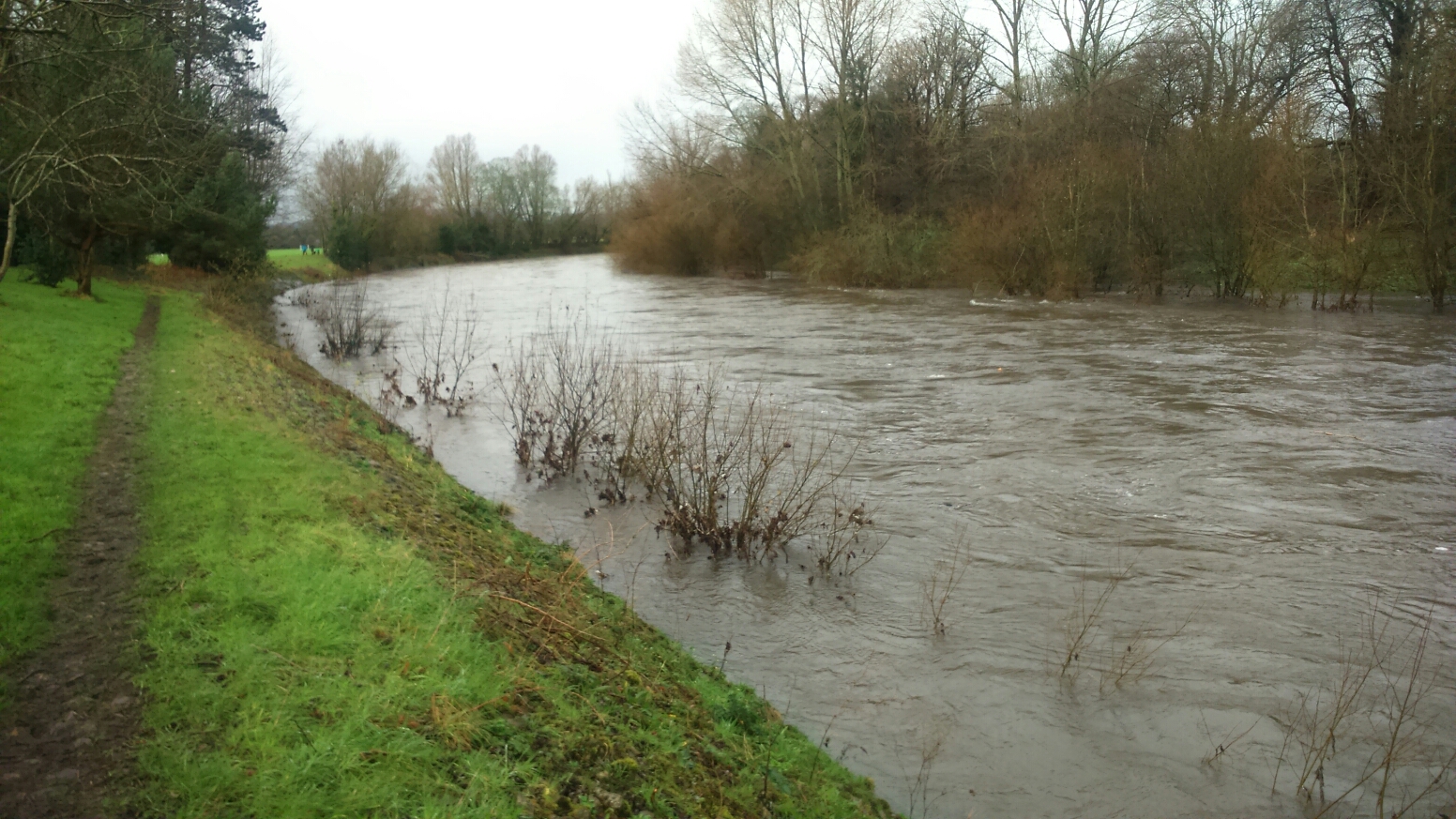
The River Taff is swollen because of the rain. Those are small trees partly submerged in the foreground, so the river is up about a couple of metres. There’s no imminent danger of flooding. I have seen it much higher than this. There seems to be more rain in store though.
I’m travelling back to Brighton on Tuesday barring any problems with the trains. I have a lot to do when I get back to the office. I have to lecture again next term, but there’s also an important grant application to put together, not to mention the official launch of the Open Journal..
Follow @telescoper


