R.I.P. Richie Benaud

Posted in Cricket with tags , on April 10, 2015 by telescoper

Just a short post to pay my respects to a great cricketing legend, Richie Benaud, who has died at the age of 84. It’s no surprise that the media are filled with tributes because he was admired by players and spectators alike. He retired as a player way back in 1964, so many would know him  as a commentator, but he was a fine cricketer in his time. A shrewd tactician, he captained Australia with great distinction but was also an excellent leg-spinner, who took 248 wickets in Test matches, and a capable batsman. In fact he was the first cricketer in history to reach 2000 runs and 200 wickets at Test level, in an era when far fewer Test matches were played.

benaud_main-620x349

When he retired from the game as a player he turned to a career in broadcasting and soon established himself as a peerless comentator on the game. The deep knowledge of the game he acquired in his playing years helped of course, but he also had a natural feeling for when to comment and when to just let it happen. Too many commentators feel the urge to babble on during slower passages of play, but Richie Benaud understood the varying tempo of the game too much to spoil the experience with tittle-tattle. He was unfailingly courteous, generous and respectful, but never afraid to be critical when that was justified. His succinct and perceptive expert analyses during the intervals and after the close of play were especially good. I was going to describe him as a “class act” but I don’t think it was an act at all. I never met him in person, but I think he was as much of a gentleman in real life as he was in the commentary box or on the cricket field. His balanced, even-handed commentary won him as many admirers here as he had in his native Austrlia.

He was a regular commentator on English cricket during what passes for summer in the Northern hemisphere until the memorable Ashes series of 2005. He started his career in commentary in 1963, which was the year I was born, and he played a very big part Here are the last few moments of his last appearance as a commentator in England.

Rest in peace, Richie Benaud (1930-2015), and thank you for all you gave to the world of cricket.

Madama Butterfly

Posted in Opera with tags , , , , on April 9, 2015 by telescoper

I have half an hour to spare this lunchtime so I thought I would do a quick review of  the production of Giacomo Puccini‘s Madama Butterfly I saw last Saturday (4th April) at the Royal Opera House in Covent Garden. I got up at 4.30 on Saturday morning to get the 6am bus from Cardiff into London in order to see this Matinee, which started at 12.30, as the trains were screwed up by engineering work over the Easter weekend. As it happened the National Express coach  ran right on schedule so I had plenty of time to get breakfast and pick up the tickets from the Box Office before the performance.

The story of Madama Butterfly must be familiar enough to opera-goers. Cio-Cio-San – the Madam Butterfly of the title – a 15 year old Geisha, is betrothed to Lieutenant BF Pinkerton of the United States Navy who has come to Japan with his ship. Pinkerton is contemptuous of all things Japanese, and shows his true nature by explaining that he has paid just 100 Yen  for his new wife via a marriage broker. She, however, is devoted to her new husband; so much so that she renounces her religion in favour of that of her man (although I doubt Pinkerton ever goes to church). Act I culminates with their wedding and a gorgeous love duet with the kind of ravishing music that only Puccini can supply. Butterfly, who is really just a child, has certainly fallen for Pinkerton but the music seems to suggest that he has even convinced himself that it’s real love.

Act II is set three years later. Pinkerton has gone back to the States, but Butterfly waits patiently for his return, singing the beautiful aria Un bel di vedremo, or One Fine Day as it is usually translated. Her maid Suzuki thinks that he will never come back – she never liked Pinkerton anyway – and points out that they’re running out of money, but Butterfly refuses to contemplate giving up on him and marrying again. She  has had a son by Pinkerton and intends to remain faithful. At the end of Scene 1 we find that Pinkerton’s ship has arrived and Butterfly waits all night to greet him. The exquisitely poignant cora a bocca chiusa (humming chorus) accompanies her vigil.

After this intermezzo, Scene 2 finds  us at dawn the following day. Butterfly is asleep. Pinkerton shows up, but he has brought with him a new American wife who offers to rescue Butterfly from poverty by adopting her son and taking him to America. Butterfly awakes, finds out what has happened. Pinkerton has left money for her but she refuses to take it, having already decided to kill herself.  She says goodbye to her son with the heartbreaking aria  Tu, tu piccolo iddio, binds his eyes so he can’t see, then kills herself. Pinkerton and his wife arrive to see her bloody corpse.

Well, what did you expect from an opera,  a happy ending?

In this production the principals were the brilliant soprano Kristine Opolais as Butterfly and tenor Brian Jagde, who was a solid but unspectacular Pinkerton.  It turned out to be the last performance with these particular leading performers before a cast change. In fact this performance came up as “sold out” when I first looked on the website, but I persevered and managed to find a couple of tickets a few days later. I’m certainly glad we got to see Kristine Opalais who was in superb voice as the tragic heroine and acted with great subtlety and conviction. I’d also like to mention Enkelejda Shkosa as Suzuki, who was also very good.

The performance got off to a strange start, with an announcement from the stage that it would be delayed by about 30 minutes due to “serious problems backstage”. I wondered whether it was some mechanical problem with the set or a bust-up between members of the cast that needed to be calmed down. The orchestra began a bit hesitantly too, perhaps unsettled by the delay, but soon recovered.

The original production of Madam Butterfly was staged in 1904 (although it took several revisions before the two-act version we saw last night emerged). It therefore dates from a time when Europeans (including Puccini) were quite ignorant about Japanese culture. Modern audiences probably find some of the stereotypes rather uncomfortable. I would say, however, that the only two characters in the Opera to show any moral integrity and nobility of spirit are the maid Suzuki and Butterfly herself. The rest are unpleasant in some way or other, especially Pinkerton who is completely odious. So the Opera is not at all nasty about Japan, although its attitudes are a bit dated and the whole opera glosses over the reality that the world of Cio-Cio-San is basically one in which child prostitution is commonplace.

Madama Butterfly is worth it for the music alone. Call me a softi,e but I love Puccini’s music which, after a slightly ropy start,  was handled beautifully by the Orchestra of the Royal Opera House under the direction of Nicola Luisotti.  This production was also visually beautiful, with exquisite costumes and a set consisting of a simple open space, accentuated from time to time with splashes of cherry blossom and glimpses of landscape and night sky revealed through sliding panels.

Here’s the trailer of the 2011 version of this production (with the same scenery and costumes) to give you an idea:

There’s only a couple of performances left of this run, but something tells me it will be revived again in the not too distant future.

An Einstein Ring – Courtesy of ALMA

Posted in Uncategorized with tags , , , , , , , on April 8, 2015 by telescoper

Just back from a short Easter holiday, I thought I’d resume blogging activities by showing you this remarkable image.


SDP81_ALMA3bands

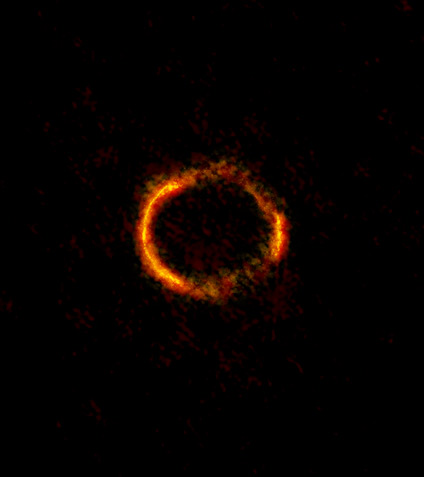
What you see is a near-perfect example of an Einstein Ring which is a result of a chance alignment between a background galaxy and a foreground concentration of mass, sometimes a cluster of galaxies but in this case another galaxy. A more usual effect is the formation of a number of bright arcs; here there are two bright segments, but there is enough detail to see the rest of the circle. The lensed galaxy has a redshift about 3, so that light from it was emitted when the Universe was about one-quarter its current size, about 12 billion years in the past.

This object, codenamed SDP81, was initially detected as a potential lens system by the Herschel Space Observatory, which turned out to be superb at identifying gravitational lenses. I posted about this here, in fact. Working in the far-infrared makes it impossible to resolve the detailed structure of lensed images with Herschel – even with a 3.5m mirror in space, λ/D isn’t great for wavelengths of 500 microns! However, the vast majority of sources found during the Herschel ATLAS survey with large fluxes at this wavelengths can be identified as lenses simply because their brightness tells us they’ve probably been magnified by a lens. Candidates can then be followed up with other telescopes on the ground. A quick look during the Science Demonstration Phase of Herschel produced the first crop of firmly identified gravitational lens systems published in Science by Negrello et al. This one was followed up last year by the Atacama Large Millimetre Array (ALMA), itself a remarkable breakthrough in observational technology; the image was actually made in an extended configuration during the commissioning tests of ALMA’s long-baseline interferometric capability, which gives it stunning resolving power of about 23 milli-arcseconds. It’s absolutely amazing to see such detail in an image made in the submillimetre region of the spectrum.

The press release accompanying this can be found here and the full scientific paper by Vlahakis et al. is already on the arXiv here.

For the specialists the abstract of the journal paper reads:

We present initial results of very high resolution Atacama Large Millimeter/submillimeter Array (ALMA) observations of the z=3.042 gravitationally lensed galaxy HATLAS J090311.6+003906 (SDP.81). These observations were carried out using a very extended configuration as part of Science Verification for the 2014 ALMA Long Baseline Campaign, with baselines of up to 15 km. We present continuum imaging at 151, 236 and 290 GHz, at unprecedented angular resolutions as fine as 23 milliarcseconds (mas), corresponding to an un-magnified spatial scale of ~180 pc at z=3.042. The ALMA images clearly show two main gravitational arc components of an Einstein ring, with emission tracing a radius of ~1.5″. We also present imaging of CO(10-9), CO(8-7), CO(5-4) and H2O line emission. The CO emission, at an angular resolution of ~170 mas, is found to broadly trace the gravitational arc structures but with differing morphologies between the CO transitions and compared to the dust continuum. Our detection of H2O line emission, using only the shortest baselines, provides the most resolved detection to date of thermal H2O emission in an extragalactic source. The ALMA continuum and spectral line fluxes are consistent with previous Plateau de Bure Interferometer and Submillimeter Array observations despite the impressive increase in angular resolution. Finally, we detect weak unresolved continuum emission from a position that is spatially coincident with the center of the lens, with a spectral index that is consistent with emission from the core of the foreground lensing galaxy.

ALMA will only work in long baseline mode for a small fraction of its time, and it is bound to be in very heavy demand, so it’s not clear how many of the hundreds of candidate lenses flagged up by Herschel will ever be mapped in such detail, but this is definitely one for the album!

Interlude

Posted in Biographical, Uncategorized with tags , , on April 1, 2015 by telescoper

The University of Sussex is closing down for a week to allow people to take a breather around Easter weekend. After this afternoon’s staff meeting, I will heading off for a week’s holiday and probably won’t be blogging until I get back, primarily because I won’t have an internet connection where I’m going. That’s a deliberate decision, by the way….

So, as the saying goes, there will now follow a short intermission….

PS. The suitably restful and very typical bit of 1950s  “light” music accompanying this is called Pastoral Montage, and it was written by South African born composer Gideon Fagan.


Why the Big Bang wasn’t as loud as you think…

Posted in The Universe and Stuff with tags , , , , , on March 31, 2015 by telescoper

So how loud was the Big Bang?

I’ve posted on this before but a comment posted today reminded me that perhaps I should recycle it and update it as it relates to the cosmic microwave background, which is what I work on on the rare occasions on which I get to do anything interesting.

As you probably know the Big Bang theory involves the assumption that the entire Universe – not only the matter and energy but also space-time itself – had its origins in a single event a finite time in the past and it has been expanding ever since. The earliest mathematical models of what we now call the  Big Bang were derived independently by Alexander Friedman and George Lemaître in the 1920s. The term “Big Bang” was later coined by Fred Hoyle as a derogatory description of an idea he couldn’t stomach, but the phrase caught on. Strictly speaking, though, the Big Bang was a misnomer.

Friedman and Lemaître had made mathematical models of universes that obeyed the Cosmological Principle, i.e. in which the matter was distributed in a completely uniform manner throughout space. Sound consists of oscillating fluctuations in the pressure and density of the medium through which it travels. These are longitudinal “acoustic” waves that involve successive compressions and rarefactions of matter, in other words departures from the purely homogeneous state required by the Cosmological Principle. The Friedman-Lemaitre models contained no sound waves so they did not really describe a Big Bang at all, let alone how loud it was.

However, as I have blogged about before, newer versions of the Big Bang theory do contain a mechanism for generating sound waves in the early Universe and, even more importantly, these waves have now been detected and their properties measured.
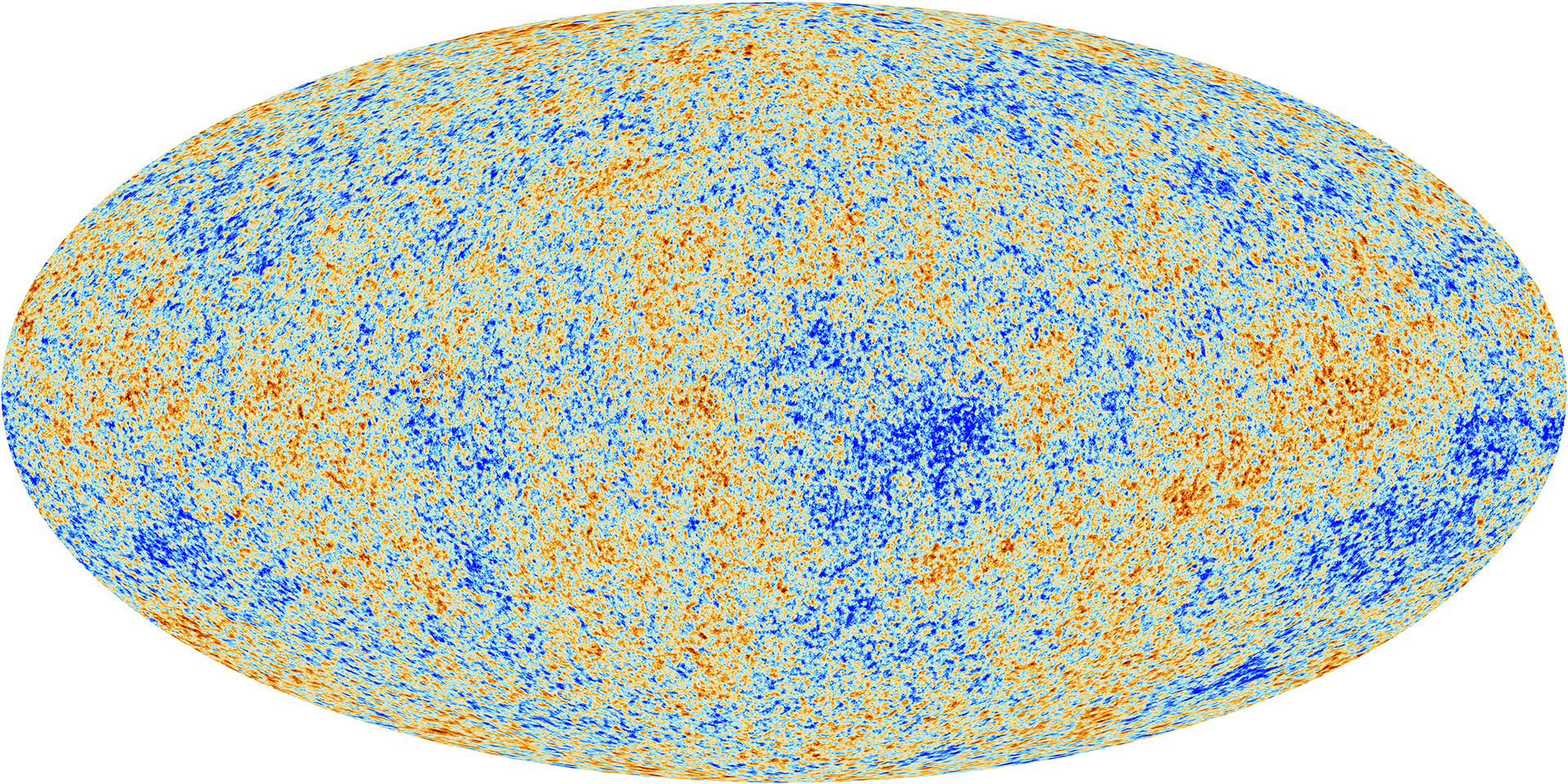
Planck_CMB

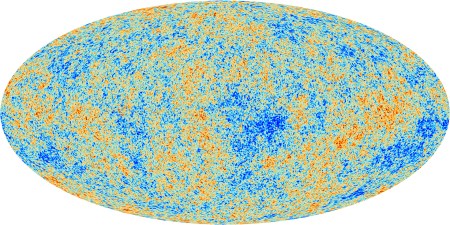
The above image shows the variations in temperature of the cosmic microwave background as charted by the Planck Satellite. The average temperature of the sky is about 2.73 K but there are variations across the sky that have an rms value of about 0.08 milliKelvin. This corresponds to a fractional variation of a few parts in a hundred thousand relative to the mean temperature. It doesn’t sound like much, but this is evidence for the existence of primordial acoustic waves and therefore of a Big Bang with a genuine “Bang” to it.

A full description of what causes these temperature fluctuations would be very complicated but, roughly speaking, the variation in temperature you corresponds directly to variations in density and pressure arising from sound waves.

So how loud was it?

The waves we are dealing with have wavelengths up to about 200,000 light years and the human ear can only actually hear sound waves with wavelengths up to about 17 metres. In any case the Universe was far too hot and dense for there to have been anyone around listening to the cacophony at the time. In some sense, therefore, it wouldn’t have been loud at all because our ears can’t have heard anything.

Setting aside these rather pedantic objections – I’m never one to allow dull realism to get in the way of a good story- we can get a reasonable value for the loudness in terms of the familiar language of decibels. This defines the level of sound (L) logarithmically in terms of the rms pressure level of the sound wave Prms relative to some reference pressure level Pref

L=20 log10[Prms/Pref].

(the 20 appears because of the fact that the energy carried goes as the square of the amplitude of the wave; in terms of energy there would be a factor 10).

There is no absolute scale for loudness because this expression involves the specification of the reference pressure. We have to set this level by analogy with everyday experience. For sound waves in air this is taken to be about 20 microPascals, or about 2×10⁻¹⁰ times the ambient atmospheric air pressure which is about 100,000 Pa.  This reference is chosen because the limit of audibility for most people corresponds to pressure variations of this order and these consequently have L=0 dB. It seems reasonable to set the reference pressure of the early Universe to be about the same fraction of the ambient pressure then, i.e.

Pref~2×10⁻¹⁰ Pamb.

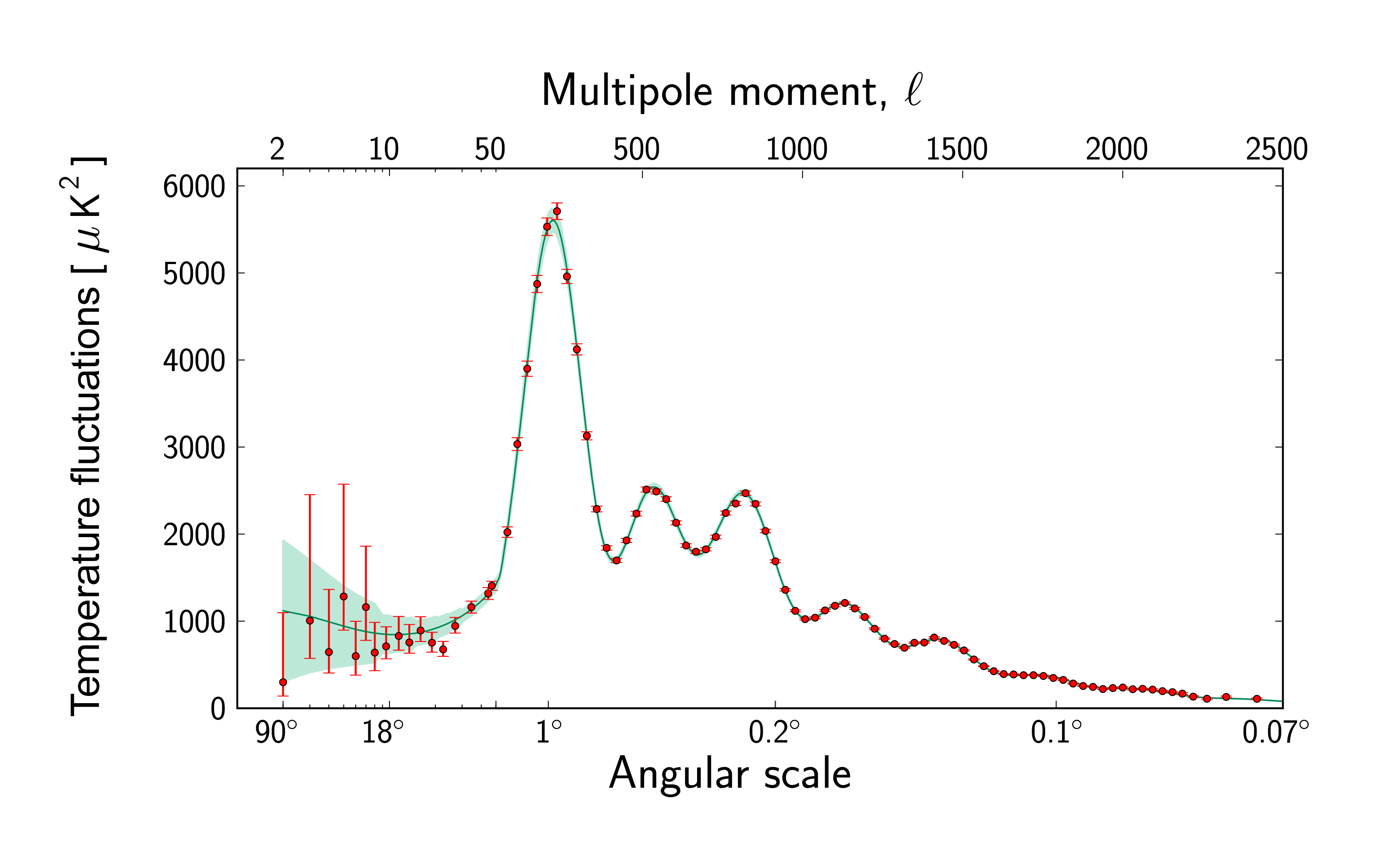
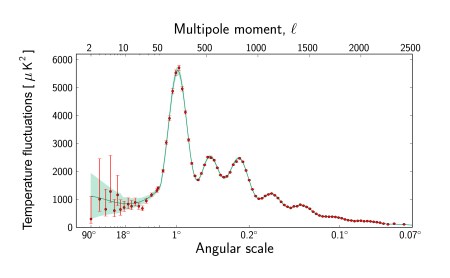
The physics of how primordial variations in pressure translate into observed fluctuations in the CMB temperature is quite complicated, because the primordial universe consists of a plasma rather than air. Moreover, the actual sound of the Big Bang contains a mixture of wavelengths with slightly different amplitudes. In fact here is the spectrum, showing a distinctive signature that looks, at least in this representation, like a fundamental tone and a series of harmonics…
Planck_power_spectrum_orig


If you take into account all this structure it all gets a bit messy, but it’s quite easy to get a rough but reasonable estimate by ignoring all these complications. We simply take the rms pressure variation to be the same fraction of ambient pressure as the averaged temperature variation are compared to the average CMB temperature,  i.e.

Prms~ a few ×10-5Pamb.

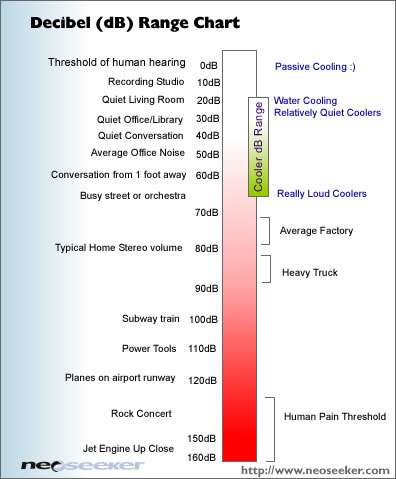
If we do this, scaling both pressures in logarithm in the equation in proportion to the ambient pressure, the ambient pressure cancels out in the ratio, which turns out to be a few times 10-5. With our definition of the decibel level we find that waves of this amplitude, i.e. corresponding to variations of one part in a hundred thousand of the reference level, give roughly L=100dB while part in ten thousand gives about L=120dB. The sound of the Big Bang therefore peaks at levels just a bit less than 120 dB.
cooler_decibel_chart

As you can see in the Figure above, this is close to the threshold of pain,  but it’s perhaps not as loud as you might have guessed in response to the initial question. Modern popular beat combos often play their dreadful rock music much louder than the Big Bang….

A useful yardstick is the amplitude  at which the fluctuations in pressure are comparable to the mean pressure. This would give a factor of about 1010 in the logarithm and is pretty much the limit that sound waves can propagate without distortion. These would have L≈190 dB. It is estimated that the 1883 Krakatoa eruption produced a sound level of about 180 dB at a range of 100 miles. By comparison the Big Bang was little more than a whimper.

PS. If you would like to read more about the actual sound of the Big Bang, have a look at John Cramer’s webpages. You can also download simulations of the actual sound. If you listen to them you will hear that it’s more of  a “Roar” than a “Bang” because the sound waves don’t actually originate at a single well-defined event but are excited incoherently all over the Universe.

Found in Translation…

Posted in Biographical, Books, Books, Talks and Reviews with tags on March 30, 2015 by telescoper

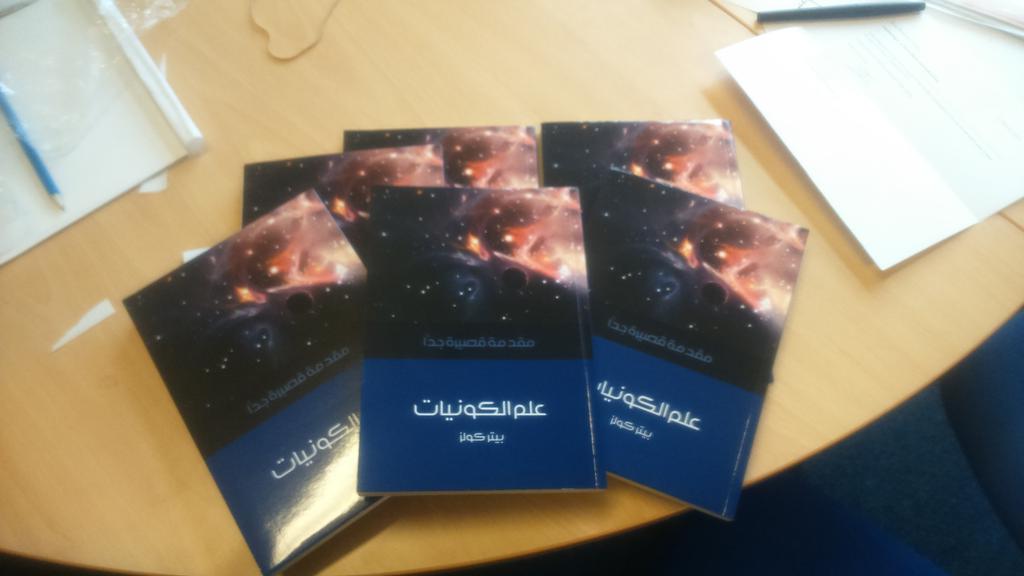
A nice surprise was waiting for me when I arrived at work this morning in the form of a parcel from Oxford University Press containing six copies of the new Arabic edition of my book  Cosmology: A Very Short Introduction. I think I’ve put them the right way up. I was a bit confused because they open the opposite way to books in English, as arabic is read from right to left rather than from left to right.

VSI-Arabic

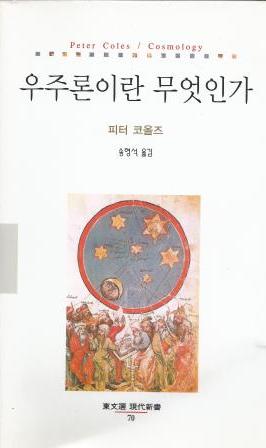
Anyway, although I can’t read Arabic it’s nice to have these to put with the other foreign editions, including these. I still can’t remember whether the first one is Japanese or Korean…

vsi_6

vsi_2

vsi_3

Vsi_5

vsi_4

…still, it’s interesting to see how they’ve chosen different covers for the different translations, and at least I know what my name looks like in Russian Bulgarian!

Praise, by R.S. Thomas

Posted in Poetry, The Universe and Stuff with tags , , , on March 29, 2015 by telescoper

Today is Palm Sunday, the start of what Christians call “Holy Week”, which culiminates in Easter. It’s also the birthday of the great Welsh poet R.S. Thomas, who was born on this day in 1913. Thomas spent much of his life as an Anglican priest. I’m not a Christian but I am drawn to the religious verse of R.S. Thomas not only for its directness and lack of artifice but also the honesty with which he addresses the problems his faith sets him. There are many atheists who think religion is some kind of soft option for those who can’t cope with life in an unfriendly universe, but reading R.S. Thomas, whose faith was neither cosy nor comfortable, led me to realise that is very far from the case. I recommend him as an antidote to the simple-minded antagonism of people like Richard Dawkins. There are questions that science alone will never answer, so we should respect people who search for a truth we ourselves cannot understand.

And whether or not it is clear to you, no doubt the universe is unfolding as it should. Therefore be at peace with God, whatever you conceive Him to be.

I will be offline for the Easter holiday so I thought I’d post a poem that I find appropriate to the time of year. You can read it as Praise for God, or for Nature, or for both. I don’t think it matters.

I praise you because
you are artist and scientist
in one. When I am somewhat
fearful of your power,
your ability to work miracles
with a set-square, I hear
you murmuring to yourself
in a notation Beethoven
dreamed of but never achieved.
You run off your scales of
rain water and sea water, play
the chords of the morning
and evening light, sculpture
with shadow, join together leaf
by leaf, when spring
comes, the stanzas of
an immense poem. You speak
all languages and none,
answering our most complex
prayers with the simplicity
of a flower, confronting
us, when we would domesticate you
to our uses, with the rioting
viruses under our lens.

Nature or Degree

Posted in Mental Health with tags , on March 28, 2015 by telescoper

A thoughtful post to follow on from yesterday’s reaction to the GermanWings tragedy…

MentalHealthCop's avatarMental Health Cop

It was the timing and tone of yesterday’s newspaper headlines that crossed the line for me: not any of discussion about mental health and airline safety. Of course, occupational health and fitness standards for pilots should be rigorous and we heard yesterday about annual testing, psychological testing, etc., etc.. By now, it may be easy to forget that when papers went to press on Thursday night, we still knew comparatively little about the pilot of the doomed flight. We certainly did not know that he appears to have ripped up sick notes that were relevant to the day of the crash or what kind of condition they related to – we still don’t, as the German police have not confirmed it. Whilst we did have suggestion that he had experience of depression and ‘burnout’ – whatever that means – we don’t know the nature or degree of this, do we?

View original post 1,050 more words

It’s Time to Change: Don’t Demonize Depression!

Posted in Mental Health with tags , , , , , on March 27, 2015 by telescoper

Like everyone else I was shocked and saddened on Tuesday to hear of the crash of an Airbus 320 (GermanWings Flight 4U 9525 from Barcelona to Dusseldorf)  in the French Alps.  That initial reaction turned to consternation and confusion when it appeared that flying conditions were good and no “Mayday” signal was sent for the eight minutes it steadily lost altitude until it hit the mountains., and then to complete incomprehension yesterday as evidence emerged that the crash, which resulted in the deaths of 150 people, appeared to have been the result of deliberate action by the co-pilot, Andreas Lubitz.  It seems that the co-pilot waited for the pilot to leave the cockpit to use the lavatory, then locked the door and proceeded to put the plane on a descending trajectory designed to take his own life along with everyone else on board. The horror of these events is beyond imagining. It’s also beyond imagining what could have possessed Andreas Lubitz to do such a terrible thing, for this was an act of mass murder.

Although it seems a paltry gesture, I’d like to take the opportunity to express by deepest condolences to the families, friends and loved ones of everyone who lost their life on that day, including Andreas Lubitz whose family must be experiencing pain on a scale the rest of us are completely unable to contemplate.

I’m not going to speculate at all about what drove this man to behave the way he did. I’m not qualified to comment and it would obviously not be helpful to anyone for me to do so.

That has not stopped the gutter press, however, who have seized upon the fact that Andreas Lubitz had a history of depressive illness to sell copies of their rags by labelling him “a madman” and splashing lurid details about his private life. A Daily Mail article (to which I refuse to link) clearly implies that anyone who has ever suffered from depression is potentially a psychopathic killer. Not for the first time, I am ashamed that people exist with so sensitivity that they could think this sort of journalism could ever be justified.

What this tragedy says to me is that only a better understanding of mental illness will help prevent similar things happening in future and that will not happen if the media continue to demonize those who suffer from depression and/or other mental health problems because the stigma that causes makes it so difficult to seek treatment. I know this for a fact. It is difficult enough to ask for help, even without  headlines screaming in your face from the front page of the Daily Fail or the Sun or even the Daily Telegraph.

I agree completely with Professor Sir Simon Wessely, President of the Royal College of Psychiatrists who is quoted in today’s Guardian as

The loss of the GermanWings Airbus is a ghastly horror. Until the facts are established, we should be careful not to rush judgements. Should it be the case that one pilot had a history of depression, we must bear in mind that so do several million people in this country.

It is also true that depression is usually treatable. The biggest barrier to people getting help is stigma and fear of disclosure. In this country we have seen a recent fall in stigma, an increase in willingness to be open about depression and most important of all, to seek help.

We do not yet know what might be the lessons of the loss of the Airbus, but we caution against hasty decisions that might make it more, not less, difficult for people with depression to receive appropriate treatment. This will not help sufferers, families or the public.

A conservative estimate is that about one in every four people in the UK suffers from depression at one time or another, many of whom struggle with mental illness without either asking for or receiving medical help. Help is there, but we need to much more to encourage people to use it.

Here’s another quote from Time to Change, for whose organization in Wales I wrote the piece linked above,

The terrible loss of life in the Germanwings plane crash is tragic, and we send our deepest sympathies to the families. Whilst the full facts are still emerging, there has been widespread media reporting speculating about the link with the pilot’s history of depression, which has been overly simplistic.

Clearly assessment of all pilots’ physical and mental health is entirely appropriate – but assumptions about risk shouldn’t be made across the board for people with depression, or any other illness. There will be pilots with experience of depression who have flown safely for decades and assessments should be made on a case by case basis.

Today’s headlines risk adding to the stigma surrounding mental health problems, which millions of people experience each year, and we would encourage the media to report this issue responsibly.

It is Time to Change attitudes to mental health, and a good place to start is to realise that it’s Time to Change how the media approach the subject. If you would like to complain about inappropriate reporting of mental health issues in the media then please follow the link here.

How Arts Students Subsidise Science

Posted in Education, Finance with tags , , , , on March 26, 2015 by telescoper

Some time ago I wrote a blog post about the madness of the current fee regime in UK higher education. Here is a quote from that piece:

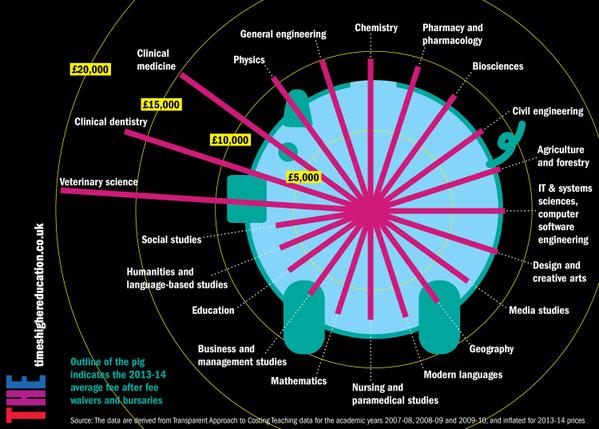
To give an example, I was talking recently to a student from a Humanities department at a leading University (not my employer). Each week she gets 3 lectures and one two-hour seminar, the latter  usually run by a research student. That’s it for her contact with the department. That meagre level of contact is by no means unusual, and some universities offer even less tuition than that. A recent report states that the real cost of teaching for Law and Sociology is less than £6000 per student, consistent with the level of funding under the “old” fee regime; teaching in STEM disciplines on the other hand actually costs over £11k. What this means, in effect, is that Arts and Humanities students are cross-subsidising STEM students. That’s neither fair nor transparent.

Now here’s a nice graphic from the Times Higher that demonstrates the extent to which Science students are getting a much better deal than those in the Arts and Humanities.

Subsidy

The problem with charging fees relating to the real cost of studying the subject concerned is that it will deter students from doing STEM disciplines and cause even greater numbers to flock into cheaper subjects (which where much of the growth in the HE sector over the last decade has actually taken place in any case). However, the diagram shows how absurd the current system (of equal fee regardless of subject really is), and it’s actually quite amazing that more Arts students haven’t twigged what is going on. The point is that they are (unwittingly) subsidising their colleagues in STEM subjects. I think it would be much fairer if that subsidy were provided directly from the taxpayer via HEFCE otherwise there’s a clear incentive for universities to rake in cash from students on courses that are cheap to teach, rather than to provide a proper range of courses across the entire curriculum. Where’s the incentive to bother teaching, e.g., Physics at all in the current system?

I re-iterate my argument from a few weeks ago that the Labour Party’s pledge to reduce fees to £6K across all disciplines would result in a much fairer and justifiable system, as long as there was a direct subsidy from the government to make good the shortfall (of around £6K per annum per student in Physics, for example).