Gowns, Grammar and Graduation

Posted in Biographical with tags , on July 19, 2015 by telescoper

After yesterday’s post about the fascinating story of the recipient of an honorary degree, I thought I’d add a few personal comments about last week’s graduation ceremony for the School of Mathematical and Physical Sciences at the University of Sussex, at which I had the pleasure of presenting the graduands. Graduation ceremonies are funny things. With all their costumes and weird traditions, they do seem a bit absurd. On the other hand, even in these modern times, we live with all kinds of  rituals and I don’t see why we shouldn’t celebrate academic achievement in this way. I love graduation ceremonies, actually. As the graduands go across the stage you realize that every one of them has a unique story to tell and a whole universe of possibilities in front of them. How their lives will unfold no-one can tell, but it’s a privilege to be there for one important milestone on their journey. Getting to read their names out is quite stressful – it may not seem like it, but I do spend quite a lot of time fretting about the correct pronunciation of the names.  It’s also a bit strange in some cases finally to put a name to a face that I’ve seen around the place regularly, just before they leave the University for good.

Anyway, here are the obligatory “mortar boards in the air” pictures of graduates and academic staff from  Physics & Astronomy and Mathematics, respectively, taken just outside the Brighton Dome shortly after the ceremony. I am actually in both of these pictures. Somewhere. I also got hit on the head twice by descending hats.

Hatshats_2

Graduation is a grammatical phenomenon too. The word “graduation” is derived from the latin word gradus meaning a step, from which was eventually made the mediaeval latin verb graduare, meaning “to take a degree”. The past participle  of this is formed via the supine graduatus, hence the English noun “graduate” (i.e. one who has taken a degree). The word graduand, on the other hand, which is used before and during the ceremony to describe those about to graduate, is from the  gerundive form graduandus meaning “to be graduated”. What really happens grammatically speaking, therefore, is that students swap their gerundives for participles, although I suspect most participants don’t think of it in quite those terms.

Graduation ceremonies are quite colourful because staff wear the gown appropriate to their highest degree. Colours and styles vary greatly from one University to another even within the United Kingdom, and there are even more variations on show when schools contain staff who got their degrees abroad. Since I got my doctorate from the University of Sussex, which was created in the 1960s, the academic garb I used to wear on these occasions  is actually quite modern-looking. With its raised collar, red ribbons and capped shoulders it’s also more than a little bit camp. It often brought  a few comments when I participated in the academic procession prior to graduation, but I usually replied by saying I bought the outfit at Ann Summers. Here is a picture of me wearing the old-style Sussex doctoral gown just after I received my DPhil in 1989 at a ceremony at the Brighton Centre:

Graduation

Unfortunately the University decided to change the style recently to something a bit more standard, as demonstrated in this picture from yesterday’s post:
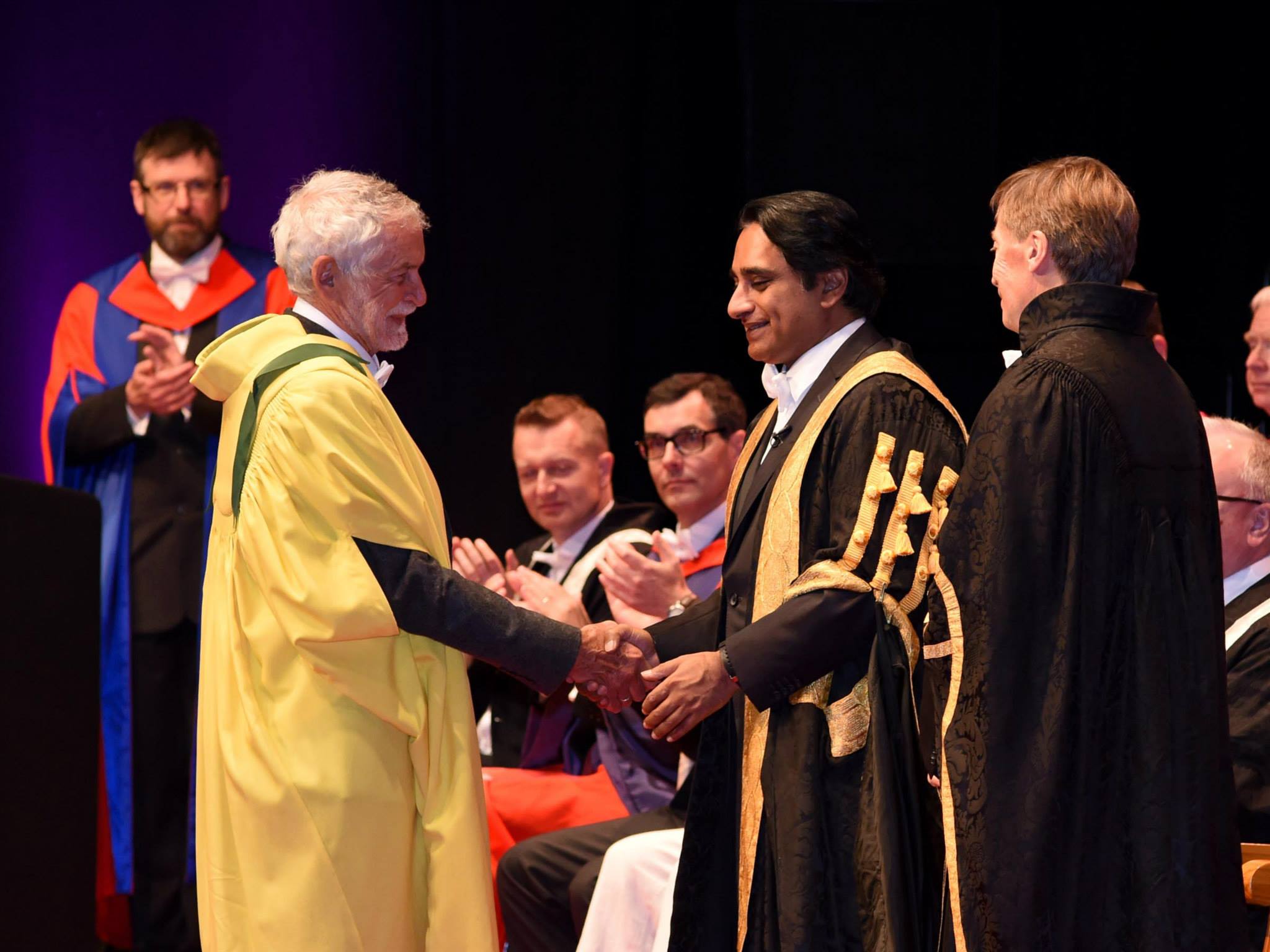
John Francis receiving his Honorary Doctorate from the Chancellor, Sanjeev Bhaskar.

John Francis receiving his Honorary Doctorate from the Chancellor, Sanjeev Bhaskar.

That’s me on the far left, in case you didn’t realise. I still feel a bit uncomfortable wearing academic dress that’s different from what I wore for my graduation. I did mention this once to the Vice Chancellor and he said that it would be perfectly alright if I wore the old style instead. The problem is that I never actually bought the gown and Ede & Ravescroft, who supply the gear for such occasions, no longer provide it. Perhaps I should try to find a second-hand one somewhere?

Graduation of course isn’t just about dressing up. Nor is it only about recognising academic achievement. It’s also a rite of passage on the way to adulthood and independence, so the presence of the parents at the ceremony adds another emotional dimension to the goings-on. Although everyone is rightly proud of the achievement – either their own in the case of the graduands or that of others in the case of the guests – there’s also a bit of sadness to go with the goodbyes. It always seems that as a lecturer you are only just getting to know students by the time they graduate, but that’s enough to miss them when they go.

I’ve also been through two graduations on the other side of the fence, as it were. My first degree came from Cambridge so I had to participate in the even more archaic ceremony for that institution. The whole thing is done in Latin there (or was when I graduated) and involves each graduand holding a finger held out by their College’s Praelector and then kneeling down in front of the presiding dignitary, who is either the Vice-Chancellor ot the Chancellor. I can’t remember which. It’s also worth mentioning that although I did Natural Sciences (specialising in Theoretical Physics), the degree I got was Bachelor of Arts. Other than that, and the fact that the graduands walk to the Senate House from their College through the streets of Cambridge,  I don’t remember much about the actual ceremony.

I was very nervous for that first graduation. The reason was that my parents had divorced some years before and my Mum had re-married. My Dad wouldn’t speak to her or her second husband. Immediately after the ceremony there was a garden party at my college, Magdalene, at which the two parts of my family occupied positions at opposite corners of the lawn and I scuttled between them trying to keep everyone happy. It was like that for the rest of the day and I have to say it was very stressful. A few years later I got my doctorate (actually DPhil) from the University of Sussex, at the Brighton Centre on the seafront. It was pretty much the same deal again with the warring family factions, but I enjoyed the whole day a lot more that time. And I got to wear the funny gown.

Anyway, apologies for going all biographical. My main purpose for writing this post was to thank Thursday’s graduands graduates for the many kind comments and to offer my heartiest congratulations to those I didn’t get to talk to in person. If you are a recent graduate from the School of Mathematical and Physical Sciences then please do stay in touch and let us know how you get on in the big wide world!

Honoris Causa: John Francis, Inventor of the QR Algorithm

Posted in The Universe and Stuff with tags , , , , , , on July 18, 2015 by telescoper

It’s been yet another busy week, trying to catch up on things I missed last week as well as preparing for Thursday’s graduation ceremony for students from the School of Mathematical and Physical Sciences. At this year’s ceremony, as well as reading out the names of graduands from the School of which I am Head, I also had the pleasant duty of presenting mathematician John G.F. Francis for an Honorary Doctorate of Science.

The story of John Francis is a remarkable one which I hope you will agree if you read the following brief account which is adapted from the oration I delivered at the ceremony. It was a special pleasure to asked to present this award because you could never wish to meet a more modest or self-effacing individual. Indeed, when I asked him at the lunch following the ceremony, what he thought of the work for which he had been awarded a degree honoris causa he shrugged it off, and said that he thought it was an obvious thing to do and anyone else could have done it had they thought of it. Maybe that’s true in hindsight, but the point is that “they” didn’t and “he” did. The fact that it has taken over fifty years for him to be recognized for something so important is regrettable to say the least, but I am glad to have been there to see him justifiably honoured. Great thanks are due to Drs Omar Lakkis and Anotida Madzvamuse of the Department of Mathematics at the University of Sussex for bringing his case to the attention of the University as eminently suitable for such an honour. So impressed were the graduating students that a number shook his hand as they passed him on the stage during their own part of the ceremony. I’ve never seen that happen before!

John Francis receiving his Honorary Doctorate from the Chancellor, Sanjeev Bhaskar.

John Francis receiving his Honorary Doctorate from the Chancellor, Sanjeev Bhaskar.

John Francis is a pioneer in the field of mathematical computation where his name is more-or-less synonymous with the so-called “QR algorithm”, an ingenious factorization procedure used to calculate the eigenvalues and eigenvectors of linear operators (represented as matrices).

Before I go on it’s probably worth explaining that the letters ‘QR’ don’t stand for any words in particular. The algorithm involves decomposing the matrix whose eigenvalues are required into the product of an orthogonal matrix (which Francis happened to call Q) and an upper-triangular matrix (which Francis happened to call R). In fact in his original manuscript, the orthogonal matrix was called O but it was subsequently changed to avoid confusion with ‘O’. At any rate, certainly has nothing to do with research funding!

The mathematics and physics graduates in the audience were probably well aware of the importance of eigenvalue problems, which crop up in a huge variety of contexts in these and other scientific disciplines, from geometry to graph theory to quantum mechanics to geology to molecular structure to statistics to engineering; the list is almost endless. Indeed here can be few people working in such fields who haven’t at one time or another turned to the QR algorithm in the course of their calculations. I know I have, in my own field of astrophysics! It has become a standard component of any theoretician’s mathematical toolkit because of its numerical stability.

The algorithm was first derived by John Francis in two papers published in 1959 and, independently a couple of years later, by the Russian mathematician Vera Kublanovskaya (who passed away in 2012). You can find both the papers online: here and here. Interestingly, the problem that John Francis was trying to solve when he devised the QR algorithm concerned the “flutter” or vibrations of aircraft wings.

But it is in the world of the World Wide Web that the QR algorithm has had perhaps its greatest impact. Many of us who were using the internet in 1998 were astonished when Google arrived on the scene because it was so much faster and more effective than all the other search engines available at the time. The secret of this success was the PageRank algorithm (named after Larry Page, one of the founders of Google) which involved applying the QR decomposition to calculate numerical factors expressing the relative “importance” of elements within a linked set (such as pages on the World Wide Web) measured by the nature of their links to other elements. The QR algorithm is not the only technique exploited by Google, but it is safe to say that it is what gave Google its edge.

The achievements of John Francis are indeed impressive, even more so when you read his biography, for he did all this pioneering work in numerical analysis without even having an undergraduate degree in Mathematics.

John Francis actually left school in 1952 and obtained a place at Christ’s College, Cambridge for entry in 1955, after two years of National Service during which he served in Germany and Korea with the Royal Artillery. On leaving the army in 1954 he worked for a time at the National Research Development Corporation which was set up in 1948 by the Attlee government in order to facilitate the transfer of new technologies developed during World War 2 into the private sector in an effort to boost British commerce and industry. Among the priority areas covered by the NRDC was computing, and it was there that John Francis cut his teeth in the field of numerical analysis. He went to University as planned but did not complete his degree, instead returning to the NRDC in 1956 after less than a year of study. It was while working there in 1958 and 1959 that he devised the QR algorithm.

He left the NRDC in 1961 to work at Ferranti Ltd after which, in 1967, he moved to Brighton and took up a position at the University of Sussex in the Laboratory of Experimental Psychology, helping to devise a new computer language for running experiments. He left the University in 1972 to work in various private sector computer service companies in Sussex. He has now retired but still lives locally, in Hove.

Having left the field of numerical analysis in the 1960s, John Francis had absolutely no idea of the impact his work on the QR algorithm had had, nor was he aware that it was widely recognized as one of the Top Ten Algorithms of the Twentieth Century, until he was traced and contacted in 2007 by the organizers of a mini-symposium that was being planned to celebrate 50 years of the QR algorithm; he was the opening speaker at that meeting in Glasgow when it took place in 2009.

More recently still, in 2011, after what he describes as “sporadic” study over many years, John Francis was awarded an undergraduate degree from the Open University, 56 years after he started one at Cambridge.  I am very glad that there was no similar delay in him proceeding to a Doctorate!

Physics is more than applied mathematics

Posted in Education, The Universe and Stuff with tags , , , on July 15, 2015 by telescoper

I thought rather hard before reblogging this, as I do not wish to cause any conflict between the different parts of my School – the Department of Mathematics and the Department of Physics and Astronomy!

I don’t think I really agree that Physics is “more” than Applied Mathematics, or at least I would put it rather differently. Physics and Mathematics intersect, but there are parts of mathematics that are not physical and parts of physics that are not mathematical.

Discuss.

Michael de Podesta's avatarProtons for Breakfast

A problem set for potential applicants in the foyer of the Cavendish Laboratory. Despite appearances - this is not physics! A problem set for potential applicants in the foyer of the Physics department of a premier UK university. It looks like physics, but it is in fact maths. The reason is that in the context of this problem, the string cannot pull a particle along at all unless it stretches slightly. Click the image for a larger diagram.

While accompanying my son on an Open Day in the Physics Department of a premier UK university, I was surprised and appalled to be told that Physics ‘was applied mathematics‘.

I would just like to state here for the record that Physics is notapplied mathematics.

So what’s the difference exactly?

I think there are two linked, but subtly distinct, differences.

1. Physics is a science and mathematics is not.

This means that physics has an experimental aspect. In physics, it is possible to disprove a hypothesis by experiment: this cannot be done in maths.

2. Physics is about…

View original post 256 more words

An Exciting Opportunity in Experimental Physics at the University of Sussex!

Posted in Education, The Universe and Stuff with tags , , , , on July 14, 2015 by telescoper

After much planning and preparatory work, I’m pleased that I am now in a position to announce that the Department of Physics & Astronomy at the University of Sussex has an exciting opportunity in the form of a brand new Chair position in Experimental Physics. The advertisement will shortly appear in both Nature and the Times Higher but it has already appeared on the University of Sussex website. I’m taking the liberty of posting a description of the new position here, but for fuller details please visit the formal advertisement.

–0–

The School of Mathematical and Physical Sciences seeks to appoint a Professor in Experimental Physics in the Department of Physics & Astronomy to lead the next phase of expansion and diversification of the research portfolio within the School by establishing an entirely new research activity in laboratory-based physics.

Sufficient resources will be made available to the selected candidate to establish a new group at Sussex in their field of experimental physics including, for example, condensed matter (interpreted widely), materials science, nanophysics or biophysics. Applicants in research areas with scope for interdisciplinary collaborations with other Schools at the University of Sussex (e.g. Life Sciences, Engineering & Informatics or Brighton and Sussex Medical School) are encouraged, especially  those in areas with potential for generating research impact, as defined in the context of the UK Research Excellence Framework.

The successful applicant will have a proven track-record of success in obtaining substantial external funding through research grants and/or industrial sponsorship.

The appointee will be supported with substantial (seven-figure) sum for start-up funding and an extensive newly-refurbished laboratory space. The financial package on offer will also support the appointment of at least two further experimental lectureships; the appointed professor is expected to be strongly involved in recruitment to these positions.

Informal (and confidential) enquiries may be addressed in the first instance to the Head of School, Professor Peter Coles (P.Coles@sussex.ac.uk).


Pluto and the Pavilion

Posted in Biographical, Football, History with tags , , , , , on July 14, 2015 by telescoper

This is a busy week in many ways and for many reasons, but the main activity revolves around Graduation at the University of Sussex; the ceremony for graduates from my School (Mathematical and Physical Sciences) takes place on Thursday which gives me a couple of days to practice the pronunciation of the names I have to read out!

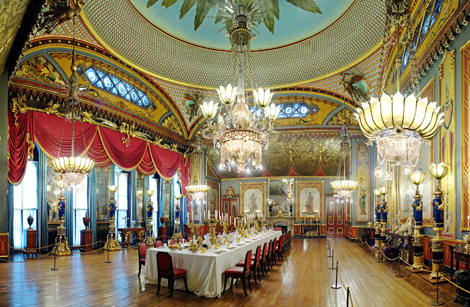
Anyway, last night there was a very Commemoration Dinner in the Dining Room of Brighton Pavilion:

Brighton_Pavilion_Dining_room

The decor is a little understated for my tastes, and in any case I was among a group of about 40 guests who were seated elsewhere owing to the popularity of the event. In fact I was in the Red Drawing Room, which as its name suggests is, er, red:

5_royal_pavilion_red_drawing_room

Anyway, the dinner itself was splendid with particularly fine wine to boot. One of the topics of conversation was the forthcoming flypast of Pluto by the NASA New Horizons spacecraft. As the token astrophysicist on my table I tried my best to answer questions about this event. In fact the closest approach to Pluto takes place about 12.50 pm today (BST) but it will take some time for the images to be downloaded and processed; data transmission rates from the outer edge of the Solar System are rather limited! After passing Pluto, the spacecraft will carry on out of the Solar System into interstellar space. One thing I didn’t know until this morning was that the discoverer of Pluto, Clyde Tombaugh, expressed a wish that when he died his ashes should be sent into space. In fact, they are on New Horizons,  being carried past the planet object he found just 85 years ago. I find that very moving, but it’s also so inspiring that such a short time after Pluto was discovered a spacecraft is arriving there to study it. We humans can do great things if we put our minds to them. Science provides us with constant reminders of this inspirational fact. Unfortunately, politics tends to do the opposite…

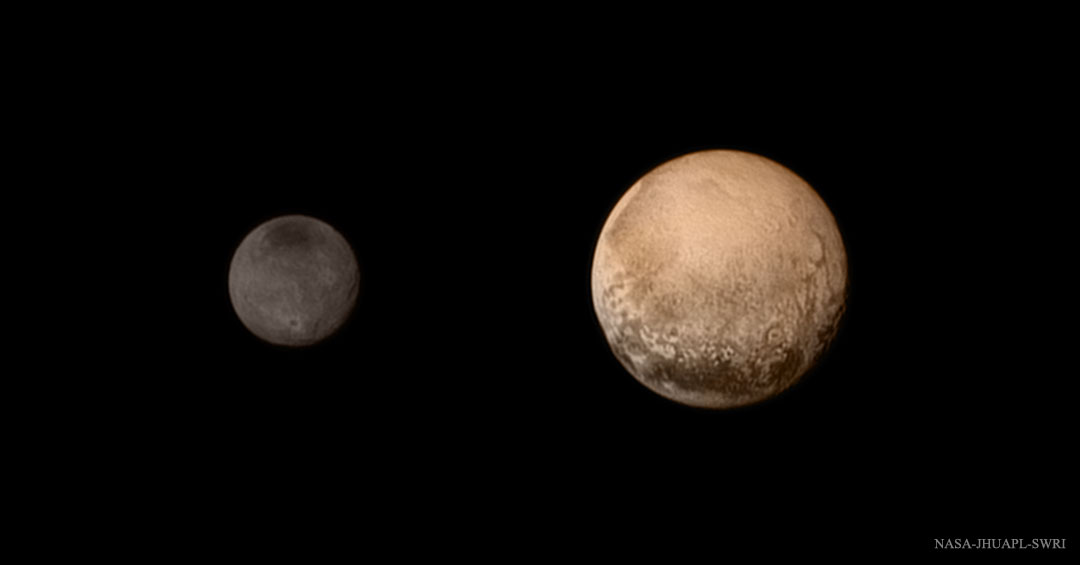
I hope to provide a few updates with images from New Horizons if I get time. Here to whet your appetite is today’s stunning Astronomy Picture of the Day, showing Pluto and its largest moon, Charon, in the same frame:

PlutoCharon01_NewHorizons_1080

Here’s a close-up of Pluto from yesterday:

Pluto_yesterday

And if that isn’t enough, click here for a simulation of the detail we expect to see when New Horizons reaches its closest approach to Pluto.

A Galaxy at Record Redshift?

Posted in The Universe and Stuff with tags , , , , , on July 13, 2015 by telescoper

Skimming through the arXiv this morning I discovered a paper by Zitrin et al. with the following abstract:


abstract_z

I’m not sure if the figures are all significant, but a redshift of z=8.68 makes this the most distant spectroscopically confirmed galaxy on record with a present proper distance of about 9.3 Gpc according to the standard cosmological model, just pipping the previous record holder (whose redshift was in any case disputed). Light from this galaxy has taken about 13.1 Gyr to reach us; that means light set out from it when the Universe was only about 4% of its current age, only about 600 million years after the Big Bang. (Those figures were obtained using the inestimable Ned Wright’s cosmology calculator.)

We are presumably seeing a very young object, in which stars are forming at a considerable rate to account for its brightness. We don’t know exactly when the first stars formed and began to ionize the intergalactic medium, but every time the cosmic distance record is broken we push that time back closer to the Big Bang.

Mind you, I can’t say I’m overwhelmingly convinced by the identification of the redshifted Lyman-α line:

high_zBut what do I know? I’m a theorist whose suspicious of data. Any observers care to comment?

Awaiting The Barbarians

Posted in Finance, Poetry, Politics with tags , , , , , on July 13, 2015 by telescoper

— Why are we come together in the market place?
 
            Barbarians are expected here to-day.
 
— Why in the Senate-house this inactivity —
why sit the Senators and do not legislate?
 
            Because barbarians are to come to-day
            What laws should they make now — the Senators?
            Presently the barbarians will make laws.
 
— Why has our Emperor risen close upon the sun —
why is he waiting there, by the main city-gates,
seated upon the throne, — august, wearing the crown?
 
            Because barbarians are to come to-day
            And so the Emperor in person waits
            to greet their leader. He has even prepared
            a title-deed, on skin of Pergamus,
            in favour of this leader. It confers
            high rank on the barbarian, many names.
 
— Why do our consuls and the praetors go about
in scarlet togas fretted with embroidery;
why are they wearing bracelets rife with amethysts,
and rings magnificent with glowing emeralds;
why are they holding those invaluable staffs
inlaid so cunningly with silver and with gold?
 
            Because barbarians are to come to-day;
            and the barbarians marvel at such things.
 
— Why come not, as they use, our able orators
to hold forth in their rhetoric, to have their say?
 
            Because barbarians are to come to-day;
            and the barbarians have no taste for words.
 
— Why this confusion all at once, and nervousness:
(how serious of a sudden the faces have become):
why are the streets and meeting-places emptying,
and all the people lost in thought as they turn home?
 
            Because the daylight fails, and the night comes,
            but the barbarians come not. And there be
            who from the frontier have arrived and said
            there are no barbarians any longer.

And now what shall become of us without barbarians?
These people were in sooth some sort of settlement.

by C.P. Cavafy (1863-1933); posted on the occasion of the all-night negotiations between the EU and Greece over a bailout deal.

Cricket, Lovely Cricket – Ashes Victory in Cardiff

Posted in Cardiff, Cricket with tags , , , , on July 12, 2015 by telescoper

Last Wednesday (8th July 2015) I had the good fortune to be in the crowd at the SWALEC Stadium in Cardiff to see the first day’s play in the First Test between England and Australia of this summer’s Ashes series. I have to say that I was very apprehensive about how the game would go, but as I was in Wales anyway I couldn’t resist being there to watch it. I think I can say without fear of contradiction that it didn’t turn out too badly.

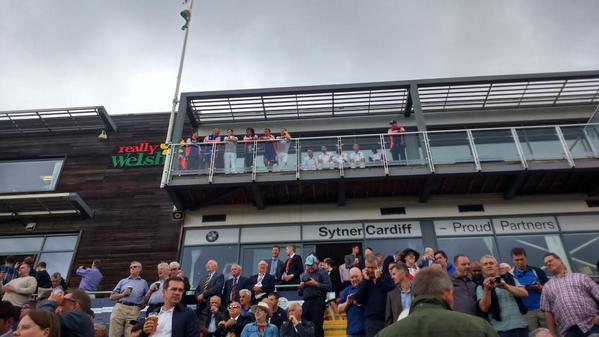
It wasn’t a very auspicious start to the day – light rain was falling as we walked to the ground and at the scheduled start time the England team were still in the pavilion:

England

Play eventually got going about fifteen minutes late, though it could have started earlier had the Powers That Be dispensed with some of the silly preliminaries. It did rain a little before lunch too, but the players didn’t come off. Thereafter the weather steadily improved and we got a full day’s play, closing at about 6.45pm. I even had sunburnt knees as a souvenir, as I had decided to wear shorts for the day and the stand we were in offered no protection from the afternoon sun. Good job I had brought my sunhat.

England had won the toss and decided to bat. The desire to have first use of a good batting pitch must have been tempered in England Captain Alastair Cook’s mind by the likelihood that the overcast conditions would help the Aussie fast bowlers. England struggled early on with the bat, Lyth getting out cheaply playing across a straight one from Hazlewood (who was in the team to replace the injured Ryan Harris) to leave England at 7 for 1. Ballance battled hard at Number 3 but Cook at the other end looked relatively comfortable. Then Michael Clarke threw the ball to offspinner Nathan Lyon to have a go at the lefthanded Cook who seemed impatient to score off him. That proved his downfall as he was out for 20, caught at the wicket, trying to cut a short ball. Ian Bell came, scored one run off a nervous looking lofted drive and was then dismissed leg before wicket by a good inswinger from the excellent Mitchell Starc. At 43-3 England were on the brink, and could have fallen over it a few balls later when new batsman Joe Root played a strange shot at his second ball, a very full swinging delivery from Starc which resulted in an edge that went at a good height to wicket-keeper Brad Haddin diving (somewhat theatrically) to his right. Fortunately for England, Haddin spilled what looked a relatively straightforward chance; having seen the replay a number of times I don’t understand why Haddin didn’t go for it with both hands. At 43-4 England would have been in deep doo-doo, but as it happened Ballance and Root steadied the ship and after a tense morning England reached lunch at 88 for 3.

The ball certainly did swing in that morning session, but the predominant impression I got was that it was a very flat pitch, with very little bounce. Watching from a position square of the wicket to a batsman at the River Taff end, it was noticeable how many balls didn’t carry through to the wicket-keeper. Indeed, Warner’s excellent slip catch to take the wicket of Lyth was harder than it needed to have been because the slips were standing too deep for much of the game. Mitchell Starc was easily the pick of the Australian bowlers; the other Mitchell (Mitchell Johnson) laboured ineffectively on the kind of pitch he clearly doesn’t like to bowl on. He was expensive too. England’s Nemesis of the 13/14 Ashes Tour down under was to finish with 0-111 off 25 overs.

After lunch the sun came out and the character of the play changed. Root and Ballance completed partnership of 153 before Ballance fell for 61 with the score on 196 for 4. This ushered in the belligerent Stokes who didn’t have it all his own way – he got into a tangle trying to hook a Mitchell Johnson bouncer, sending it high over Haddin’s head for six – but Root at the other end had ridden his early luck and made an excellent century. Root is currently in unbelievably good form and it says something for his temperament that he looked bitterly disappointed when he eventually got out for a superb 134, shortly followed by Stokes who made 54. The score was then 293 for 6, by no means enough runs on a good batting pitch but a good recovery from 43-3. Buttler and Moeen Ali added another 50 partnership in quick time until Buttler fell nearly at the end of the day’s play. I was particularly impressed with Moeen’s batting late on and it was he who produced the short of the day for me – a magnificent sweep into the stands for six off the bowling of Lyon. Broad survived a torried couple of overs to leave England on 343-7 at the close of play.

I couldn’t help recalling that the closing score on the first day of corresponding fixture in 2009, which ended famously in a draw, was 336-7. On that occasion, England’s tail wagged brightly the following morning (when I was in the ground) to take their score to 435 all out. As things stood, I felt that the match was evenly poised. If England could do something similar to their feats of 2009 on the second day of this match then they would have a good chance of winning, but if Australia could take quick wickets they would have the edge.

Unfortunately I only had tickets for the first day so I ad to keep up with the rest of the match on the radio and via Twitter. On Day 2, England’s tail did wag – Moeen scoring an excellent 77 – to finish on 430 all out. So far the pattern remained similar to 2009, but that was about to change. Australia got a much better start to their first innings than England had, but lost wickets at the end of Day 2 to close on 264-5 – a far cry from the 248-1 which was their position at the end of Day 2 in 2009. The following morning they were all out for 308, a deficit of 122. England batted again on Day 3 and, not without moments of alarm, accumulated enough runs to build an imposing lead; they were eventually all out at the end of Day 3 for 289. Australia needed to score 412 to win with two days left, though the forecast for Day 5 was for heavy rain.

Clouds had returned to Cardiff for Day 4 (Saturday) and the Australian batsmen were in all sorts of difficulties against the swing on Anderson and Broad. Rogers fell cheaply, Warner was having trouble laying bat on ball, and the runs had dried up. Then Alastair Cook made I think his only tactical mistake of the match: he brough Moeen on to bowl too early. Warner seemed to relax and played some good shots. Moeen was withdrawn after just two expensive overs. The momentum had been handed back to Australia, who began scoring freely. In the last over before lunch they were 97-1, with two batsmen at the crease who were both perfectly capable of posting big scores. Then Cook brough Moeen back for one over before lunch, whereupon he trapped Warner lbw for 52. It was just the fillip England needed. After lunch Smith, Clarke and Voges fell in quick succession to leave Australia in the mire at 106-5. Neither Haddin not Watson stayed around long and Australia were soon 151 for 7. Mitchell Johnson batted defiantly in difficult circumstances, adding 72 for the 8th wicket with Mitchell Starc until their partnership was broken by none other than Joe Root, who as well as being a superb batsman is a spin bowler with an uncanny knack of taking important wickets. Root also took the catch, off the bowling of Moeen Ali, that sealed the game. Australia were all out for 242 about an hour after tea. England had won by 169 runs. Man of the Match: Joe Root, obviously.

So, first blood to England. Of course there are another four Tests to go, starting at Lord’s on Thursday where the pitch may well be much more helpful to the Australian quick bowlers, but this result is better than I imagined at the start of the game and if England can keep it up they at least have a chance of winning back the Ashes. Don’t expect the Aussies to roll over, though. They will be stung by this defeat, and I full expect them to come back hard.

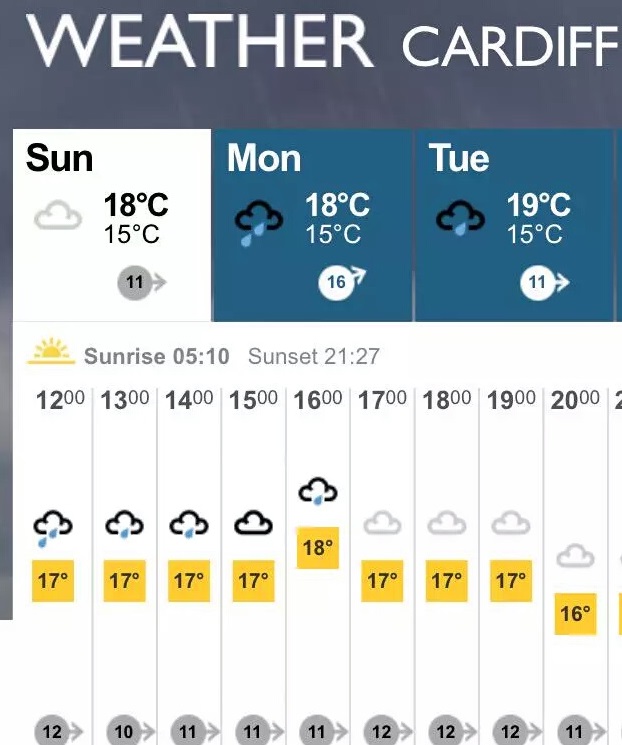
P.S. This was the weather situation in Cardiff earlier today, which would have been the fifth day.

Cardiff_weather

Had Australia batted through to the close on Day 4, it is quite possible that there would have been no play on Day 5, which means the game would have ended in a draw. Now I understand why this Test started on a Wednesday!

P.P.S. Only three members of the current England team played in the 2009 Ashes Test in Cardiff: Anderson, Broad and Cook.

R.I.P. Jon Vickers (1926-2015)

Posted in Opera with tags , , , , on July 12, 2015 by telescoper

Ah well. Back in the office on a rainy Sunday afternoon after a few days away trying to catch up before a very busy week next week. I thought I’d pause first, however, to pay my respects to the great Canadian tenor Jon Vickers, whose death I learnt of last night. Many tributes have been paid to him already, including several examples of his work on Radio 3 this morning. There’s nothing much I can add to them except to say that he not only had a great voice, but was also a fine actor with a powerful stage presence.

What I can do is post again one of my favourite examples of Jon Vickers, singing the greatest passages in one of the greatest of all operas, Peter Grimes by Benjamin Britten. Most people I know who have seen Peter Grimes think it is a masterpiece, and I’m interested to see another physics blog has already discussed this aria. Still, I don’t think Britten is sufficiently appreciated even in the land of his birth. There aren’t that many operas written in English so perhaps we feel a little uncomfortable when we can actually understand what’s going on without reading the surtitles?

I’ve often heard Peter Grimes described as one of the great operas written in English. Well, as far as I’m concerned you can drop “written in English” from that sentence and it’s still true. It’s certainly in my mind fit to put up alongside anything by Verdi, Puccini, Wagner and even Mozart.

In this aria it’s not just the extraordinary vocal line, beginning way up among the “head notes” beyond a tenor’s usual range, that makes it such a  powerful piece of music,  but also the tragic poetry in the words. The main character of Peter Grimes is neither hero nor villain, but  a man trapped in his own destiny. It’s a tragedy in the truest sense of the word:

Now the great Bear and Pleiades where earth moves
Are drawing up the clouds of human grief
Breathing solemnity in the deep night.
Who can decipher in storm or starlight
The written character of a friendly fate
As the sky turns, the world for us to change?
But if the horoscope’s bewildering
Like a flashing turmoil of a shoal of herring,
Who can turn skies back and begin again?


The part of Peter Grimes was actually written by Britten specifically to suit the voice of his partner, Peter Pears, who performed the role first. The classic recording of that performance is wonderful, but this later version starring Jon Vickers is quite different, and the inner agony portrayed by Vickers’ voice in the upper register is most moving. For its combination of musical expressiveness and dramatic intensity, this music really does take some beating even if you listen to it on its own outside the context of the opera.

Rest in Peace, Jon Vickers (1926-2015)

Ten Years and a Day…

Posted in Biographical with tags , , on July 7, 2015 by telescoper

Today is the tenth anniversary of the terrorist attacks that killed 58 people in London on 7th July 2005. Can that really have been ten years ago?

It seems apt to post this recollection again.

–o–

One summer morning in 2005 I rose early and left my house – I was living in Nottingham then – and took a train to London. I was quite excited. I was going to be interviewed later that day for a programme in the BBC TV series Horizon called The Hawking Paradox. The filming was to take place inside the Café de Paris near Piccadilly Circus, for the simple reason that it wasn’t used during the daytime, and would therefore be both quiet and cheap to hire. I was keen not to be late so I got a train that was due to arrive at St Pancras Station in London at about 9.30am.

On the train I dealt with a few bits of correspondence, filling in forms and writing out cheques to pay bills, so had a couple of  items of mail to post when I got to London. The train was on time, and it was a fine morning, so I decided to walk from the station down through Soho to the location of the shoot.

I crossed Euston Road and walked down towards Bloomsbury. Spying  a bright red Royal Mail postbox across the road  in Tavistock Square, I waited for a bus to go past, crossed the road and popped my letters into the box. I looked at my watch to see if I had time for coffee on the way to Piccadilly. It was exactly 9.45am, on July 6th 2005.

I enjoyed the filming, although it took quite a long time – as these things do. Breaking for lunch in a local pizzeria, we were surrounded by a hubbub of excitement when news broke that London had been awarded the right to stage the 2012 Olympics. We finished the filming and I headed back to Nottingham on the train. All-in-all it had been a very pleasant day.

Last week the inquest into the terrorist attacks on London delivered its long awaited verdict into the terrible events of 7th July 2005, the day after my trip. Here is a picture of the postbox in Tavistock Square taken on 7/7/2005. The bomb that tore the roof off the bus and killed 13 people went off at 9.47am, almost exactly 24 hours after I had been in precisely the same spot. Spooky.