Rest in Peace, P.D. James

Posted in Literature with tags , , on November 28, 2014 by telescoper

I was saddened yesterday to hear of the death, at the age of 94, of the great crime novelist P.D. James so decided to take a few minutes out of my lunch break to post this little tribute. I’ve long been a fan of detective fiction in general but there was something very special about the writing of P.D. James; the initials stand for Phyllis Dorothy, by the way. I think she was one of the few crime novelists who managed to transcend the whodunnit genre  to produce work of authentic literary merit in its own right; Ruth Rendell is the only other that springs to mind among contemporary writers of detective fiction. Her style was as polished and the subject matter as meticulously researched was you would expect from a direct descendant of Dorothy L. Sayers, one of the leading exponents of the “Golden Age” of detective fiction.

P.D. James is most famous for her series of fourteen books featuring the poetry-loving detective Adam Dalgleish, the first of which, Cover Her Face, was published in 1962. That series contained many superb stories, such as Shroud for a Nightingale, Devices and Desires, and Death of an Expert Witness. She also wrote two novels about the female private detective Cordelia Gray, including An Unsuitable Job for a Woman. More recently she wrote a murder mystery  sequel to Jane Austen’s Pride and Prejudice called Death Comes to Pemberley. I bought this last year, but somehow never got around to reading it but will definitely do so now, as I now know it her last; I have read all her other books.

As well as numerous awards for her writing, P.D. James was honoured by the Establishment with an OBE in 1983 and a Life Peerage in 1999. It’s says most however that so many other authors, even those whose style is markedly different have offered heartfelt tributes to her (including these in the Guardian). The main reason why she was held in such high regard by fellow authors was simply that she was bloody good at being a writer; she cared about her craft and was proud of what she did.

There’s something distinctively English about the detective novels of P.D. James, although that something is a something that clearly tends to polarize people. Some find her approach a bit too detached and genteel, some find it, “cosy”, snobbish and class-ridden, and some think that she was just an anachronism, harking back too much to the era of Agatha Christie and Dorothy L. Sayers. Yet others can’t understand the attraction of the genre at all. People are welcome to their opinions of course, but I think that the best detective fiction is not just about setting a puzzle for the reader to solve, but also posing questions about the nature of a society in which such crimes can happen. Far from being “cosy”, great crime writing actually unsettles bourgeois attitudes. The solution of the mystery may offer us a form of comfort, but the questions exposed by the investigation do not go away. As Val McDermid
wrote in the Guardian
, “People who know no better sometimes describe her work as cosy. If a scalpel is cosy, then so was Phyllis”.

Rest in Peace, P.D. James (1920-2014).

Cricketer Moeen Ali & author Philip Ardagh on Beard of Year shortlist. Russell Brand doesnt make cut

Posted in Beards, Biographical on November 28, 2014 by telescoper

So it seems that I’ve made the shortlist for Beard of the Year 2014. No doubt many would consider it to be unseemly for me to tout for votes on this blog. All I can say to such people is VOTE FOR ME!

kmflett's avatarKmflett's Blog

Beard Liberation Front

Press release 27th November

Contact keith Flett 07803 167266

Cricketer Moeen Ali & author Philip Ardagh on Beard of Year shortlist as Russell Brand doesn’t make cut

The Beard Liberation Front, the informal network of beard wearers, has revealed the 10 names that will go forward to a poll for the Beard of the Year after a public vote eliminated such well known beard wearers as Russell Brand and Pink Floyd’s Dave Gilmour.

England cricketer Moeen Ali who has just scored the third fastest England ODI century and author Philip Ardagh are among the favourites to win the coveted Award, along with surprise contender the Bishop of Brentwood.

After an on-line vote which opens on 28th November the winners of Beard of the Year will be revealed on December 28th.

BLF Organiser Keith Flett said, it’s fair to say that competition for the Beard of the…

View original post 114 more words

At a Lecture

Posted in Education, Poetry with tags , , , on November 27, 2014 by telescoper

Since mistakes are inevitable, I can easily be taken
for a man standing before you in this room filled
with yourselves. Yet in about an hour
this will be corrected, at your and at my expense,
and the place will be reclaimed by elemental particles
free from the rigidity of a particular human shape
or type of assembly. Some particles are still free. It’s not all dust.

So my unwillingness to admit it’s I
facing you now, or the other way around,
has less to do with my modesty or solipsism
than with my respect for the premises’ instant future,
for those afore-mentioned free-floating particles
settling upon the shining surface
of my brain. Inaccessible to a wet cloth eager to wipe them off.

The most interesting thing about emptiness
is that it is preceded by fullness.
The first to understand this were, I believe, the Greek
gods, whose forte indeed was absence.
Regard, then, yourselves as rehearsing perhaps for the divine encore,
with me playing obviously to the gallery.
We all act out of vanity. But I am in a hurry.

Once you know the future, you can make it come
earlier. The way it’s done by statues or by one’s furniture.
Self-effacement is not a virtue
but a necessity, recognised most often
toward evening. Though numerically it is easier
not to be me than not to be you. As the swan confessed
to the lake: I don’t like myself. But you are welcome to my reflection.

by Joseph Brodsky (1940-1996)


Quantum Technologies at Sussex

Posted in The Universe and Stuff with tags , , , , , on November 26, 2014 by telescoper

Some good news arrived today. We had been hoping to hear it since September but it finally appeared today. It involves several physicists from the Atomic, Molecular and Optical (AMO) Group of the Department of Physics & Astronomy in the School of Mathematical and Physical Sciences here at the University of Sussex who bid to participate in a major investment (of ~£270M) in quantum technology overseen by the Engineering and Physical Sciences Research Council (EPSRC). Today we learned that Sussex physicists were successful in their applications and in fact will participate in two of the four new Quantum Technology “hubs” now being set up. One of the hubs is led by the University of Oxford and the other by the University of Birmingham. We will be starting work on these projects on 1st December 2014 (i.e. next Monday) and the initial funding is for five years. Congratulations to all those involved, not just at Sussex but also in those other institutions participating in the new programme.

For a relatively small Department this is an outstanding achievement for Sussex, and the funding gained will help us enormously with our strategy of expanding laboratory-based experiment physics on the University of Sussex campus. Since I arrived here last year it has been a priority for the School to increase and diversify its research portfolio, both to enhance the range and quality of our research itself and to allow us to teach a wider range of specialist topics at both undergraduate and postgraduate level. This particular subject is also one in which we hope to work closely with local comanies, as quantum technology is likely to be a key area for growth over the next few years.

I’m very excited by all this, because it represents a successful first step towards the ambitious goals the Department has set and it opens up a pathway for further exciting developments I hope to be able to post about very soon.

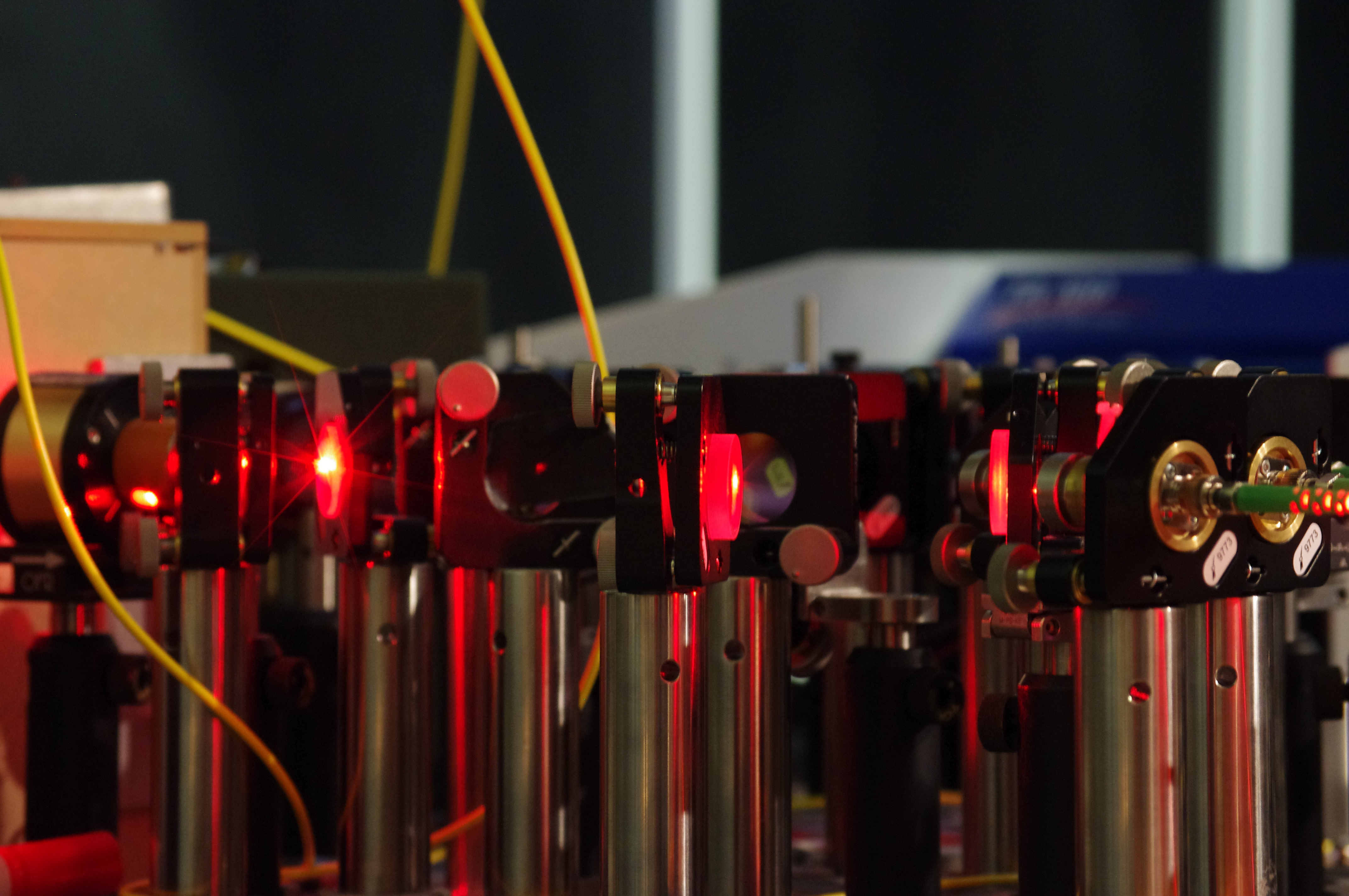
To celebrate, here’s a gratuitous picture of a laser experiment:

laser

You can find more information about the Quantum Technology hubs altogether here.

The text of the official University of Sussex  press release follows:

Sussex scientists have been awarded £5.5 million to develop devices that could radically change how we measure time, navigate our world and solve seemingly impossible mathematical equations.

The grants, received by members of the University’s Atomic, Molecular and Optical Physics (AMO) research group, represent part of a £270 million UK government investment announced today (26 November) to convert quantum physics research into commercial products.

Quantum technology is the applied field of quantum theory. It includes such phenomena as “quantum entanglement”, the idea that objects are not independent if they have interacted with each other or come into being through the same process, and that changing one will also change the other, no matter how far apart they are.

Members of the AMO group have become part of two major national quantum centres: the UK Quantum Technology Hub on Networked Quantum Information Technologies and the UK Quantum Technology Hub for Sensors and Metrology. These centres bring together universities and industry to develop and construct quantum technologies.

The award from the Engineering and Physical Sciences Research Council (EPSRC) will help to fund several Sussex research projects:

  • Dr Jacob Dunningham will be developing a theory to understand how remote objects can be detected with exquisite precision by making use of a networks of sensors linked by quantum entanglement.
  • Dr Winfried Hensinger, as part of one hub, will develop the quantum processor microchip architecture and a new technique of quantum processing using microwave radiation to enable the construction of a large-scale “super-fast” quantum computer. As part of the other hub, he will develop powerful portable sensors able to detect magnetic fields with unprecedented accuracy utilizing a new generation of microchips capable of holding arrays of individual charged atoms.
  • Dr Alessia Pasquazi will develop miniature, ultra-fast, photonic sources of light that form the heart of a new generation of quantum sensors and navigation devices.
  • Dr Marco Peccianti will shrink to the size of a shoe box an “optical frequency comb”, a highly accurate clock currently found only in state-of-the-art laboratories.
  • Prof Barry Garraway will design new rotation sensors for compact navigation devices using atom-chip technology.
  • Dr Matthias Keller will develop a network connecting several quantum processors through the exchange of single photons, resulting in a new version of the internet, the so-called ‘quantum internet’.

In response to the funding news, Professor Peter Coles, Head of the School of Mathematics and Physical Sciences, said: “Quantum sensors offer amazing possibilities for smaller and lighter devices with extraordinary precision. As a consequence, quantum theory promises revolutionary technological applications in computing, measurement, navigation, and security.”

Professor Michael Davies, Pro-Vice-Chancellor for Research, said: “This new research programme will consolidate the reputation of the University of Sussex as one of the world-leading centres for the development of ground-breaking quantum technologies.”

The research will be supplemented by a significant Sussex investment and will make use of the world-leading multi-million pound quantum technology laboratories located at the University.

Professor Coles added: “Our pioneering ‘MSc in Frontiers of Quantum Technology’ program along with numerous PhD positions will provide training for a new generation of researchers and developers to be employed in the emerging quantum technology sector.”

Greg Clark, Minister of State for Universities, Science and Cities, said: “This exciting new Quantum Hubs network will push the boundaries of knowledge and exploit new technologies, to the benefit of healthcare, communications and security.

“Today’s announcement is another example of the government’s recognition of the UK’s science base and its critical contribution to our sustained economic growth”.

Research in Modelling Ocean Systems

Posted in The Universe and Stuff with tags , , , on November 26, 2014 by telescoper

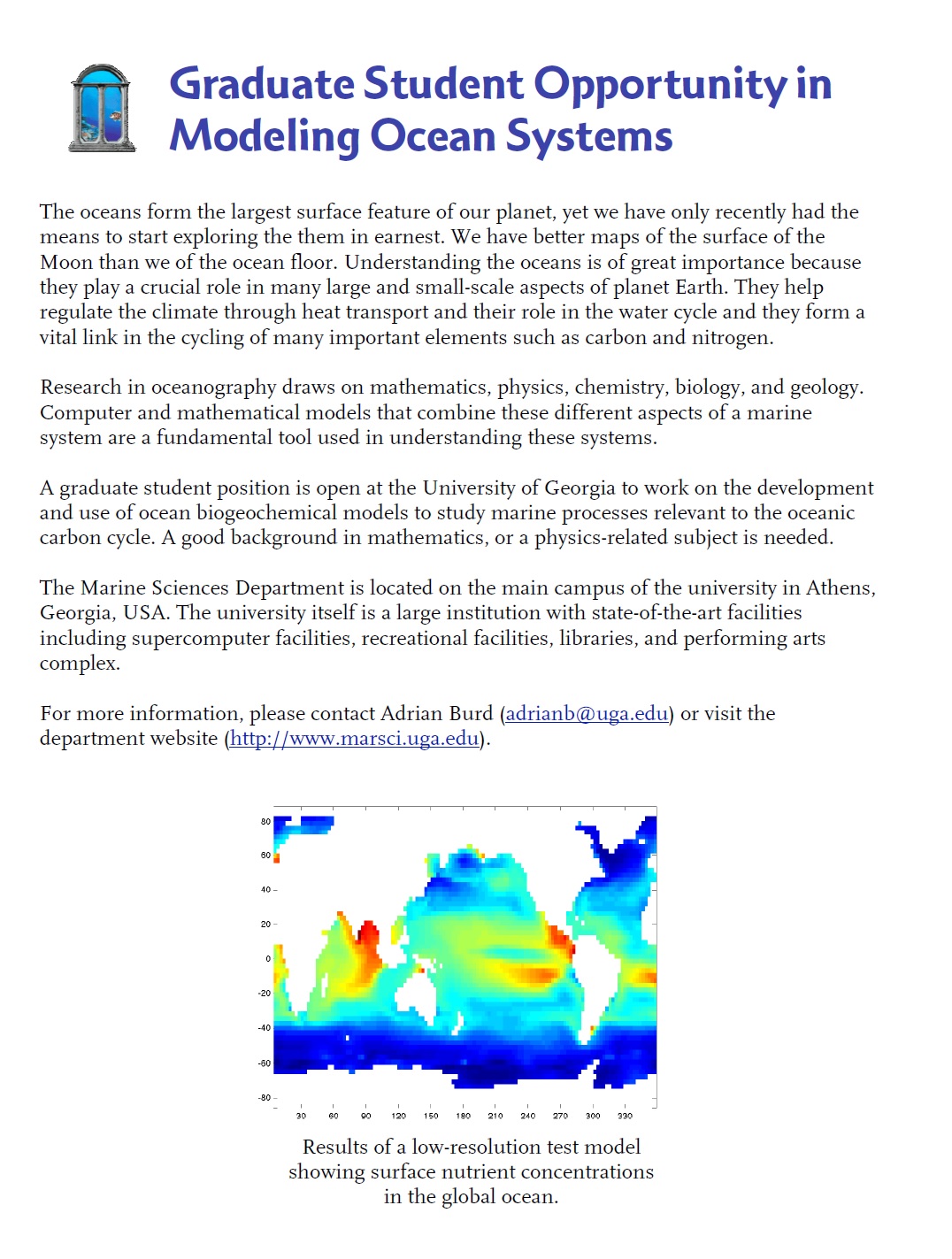
Time to do a favour for an old friend of mine (who was in fact a graduate student at Sussex at the same time as me, back in the 80s, and is an occasional commenter on this blog), Adrian Burd. Adrian moved to the US of A some time ago and now works on Oceanography (that’s Wave Mechanics, I guess..). Anyway, he now has an opportunity for a PhD student which is suitable for a candidate with a background in Mathematics or Physics. Since I’m Head of the School of Mathematical and Physical Sciences, I thought I’d put the advertisement up on here and see if there are any takers. Looks like an interesting one to me!

GradFlyer

You can download a pdf of the flyer here.

Please direct any queries to Adrian!

Doomsday is Cancelled…

Posted in Bad Statistics, The Universe and Stuff with tags , on November 25, 2014 by telescoper

Last week I posted an item that included a discussion of the Doomsday Argument. A subsequent comment on that post mentioned a paper by Ken Olum, which I finally got around to reading over the weekend, so I thought I’d post a link here for those of you worrying that the world might come to an end before the Christmas holiday.

You can find Olum’s paper on the arXiv here. The abstract reads (my emphasis):

If the human race comes to an end relatively shortly, then we have been born at a fairly typical time in history of humanity. On the other hand, if humanity lasts for much longer and trillions of people eventually exist, then we have been born in the first surprisingly tiny fraction of all people. According to the Doomsday Argument of Carter, Leslie, Gott, and Nielsen, this means that the chance of a disaster which would obliterate humanity is much larger than usually thought. Here I argue that treating possible observers in the same way as those who actually exist avoids this conclusion. Under this treatment, it is more likely to exist at all in a race which is long-lived, as originally discussed by Dieks, and this cancels the Doomsday Argument, so that the chance of a disaster is only what one would ordinarily estimate. Treating possible and actual observers alike also allows sensible anthropic predictions from quantum cosmology, which would otherwise depend on one’s interpretation of quantum mechanics.

I think Olum does identify a logical flaw in the argument, but it’s by no means the only one. I wouldn’t find it at all surprising to be among the first “tiny fraction of all people”, as my genetic characteristics are such that I could not be otherwise. But even if you’re not all that interested in the Doomsday Argument I recommend you read this paper as it says some quite interesting things about the application of probabilistic reasoning elsewhere in cosmology, an area in which quite a lot is written that makes no sense to me whatsoever!


Farewell to Blackberry…

Posted in Uncategorized with tags , , , on November 24, 2014 by telescoper

I’m not really a great one for gadgets so I rarely post about technology. I just thought I’d do a quick post because the weekend saw the end of an era. I had been using a Blackberry smartphone for some time, the latest one being a Blackberry Curve, and even did a few posts on here using the WordPress App for Blackberry. I never found that particular bit of software very easy to use, however, so it was strictly for emergencies only (e.g. when stuck on a train). Other than that I got on pretty well with the old thing, except for the fact that there was no easy way to receive my work email from Sussex University on it. That has been a convenient excuse for me to ignore such communications while away from the internet, but recently it’s become clear that I need to be better connected to deal with pressing matters.

Anyway a few weeks ago I got a text message from Vodafone telling me I was due a free upgrade on my contract so I decided to bite the bullet, ditch the Blackberry and acquire an Android phone instead. I’m a bit allergic to those hideously overpriced Apple products, you see, which made an iPhone unthinkable.  On Saturday morning I paid a quick visit to the vodafone store in Cardiff and after a nice chat – mainly about Rugby (Wales were playing the All Blacks later that day) and the recent comet landing – I left with a new Sony Xperia Z2. I feel a bit sorry for turning my back on Blackberry; they really were innovators at one point, but they made some awful business decisions and have been left behind by the competition. Incidentally, the original company Research In Motion (RIM) was doing well enough 15 years ago to endow the PeRIMeter Institute for Theoretical Physics in Waterloo, Ontario, which was one of the reasons for my loyalty to date. The company is now called Blackberry Limited and has recently gone through major restructuring in its struggle for survival.

The Xperia Z2 is a nice phone, with a nice big display, generally very easy to find your way around, and with a lot more apps available than for Blackberry. I’ve got my Sussex email working and got Twitter, Facebook and WordPress installed; the latter is far better on Android than on Blackberry. The only thing I don’t like is the autocorrect/autocomplete, which is wretched, and which  I haven’t yet figured out how to switch off. The other thing is that it’s completely waterproof, but I haven’t taken it into the shower yet.

I feel quite modern for a change – my old Blackberry did make me feel like an old fogey sometimes – but since I’ve now signed up for another two years of contract before my next upgrade, there’s plenty of time for technology to overtake me again.


Autumn: A Dirge

Posted in Poetry with tags , on November 24, 2014 by telescoper

I.

The warm sun is failing, the bleak wind is wailing,
The bare boughs are sighing, the pale flowers are dying,
And the Year
On the earth her death-bed, in a shroud of leaves dead,
Is lying.
Come, Months, come away,
From November to May,
In your saddest array;
Follow the bier
Of the dead cold Year,
And like dim shadows watch by her sepulchre.

II.

The chill rain is falling, the nipped worm is crawling,
The rivers are swelling, the thunder is knelling
For the Year;
The blithe swallows are flown, and the lizards each gone
To his dwelling;
Come, Months, come away;
Put on white, black, and gray;
Let your light sisters play —
Ye, follow the bier
Of the dead cold Year,
And make her grave green with tear on tear.


by Percy Bysshe Shelley (1792-1822)


Warning! Offensive Image…

Posted in Politics with tags , , , on November 21, 2014 by telescoper

van No reasonable person could possibly take offence at that tweet from Emily Thornberry, yet she has had to resignfrom the Shadow Cabinet because of it. It is beyond belief how pathetic British politics and the British media have become.

Hubble Images With Music By Herschel

Posted in History, Music, The Universe and Stuff with tags , , on November 20, 2014 by telescoper

Too busy for a full post today, so here’s a little stocking filler. The, perhaps familiar, pictures are taken by the Hubble Space Telescope but the music is by noted astronomer (geddit?) Sir William Herschel – the Second Movement of his Chamber Symphony In F Major, marked Adagio e Cantabile. Although best known as an astronomer Herschel was a capable musician and composer with a style very obviously influenced by his near contemporary Georg Frideric Handel. Although music of this era puts me on a High Harpsichord Alert, I thought I’d share this example of music for those of you unfamiliar with his work…