Three Minutes of Cosmology

Posted in The Universe and Stuff with tags , , on October 29, 2014 by telescoper

Not much time today to do anything except help one of my former PhD students become a Youtube sensation by sharing this video of Ian Harrison. Ian did his doctorate with me in Cardiff but now works in the Midlands, at the University of Manchester. Here he is talking about part of his PhD work for just three minutes without repetition, hesitation, deviation, or repetition:


STFC Consolidated Grants Review

Posted in Finance, Science Politics with tags , , , , , , , , on October 28, 2014 by telescoper

It’s been quite a while since I last put my community service hat on while writing a blog post, but here’s an opportunity. Last week the Science and Technology Facilities Council (STFC) published a Review of the Implementation of Consolidated Grants, which can be found in its entirety here (PDF). I encourage all concerned to read it.

Once upon a time I served on the Astronomy Grants Panel whose job it was to make recommendations on funding for Astronomy through the Consolidated Grant Scheme, though this review covers the implementation across the entire STFC remit, including Nuclear Physics, Particle Physics (Theory), Particle Physics (Experiment) and Astronomy (which includes solar-terrestrial physics and space science). It’s quite interesting to see differences in how the scheme has been implemented across these various disciplines, but I’ll just include here a couple of comments on the Astronomy side of things.

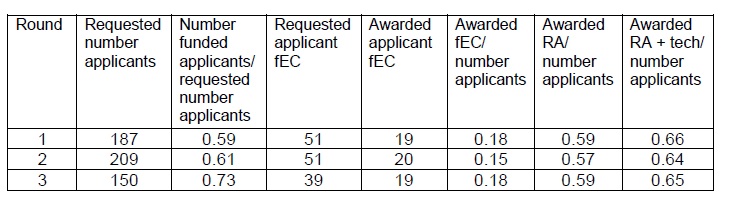
First, here is a table showing the number of academic staff for whom support was requested over the three years for which the consolidated grant system has been in existence (2011, 2012 and 2013 for rounds 1, 2 and 3 respectively).  You can see that the overall success rate was slightly better in round 3, possibly due to applicants learning more about the process over the cycle, but otherwise the outcomes seem reasonably consistent:

STFC_Con1

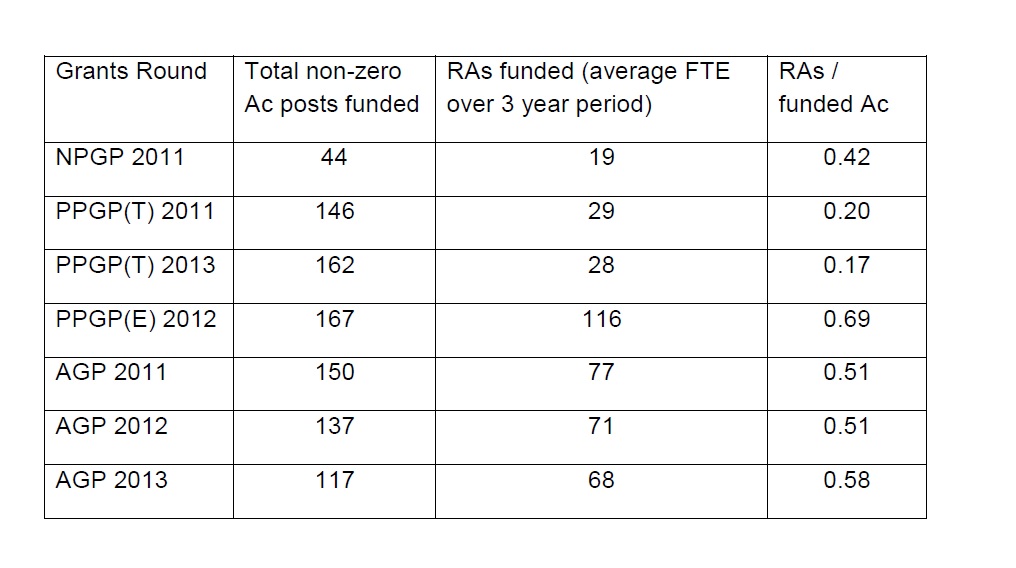
The last three rows of this table  on the other hand show quite clearly the impact of the “flat cash” settlement for STFC science funding on Postdoctoral Research Assistant (PDRA) support:
STFC_Con

Constant cash means ongoing cuts in real terms; there were 11.6% fewer Astronomy PDRAs supported in 2013 than in 2011. Job prospects for the next generation of astronomers continue to dwindle…

Any other comments, either on these tables or on the report as a whole, are welcome through the comments box.


Poets in October

Posted in Poetry with tags , on October 27, 2014 by telescoper

I’m sure few readers of this blog can have failed to notice that today is the 100th anniversary of the birth of Welsh poet Dylan Thomas. I’ve posted quite a few of his poems over the years so it seems fitting to post this, Poem in October, as a birthday tribute.

It was my thirtieth year to heaven
Woke to my hearing from harbour and neighbour wood
And the mussel pooled and the heron
Priested shore
The morning beckon
With water praying and call of seagull and rook
And the knock of sailing boats on the webbed wall
Myself to set foot
That second
In the still sleeping town and set forth.


My birthday began with the water-
Birds and the birds of the winged trees flying my name
Above the farms and the white horses
And I rose
In a rainy autumn
And walked abroad in shower of all my days
High tide and the heron dived when I took the road
Over the border
And the gates
Of the town closed as the town awoke.

A springful of larks in a rolling
Cloud and the roadside bushes brimming with whistling
Blackbirds and the sun of October
Summery
On the hill’s shoulder,
Here were fond climates and sweet singers suddenly
Come in the morning where I wandered and listened
To the rain wringing
Wind blow cold
In the wood faraway under me.

Pale rain over the dwindling harbour
And over the sea wet church the size of a snail
With its horns through mist and the castle
Brown as owls
But all the gardens
Of spring and summer were blooming in the tall tales
Beyond the border and under the lark full cloud.
There could I marvel
My birthday
Away but the weather turned around.

It turned away from the blithe country
And down the other air and the blue altered sky
Streamed again a wonder of summer
With apples
Pears and red currants
And I saw in the turning so clearly a child’s
Forgotten mornings when he walked with his mother
Through the parables
Of sunlight
And the legends of the green chapels

 
And the twice told fields of infancy
That his tears burned my cheeks and his heart moved in mine.
These were the woods the river and the sea
Where a boy
In the listening
Summertime of the dead whispered the truth of his joy
To the trees and the stones and the fish in the tide.
And the mystery
Sang alive
Still in the water and singing birds.

 
And there could I marvel my birthday
Away but the weather turned around. And the true
Joy of the long dead child sang burning
In the sun.
It was my thirtieth
Year to heaven stood there then in the summer noon
Though the town below lay leaved with October blood.
O may my heart’s truth
Still be sung
On this high hill in a year’s turning.


I admire greatly the poems of Dylan Thomas for their energy and colour and the truly original way he uses words. Nevertheless I do agree with a friend of mine who said earlier today that Dylan Thomas is the second-greatest Welsh poet of the twentieth century who wrote in English and had the surname “Thomas”. I mean no disrespect at all to DM but, although the two are very different, RS has to be the greater of the two Thomases.

This poem by R.S. Thomas is called Song at a Year’s Turning; the echo of the final phrase of Poem in October and the fact that it was published in 1955 make it very clear that it was written as a kind of elegy from one Thomas to the other:

Shelley dreamed it. Now the dream decays.
The props crumble; the familiar ways
Are stale with tears trodden underfoot.
The heart’s flower withers at the root.
Bury it then, in history’s sterile dust.
The slow years shall tame your tawny lust.

Love deceived him; what is there to say
The mind brought you by a better way
To this despair? Lost in the world’s wood
You cannot stanch the bright menstrual blood.
The earth sickens; under naked boughs
The frost comes to barb your broken vows.

Is there blessing? Light’s peculiar grace
In cold splendour robes this tortured place
For strange marriage. Voices in the wind
Weave a garland where a mortal sinned.
Winter rots you; who is there to blame?
The new grass shall purge you in its flame.
Thursday (and Friday and Saturday) Night Fever

Posted in Biographical on October 26, 2014 by telescoper

It’s been a very strange weekend. Some horrible bug hit me with a fever on Thursday evening, so I had to cancel my Friday appointments.

Then I remembered I was supposed to be in Cardiff this weekend so dragged myself out of bed and onto the train. Although I wasn’t at all comfortable, I slept for most of the journey. I hope I didn’t infect too many other passengers…

An early night on Friday and most of Saturday in bed seem to have helped, though I was clearly still delirious this afternoon when I dreamt that Newcastle managed to beat Spurs 2-1 at White Hart Lane. I also seem to have won another dictionary in the Sunday Independent Crossword competition.

Now the fever seems to have morphed into a fairly standard cold-type thing and I’ll have to face getting an early morning train back to Brighton tomorrow. Hopefully I’ll get back about lunchtime.

Thought for the Day

Posted in History, Literature with tags on October 25, 2014 by telescoper

A good world needs knowledge, kindliness, and courage; it does not need a regretful hankering after the past, or a fettering of the free intelligence by the words uttered long ago by ignorant men.

Bertrand Russell (1927)

Why Cosmology Isn’t Boring

Posted in Brighton, The Universe and Stuff with tags , , , on October 23, 2014 by telescoper

As promised yesterday, here’s a copy of the slides I used for my talk to the ~150 participants of the collaboration meeting of the Dark Energy Survey that’s going on here this week at Sussex. The title is a reaction to a statement I heard that recent developments in cosmology, especially from Planck, have established that we live in a “Maximally Boring Universe”. I the talk I tried to explain why I don’t think the standard cosmology is at all boring. In fact, I think it’s only now that we can start to ask the really interesting questions.

At various points along the way I stopped to sample opinions…

IMG-20141022-00439

I did however notice that Josh Frieman (front left) seemed to vote in favour of all the possible options on all the questions.  I think that’s taking the multiverse idea a bit too far..


Cosmology, to be precise…

Posted in The Universe and Stuff with tags , on October 22, 2014 by telescoper

After an extremely busy morning I had the pleasant task this afternoon of talking to the participants of a collaboration meeting of the Dark Energy Survey that’s going on here at Sussex. Now there’s the even more pleasant task in front of me of having drinks and dinner with the crowd. At some point I’ll post the slides of my talk on here, but for the mean time here’s a pretty accurate summary..

Summary

A Dirge

Posted in Poetry with tags , , on October 21, 2014 by telescoper

Rough Wind, that moanest loud
Grief too sad for song;
Wild wind, when sullen cloud
Knells all the night long;
Sad storm, whose tears are vain,
Bare woods, whose branches strain,
Deep caves and dreary main, _
Wail, for the world’s wrong!

by Percy Bysshe Shelley


Controlled Nuclear Fusion: Forget about it

Posted in The Universe and Stuff with tags , , , on October 20, 2014 by telescoper

You’ve probably heard that Lockheed Martin has generated a lot of excitement with a recent announcement about a “breakthrough” in nuclear fusion technology. Here’s a pessimistic post from last year. I wonder if it will be proved wrong?

Michael de Podesta's avatarProtons for Breakfast

Man or woman doing a technical thing with a thingy told with laser induced nuclear fusion. Man or woman adjusting the ‘target positioner’ (I think) within the target chamber of the US Lawrence Livermore National Laboratory.

The future is very difficult to predict. But I am prepared to put on record my belief that controlled nuclear fusion as a source of power on Earth will never be achieved.

This is not something I want to believe. And the intermittent drip of news stories about ‘progress‘ and ‘breakthroughs‘ might make one think that the technique would eventually yield to humanity’s collective ingenuity.

But  in fact that just isn’t going to happen. Let me explain just some of the problems and you can judge for yourself whether you think it will ever work.

One option for controlled fusion is called Inertial Fusion Energy, and the centre of research is the US National Ignition Facility. Here the most powerful laser…

View original post 601 more words

What’s the point of conferences?

Posted in Education, The Universe and Stuff with tags , , , , , on October 19, 2014 by telescoper

Well, here I am back in the office making a start on my extensive to-do list. Writing it, I mean. Not actually doing any of it.

It was nice to get away for a couple of weeks, to meet up with some old friends I haven’t seen for a while and also to catch up on some of the developments in my own field and other related areas. We do have pretty good seminar series here at Sussex which should in principle allow me to keep up to date with developments in my own research area, but unfortunately the timing of these events often clashes with other meetings  that I’m obliged to attend as Head of School. Escaping to a conference is a way of focussing on research for a while without interruption. At least that’s the idea.

While at the meeting, however, I was struck by a couple of things. First was that during the morning plenary lectures given by invited speakers almost everyone in the audience was spending much more time working on their laptops than listening to the talk.  This has been pretty standard at every meeting I’ve been to for the last several years. Now that everyone uses powerpoint (or equivalent) for such presentations nobody in the audience feels the need to take notes so to occupy themselves they spend the time answering emails or pottering about on Facebook. That behaviour does not depend on the quality of the talk, either. Since nobody seems to listen very much the question naturally arises as to whether the presentations have any intrinsic value at all. It often seems to me that the conference talk has turned into a kind of ritual that persists despite nobody really knowing what it’s for or how it originated. An hour is too long to talk if you really want people to listen, but we go on doing it.

The part of a conference session that’s more interesting is the discussion after each talk. Sometimes there’s a genuine discussion from which you learn something quite significant or get an idea for a new study.  There’s often also a considerable amount of posturing, preening and point-scoring which is less agreeable but in its own way I suppose fairly interesting.

At the meeting I was attending the afternoons were devoted to discussion sessions for which we split into groups. I was allocated to “Gravitation and Cosmology”; others were on “Cosmic Rays”, “Neutrino Physics and Astrophysics”, and so on. The group I was, of about 25 people, was a nice size for discussion. These sessions were generally planned around short “informal” presentations intended to stimulate discussion, but generally these presentations were about the same length as the plenary talks and also given in Powerpoint. There was discussion, but the format turned out to be less different from the morning sessions than I’d hoped for. I’m even more convinced than ever that Powerpoint presentations used in this way stifle rather than stimulate discussion and debate. The pre-prepared presentation is often used as a crutch by a speaker reluctant to adopt a more improvisatory approach that would probably be less polished but arguably more likely to generate new thoughts.

I don’t know whether the rise of Powerpoint is itself to blame for our collective unwillingness inability to find other ways of talking about science, but I’d love to try organizing a workshop or conference along lines radically different from the usual “I talk, you listen” format in which the presenter is active and the audience passive for far too long.

All this convinced me that the answer to the question “What is the point of conferences?” has very little to do with the formal  programme and more with the informal parts, especially the conversations over coffee and at dinner. Perhaps I should try arranging a conference that has nothing but dinner and coffee breaks on the schedule?