A few days ago I posted an article moaning about the enshittification of Google Search. Usually posting a piece like that achieves nothing except letting off a bit of steam. This time, however, one of the comments suggested a way to decrapify Google Search. Thanks to Andy Newsam for the tip.
If you click on udm14.com you will find out more about this useful site including how to share it. It doesn’t solve all the problems with Google, which are many and various, but it’s a start…
As the Christmas holiday draws to a close and I begin thinking about the possibility that sooner or later, in due course, at some point in the future, in the fullness of time, all things considered, when all is said and done, in the end, I will have to start teaching again. Thinking about this is preferable to thinking about the stack of exam marking that I will have to contend with shortly.
One of the modules I am down to teach in the Spring Semester is particle physics, a subject I haven’t taught for well over a decade, so I have been looking through a box of old notes on the subject. Doing so I remembered that I had to explain neutrino oscillations, a process in which neutrinos (which have three distinct flavour states, associated with the electron, mu and tau leptons) can change flavour as they propagate. It’s quite a weird thing to spring on students who previously thought that lepton number was always conserved so I decided to start with an analogy based on more familiar physics.
A charged fermion such as an electron (or in fact anything that has a magnetic moment, which would include, e.g. the neutron) has spin and, according to standard quantum mechanics, the component of this in any direction can can be described in terms of two basis states, say “up” for the +z-direction and “down” for the opposite (-z) represented schematically like this:
In this example, as long as the particle is travelling through empty space, the probability of finding it with spin “up” is 50%, as is the probability of finding it in the spin “down” state, the probabilities defined by the square of the amplitudes. Once a measurement is made, however, the state collapses into a definite “up” or “down” wherein it remains until something else is done to it. In such a situation one of the coefficients goes to zero and the other is unity.
If, on the other hand, the particle is travelling through a region where there is a magnetic field the “spin-up” and “spin-down” states can acquire different energies owing to the interaction between the magnetic moment of the particle and the magnetic field. This is important because it means the bits of the wave function describing the up and down states evolve at different rates, and this has measurable consequences: measurements made at different positions yield different probabilities of finding the spin pointing in different directions. In effect, the spin vector of the particle performs a sort of oscillation, similar to the classical phenomenon called precession.
The mathematical description of neutrino oscillations is very similar to this, except it’s not the spin part of the wavefunction being affected by an external field that breaks the symmetry between “up” and “down”. Instead the flavour part of the wavefunction is “precessing” because the flavour states don’t coincide with the eigenstates of the Hamiltonian that describes the neutrinoes. For this to happen, however, different neutrino types must have intrinsically different energies (which, in turn, means that the neutrinos must have different masses), in quite a similar way similar to the spin-precession example.
Although this isn’t a perfect analogy I thought it was a good way of getting across the basic idea. Unfortunately, however, when I subsequently asked an examination question about neutrino oscillations I got a significant number of answers that said “neutrino oscillations happen when a neutrino travels through a magnetic field….”.
Sigh.
Neutrinos have no magnetic moment so don’t interact with magnetic fields, you see…
Anyhow, I’m sure there’s more than one reader out there who has had a similar experience with an analogy that wasn’t perhaps as instructive as hoped. Feel free to share through the comments box…
Snow-happy hicks of a boy’s world –
O crunch of bull’s-eyes in the mouth,
O crunch of frost beneath the foot –
If time would only remain furled
In white, and thaw were not for certain
And snow would but stay put, stay put!

When the pillar-box wore a white bonnet –
O harmony of roof and hedge,
O parity of sight and thought –
And each flake had your number on it
And lives were round for not a number
But equalled nought, but equalled nought!

But now the sphinx must change her shape –
O track that reappears through slush,
O broken riddle, burst grenade –
And lives must be pulled out like tape
To measure something not themselves,
Things not given but made, but made.

For now the time of gifts is gone –
O boys that grow, O snows that melt,
O bathos that the years must fill –
Here is dull earth to build upon
Undecorated; we have reached
Twelfth Night or what you will … you will.
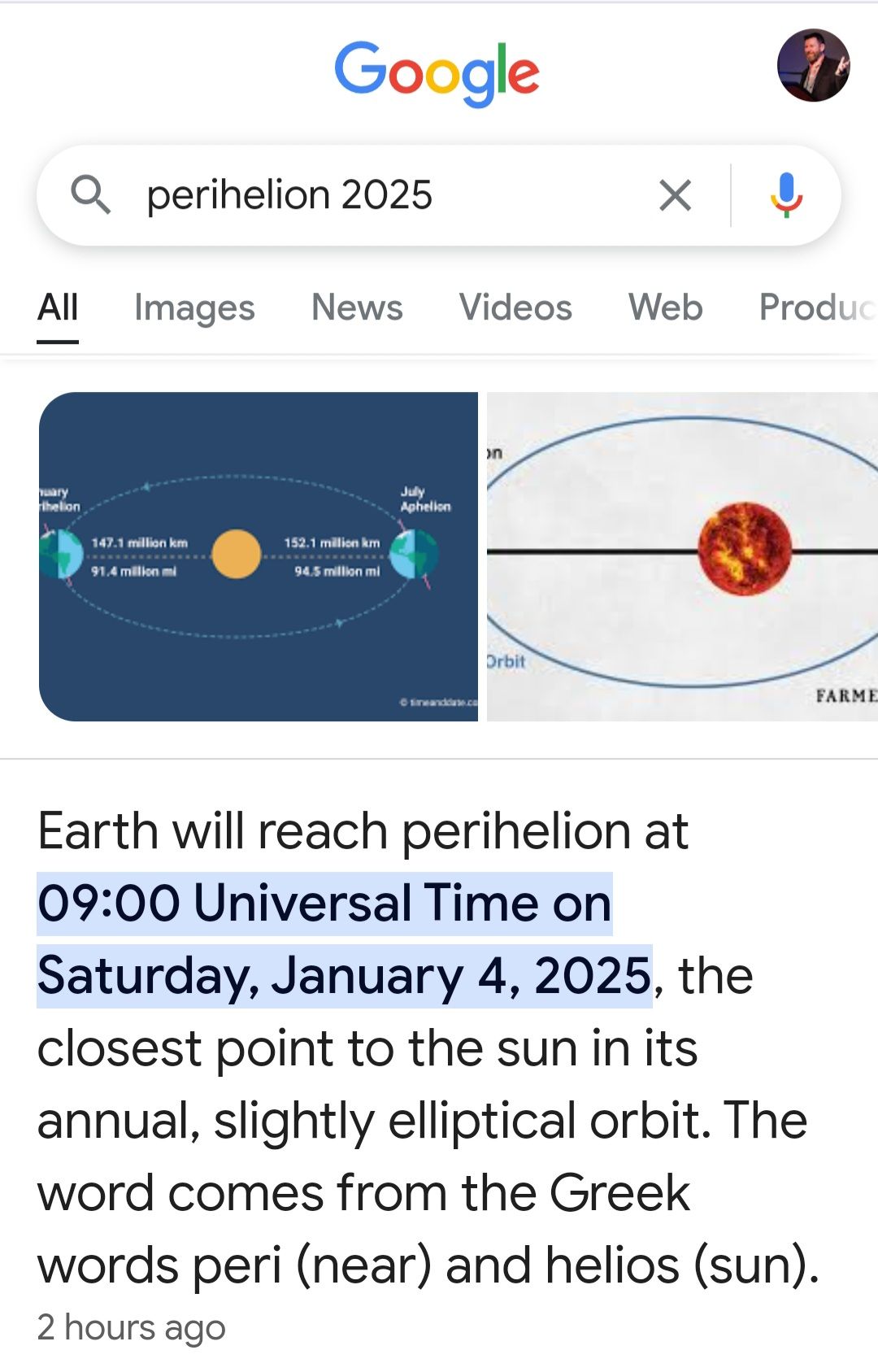
In the course of double-checking the time of perihelion for yesterday’s post I did a quick Google search. What came up first was this:
Google search results nowadays are prefaced by a short summary like this one, presumably generated by some sort of AI. This one – like many others I’ve seen recently – is just plain wrong. The time of perihelion was 13.28 Universal Time, not 09.00.
I am old enough to remember when Google Search first appeared in 1998. It was so much better than other search engines at that time, largely because of the PageRank algorithm; see this piece for a bit of the history and the reason it worked so well. Some years ago, however, Google Search underwent a transition from being a useful facility for web browsers to a piece of adtech useful only for marketing companies who pay to have their sites artificially boosted. Every time you do a search nowadays you have to scroll through a deluge of promoted pages that have very little to do with what you searched for. Google is now so corrupted as to be virtually useless. Adding garbled AI junk to the mixture is just making it worse. It’s not only frustrating but potentially dangerous. Information can be manipulated for purposes other than selling things; the systematic spread of misinformation by those in power has potentially catastrophic consequences.
Earth’s elliptical orbit viewed at an angle (which makes it look more eccentric than it is – in reality is very nearly circular).
At 13.28 GMT today (Saturday 4th January 2025), the Earth reaches its perihelion. At this time the distance from the Sun’s centre to Earth’s centre will be 147,103,686 km. This year, aphelion (the furthest distance from the Sun) is at 20.54 GMT on July 3rd 2025 at which point the centre of the Earth will be 152,087,738 km from the centre of the Sun. You can find a list of times and dates of perihelion and aphelion for future years here.
It surprises me how many people think that the existence of the seasons has something to do with the variation of the Earth’s distance from the Sun as it moves in its orbit in that the closer to the Sun we get the warmer the weather will be. The fact that perihelion occurs in the depth of winter should convince anyone living in the Northern hemisphere that this just can’t be the case, as should the fact that it’s summer in the Southern hemisphere while it is winter in the North.
The real reason for the existence of seasons is the tilt of the Earth’s axis of rotation. I used to do a little demonstration with a torch (flashlight to American readers) to illustrate this when I taught first-year astrophysics. If you shine a torch horizontally at a piece of card it will illuminate a patch of the card. Keep the torch at the same distance but tilt the card and you will see the illuminated patch increase in size. The torch is radiating the same amount of energy but in the second case that energy is spread over a larger area than in the first. This means that the energy per unit area incident on the card is decreases when the card is tilted. It is that which is responsible for winter being colder than summer. In the summer the sun is higher in the sky (on average) than in winter. From this argument you can infer that the winter solstice not the perihelion, is the relevant astronomical indicator of winter.
That is not to say that the shape of the Earth’s orbit has no effect on temperatures. It may, for example, contribute to the summer in the Southern hemisphere being hotter than in the North, although it is not the only effect. The Earth’s surface possesses a significant North-South asymmetry: there is a much larger fraction of ocean in the Southern hemisphere, for example, which could be responsible for moderating any differences in temperature due to insolation. The climate is a non-linear system that involves circulating air and ocean currents that respond in complicated ways and on different timescales not just to insolation but to many other parameters, including atmospheric composition (especially the amount of water vapour).
The dates when Earth reaches the extreme points on its orbit (apsides) are not fixed because of the variations in its orbital eccentricity so, in the short-term, the dates can vary up to 2 days from one year to another. The perihelion distance varies slightly from year to year too; it’s slightly larger this year than last year, for example.
There is however a long-term trend for perihelion to occur later in the year. For example, in 1246, the December Solstice (winter solstice for the Northern Hemisphere) was on the same day as the Earth’s perihelion. Since then, the perihelion and aphelion dates have drifted by an average of one day every 58 years. This trend will continue, meaning that by the year 6430 the timing of the perihelion and the March Equinox will coincide, although I hope to have retired by then…
Although the Toccata and Fugue in D Minor, thought* to be by Johann Sebastian Bach, is such a famous work that few people out there will not have heard it, I couldn’t resist sharing this great version which a friend send me recently. It was played by Hungardian-born organist Xaver Varnus in 2013 in the beautiful but cavernous Berliner Dom. It’s particular noticeable how Varnus adjusts his performance to account for the reverberation time. Playing too quickly when there is a long echo can lead to confusion but in this case the playing is crisp enough to hear the piece unfolding while slow enough to let the acoustic add a special ingredient of its own. This performance lasts a good couple of minutes longer than any other version I have on CD. One of the YouTube commenters on this video puts it very well indeed: “It’s nice to see an organist who understands they are not only playing the organ, but the entire building. His timing as the sound decays across the auditorium is impeccable.” Indeed. A mere recording can’t capture the sensation of hearing the music through the soles of your feet as well through your ears, but it’s very enjoyable nonetheless. It’s also good to see the organist close up so you can see how demanding it is to play a work like this.
*the attribution to Johan Sebastian Bach has been questioned. There is no surviving manuscript in Bach’s hand and the evidence that it was actually written by him is circumstantial.
Just before the Christmas break I noticed a considerable amount of press coverage claiming that Dark Energy doesn’t exist. Much of the media discussion is closely based on a press release produced by the Royal Astronomical Society. Despite the excessive hype, and consequent initial scepticism, I think the paper has some merit and raises some interesting issues.
The main focus of the discussion is a paper (available on arXiv here) by Seifert et al. with the title Supernovae evidence for foundational change to cosmological models. This paper is accompanied by a longer article called Cosmological foundations revisited with Pantheon+ (also available on arXiv) by a permutation of the same authors, which goes into more detail about the analysis of supernova observations. If you want some background, the “standard” Pantheon+ supernova analysis is described in this paper. The reanalysis presented in the recent papers is motivated an idea called the Timescape model, which is not new. It was discussed by David Wiltshire (one of the authors of the recent papers) in 2007 here and in a number of subsequent papers; there’s also a long review article by Wiltshire here (dated 2013).
So what’s all the fuss about?
Simulation of the Cosmic Web
In the standard cosmological model we assume that, when sufficiently coarse-grained, the Universe obeys the Cosmological Principle, i.e. that it is homogeneous and isotropic. This implies that the space-time is described by a Friedmann–Lemaître–Robertson–Walker metric (FLRW) metric. Of course we know that the Universe is not exactly smooth. There is a complex cosmic web of galaxies, filaments, clusters, and giant voids which comprise the large-scale structure of the Universe. In the standard cosmological model these fluctuations are treated as small perturbations on a smooth background which evolve linearly on large scales and don’t have a significant effect on the global evolution of the Universe.
This standard model is very successful in accounting for many things but only at the expense of introducing dark energy whose origin is uncertain but which accounts for about 70% of the energy density of the Universe. Among other things, this accounts for the apparent acceleration of the Universe inferred from supernovae measurements.
The standard cosmology’s energy budget
The approach taken in the Timescape model is to dispense with the FLRW metric, and the idea of separating the global evolution from the inhomogeneities. The idea instead is that the cosmic structure is essentially non-linear so there is no “background metric”. In this model, cosmological observations can not be analysed within the standard framework which relies on the FLRW assumption. Hence the need to reanalyse the supernova data. The name Timescape refers to the presence of significant gravitational time-dilation effects in this model as distinct from the standard model.
….the supernovae measurements do not directly measure cosmic acceleration. If one tries to account for them with a model based on Einstein’s general relativity and the assumption that the Universe is on large-scales is homogeneous and isotropic and with certain kinds of matter and energy then the observations do imply a universe that accelerates. Any or all of those assumptions may be violated (though some possibilities are quite heavily constrained). In short we could, at least in principle, simply be interpreting these measurements within the wrong framework…
So what to make of the latest papers? I have to admit that I didn’t follow all the steps of the supernova reanalysis. I hope an expert can comment on this! I will therefore restrict myself to some general comments.
My attitude to the standard cosmological model is that it is simply a working hypothesis and we should not elevate it to a status any higher than that. It is based not only on the Cosmological Principle (which could be false), but on the universal applicability of general relativity (which might not be true), and on a number of other assumptions that might not be true either.
It is important to recognize that one of the reasons that the standard cosmology is the front-runner is that it provides a framework that enables relatively straightforward prediction and interpretation of cosmological measurements. That goes not only for supernova measurements but also for the cosmic microwave background, galaxy clustering, gravitational lensing, and so on. This is much harder to do accurately in the Timescape model simply because the equations involved are much more complex; there are few exact solutions of Einstein’s equations that can help. It is important that people work on alternatives such as this.
Second, the idea that inhomogeneities might be much more important than assumed in the standard model has been discussed extensively in the literature over the last twenty years or so under the heading “backreaction”. My interpretation of the current state of play is that there are many unresolved questions, largely because of technical difficulties. See, for example, work by Thomas Buchert (here and, with many other collaborators here) and papers by Green & Wald (here and here). Nick Kasiser also wrote about it here.
The new papers under discussion focus entirely on supernovae measurements. It must be recognized that these provide just one of the pillars supporting the standard cosmology. Over the years, many alternative models have been suggested that claim to “fix” some alleged problem with cosmology only to find that it makes other issues worse. That’s not a reason to ignore departures from the standard framework, but it is an indication that we have a huge amount of data and we’re not allowed to cherry-pick what we want. We have to fit it all. The strongest evidence in favour of the FLRW framework actually comes from the cosmic microwave background (CMB) with the supernovae provide corroboration. I would need to see a detailed prediction of the anisotropy of the CMB before being convinced.
The Timescape model is largely based on the non-linear expansion of cosmic voids. These are undoubtedly important, and there has been considerable observational and theoretical activity in understanding them and their evolution in the standard model. It is not at all obvious to me that the voids invoked to explain the apparent acceleration of the Universe are consistent with what we actually see in our surveys. That is something else to test.
Finally, the standard cosmology includes a prescription for the initial conditions from which the present inhomogeneities grew. Where does the cosmic web come from in the Timescape model?
Anyway, I’m sure there’ll be a lot of discussion of this in the next few weeks as cosmologists return to the Universe from their Christmas holidays!
Comments are welcome through the box below, especially from people who have managed to understand the cos.
For last year’s words belong to last year’s language
And next year’s words await another voice.
And to make an end is to make a beginning.
From Four Quartets, ‘Little Gidding’ by T. S. Eliot.
January is named after the Roman deity Janus, who according to Wikipedia, is the god of beginnings, gates, transitions, time, duality, doorways, passages, frames, and endings. Since I did a retrospective post yesterday about 2024 in retrospect, I thought I’d do a quick one today (1st January 2025) to mention a few things looking forward.
January will, as usual, be dominated by examinations, and especially the marking thereof. The first examination for which I am responsible is on January 13th.
February sees the start of a new semester. I’ll be teaching Particle Physics for the first time at Maynooth. I taught this subject for many years at Nottingham and Cardiff (the latter combined with Nuclear Physics), so it should be OK. My other module is Computational Physics which I have taught at Maynooth every year since 2018, apart from 2024 when I was on sabbatical.
The big event in March will be the release of “Q1” data from Euclid. This is only a very small part of the full survey, but is an important milestone and will no doubt attract a lot of press coverage. There’s a blog post by Knud Jahnke here. No doubt I’ll do a few blog posts too. The first full data release DR1 will take place in 2026. The Q1 release is timed to coincide with the annual Euclid Consortium Meeting, which this year takes place in Leiden. I won’t be able to attend in person, as it happens during teaching term, but may be able to follow some of the sessions remotely.
In April we will have a very special visitor to Maynooth to deliver the Dean’s Lecture (of which more anon). Much less significantly, I’ll be giving a Colloquium in the Department of Physics.
May will largely be taken up with second semester exams and assessments – there will be a lot of computational physics projects to correct as well as the usual examinations.
And then it will be summer. I did a lot of travelling during my sabbatical so I am not planning to travel much in 2025, though I may try to visit some more places in Ireland. Hopefully I’ll be able to get on with some research too. This year I am supervising my first MSc project at Maynooth, so that will be an interesting new experience.
And then we’re more-or-less into the next academic year 25/26. That’s beyond my planning horizon. I don’t know what I’ll be teaching, but it may be the same as 2024 (at least for Semester 1). I wonder if I’ll get to teach any astrophysics or cosmology here before I retire? It doesn’t look likely…
What we call the beginning is often the end
And to make an end is to make a beginning.
The end is where we start from.
T. S. Eliot, from Little Gidding, the last of the Four Quartets.
I wasn’t really planning on posting a retrospective of the year 2024, but the rain is pouring down outside so I’ve decided to use up a bit of time before going out in the hope that the rain stops.
The past year has been very busy with significant life events. One particular highlight has to be a wonderful once-in-a-lifetime trip to Sydney in February. I don’t know if I’ll ever get the chance to visit Australia again, but if I do I’ll take it! Shortly after returning from that trip I went back to Barcelona until the summer, leaving briefly for visits to Rome (Euclid Consortium Meeting), Valencia (Department Colloquium), Newcastle (to do a PhD examination) and Oxford (to give the inaugural Pride talk at the Department of Physics).
Unfortunately, at that point my laptop gave up the ghost so I had to come back to Maynooth a little earlier than planned to salvage what was on it and get a new one. And so ended my sabbatical. I’d like to take the opportunity again to thank everyone at the Universities of Barcelona and Sydney for making me feel so welcome and, of course, to Maynooth for granting me a full-year sabbatical in the first place.
As well as giving me some time for my own research, the year saw significant progress with the Open Journal of Astrophysics, both in terms of numbers of papers published (120 in 2024) but also some much-needed work on automation and an increase in the size of the Editorial Board. It’s hard to predict what will happen in 2025, but I’m glad that a significant number of members of the astrophysics community seem to be regarding OJAp as a viable avenue for communicating their results.
I will also mention – for those that care – that the Open Journal of Astrophysics is now listed in Scopus, but all the numbers they have published about the journal are inaccurate. I have spent months trying to get them to correct the figures but, although they have admitted errors, they have failed to do so. My next step will be to take legal action against Scopus (which is based in The Netherlands) under the Dutch Civil Code.
The big event workwise at Maynooth was the merger of the Departments of Theoretical Physics and Experimental Physics into a single Department of Physics. So far this has been largely paper exercise. What will result from it in the long term remains to be seen. I was given two new modules to teach last Semester and have another new one next Semester (as well as one I’ve done before). Although this made for a heavy workload, it wasn’t as bad as what happened after the only other sabbatical I’ve had in my career. I got a one Semester sabbatical when I was at Nottingham, but the Department simply moved my first-semester teaching to the second semester in addition to what had already been allocated for the second, so I had a double teaching load when I got back!
There has been a significant change in my personal circumstances too. During 2024 I finally completed the sale of my former home in Pontcanna, Cardiff. I had intended to do this years ago, but the pandemic and subsequent workload issues made it difficult to travel and sort this matter out. In the meantime bought my house in Maynooth with a mortage so I owned two properties, one of which was empty for much of the time. After much stopping and starting, and being badly let down by more than one prospective buyer, the Cardiff house is now sold. I now feel much less delocalised. I also felt very rich when the proceeds hit my bank account, but only briefly. I used a big chunk to pay off my mortgage and put the rest into fixed-term investments for retirement.
Anyway, writing about Sydney reminded me that there are parts of the world in which it is 2025 already, so let me end with a “Happy New Year” and a few interesting numerological facts about the number 2025:
P.S. It’s still raining.
P.P.S. Athbhliain faoi shéan agus faoi mhaise daoibh!
The news of the death at the age of 100 of former US President Jimmy Carter reminded me of a day way back when I was still at school. It was Friday, May 6th, 1977 and I was at the Royal Grammar School, Newcastle upon Tyne. I remember that morning it was announced at Assembly that Carter would be visiting the city and giving a speech outside the Civic Centre, which was less than 10 minutes’ walk from the School. I think some senior boys were allowed to go an see him, but as a mere third-former I went to a class and the occasion largely passed me by.
One thing I do remember is a classmate after Assembly saying “Thank God he didn’t visit Sunderland instead…” – Carter visited Newcastle on his way to Washington (the ancestral home of George Washington), which is nearer to Sunderland than Newcastle. I suppose the reason was that Newcastle has an airport, whereas Sunderland hasn’t.
The other thing I remember was the TV coverage on Look North when I got home, which showed the start of President Carter’s speech with his famous “Howay the Lads!”
The views presented here are personal and not necessarily those of my employer (or anyone else for that matter).
Feel free to comment on any of the posts on this blog but comments may be moderated; anonymous comments and any considered by me to be vexatious and/or abusive and/or defamatory will not be accepted. I do not necessarily endorse, support, sanction, encourage, verify or agree with the opinions or statements of any information or other content in the comments on this site and do not in any way guarantee their accuracy or reliability.






 In the Dark