Yet another very busy day with no time for a proper post. However, I did notice this morning that today was the birthday of the great Russian cellist Mstislav Rostropovich (who died in 2007) and that gives me the excuse to post this recording, which I’ve loved for years and which gets played very frequently on my iPoD, especially in times of stress. The Introduction and Polonaise Brillante is a very early piece by Frederic Chopin; it’s his Opus 3 in fact and was composed when he was about 20 years old. He later dismissed it as “a bit of froth for the salon ladies”. It may not be an enormously profound piece of music – and I’ve heard many insipid versions that have almost put me off it entirely – but I think this performance is great. The combination of Rostropovich on cello with another iconoclast Marta Argerich on piano was never going to produce insipid music, and it’s abundantly clear that, though it’s not a particularly challenging piece, they both had a whale of a time recording it!
Follow @telescoperIntroduction and Polonaise Brillante
Posted in Music with tags Frederic Chopin, Introduction and Polonaise Brillante, Marta Argerich, Mstislav Rostropovich on March 27, 2014 by telescoperAAA Day in the LIfE of the 137 SS Mystic – August 3, 2013 – N, SHE, and NUN … where Egypt hid the swastika
Posted in The Universe and Stuff with tags Bicep2 on March 26, 2014 by telescoperOh my…

August 3, 2013
So where did Egypt hide the swastika?
How was it vEILed?
UPDATE March 24, 2014
The Smoking Gun and the Gravity of the Situation

Jesus positioned between the two thieves RED and BLUE
a.k.a. the two B-mode gravitational waves


polarized RED and BLUE gravitational waves
On March 17th, 2014 an announcement was made that confirms what I AM now sharing.
The announcement apparently confirms Einstein’s musings about gravitational waves, an expanding universe and an early ‘imprinting’ that took place.
There are rumors of a big bang Nobel prize.
But inflation came with a very specific prediction – that it would be associated with waves of gravitational energy, and that these ripples in the fabric of space would leave an indelible mark on the oldest light in the sky – the famous Cosmic Microwave Background.
The BICEP2 team says it has now identified that signal.
Scientists call…
View original post 1,196 more words
Beard of Spring nomination list bristles with Spring promise
Posted in Beards, Biographical with tags Beard Liberation Front, beards, Keith Flett on March 26, 2014 by telescoperThe other night somebody asked me if I don’t watch TV how do I keep up with current affairs? The answer is, of course, that I don’t. I do however keep up with important things via Twitter. Yesterday, for example, I heard that there’s a possibility that I might make the nomination list for the Beard Liberation Front’s “Beard of Spring”. Since I’ve never been nominated for anything in my entire life, I thought I would offer my readership (Sid and Doris Bonkers) the chance to boost my vote. And if anyone accuses me of blatant self-promotion, all I can say is “Vote for Me!

Beard Liberation Front
PRESS RELEASE 21st March
Contact Keith Flett 07803 167266
Beard of Spring nomination list bristles with Spring promise
The Beard Liberation Front, the network of beard wearers that campaigns against beardism, has said that the nomination list for the Beard of Spring 2014 Award is bristling with Spring promise.
The nominations list is now open to suggestions from the wider public with a poll starting on 5th April and the winner announced on 19th April
The Award one of four seasonal hirsute accolades that leads to the Beard of the Year in December celebrates the coming of Spring and the growth of beards new and old.
BLF Organiser Keith Flett said the initial nomination list contains several names who have never been honoured because of their beard and we are keen to receive further suggestions from the wider public
Beard of Spring nomination list
Moeen Ali, cricketer
View original post 38 more words
Hampton Hawes – The Trio, Vol. 1
Posted in Jazz with tags All the things you are, Hampton Hawes, Jazz, Piano on March 25, 2014 by telescoperThe old blog has been generating far too much traffic over the last couple of weeks so I thought I’d try to calm things down by posting something about Jazz (which usually scares the traffic away). I was listening this album the other day and thought I’d write about it because the pianist concerned Hampton Hawes is so underrated.
The Trio – Vol. 1 was Hawes’s first LP under his own name and it proved to be the start of a long and successful association with Contemporary Records. Hawes’s playing has been described as a more-or-less literal keyboard transcription of Charlie Parker and indeed his lines do sound more like Parker than those of Bud Powell, the archetypal bebop pianist. Indeed Hawes stated that Powell had never really been influence, or at least not as much of an influence as he had been on the rest of his generation of jazz pianists. Like Charlie Parker, Hawes had a great gift for playing the blues and even when not actually playing standard 12-bar blues material he somehow managed to make almost everything he played sound like the blues; a great example from this album is the ballad Easy Livin’ which Hawes augments by inserting some blues phrases into the melody. There are three “orthodox” blues tracks on the album, although one of them Feelin’ Fine is based on an altered chord progression.
Fast tempi gave Hawes very few problems. On the album he seems completely comfortable maintaining the logic and continuity of his improvisations even while playing at about 80 bars to the minute. I Got Rhythm is taken at a very brisk pace but Hawes is always master of the situation. The track I’ve picked from Youtube, the great Jerome Kern standard All The Things You Are, the chords of which lurk underneath a great many bebop tunes, is very different, with an out-of-tempo introduction picking up into the jaunty medium pace “bounce” that’s very characteristic of the bebop era.
Throughout the 50s and 60s, Hampton Hawes was head and shoulders above most of his competitors. Red Mitchell (bass) and Chuck Thompson (drums) remained his colleagues for years, which is no doubt why their playing is so together.
Follow @telescoper
Scholarly publishers and their high profits
Posted in Open Access on March 25, 2014 by telescoperLest we forget the Great Academic Publishing Ripoff…

I recently published the below chart to document the outrageous profit margins of scholarly publishers in the sciences.
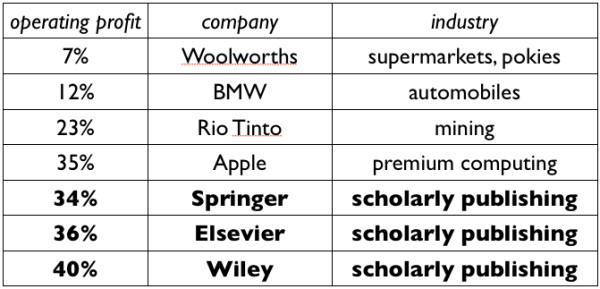
This post is to provide the sources for the numbers in the chart.
The Woolworths number comes from their website, where they write “As a group, Woolworths Limited makes less than seven cents in the dollar before we then pay interest and tax”.
The Rio Tinto figure of 23% is based on the operating profit they report divided by the consolidated sales revenue in their 2011 financial summary.
Apple’s profit of 35% is based on these numbers, dividing their operating income for the year ending September 2012 of 55.2 billion by the revenue for the same period of 156.5 billion.
The 34% number for Springer comes from Heather Morrison’s PhD thesis, in which she writes that “Springer’s Science + Business Media (2010) reported a return on sales (operating profit)…
View original post 66 more words
Responding to the Mail
Posted in The Universe and Stuff with tags Bicep2, Daily Mail, Hiranya Peiris, newsnight, Royal Astronomical Society on March 24, 2014 by telescoperWhat was that quotation by Oscar Wilde, “We are all in the gutter, but some of us aren’t reading the Daily Mail“? Last week that particular element of the gutter press took the opportunity to display its aptitude for racism and sexism in a snide piece about the appearance of two female (shock!) and non-white (horror!) scientists on Newsnight. It’s not really a surprise that the Daily Mail would publish such a scummy article, but it’s still depressing to see how the minds of some people work.
For the record I’ll say that I only know one of the scientists concerned personally (Hiranya Peiris of University College, London). Speaking as a cosmologist, I’m sure I’m not alone in saying that if someone from the press had phoned me up and asked me to suggest an expert to invite onto a television show to explain the BICEP2 results then Hiranya would have been right at the top of my list – because she’s a brilliant scientist (in exactly the relevant area) and a gifted communicator to boot. Is it really so hard to grasp the idea that a brilliant scientist can be female? Or born in Sri Lanka?
Anyway, University College was quick to criticize the Daily Fail in an open letter from Professor David Price, Vice-Provost for Research. Meanwhile a flurry of enraged emails was going around the Council of the Royal Astronomical Society (of which I am a member) that led to a collective response being issued on Friday.
Here follows the RAS statement on the matter which I reproduce here in full, apart from the link to the offensive Daily Mail “article” which I have removed because I don’t want them to profit from traffic sent by this blog.
The statement was written by RAS President David Southwood and RAS Press Officer Robert Massey who are to be congratulated for their measured yet forceful riposte. The last two paragraphs are particularly good.
I’m glad the task of responding to the Daily Mail wasn’t left to me. I would have been far less diplomatic.
–0–
The Council and President of the Royal Astronomical Society (RAS) have offered unequivocal support to astronomers Dr Hiranya Peiris and Dr Maggie Aderin-Pocock. An article in the Daily Mail suggested that they were selected to appear on an episode of theBBC Newsnight programme on the basis of their ethnic background, nationality and gender.
The two astronomers discussed results from the BICEP-2 experiment announced earlier this week, which offered evidence of gravitational waves in the early universe and for a rapid expansion of the cosmos (known as inflation) shortly after the Big Bang. If confirmed, this discovery is of huge significance and was rightly covered by news media all over the world.
Dr Peiris is a world-leading cosmologist now based at University College London (UCL), with degrees from Cambridge and Princeton. In 2012 she received the RAS Fowler Award in recognition of her immense contribution to her field at an early stage of her research career.
Dr Aderin-Pocock has a background in space engineering and science communication and is now co-presenter of theBBC’s The Sky at Night, a role which demands the ability to convey complex ideas to the public at large.
Both scientists are thus exceptionally well qualified to discuss the BICEP-2 results and were natural choices for the Newsnight piece.
In the Daily Mail article, columnist ‘Ephraim Hardcastle’ (the nom de plume of Peter Mackay) not only ignored their expertise entirely but incorrectly suggested that the BICEP-2 team consisted only of white, male, American astronomers.
Astronomy world-wide has long ceased to be a closed male world and the backgrounds of astronomers have long been culturally diverse. Specifically in Britain, women now make up 27% of UK university lecturers in astronomy [see e.g. the  RAS Demographic Survey (2011)] and lead space- and ground-based research projects alike.
RAS President Prof. David Southwood commented: “Astronomy did not begin in Western Europe and has always been an international science. Today researchers from many nations and many cultures routinely work together to achieve shared goals. In the UK, our field is enriched by some of the most talented people from all over the world who choose to join teams in this country.
“It is deeply regrettable that the Daily Mail column chose to overlook the scientific achievements of the BICEP-2 team and the expertise of Hiranya and Maggie and instead concentrate on their skin colour and gender. The implied and deplorable message – that astronomy is the exclusive business of people who are white and male – completely ignores the successful efforts made by the RAS and other scientific bodies to create an environment where science can be done by those best suited to do it, irrespective of background culture, nationality or gender.”
Follow @telescoperClover: What Might Have Been
Posted in Science Politics, The Universe and Stuff with tags B-modes, Bicep2, Clover, Cosmic Microwave Background on March 23, 2014 by telescoperQuite a few people have been asking me whether the UK’s cancelled B-mode experiment, Clover, could have detected what BICEP2 may have found; I’m still not convinced, by the way. It therefore seemed apt to do a quick post in order to direct you to relevant sources of information. If you’re interested in Clover’s capabilities you can find a nice summary on the ArXiv here. The abstract reads:
We describe the objectives, design and predicted performance of Clover, which is a ground-based experiment to measure the faint “B-mode” polarisation pattern in the cosmic microwave background (CMB). To achieve this goal, clover will make polarimetric observations of approximately 1000 deg^2 of the sky in spectral bands centred on 97, 150 and 225 GHz. The observations will be made with a two-mirror compact range antenna fed by profiled corrugated horns. The telescope beam sizes for each band are 7.5, 5.5 and 5.5 arcmin, respectively. The polarisation of the sky will be measured with a rotating half-wave plate and stationary analyser, which will be an orthomode transducer. The sky coverage combined with the angular resolution will allow us to measure the angular power spectra between 20 < l < 1000. Each frequency band will employ 192 single polarisation, photon noise limited TES bolometers cooled to 100 mK. The background-limited sensitivity of these detector arrays will allow us to constrain the tensor-to-scalar ratio to 0.026 at 3sigma, assuming any polarised foreground signals can be subtracted with minimal degradation to the 150 GHz sensitivity. Systematic errors will be mitigated by modulating the polarisation of the sky signals with the rotating half-wave plate, fast azimuth scans and periodic telescope rotations about its boresight. The three spectral bands will be divided into two separate but nearly identical instruments – one for 97 GHz and another for 150 and 225 GHz. The two instruments will be sited on identical three-axis mounts in the Atacama Desert in Chile near Pampa la Bola. Observations are expected to begin in late 2009.
The following points, gleaned from a very quick skimming of the above paper, are worth noting (but please note the important corrections and clarifications in the comments below from the first author of the above paper and also bear in mind that the Clover numbers are estimated rather than based on actual measurements):
- The sky coverage of Clover would have been 1000 square degrees, compared with 380 square degrees of BICEP2
- Clover measurements would have been made at three frequencies, 97 GHz, 150 GHz and 225 GHz. This would have enabled the possibility of foreground contamination to be rejected with much greater confidence than in BICEP2 (which only operates at 150 GHz)
- The sensitivity of Clover at 150 GHz (the frequency at which BICEP2 operates) would have been about 1.4 times better than BICEP2
- Had it gone ahead, Clover would have started taking data at around the same time as BICEP2 (perhaps even a bit earlier).
- Clover was originally intended to be positioned at the South Pole, where observing conditions are better than in Chile and where BICEP2 is placed, but this was in the middle of STFC’s financial crisis and running costs would have been much higher than the alternative location in Chile. This might have had a negative impact on its sensitivity.
Here’s a plot from the above paper showing a the anticipated measurement if the tensor scalar ratio had been 0.1; BICEP2 detection (if real) corresponds to a signal twice this amplitude:

In other words, we don’t know whether Clover would have hit its target sensitivity and there are many other imponderables, but it’s a very great shame it never got the chance to try…
Follow @telescoperSpring Rain
Posted in Poetry with tags Poem, Sara Teasdale, Spring Rain on March 22, 2014 by telescoperI thought I had forgotten,
But it all came back again
To-night with the first spring thunder
In a rush of rain.
I remembered a darkened doorway
Where we stood while the storm swept by,
Thunder gripping the earth
And lightning scrawled on the sky.
The passing motor busses swayed,
For the street was a river of rain,
Lashed into little golden waves
In the lamp light’s stain.
With the wild spring rain and thunder
My heart was wild and gay;
Your eyes said more to me that night
Than your lips would ever say. . . .
I thought I had forgotten,
But it all came back again
To-night with the first spring thunder
In a rush of rain.
by Sara Teasdale (1884-1933)
Follow @telescoperResearch Hive on Open Access
Posted in Open Access, The Universe and Stuff with tags Bicep2, Open Access, Peer Review, Research Hive, University of Sussex on March 21, 2014 by telescoperNear the end of a week that has been both exciting and exhausting, I had the opportunity to take part in a seminar on Open Access publishing. I agreed to do this last year sometime, and only remembered that it was today because I got an email reminder a couple of days ago! Anyway it was nice to have an excuse to visit the iconic Library of the University of Sussex for this event.
Fortunately, as things turned out, I had plenty of topical material to draw on for inspiration and spent some time discussion the possibilities of community peer review with reference with what’s been happening with BICEP2. Here’s me in the middle of the talk on that very subject showing the Live Discussion Facebook page:

I shared the bill with Rupert Gatti from Open House Press which publishes mainly in the Arts and Humanities area; generally speaking these disciplines are a long way behind astrophysics in terms of their readiness for the age of Open Access but I think change across all academia is inevitable.
For those of you interested I realize that an update on the Open Journal For Astrophysics is long overdue. I’ve just been too busy with other things to devote much time to it. I do hope to have further news very soon…
Follow @telescoperBICEP2, Social Media and Open Science
Posted in Open Access, The Universe and Stuff with tags Facebook, Open Access, open science, social media on March 20, 2014 by telescoperI’ve been finding it a bit difficult to keep up with all the BICEP2 excitement in between all the other things I’ve had to do this week but at least the blog has been generating some interest and there’s no sign of that abating yet. In fact, according to the wordpress elves, today is the busiest day I’ve ever had on In the Dark – and it’s not even 6pm yet!
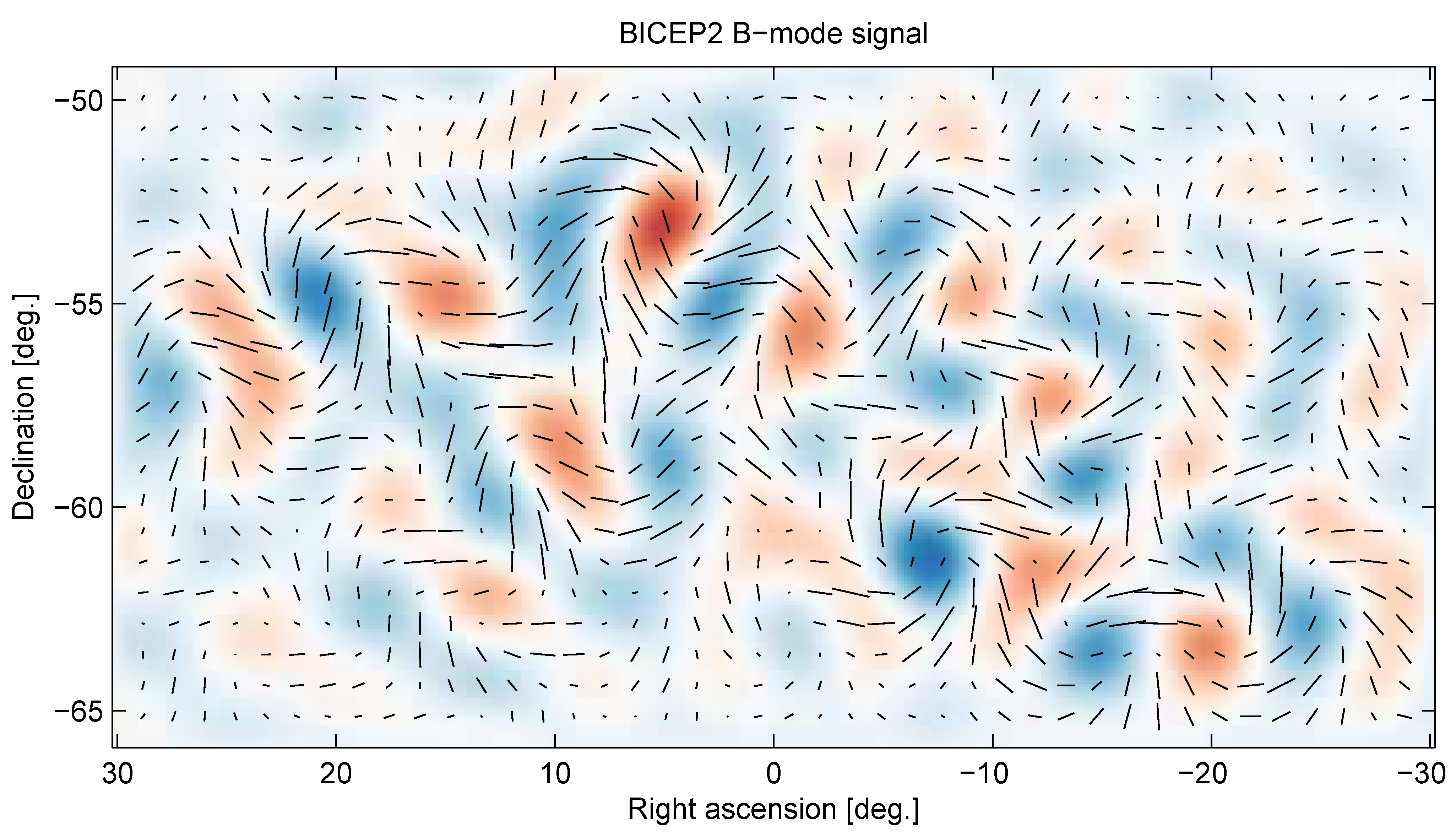
I realize that I’ve posted several items on B-modes without ever showing a picture of what they look like, so here you go, an image of the B-mode polarization seen by the BICEP2 experiment:
When the BICEP2 team announced that a “major astrophysics discovery” would be announced this Monday I have to admit that I was quite a bit uncomfortable about the way things were being done. I’ve never been keen on “Science by Press Release” and when it became clear that the press conference would be announcing results that hadn’t yet been peer-reviewed my concerns deepened.
However, the BICEP2 team immediately made available not only the “discovery” paper but also the data products, so people with sufficient expertise (and time) could try to unpick the content. This is fully in the spirit of open science and I applaud them for it. Indeed one could argue that putting everything out in the open the way they have is ensuring that that their work is being peer-reviewed in the open by the entire cosmological community not secretly and by one or two anonymous individuals. The more I think about it the more convinced I am becoming that this is a better way of doing peer review than the traditional method, although before I decide that for sure I’d like to know whether the BICEP2 actually does stand up!
One of the particularly interesting developments in this case is the role social media are playing in the BICEP2 story. A Facebook Group was set up in advance of Monday’s announcement and live discussion started immediately the press conference started. The group now has well over 700 members, including many eminent cosmologists. And me. There’s a very healthy scientific discussion going on there which may well prove to be a model of how such things happen in the future. Is this a sign of a major change in the way science is done, the use of digital technology allowing science to break free from the shackles placed on it by traditional publication processes? Maybe.
Anyway, no time to write any more. I just remembered I have to participate in a seminar on Open Access publishing and I have to start thinking about what I’m going to say!
P.S. The Vernal Equinox happened at 16.:57 GMT today, so welcome to Spring!
Follow @telescoper
 In the Dark