Politics, Polls and Insignificance

Posted in Bad Statistics, Politics with tags , , , , , on July 29, 2014 by telescoper

In between various tasks I had a look at the news and saw a story about opinion polls that encouraged me to make another quick contribution to my bad statistics folder.

The piece concerned (in the Independent) includes the following statement:

A ComRes survey for The Independent shows that the Conservatives have dropped to 27 per cent, their lowest in a poll for this newspaper since the 2010 election. The party is down three points on last month, while Labour, now on 33 per cent, is up one point. Ukip is down one point to 17 per cent, with the Liberal Democrats up one point to eight per cent and the Green Party up two points to seven per cent.

The link added to ComRes is mine; the full survey can be found here. Unfortunately, the report, as is sadly almost always the case in surveys of this kind, neglects any mention of the statistical uncertainty in the poll. In fact the last point is based on a telephone poll of a sample of just 1001 respondents. Suppose the fraction of the population having the intention to vote for a particular party is p. For a sample of size n with x respondents indicating that they hen one can straightforwardly estimate p \simeq x/n. So far so good, as long as there is no bias induced by the form of the question asked nor in the selection of the sample, which for a telephone poll is doubtful.

A  little bit of mathematics involving the binomial distribution yields an answer for the uncertainty in this estimate of p in terms of the sampling error:

\sigma = \sqrt{\frac{p(1-p)}{n}}

For the sample size given, and a value p \simeq 0.33 this amounts to a standard error of about 1.5%. About 95% of samples drawn from a population in which the true fraction is p will yield an estimate within p \pm 2\sigma, i.e. within about 3% of the true figure. In other words the typical variation between two samples drawn from the same underlying population is about 3%.

If you don’t believe my calculation then you could use ComRes’ own “margin of error calculator“. The UK electorate as of 2012 numbered 46,353,900 and a sample size of 1001 returns a margin of error of 3.1%. This figure is not quoted in the report however.

Looking at the figures quoted in the report will tell you that all of the changes reported since last month’s poll are within the sampling uncertainty and are therefore consistent with no change at all in underlying voting intentions over this period.

A summary of the report posted elsewhere states:

A ComRes survey for the Independent shows that Labour have jumped one point to 33 per cent in opinion ratings, with the Conservatives dropping to 27 per cent – their lowest support since the 2010 election.

No! There’s no evidence of support for Labour having “jumped one point”, even if you could describe such a marginal change as a “jump” in the first place.

Statistical illiteracy is as widespread amongst politicians as it is amongst journalists, but the fact that silly reports like this are commonplace doesn’t make them any less annoying. After all, the idea of sampling uncertainty isn’t all that difficult to understand. Is it?

And with so many more important things going on in the world that deserve better press coverage than they are getting, why does a “quality” newspaper waste its valuable column inches on this sort of twaddle?

In Thunder, Lightning and in Rain..

Posted in Biographical with tags , , , , on July 28, 2014 by telescoper

A while before 6am this morning I was woken up by the sound of fairly distant thunder to the West of my flat. I left the windows open – they’ve been open all the time in this hot weather – and dozed while rumblings continued. Just after six there was a terrifically bright flash and an instantaneous bang that set car alarms off in my street; lightning must have struck a building very close. Then the rain arrived. I got up to close the windows against the torrential downpour, at which point I noticed that water was coming in through the ceiling. A further inspection revealed another leak in the cupboard where the boiler lives and another which had water dripping from a light fitting. A frantic half hour with buckets and mops followed, but I had to leave to get to work so I just left buckets under the drips and off I went into the deluge to get soaked.

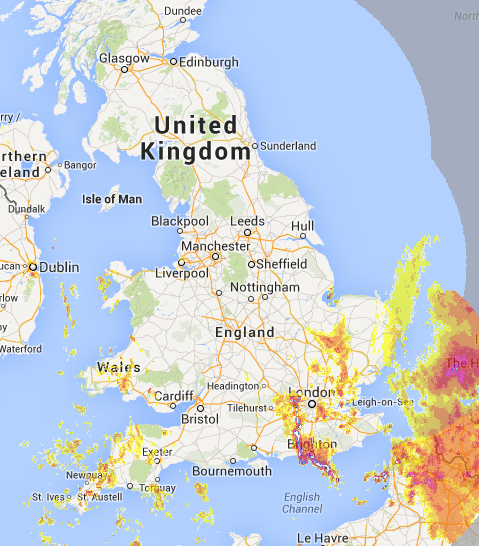
Here is the map of UK rain at 07:45 am, with Brighton in the thick of it:

rain

I made it up to campus (wet and late); it’s still raining but hopefully will settle down soon. This is certainly turning into a summer of extremes!

Demolition at Didcot

Posted in Uncategorized with tags , , on July 27, 2014 by telescoper

As someone who has spent his fair share of time traveling backwards and forwards on the First Great Western railway line between Cardiff (or Swindon) and London, it seems appropriate to note that the environs of Didcot Parkway station (which lies on the main line) will look rather different next time I do that journey. In the early hours of this morning, three of the six enormous cooling towers came tumbling down:

I gather the other three are also scheduled for demolition, although I doubt I’ll be able to attend that event in person either!

Night hath no wings

Posted in Poetry on July 27, 2014 by telescoper

Night hath no wings to him that cannot sleep;
And Time seems then not for to fly, but creep;
Slowly her chariot drives, as if that she
Had broke her wheel, or crack’d her axletree.
Just so it is with me, who list’ning, pray
The winds to blow the tedious night away,
That I might see the cheerful peeping day.
Sick is my heart; O Saviour! do Thou please
To make my bed soft in my sicknesses;
Lighten my candle, so that I beneath
Sleep not for ever in the vaults of death;
Let me thy voice betimes i’ th’ morning hear;
Call, and I’ll come; say Thou the when and where:
Draw me but first, and after Thee I’ll run,
And make no one stop till my race be done.

by Robert Herrick (1591-1674)


What is science and why should we care? — Part III

Posted in Politics, The Universe and Stuff with tags , on July 26, 2014 by telescoper

Interesting post, one of a series about the Philosophy of science by Alan Sokal (of the famous hoax). The other posts in the series are well worth reading, too…

The Expert

Posted in Uncategorized on July 25, 2014 by telescoper

Brilliant sketch about the difficulty of fitting into the corporate world when you actually know things about stuff:


A Keno Game Problem

Posted in Cute Problems with tags , , , , on July 25, 2014 by telescoper

It’s been a while since I posted anything in the Cute Problems category so, given that I’ve got an unexpected gap of half an hour today, I thought I’d return to one of my side interests, the mathematics and games and gambling.

There is a variety of gambling games called Keno games in which a player selects (or is given) a set of numbers, some or all of which the player hopes to match with numbers drawn without replacement from a larger set of numbers. A common example of this type of game is Bingo. These games mostly originate in the 19th Century when travelling carnivals and funfairs often involved booths in which customers could gamble in various ways; similar things happen today, though perhaps with more sophisticated games.

In modern Casino Keno (sometimes called Race Horse Keno) a player receives a card with the numbers from 1 to 80 marked on it. He or she then marks a selection between 1 and 15 numbers and indicates the amount of a proposed bet; if n numbers are marked then the game is called `n-spot Keno’. Obviously, in 1-spot Keno, only one number is marked. Twenty numbers are then drawn without replacement from a set comprising the integers 1 to 80, using some form of randomizing device. If an appropriate proportion of the marked numbers are in fact drawn the player gets a payoff calculated by the House. Below you can see the usual payoffs for 10-spot Keno:

tabke
If fewer than five of your numbers are drawn, you lose your £1 stake. The expected gain on a £1 bet can be calculated by working out the probability of each of the outcomes listed above multiplied by the corresponding payoff, adding these together and then subtracting the probability of losing your stake (which corresponds to a gain of -£1). If this overall expected gain is negative (which it will be for any competently run casino) then the expected loss is called the house edge. In other words, if you can expect to lose £X on a £1 bet then X is the house edge.

What is the house edge for 10-spot Keno?

Answers through the comments box please!

Long Long Summer – Reprise

Posted in Jazz with tags , , on July 24, 2014 by telescoper

I know it’s tempting fate to post something with a title like Long Long Summer, as indeed it was last time I posted it, but we’ve had such lovely warm weather for the last week or so I couldn’t resist putting this up while the sun’s still shining. I particularly wanted to share this track (a) because it matches the weather perfectly and (b) because it’s by the great Dizzy Gillespie Quintet of 1962 with Lalo Schifrin on piano, best known as a prolific composer of film and TV scores. The band also featured Leo Wright, a very under-rated saxophonist and flautist. They all play terrifically on this original composition by Lalo Schifrin. There’s also a chance to see an interesting collection of photographs of Dizzy Gillespie, and his amazing cheeks!

BICEP2 – The Video!

Posted in The Universe and Stuff with tags , , , on July 23, 2014 by telescoper

A video about cosmic inflation and the BICEP2 results produced by the University of Sussex and PhD Comics!

Time for a Factorial Moment…

Posted in Bad Statistics with tags , , on July 22, 2014 by telescoper

Another very busy and very hot day so no time for a proper blog post. I suggest we all take a short break and enjoy a Factorial Moment:

Factorial Moment

I remember many moons ago spending ages calculating the factorial moments of the Poisson-Lognormal distribution, only to find that they were well known. If only I’d had Google then…