How should mathematics be taught to non-mathematicians?

Posted in Education with tags , , , , on February 25, 2014 by telescoper

This post from the estimable “Gowers’s Weblog” passed me by when it was originally published in 2012, but I saw the link on Twitter and decided to repost it here because it’s still topical..

gowers's avatarGowers's Weblog

Michael Gove, the UK’s Secretary of State for Education, has expressed a wish to see almost all school pupils studying mathematics in one form or another up to the age of 18. An obvious question follows. At the moment, there are large numbers of people who give up mathematics after GCSE (the exam that is usually taken at the age of 16) with great relief and go through the rest of their lives saying, without any obvious regret, how bad they were at it. What should such people study if mathematics becomes virtually compulsory for two more years?

A couple of years ago there was an attempt to create a new mathematics A-level called Use of Mathematics. I criticized it heavily in a blog post, and stand by those criticisms, though interestingly it isn’t so much the syllabus that bothers me as the awful exam questions. One might…

View original post 9,949 more words

From Real Time to Imaginary Time

Posted in Brighton, Education, The Universe and Stuff with tags , , , , , , , , , , , on February 24, 2014 by telescoper

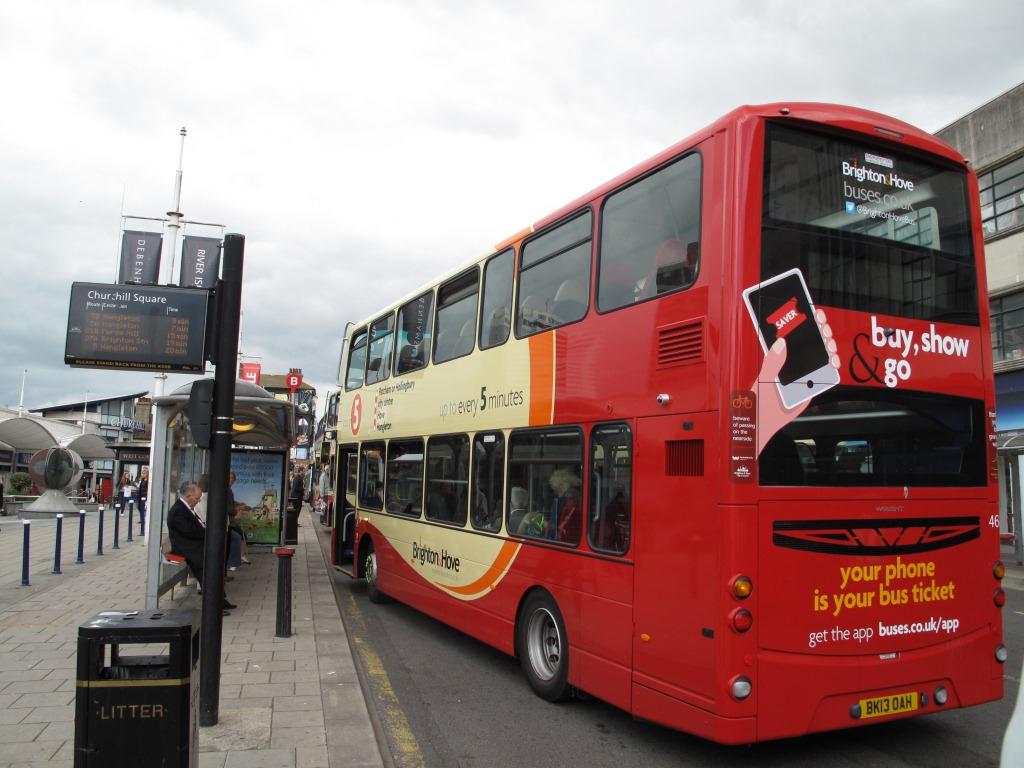
Yesterday, after yet another Sunday afternoon in my office on the University of Sussex campus, I once again encountered the baffling nature of the “real time boards” at the bus-stop at Falmer Station (just over the road from the University). These boards are meant to show the expected arrival times of buses; an example can be seen on the left of the picture below, taken at Churchill Square (in the City Centre).
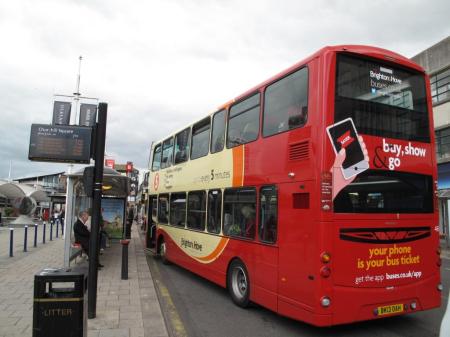
???????????????????????????????

The real-time board system works pretty well in central Brighton, but it’s a very different story at Falmer, especially for the Number 23 which is my preferred bus home. Yesterday provided a typical illustration of the problem: the time of the first bus on the list, a No. 23, was shown as “1 min” when I arrived at the stop. It then quickly moved to “due” (a word which I’ll comment about later). It then moved back to “2 mins” for about 5 minutes and then back to “due” again. It stayed like that for over 10 minutes at which point the bus that was second on the list (a No. 28 from Lewes) appeared. Rather than risk waiting any longer for the 23 I got on the 28 and had a slightly longer walk home from the stop at the other end. Just as well I did because the 23 vanished entirely from the screen as soon as I boarded the other bus. This apparent time-travel isn’t unusual at Falmer, although I’ve never really understood why.

By sheer coincidence when I got to the bus stop to catch a bus to campus this morning there was a chap from Brighton and Hove buses there. He was explaining what sometimes goes wrong with the real time boards to a lady, so I joined in the conversation and asked him if he knew why Falmer is so unreliable. He was happy to oblige. It turns out that the way the real-time boards work depends on each bus having a GPS system that communicates to a central computer via a radio link. If the radio link drops out for some reason – as it apparently does quite often up at Falmer (mobile phone connectivity is poor here also) – the system looks up the expected time of the bus after the one that it has lost contact with. Thus it is that a bus can apparently be “due” and then apparently go back in time. Also, if a bus has to divert from the route programmed into the GPS tracker then it is also removed from the real-time boards.

However, there is another system in operation alongside the GPS tracker. When a bus actually stops at a stop and opens its doors the onboard computer communicates this to the central system at the same time as the location signs inside the bus are updated. At this point the real-time boards are reset.

The unreliability I’ve observed at Falmer is in fact caused by two problems: (i) the patchy radio coverage as the bus wanders around the hilly environs of Falmer campus; and (ii) the No. 23 is on a new route around the back of campus which means that it vanishes from the system entirely when it wanders off the old route, as would happen if the bus were to break down.

Mystery solved then, in a sense, but it means there’s a systematic problem that isn’t going to be fixed in the short-term. Would it be better to switch off the boards than have them show inaccurate information? Perhaps, but only if it were always wrong. In fact the boards seem to work OK for the more frequent bus, the No. 25. My strategy is therefore never to rely on the information provided concerning the No. 23 and just get the first bus that comes. It’s not a problem anyway during the week because there’s a bus every few minutes, but on a Sunday evening it is quite irksome to see apparently random times on the screens.

All this talk about real-time boards reminds me of a question I was asked in a lecture last week. I was starting a new section of my Theoretical Physics module for 2nd Year students on Complex Analysis: the Cauchy-Riemann equations, Conformal Transformations, Contour Integrals and all that Jazz. To start the section I went on a bit of a ramble about the ubiquity of complex numbers in physics and whether this means that imaginary numbers are, in some sense, real. You can find an enjoyable polemic on this subject, given the answer “no” to the question here.

Anyway, I got the class to suggest examples of the use of complex numbers in physics. The things you’d expect came up such as circuit theory, wave propagation etc. Then somebody mentioned that somewhere they had heard of imaginary time. The context had probably been provided Stephen Hawking who mentioned this in his book A Brief History of Time. In fact the trick of introducing imaginary time is called a Wick Rotation and the basic idea is simple. In special relativity we deal with four-dimensional space-time intervals of the form

ds^2 = -c^2dt^2 + dx^2 + dy^2 +dz^2,

i.e. the metric describing Minkowski space. The minus sign in front of the time bit is essential to the causal structure of space-time but it causes quite a few mathematical difficulties. However if we make the substitution

\tau \rightarrow i c t

then the metric becomes

ds^2 = d\tau^2 + dx^2 + dy^2 +dz^2,

which corresponds to a four-dimensional Euclidean space which is in many situations much easier to handle mathematically.

Complex variables and complex functions provide the theoretical physicist with a host of extremely elegant techniques for solving tricky problems. But does that mean they are somehow “built in” to nature? I don’t think so. I don’t think the Brighton & Hove Bus company uses imaginary time on its display boards either, although it does sometimes seem that way.


POSTSCRIPT. I forgot to include my planned rant about the use of the word “due”. The boards displaying train times at railway stations usually give the destination and planned departure time of the train, e.g. “Brighton 11.15”. If things are running to schedule this information is supplemented by the phrase “On Time”. If not, which is sadly a more likely contingency in the UK, this changes to “due 11.37” or some such. This really annoys me.: the train is due at 11.15. If it doesn’t come until after then, it’s overdue or, in other words, late.

The Quintet at Massey Hall

Posted in Jazz with tags , , , , , , , , , on February 23, 2014 by telescoper

Time for a quick Jazz review, I think. This time I thought I’d pick a classic live performance from May 15th 1953 at Massey Hall in Toronto. Originally released as a vinyl LP with only 6 tracks on it, and called The Quintet of the Year, but subsequently re-released in various versions on CD, with various titles including Jazz at Massey Hall. The whole concert  is now available on Youtube here:

This concert was planned to unite the greatest stars of the bebop era who had performed together earlier in their careers but had gradually evolved different styles over the intervening years. The line-up is Charlie Parker on alto, Dizzy Gillespie on trumpet, Bud Powell on piano, Charles Mingus on bass and the great Max Roach on drums which is stellar by any criterion!

Gatherings of star jazz players have often turned out to be disappointing, largely because very great musicians can sometimes interfere negatively rather than positively with each other, not necessarily consciously but because they can have ideas incompatible with one another. This evening, however,  was a glorious exception to this rule, doubtless because all the musicians had worked together in the past, and their subsequent individual development had not taken them too far beyond their shared musical background. It is true that the ensemble passages are slight, but that doesn’t matter much because the solos are of such a remarkable and consistently high standard. Charlie Parker turns in some of the very best of his later recorded work, giving the lie to those who argue that his musical abilities were in decline at this time. He might not play as elegantly as he did on the classic Dial and Savoy sessions, but he is significantly more adventurous, with startling melodic contrasts in much of his work. At times this is a bit of a problem in that he seems to full of ideas that what comes out is a sequence of breathtaking fragments rather than a cohesive solo. This happens on A Night in Tunisia, for example, which never quite fulfills the promise of its magnificent opening break. On other tracks, though, especially Hot House his improvisations are just brilliant. It’s hard to imagine listening to this that in less than two years he would be dead.

Dizzy Gillespie matches Parker in superb fashion, betraying none of the offhandedness that often afflicted his later recorded performances, and the pyrotechnical quality of his playing is as exhilarating as it is instantly recognizable. Gillespie was an extrovert on stage and his frequent dancing around on the stage results in him going on and off mike from time to time, but it doesn’t detract from the performance once you realize why he’s fading in and out. It is, after all, a live performance and if you shut your eyes you can imagine Dizzy Gillespie the showman without any difficulty at all!

Most Jazz reviewers confine their comments on the rhythm section to a few kind words, but in this case that would be a travesty. The limitations of live recording technology in 1953 result in a rather unbalanced mix, but the flip side of that is that you can hear  particularly well the pivotal importance of the bass playing of Charles Mingus. Between them Mingus and Max Roach lay down a relentlessly propulsive beat as well as taking gripping solos; the drum workouts in Wee and Salt Peanuts are astonishing in their interplay of rhythm and texture. Trumping even them, however, is the genius of Bud Powell who plays at a level consistently high even by his own standards.

Bud Powell is a fascinating musician for many reasons. Much less of a formalist than many Jazz pianists he nevertheless seems to generate a real sense of unity, more through the  emotional drive underpinning his phrases than by imposing any set structure on his improvisations. His solo on Wee offers a fine example of this: moving inexorably towards a shattering climax as the right hand figures vary ceaselessly in their length and the chords punched out by the left hand grow more frequent and more percussive.

This album is another must-have for any serious collector of post-War jazz. The individual parts are all superb, but the whole is even greater than their sum.

PS. I had the pleasure of attending a concert at Massey Hall myself, when I was on sabbatical in Toronto in 2005/6.

Graduation and Pronunciation

Posted in Biographical, Brighton, Education with tags , , on February 22, 2014 by telescoper

Here’s a chance to relive (if you were there) or experience for the first time (if you weren’t)  the hilarity of my attempts to pronounce the names of all the graduands from the School of Mathematical and Physical Sciences at the Winter Graduation Ceremony for the University of Sussex at the Dome, in Brighton, last month.  I blogged about this here and there are also some pictures here. My stint commences at about 1:35:30 and finishes about 1:48:00 so there’s not too much of me to put up with, and if you get bored with my voice there’s always the irrepressible Chancellor, Sanjeev Baskar, to keep you entertained…

The National Student Survey: Feedback and Response

Posted in Education with tags , , , on February 21, 2014 by telescoper

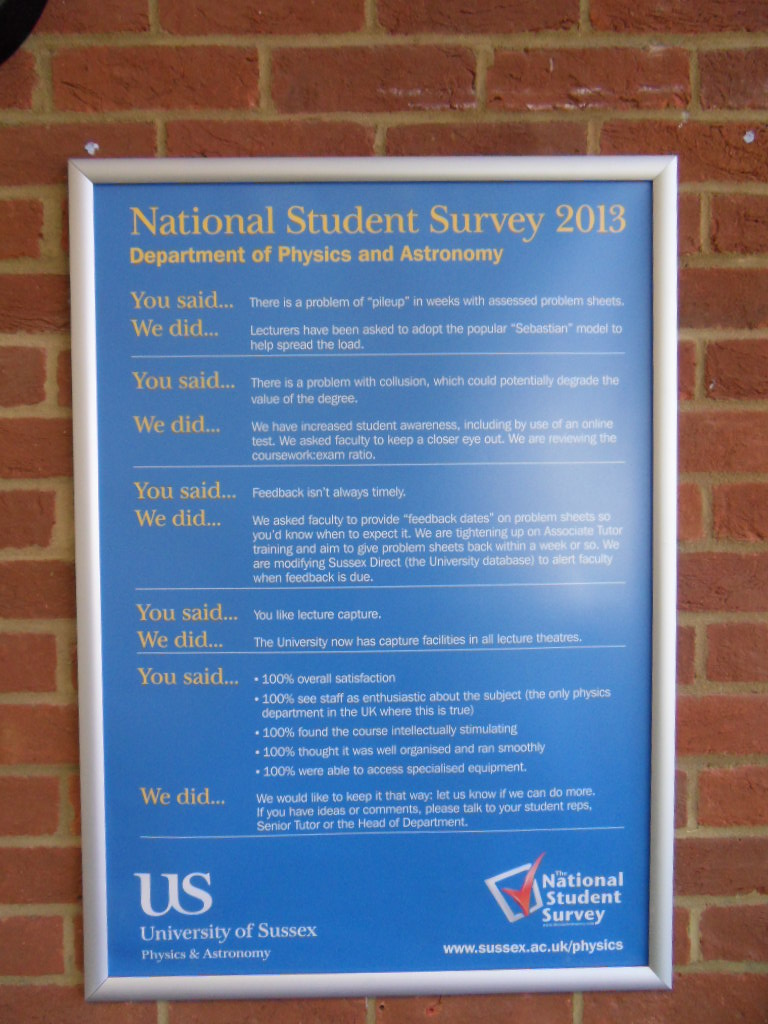
So the 2014 National Student Survey is under way. The NSS is much maligned, largely because it seems to be regarded by the powers that be solely for the purpose of constructing meaningless league tables. In reality I think the NSS survey is actually rather valuable because it allows us to gather systematic feedback on things that we do well and things we do not so well so we can look to improve our teaching for future generations of students. This isn’t just a PR exercise, at least not here in the School of Mathematical and Physical Sciences at the University of Sussex. We really do listen. Here are our responses to last year’s survey in the Department of Physics & Astronomy:

SAMSUNG DIGITAL CAMERA

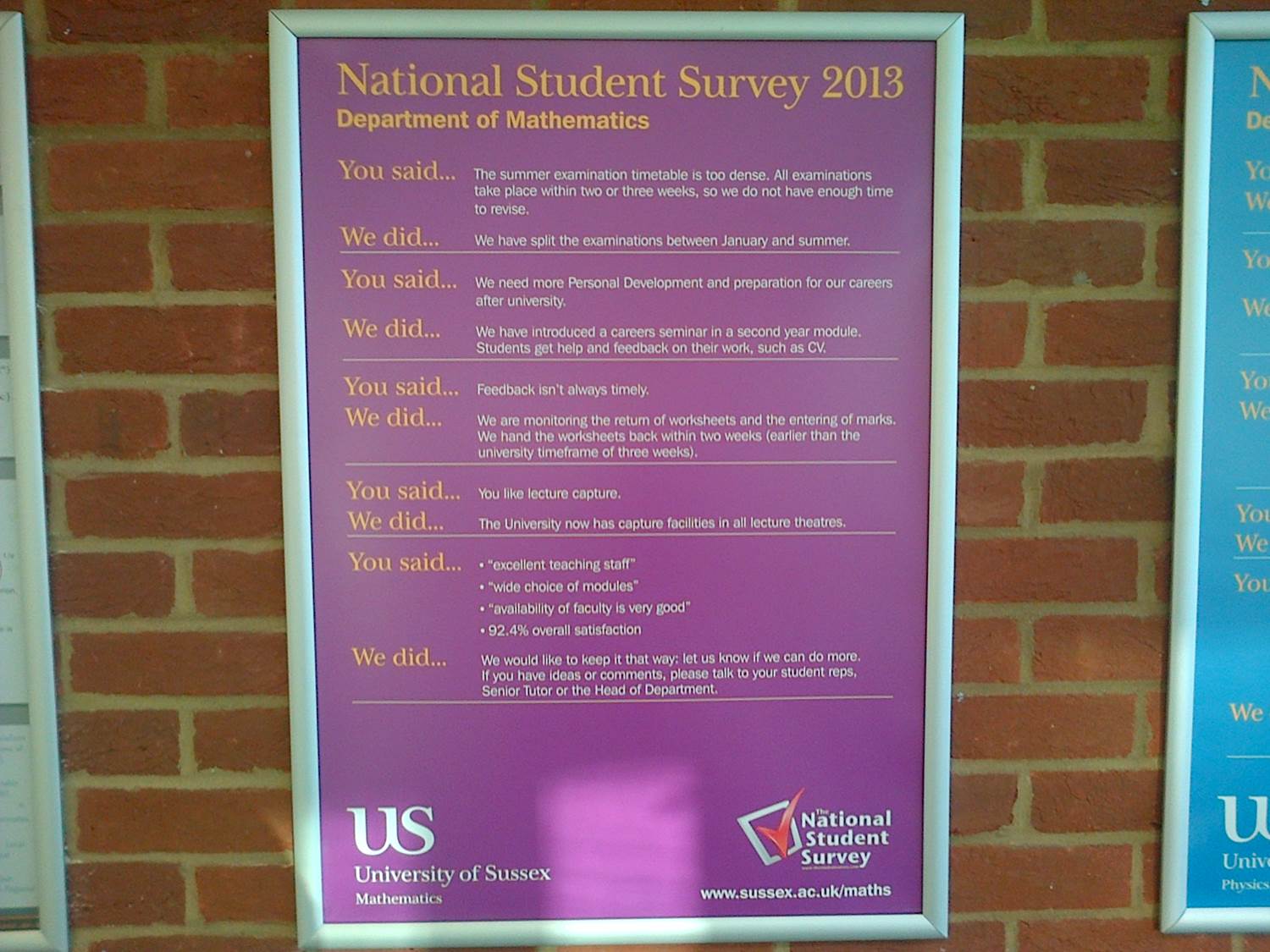
and for the Department of Mathematics:

Picture1

I hope the fact that we have responded to the feedback we’ve got will encourage more students to participate in this year’s National Student Survey, regardless of what they have to say; that way we can try to improve still further.

Jacques Loussier and the Pekinel Twins play Bach

Posted in Jazz, Music with tags , , on February 21, 2014 by telescoper

I heard a track by this combination on the Breakfast Programme on BBC Radio 3 yesterday morning and thought I’d include something on here; it’s basically the Jacques Loussier Trio, which is famous for its Jazz re-workings of the music of Johann Sebastian Bach with the addition of the identical twins Güher  and Süher Pekinel on pianos.

Apparently some members of the Radio 3 audience didn’t take kindly to Ian Skelly’s decision to play something by this combination, but I have to say I loved it; it really put a spring in my step. I’ve remarked before on this blog that many Jazz musicians are great admirers of Bach (who was himself a talented improviser).  It’s not difficult to understand why this is the case, particularly in the case of the keyboard works, because the music always has such a rich and compelling  harmonic progression built into it – just what a Jazz musician needs. Bach’s compositions are so well constructed that they can cope with being pulled around more than those of any other composer I can think of. Above all, despite the change of musical vocabulary and the addition of a rhythm section, the best Jazz versions still somehow manage to sound  like Bach….

From the following clips you can see that the twins play from sheet music – I think the arrangement was written  by Jacques Loussier – while Loussier’s contribution is largely improvised. In the clip they play versions of Bach’s Triple Concerto in D minor BWV 1063 (with Jacques Loussier) followed the Concerto for Two Keyboards in C minor, BWV 1060  (without Loussier)…

Double Indemnity – Statistics Noir

Posted in Film with tags , , , , on February 20, 2014 by telescoper

The other day I decided to treat myself by watching a DVD of the  film  Double Indemnity. It’s a great movie for many reasons, not least because when it was released in 1944 it immediately established much of the language and iconography of the genre that has come to be known as film noir, which I’ve written about on a number of occasions on this blog; see here for example. Like many noir movies the plot revolves around the destructive relationship between a femme fatale and male anti-hero and, as usual for the genre, the narrative strategy involves use of flashbacks and a first-person voice-over. The photography is done in such a way as to surround the protagonists with dark, threatening shadows. In fact almost every interior in the film (including the one shown in the clip below) has Venetian blinds for this purpose. These chiaroscuro lighting effects charge even the most mundane encounters with psychological tension or erotic suspense.

di6

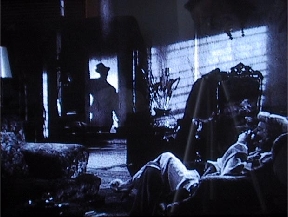
To the left is an example still from Double Indemnity which shows a number of trademark features. The shadows cast by venetian blinds on the wall, the cigarette being smoked by Barbara Stanwyck and the curious construction of the mise en scene are all very characteristic of the style. What is even more wonderful about this particular shot however is the way the shadow of Fred McMurray’s character enters the scene before he does. The Barbara Stanwyck character is just about to shoot him with a pearl-handled revolver; this image suggests that he is already on his way to the underworld as he enters the room.

I won’t repeat any more of the things I’ve already said about this great movie, but I will say a couple of things that struck me watching it again at the weekend. The first is that even after having seen it dozens of times of the year I still found it intense and gripping. The other is that I think one of the contributing factors to its greatness which is not often discussed is a wonderful cameo by Edward G Robinson , who steals every scene he appears in as the insurance investigator Barton Keyes. Here’s an example, which I’ve chosen because it provides an interesting illustration of the the scientific use of statistical information, another theme I’ve visited frequently on this blog:

It’s Official, it’s PLATO!

Posted in Science Politics, The Universe and Stuff with tags , , , , on February 19, 2014 by telescoper

Just a quick post to pass on the news that the European Space Agency has officially selected the third M-Class mission to form part of its Cosmic Vision Programme (which covers the period 2015-2025). The lucky winner is PLATO (PLAnetary Transits and  Oscillations of stars) and it will detect extra-solar planets by monitoring relatively nearby stars, searching for tiny, regular dips in brightness as planets transit in front of them. It will also study astroseismological activity, enabling a precise characterisation of the host star of each planet discovered, including its mass, radius and age.

plato_satelliteIt is expected that PLATO will find and analyse thousands of  such exoplanetary systems in this way, with an emphasis on discovering and characterizing Earth-sized planets and super-Earths in the habitable zone of their parent star. PLATO will be launched on a Soyuz rocket from Europe’s Spaceport in Kourou by 2024 for an initial six-year mission. It will operate from the Second Lagrange Point, or L2 for short. It’s an intriguing design consisting of 34 small telescopes (left).

PLATO joins Solar Orbiter and Euclid, which were chosen in 2011 as ESA’s first two M-class missions. Solar Orbiter will be launched in 2017 to study the Sun and solar wind from a distance of less than 50 million km, while Euclid, to be launched in 2020, will focus on dark energy, dark matter and the structure of the Universe.

The decision to select PLATO wasn’t exactly a surprise as it was singled out as the leading candidate by an expert panel last month, but there was nevertheless some nervousness among certain senior astronomers at the Royal Astronomical Society on Friday in advance of the formal decision. I suspect they’ll all be out celebrating tonight!

Spring is like a perhaps hand

Posted in Poetry with tags , , on February 19, 2014 by telescoper

Spring is like a perhaps hand
(which comes carefully
out of Nowhere) arranging
a window,into which people look (while
people stare
arranging and changing placing
carefully there a strange
thing and a known thing here) and

changing everything carefully

spring is like a perhaps
Hand in a window
(carefully to
and from moving New and
Old things, while
people stare carefully
moving a perhaps
fraction of flower here placing
an inch of air there) and

without breaking anything.

by e e cummings (1894-1962).

Cat Curling

Posted in Sport with tags , on February 18, 2014 by telescoper

No cats were curled during the making of this video…