Cosmological Tanka

Posted in Poetry, The Universe and Stuff with tags , , , on January 14, 2014 by telescoper

Most readers of this blog will be familiar with the form of Japanese poetry known as Haiku. I’ve even had a go at producing some cosmological Haiku myself. I suspect rather fewer will have come across another form known as Tanka. Being 31 syllables long rather than the 17 of Haiku, these are not quite as short but still quite a challenge to write.  They comprise 5 lines with a 5-7-5-7-7 pattern of syllables. I’m told by Japanese friends that Tanka are specifically written to celebrate a special event or to capture the mood of a particular moment. Here is an exquisite example by a famous poet called Otomo No Yakamochi:

From outside my house,
only the faint distant sound
of gentle breezes
wandering through bamboo leaves
in the long evening silence.

I’ve had a go at composing a couple of Tanka to do with specific moments in cosmology. Here’s one about the epoch of recombination:

An electron finds
a proton and marries it;
they make hydrogen.
Simultaneous weddings
free light across the cosmos.

I was talking to some students about the spherical collapse model so here’s a Tanka for that:

I was more dense than
my surroundings, expanded
more slowly, then stopped.
Now I must start to collapse;
soon I shall virialize.

Further attempts welcome through the comments box!

A Summer of Undergraduate Physics Research

Posted in Biographical, Education, The Universe and Stuff with tags , , , , on January 14, 2014 by telescoper

I was compiling a bibliography for a new paper yesterday and noticed that a paper published in December 2013 cited one I wrote in 2005 with Andrew Stannard while I was working at the University of Nottingham; the rarity of anyone actually referring to any of my papers caught my attention. I include the abstract of the Stannard-Coles paper here for reference:

We investigate the properties of the (complex) coefficients obtained in a spherical harmonic representation of temperature maps of the cosmic microwave background (CMB). We study the effect of the coefficient phase only, as well as the combined effects of phase and amplitude. The method used to check for anomalies is to construct a `random walk’ trajectory in the complex plane where the step length and direction are given by the amplitude and phase (respectively) of the harmonic coefficient. If the fluctuations comprise a homogeneous and isotropic Gaussian random field on the sky, the path so obtained should be a classical `Rayleigh flight’ with very well known statistical properties. We illustrate the use of this random-walk representation by using the net walk length as a test statistic, and apply the method to the coefficients obtained from a Wilkinson Microwave Anisotropy Probe (WMAP) preliminary sky temperature map.

This seems like ancient history now, particularly with regard to the use of “preliminary” WMAP data, but it was only just over 8 years ago. I never imagined during the time that we were working on this paper that I’d be moving twice! By contrast, Andrew Stannard remained in Nottingham, doing a PhD there and is now employed as a Research Fellow, although he switched fields after the project and moved into nanoscience.

Anyway, I wasn’t posting this so I could take a trip down memory lane. I thought I’d post it in order to point out that this paper actually came about as an undergraduate research project that Andrew did under my supervision during the summer of 2005, funded by a Mary Cannell Summer Studentship. Mary Cannell was the author of a book about the life of George Green (the famous mathematician who came from Nottingham); she passed away in 2000 leaving some money to the School of Physics & Astronomy to fund summer research placements for undergraduates. If I recall correctly, we completed the analysis and wrote the paper during the summer of 2005, submitting it in August and having it accepted in September. If only it were always so straightforward! Since publication it has garnered 15 citations according to the ADS website; not exactly earth-shattering, but respectable enough, especially given the background. I think it may get a few more in the next few years because the quality of data from Planck may now be good enough to actually detect the features we were looking for all those years ago!

It’s worth mentioning that in the School of Physics and Astronomy at the University of Sussex we have a degree programme in which students receive a stipend to cover living expenses during a summer vacation placement with one of the research groups each and every year of their studies. This is in addition to the usual lectures and laboratory work of the standard  course. This involves many more students than was the case back in Nottingham in 2005, but since I’ve only been at the University of Sussex for  a year I don’t know how many such placements have led to actual publications.

Does anyone know of any really important papers out there that came from undergraduate research projects? If so, please let me know through the comments box..

Come again? “Penile Strangulation by Metallic Rings” retracted for duplication

Posted in Uncategorized on January 13, 2014 by telescoper

Here’s an interesting development from the inestimable blog Retraction Watch, which I thought I should display on my own organ. A paper on “Penile Strangulation by Metallic Rings” has been withdrawn from publication. Pity, because the authors probably went through lots of hoops to get it past the editor…

Adam Marcus's avatarRetraction Watch

indjrnsurgThe Indian Journal of Surgery, a Springer-Verlag title, has retracted a 2011 paper with a title only the Marquis de Sade would love: “Penile Strangulation by Metallic Rings.”

We know what you’re saying: Who knew penises could be strangulated? Well, it’s true.

View original post 606 more words

The Riddle of the Samurai Sword

Posted in Cute Problems with tags , on January 13, 2014 by telescoper

For some reason I just remembered a simple little puzzle I was told about ages ago, so I thought I’d try it out here.

On certain trains in Japan, passengers are not allowed to enter a compartment with any piece of luggage which is too long or too wide to be placed in the overhead racks; any parcel or package with dimensions larger than 60 cm × 80 cm is forbidden.  It is possible however to enter the carriage with a metre-long samurai sword.

How?

Answers through the comments box please…

The Medical Case for Beards in the 19th Century

Posted in Beards, History on January 13, 2014 by telescoper

Fascinating article by historian of medicine, Dr Alun Withey, about the medical benefits of facial hair. ..

Dr Alun Withey's avatarDr Alun Withey

As Christopher Oldstone-Moore has argued in his excellent article about the Victorian ‘beard movement’, the middle years of the nineteenth century witnessed an abrupt volte-face in attitudes towards facial hair. The eighteenth century had been one where men were almost entirely clean-shaven. The face of the enlightened gentleman was smooth, his face youthful and his countenance clear, suggesting a mind that was also open. Growing a beard at this point would have been a deliberate act done purposefully to convey a message. John Wroe, for example, leader of the Christian Israelite group, let his beard grow wild to signify his withdrawal from society.

By the mid-Victorian period, however, the beard came back into fashion with remarkable swiftness. Part of the reason for this was changing ideals of masculinity. This was the age of exploration, of hunters, climbers and explorers. As rugged adventurers began to tackle the terra incognita of far-flung…

View original post 633 more words

Music for Zen Meditation

Posted in Jazz, Music with tags , , , on January 12, 2014 by telescoper

Given my current location I thought I’d try this one out readers of this blog. I bought the album Music for Zen Meditation about 20 years ago; it was recorded in 1964 and features jazz clarinettist Tony Scott with two Japanese musicians, Shinichi Yuize (who plays the koto, a 13-stringed Japanese harp) and Hōzan Yamamoto (shakuhachi, a kind of bamboo flute). I think the music, and especially Scott’s lovely tone on the clarinet, creates a wonderful sense of peace, and it’s fascinating to hear the blending of styles. However, I played some of the music for my Japanese friend Chiaki some time ago and he said it sounded like something you would hear in an elevator. Ouch!

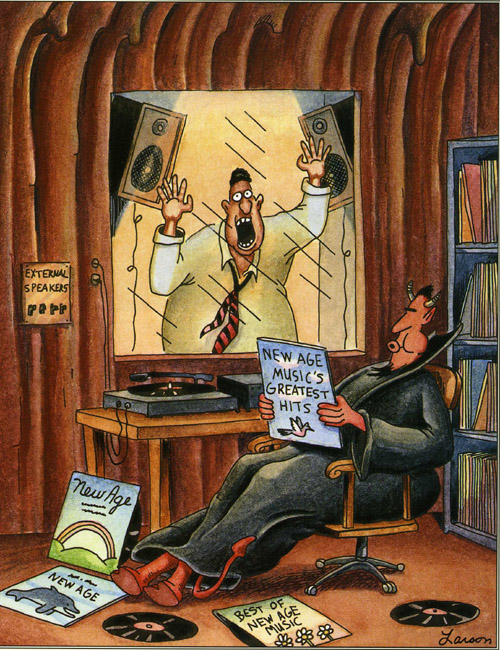
This album is often said to have been the first ever recording in the musical genre that came to be known as New Age, most of which I can’t stand. That reminds me of one of my favourite Gary Larson cartoons:

charlie_parker_hell

Music for Zen Meditation is certainly a far cry from bebop, but I’ll leave it to you to make your own mind up about it. See what you think. This track is the first one on the album and is entitled Is All Not One?

The Flowers of January

Posted in Art, Biographical, History with tags , , , , on January 12, 2014 by telescoper

Today’s tourist itinerary  took me first to the Tokugawa Art Museum, which contains family treasures from the Owari Tokugawa family, one of the families from which the Shogun was chosen during the Edo period (which lasted from 1603 until 1867 and is sometimes called the Tokugawa period). The collection is magnificent, comprising arms and armour of the elite Samurai warriors as well as art, garments, furniture, and household objects of the period, all made to a standard befitting a Japanese noble family. The highlight for me was the wonderful display of maps and books illustrated with exquisite ink drawings. What struck me most is how stable was the general form of artistic expression in the period covered by the museum, in contrast with what you would find in a European collection over a similar timescale. Japan was very much a closed country during the Edo period  and consequently did not experience foreign influences on its culture in the same way as Britain did in the 17th-19th centuries.

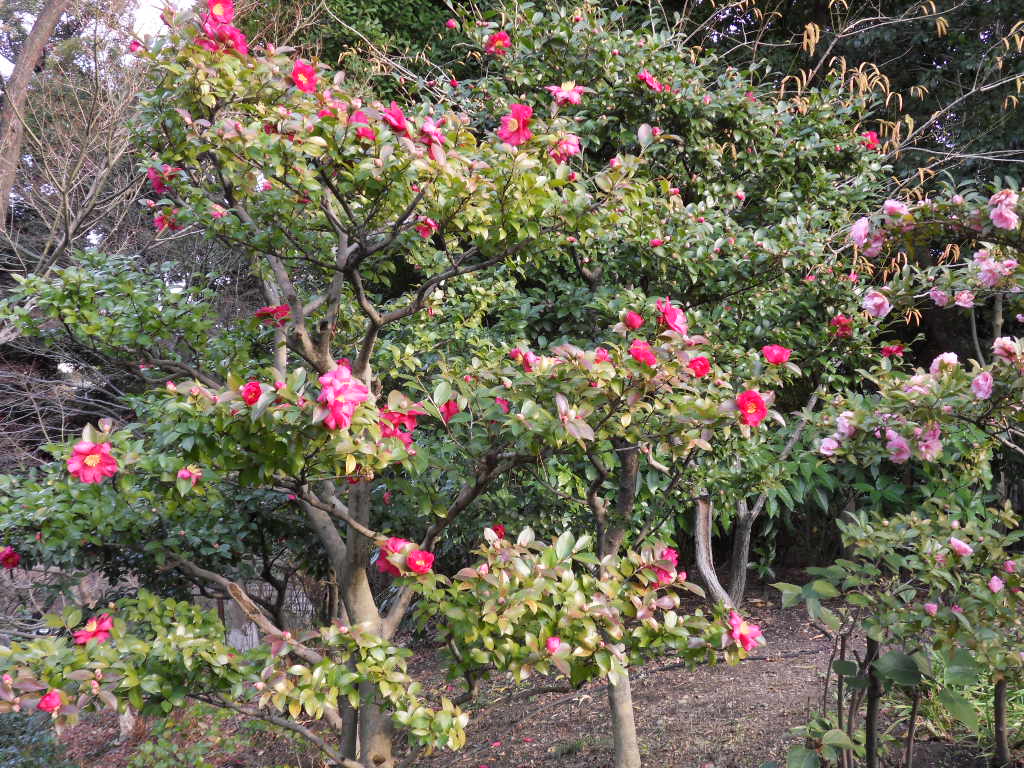
The Tokugawa Art Museum is adjacent to the Tokugawaen, a formal Japanese garden originally built in 1695. January is probably not the best time to visit this place – the numerous cherry trees must look beautiful when covered in blossom – but I was quite surprised to see a significant number of flowering plants even at this time of year.

I’m no botanical expert but these look like Camellias to me:

SAMSUNG DIGITAL CAMERA

SAMSUNG DIGITAL CAMERA

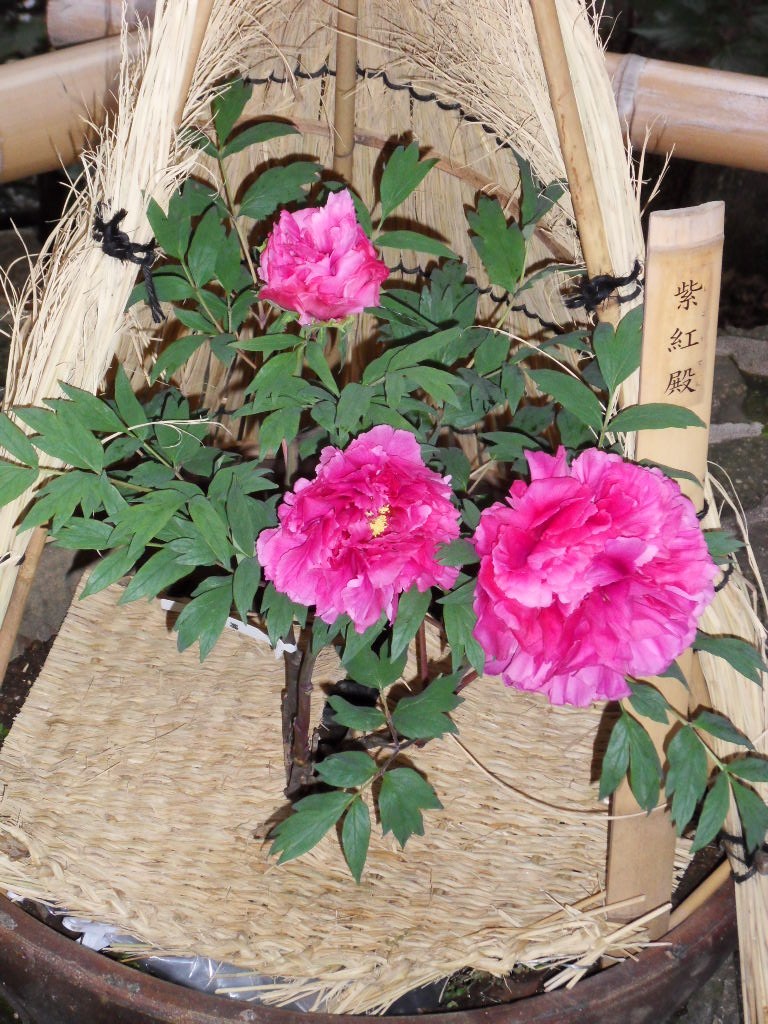
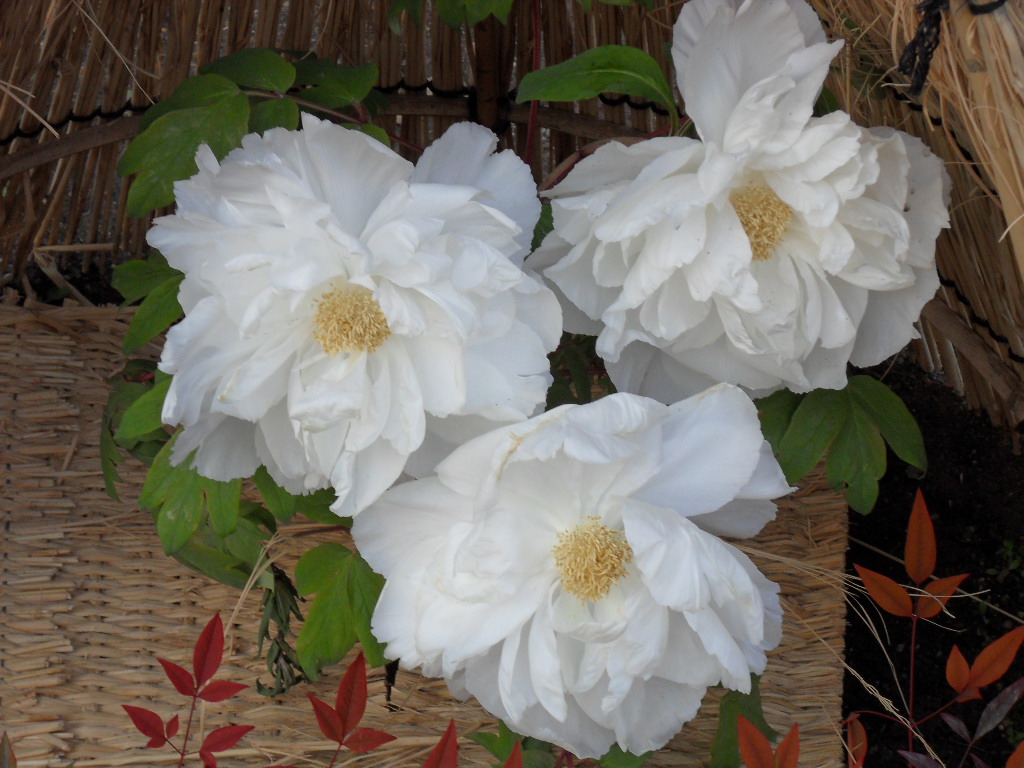
These are Peonies:
SAMSUNG DIGITAL CAMERA

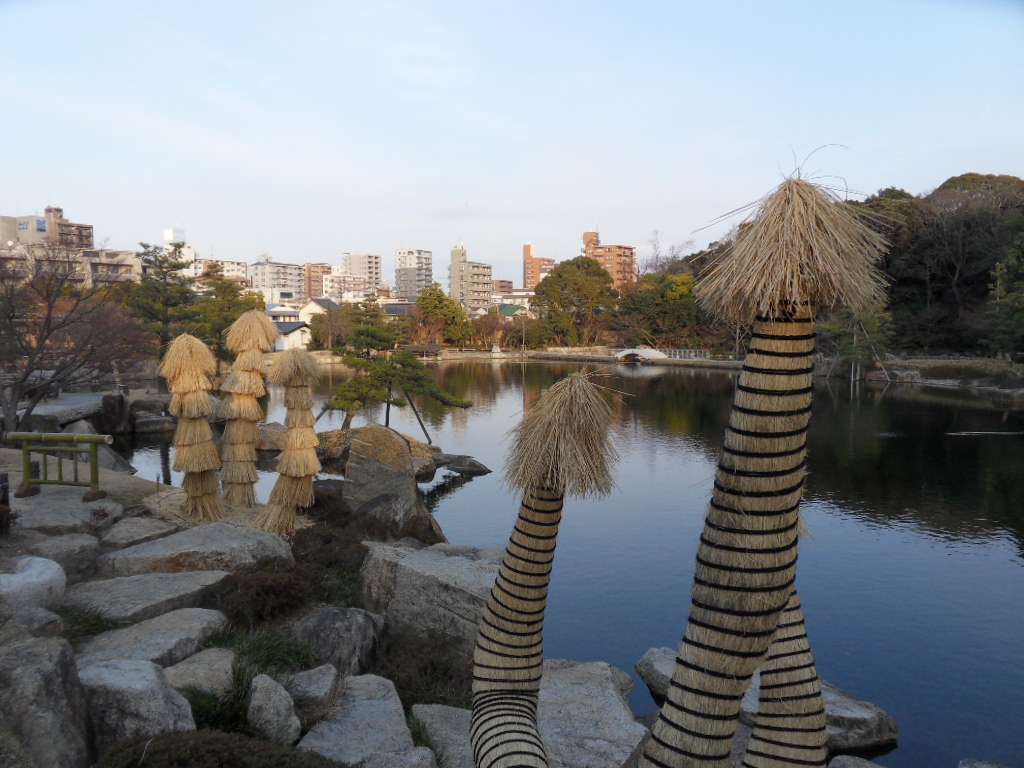
Some of the trees are still wrapped in their winter bamboo coats for protection from the frost:

SAMSUNG DIGITAL CAMERA
The lake contains an impressive collection of multi-coloured carp

SAMSUNG DIGITAL CAMERA

The Tokugawaen is worth a visit even in the off-season, but I really must find an excuse to come back in April or May when the cherry blossom will be out and, according to the literature handed out to visitors, thousands of Peonies will be in bloom all around the lake. That must look amazing!

Anyway, after that I travelled across town to visit the famous Atsuta Shrine, a holy place for the Shinto religion:

SAMSUNG DIGITAL CAMERA

Light was fading and I was already feeling a bit tired, but I did the necessary ritual ablutions, and had a quick look around. Visitors are allowed to make a wish after throwing a coin in the appropriate place, then bowing and clapping twice. I wished for a beer, and lo and behold on the way home I found a bar in which my wish was granted!

Out and about in Nagoya

Posted in Biographical, History with tags , , , , on January 11, 2014 by telescoper

I spent an enjoyable morning wandering about Nagoya, so I thought I’d post a few pictures before settling down to do some work (which is, after all, what I’m here for…)

First off, here’s the place I am officially visiting. This is the central building of the Graduate School of Science and Engineering, the top two floors of which comprise the Kobayashi-Maskawa Institute, which covers particle physics and astrophysics.

SAMSUNG DIGITAL CAMERA

I’ll be giving a talk there next week, in fact. I’m staying on the campus about 5 minutes’ walk away from this building in a pleasant guest room in the Green Salon Higashiyama which is not green and is not a hairdresser’s shop.

The nearest Metro station is a very short walk from the Department building and the first thing I discovered when I entered was surprising evidence that the Japanese have an interest in cricket:

SAMSUNG DIGITAL CAMERA

Given that I posted a picture of the place before embarking on my travels I decided to visit Nagoya Castle. This enormous complex of buildings and fortifications was constructed in the early 17th Century, but a visit by American B29 bombers on 18th May 1945 dropping thousands of incendiary bombs destroyed everything except the massive stone walls; the other buildings were made of wood and would have burned easily in such an attack. At the time the Castle was being used as an army base, so it was inevitable that it would be a target.

The perimeter of the Castle is defined by massive stone walls surround by a wide moat. Similar stone fortifications surround the central buildings and the only approach to the centre of the Castle by water is surrounded on both sides by similarly formidable structures from which missiles would no doubt rain down on unwelcome visitors. The central buildings are also ringed by a deep ditch which was clearly designed to be flooded when necessary; today there are deer grazing at the bottom of it.

The two main keeps or donjons of the castle have been reconstructed and now house very interesting museums containing not only military artefacts but also lovely screen prints and pieces of furniture from the Edo period, during which the castle was constructed.

Here are a few pictures just to prove that I was there!

One of the smaller buildings inside the perimeter of the Castle:

SAMSUNG DIGITAL CAMERA

Approaching the main keep:

SAMSUNG DIGITAL CAMERA

Entrance to the main keep:

SAMSUNG DIGITAL CAMERA

Main keep, with walls and ditch..

SAMSUNG DIGITAL CAMERA

This is the view from the gallery at the top…
SAMSUNG DIGITAL CAMERA

From Nagoya

Posted in Biographical with tags , , , on January 10, 2014 by telescoper

So, my first ever trip to Japan has started pretty well. The flight via Frankfurt arrived on schedule and I arrived with all the luggage I was supposed to have too! I didn’t get any sleep on the long flight from Frankfurt to Nagoya, but then I never seem to manage to drop off on aircraft. I was quite jealous of the lady next to me, actually, as she slept soundly for most of the journey.

Here I am, then. It’s mid-afternoon local time but ridiculously early morning on my body clock. Travelling West to East is always more difficult, I think. Going the other way you can usually sleep off the jet lag pretty quickly, but going East-West and arriving in the morning (local time) means you’ve basically lost a night’s sleep. On a trip to Shanghai years ago I was in a similar situation, arriving at the airport in mid-morning to be met with a welcoming committee and taken to a very big lunch (complete with beer). When this was over, around 3.30 in the afternoon, my hosts suggested that I must be tired and took me to my hotel. No sooner had I unpacked my bags and put my feet up than I fell sound asleep; I didn’t wake up until midnight. So it was that I remained completely out of kilter with the time zones. It took most of my stay in China to get adjusted. I thus learned the hard way that if you want to deal successfully with the problem of jetlag then you have to stay awake as long as possible on the day you arrive…

I must seem like a complete wimp to those observational astronomers who not only go jet-setting around the world but also climb up and down mountains to get to observatories perched on their summit as well as working all night rather than day once they’ve got there.  How they manage to cope with all that and remain (relatively) compos mentis when they arrive back at their day job is beyond me.

Anyway, despite lack of sleep the flight wasn’t too bad. I was impressed by the collection of classical music and jazz available on the in-flight entertainment system offered by Lufthansa, and there were even some decent movies on offer. I managed to see the first of Peter Jackson’s Hobbit movies, which I quite enjoyed though I found some of the set-pieces far too drawn out. I also watched, for the first time in ages, Kubrick’s 2001: A Space Odyssey

First impression of Nagoya is that it’s basically an industrial city. My hosts tell me that the city was very heavily bombed during WW2 because of the important factories in the area. The campus at Nagoya University where I’m staying is fairly small but facilities seem pretty good. I’m looking forward to doing a bit of exploring at the weekend, when hopefully I’ll find some interesting historical buildings!

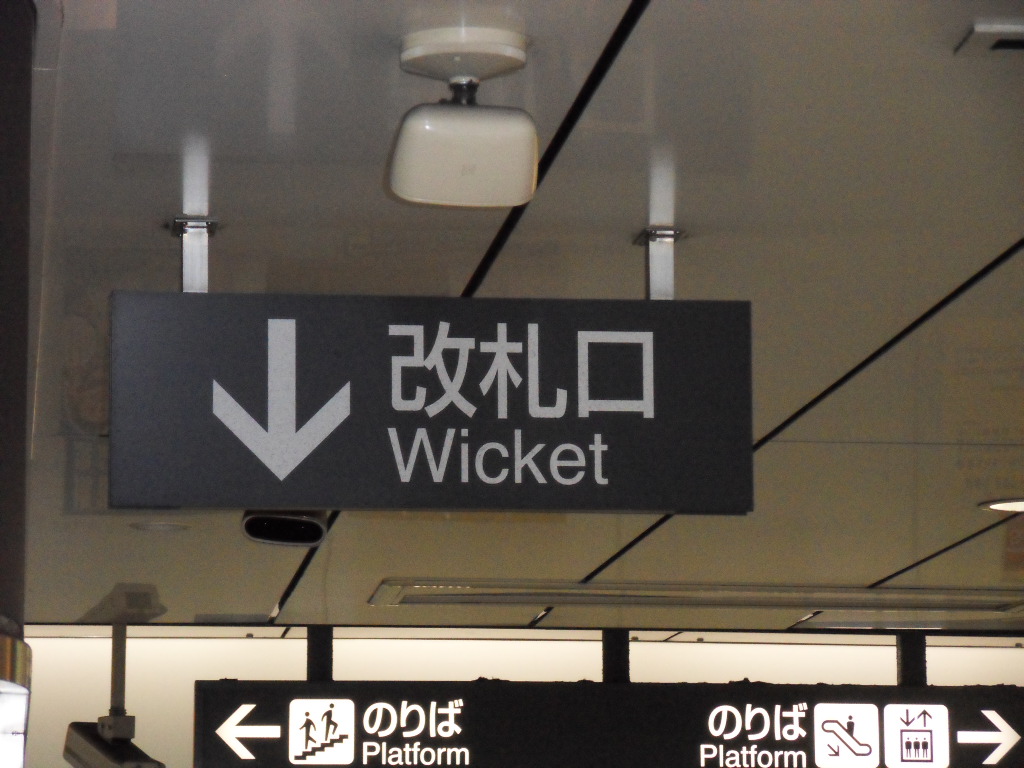
I was a bit worried about how well I would manage without being able to speak (or read) any Japanese. There are challenges, but the excellent Metro system is actually quite well signposted in English so I’m not anticipating too many problems sightseeing. Buying food might be another matter!

Better draw this rambling post to a close. Hopefully my brain will be up to writing something more substantial tomorrow..

On my travels…

Posted in Biographical with tags on January 9, 2014 by telescoper

Hopefully by the time this post is published I’ll be in mid-air. I may be offline for a while but home to resume my blogging activities when I reach my destination.

If you’d like a bit of a clue as to where I’m going, here’s a local landmark…

Mystery Image