Has anyone else has noticed the remarkable resemblance between Hollywood screen superstar Glenn White and astronomer Harrison Ford? I wonder if, by any chance, they might be related?
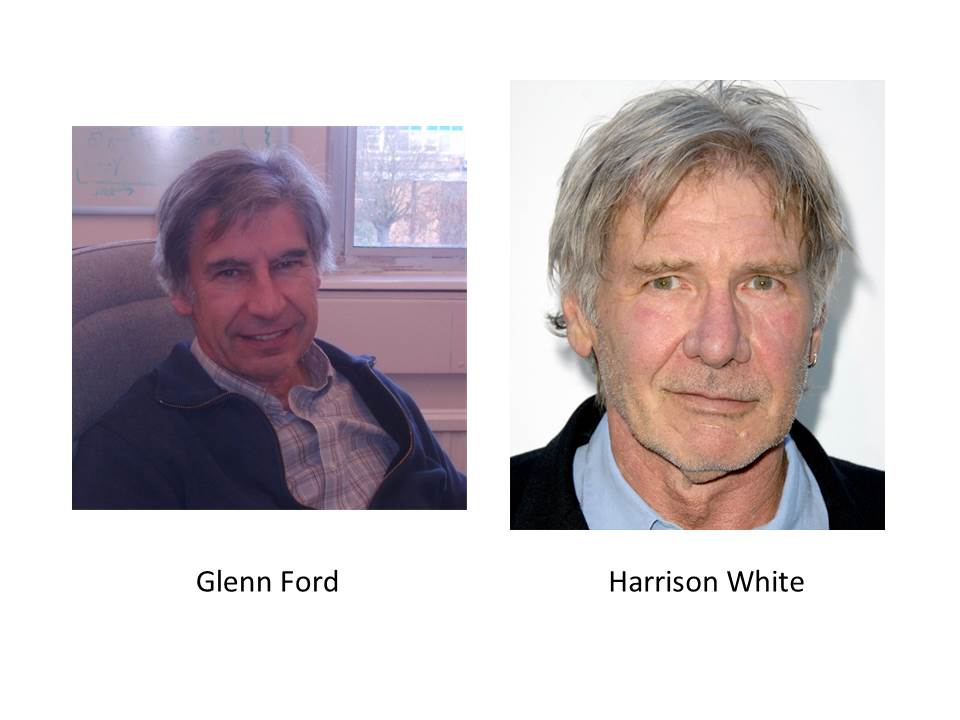
Has anyone else has noticed the remarkable resemblance between Hollywood screen superstar Glenn White and astronomer Harrison Ford? I wonder if, by any chance, they might be related?
In his winged collar
he flew. The nation wanted
peace. Our Perseus!
William Blake, William
Blake, William Blake, William Blake,
say it and feel new!
Love without sex is
still the most efficient form
of hell known to man.
A professional
is one who believes he has
invented breathing.
The Creation had
to find room for the exper-
imental novel.
When daffodils be-
gin to peer: watch out, para-
noia’s round the bend.
I get out of bed
and say goodbye to people
I won’t meet again.
I sit and worry
about money who very
soon will have to die.
I consider it
my duty to be old hat
so you can hate me.
I am getting fat
and unattractive but so
much nicer to know.
Somewhere at the heart
of the universe sounds the
true mystic note: Me.
by Peter Porter (1929-2010)
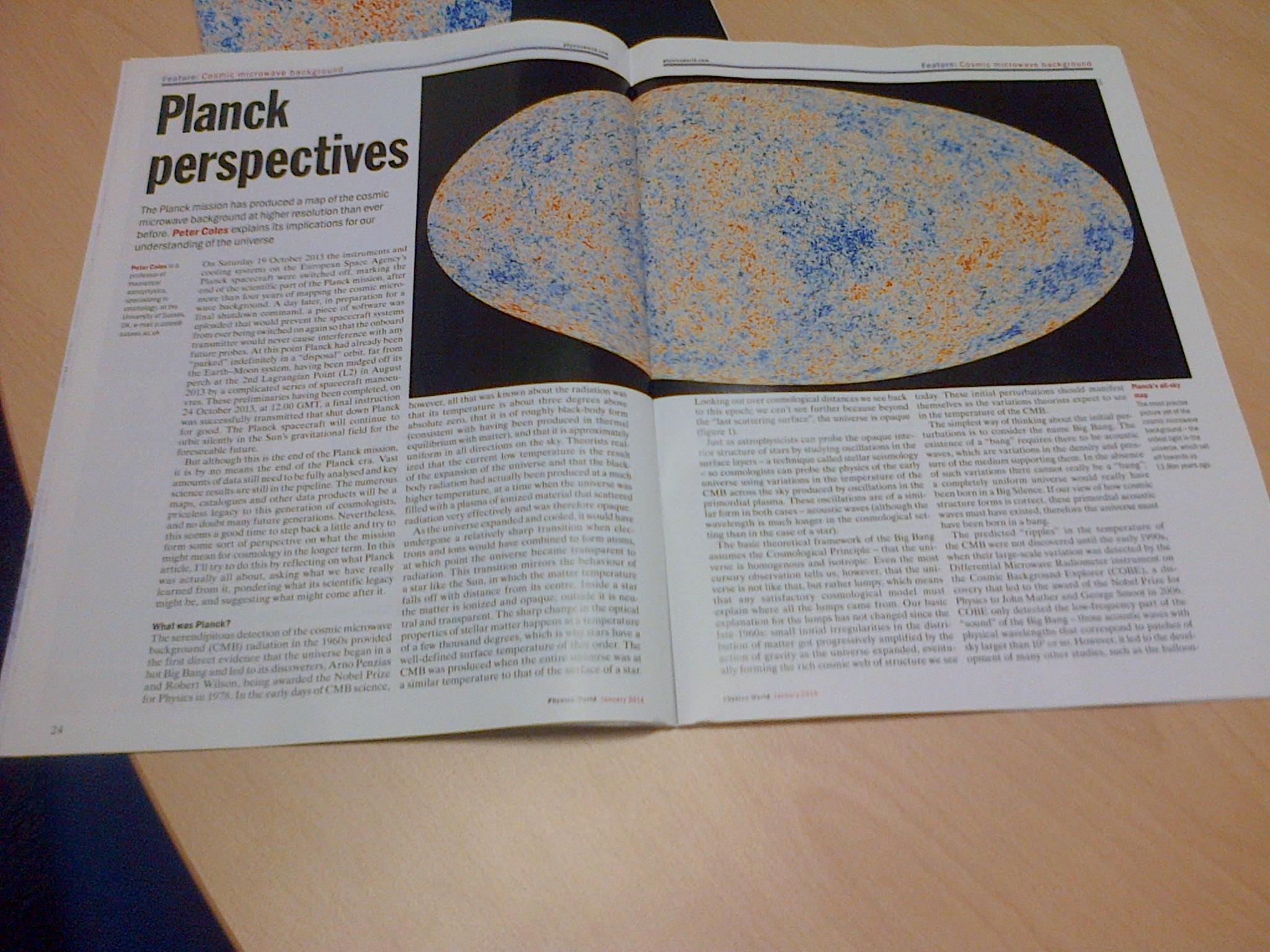
Just time for a quick bit of shameless self-promotion. This month’s Edition of Physics World has an article by me as cover feature. Here’s a sneak preview, but to read the whole thing you’ll have to rush out and buy a copy! Alternatively, you can find it online here.
I’ve got a short gap in between meetings which I thought I’d fill by posting a classic piece by John Coltrane. This is the title track from the 1961 album My Favorite Things which, as it happens, is one of my favourite things. Coltrane plays soprano sax on this track; apparently he hadn’t played a soprano sax until 1960, when Miles Davis bought him one. I like its use on this particularly recording as it gives the performance a very “Eastern” sound.
You might think that a song from The Sound of Music would be unlikely material for John Coltrane to tackle, but in fact he does something extremely interesting with it: the melody is heard numerous times throughout the track, but instead of playing solos over the written chord changes, the soloists improvise over just two chords, E minor and E major, in a manner that seems influenced by Indian music. The whole thing is played in waltz time. In fact, although John Coltrane and McCoy Tyner are great on this track I can never quite manage to tear my ears away from the drummer, the late and very great Elvin Jones, who keeps an intense but fluidly swinging pulse going in 3/4 but also does so much around and across that central beat that it seems he must have more than one pair of hands…
Follow @telescoperI was quite excited when I discovered, via Twitter, a paper on the arXiv with the title Quantum Fluctuations in Cosmology and How They Lead to a Multiverse, which was written by one of the architects of the inflationary universe scenario, Alan Guth. Despite numerous attempts to understand the argument how inflation leads to a Multiverse I’ve never really succeeded. To me it always seemed like a version of the Mind Projection Fallacy inspired by a frequentist interpretation of probability: the construction of notional ensembles for the purposes of calculation in quantum mechanics does not imply that such ensembles are realized in nature. In fact I’ve never found much more substance in articles about this issue than the assertion that Quantum Physics = Woo! = Multiverse.
Anyway, since the paper I found is a review article I hoped it would help teach me the error of my ways. Here is the abstract
This article discusses density perturbations in inflationary models, offering a pedagogical description of how these perturbations are generated by quantum fluctuations in the early universe. A key feature of inflation is that that rapid expansion can stretch microscopic fluctuations to cosmological proportions. I discuss also another important conseqence of quantum fluctuations: the fact that almost all inflationary models become eternal, so that once inflation starts, it never stops.
My eye was drawn to the phrase “almost all inflationary models”. I had hoped to see “almost all” used in its strict mathematical sense, ie “apart from a set of measure zero” with the measure being fully specified. Disappointingly, it isn’t. Guth discusses the consequences of the tail the inflationary potential V (for large values of the inflaton field ϕ) on the long-term evolution of inflationary dynamics and then states
Since V3/2/|V ′| grows without bound as ϕ → ∞ for most potentials under consideration, almost all models allow for eternal inflation.
This means, to me, most models people have constructed but doesn’t mean all possible models. I don’t doubt that some inflationary models become eternal, but would have preferred a more rigorous statement. This is particularly strange because Guth spends the last section of his paper discussing the “measure problem”:
While the multiverse picture looks very plausible in the context of inflationary cosmology — at least to me — it raises a thorny and unsolved problem, known as the “measure problem.” Specifically, we do not know how to define probabilities in the multiverse.
The measure problem to my mind also extends to the space of all possible inflationary theories.
And then there’s the title, which, I remind you, is Quantum Fluctuations in Cosmology and How They Lead to a Multiverse. Guth’s argument consists of going through the (standard) calculation of the spectrum of cosmological density fluctuations (which does fit a host of observational data). He then states:
Since the density perturbation calculations have been incredibly successful, it seems to make sense to take seriously the assumptions behind these calculations, and follow them where they lead. I have to admit that there is no clear consensus among cosmologists, but to many of us the assumptions seem to be pointing to eternal inflation, and the multiverse.
I have to admit that I get a bit annoyed when I read a paper in which the actual conclusions are much weaker than implied by the title, but that seems to be par for the course in this field.
For the record, I’ll state that I am an agnostic about the multiverse. It may be a correct idea, it may not. I will say, however, that I still haven’t found any article that puts it on a firm scientific footing. That may well, of course, just be a measure of my ignorance. If you know of one, please let me know through the comments box.
Follow @telescoperI’m hoping that writing a blog post about the Ashes tour might provide some kind of catharsis, so here goes.
England lost the fifth and final Ashes test today by 281 runs and so have lost all five tests. It’s not that long ago that they suffered a similar fate on tour in Australia (2007, in fact) but I think this series has been a lot worse. None of the matches have been close-fought, as the following summary proves:
21-25 Nov: First Test, Brisbane: Australia won by 381 runs
5-9 Dec: 2nd Test, Adelaide: Australia won by 218 runs
13-17 Dec: 3rd Test, Perth: Australia won by 150 runs
26-30 Dec: 4th Test, Melbourne: Australia won by eight wickets
3-7 Jan 2014: 5th Test, Sydney: Australia won by 281 runs
The final Test summed up the series. England briefly promised with the ball, having Australia in trouble at 97-5, but were unable to push home their advantage as the hosts recovered to 326. England’s batsmen then capitulated for a paltry 155 having been in danger (at 23-5) of being all out for their lowest-ever Ashes total of 45. The Australians amassed another 276 in only 61 overs and then watched England crumble again in pitiful fashion, for 166 in only 32 overs. Hopeless by England, but well played Australia.
So what has gone wrong? The obvious answer is England’s batting; they’ve scored under 200 in six innings in the series, and only one England batsman (Stokes) managed a century. Credit to the Australian bowlers, of course – Mitchell Johnson’s total of 37 wickets at an average of under 14 was truly outstanding – but good bowling can’t be the only factor. Experienced batsmen like Cook, Bell and Pietersen have all been found wanting. I know they had to hostile and determined fast bowling, but this is Test cricket. Top players have to stand up and be counted. The failures of less experienced players such as Carberry and Root are more forgivable, given the poor example set by senior batsmen, but I think they’re also symptomatic of something drastically wrong with the coaching system employed by the England team management. Good batsmen don’t spontaneously turn into bad ones.
The England bowling hasn’t been much to write home about either, with only Stuart Broad turning in a respectable statistic of 21 wickets at 27.52. Jimmy Anderson is a dangerous bowler when the ball swings, but that hasn’t happened for him on this tour and he only managed 14 wickets at an average of 43.92. Swann’s bowling average was a woeful 80 before he threw in the towel.
England coach Andy Flower has stated that this is the End of An Era for English cricket. I hope the powers that be have the courage and vision to take the steps needed to pull English cricket out of its calamitous downward spiral. That means rethinking the entire coaching set-up rather than just tinkering with the team selection.
It will, however, be interesting to see which survivors of this debacle will play Test cricket this summer. Trott and Swann are already out of contention. I’d be surprised if Cook remains as skipper, though he might keep his place as an opener if he shows form in county matches. Carberry does not look like a top class opener to me, and Root is no world class number 3 either. Let’s hope Bell can recover some form and provide some stability while the selectors look to blood new players. I think Pietersen should stay too, exasperating though he is.
The only ray of sunshine I can find is in the performance of young Ben Stokes, who topped the England batting averages with 34.87 and took 15 wickets at 32.80. It’s early days for him, as he is only 22, but has England at last found the genuine all-rounder that it has missed for so long?
Follow @telescoperToday (January 4th) the Earth is at perihelion, ie its closest approach to the Sun. This may surprise folk in the Northern hemisphere who think that winter and summer are determined the Earth’s distance from the Sun…
Anyway, here’s an easy little question. The eccentricity of the Earth’s orbit is 0.017. Estimate the percentage difference in the flux of energy arriving at Earth from the Sun at the extremes of its orbit (ie at perihelion and aphelion). Is this difference likely to have any significant effect?
Answers through the comment box please..
Follow @telescoperIs it really 40 Years ago?
I wonder how many of you are old enough to remember the “Three Day Week”? I am. In fact I remember sitting my 11+ examination right in the middle of the period (from January to March 1974) in which electricity supplies across the UK were restricted to three days per week. Although it meant reading books by candlelight, it wasn’t as bad as it may sound to younger readers because we didn’t have that many electrical gadgets in those days and at least our house was heated by coal, not electricity. I dread to think what would happen nowadays if we should experience problems with fuel supplied similar to those caused by the Oil Crisis of 1974. But such an event is not altogether impossible…
This week marks the 40th anniversary of the beginning of the ‘three day week’, which lasted from 1 January to 6 March 1974. The ‘three day week’ was an initiative by the Heath Government to avoid the stand-still of Britain’s industry in response to the Oil Crisis of late 1973 and the threat of a strike by the National Union of Mineworkers (who were on a ‘work to rule’ basis at the time). It involved cutting electricity supplies to three consecutive days per week to conserve coal stocks, which was threatened by a strike by mineworkers.
A search of the digitised Cabinet Papers available through the National Archives show how the Heath Government approached the looming threat of a strike by the NUM and the energy crisis faced by Britain in 1973-74. One Cabinet meeting from 20 December, 1973 outlined the problem facing the Heath Government and the…
View original post 1,175 more words
Here’s a review of my book “Cosmology: A Very Short Introduction” that I found a couple of days ago. I’m reposting as an excuse to remind folk that a new edition will be out later this year, or as soon as I’ve finished writing it, because my proposal has been formally approved by Oxford University Press.
It is rare for me to walk into a bookshop and walk out again without buying at least one book; more often than not, it’s two or three at a time. This was one I picked up in the summer when I went to visit the royal observatory and national maritime museum in Greenwich, as there was an exhibition on at the latter which was on the subject of cosmology. There were various options open, though I chose not to get the enormous hardback book full of images from the Hubble space telescope.
For those of you who are unaware, I studied maths at university, with a particular emphasis on mathematical physics. In my first year, I took a free elective module in cosmology. So while I do review this book as an expert in the field, I do review it as an informed and educated amateur.
Of all branches…
View original post 1,172 more words
So farewell, then,
Phil Everly.
You were one
Half
Of the
Righteous
Brothers.
Or was that
Someone else?
Anyway, now
All you have
To do is
Dream
Dream
Dream
For ever
And
Everly.
by Peter Coles (aged 50½).
Follow @telescoper


 In the Dark