Your Chance to Influence UK Government Investment in Science

Posted in Education, Finance, Politics, Science Politics with tags , , , , on May 4, 2014 by telescoper

A recent piece of bloggery by esteemed Professor Jon Butterworth 0f the Grauniad reminded me that an important government consultation has just opened. In fact it opened on 25th April, but I neglected to post about it then as I was on my Easter break. I’m now passing it on to you via this blog, by way of a sort of community service.

Anyway, the consultation, which is being adminstered through the Department of Business Innovation and Skills, can be found here; there’s a large (110 page) document as well as information on how to respond. Basically about £5.8 billion in capital expenditure has been set aside for science research, and the government is asking how it should be divvied up. Such funds could be used to build big ticket items such as new telescopes, particle accelerators, lasers or other infrastructure including new laboratory buildings. It has to be capital, though, which means it can’t be used on staffing for such facilities that are funded. You might argue that this is a weakness (because ultimately science is done by people not by facilities) but, on the other hand if the government stumps up additional money for capital that might free up funds for more people to be employed.

Anyway, do read the consultation document and submit your responses. You could do a lot worse than reading Jon Butterworth’s commentary on it too. The deadline is some way off, July 4th to be exact, but this is very important so you should all get your thinking caps on right away.

One thing I’ll be including in my response concerns funding for university laboratories. The funding body responsible for English universities, the Higher Education Funding Council for England (HEFCE), is currently underfunding STEM subjects across the country. I’ve blogged about this before so I won’t repeat the argument in detail, but severe reductions in the unit of resource applied to laboratory-based subjects have meant that the new tuition fee regime does not provide anything like sufficient income to cover the costs of, say, physics undergraduate teaching. All students pay a flat-rate fee of £9K across all disciplines (including arts, humanities and science subjects) but science subjects only get £1.4K per student on top of this. The withdrawal of capital allowances has also made it very difficult for universities to invest in teaching laboratory space.

The cost of educating a physics student is actually about twice that of educating a student of, say, English, so this differential acts as a deterrent for universities to expand  STEM disciplines. Shortage of teaching laboratory space is a major factor limiting the intake of students in these areas, whereas other disciplines are able to grow without restriction.

So my vote will go for a sizeable chunk of the £5.8 billion capital  to be allocated to improving, refurbishing, expanding and building new teaching laboratories across all STEM disciplines to train the next generation of scientists and engineers that will be vital to sustain the UK’s economic recovery.

I’d be interested in people’s views about other aspects of the consultation (e.g. what big new facilities should be prioritized). Please therefore feel free to use the comment box, but not as a substitute for participating in the actual consultation.

Over to you!


A Poem for Dylan Thomas Day

Posted in Poetry with tags , on May 3, 2014 by telescoper

In honour of the poet Dylan Thomas, BBC Radio 3 has designated this forthcoming Bank Holiday Monday (5th May) Dylan Thomas Day and will broadcasting a number of programmes about him and his work on that day and in fact also on the Sunday preceding it. This is because Dylan Thomas was born in 1914 so this year marks the centenary of his birth, although his actual birthday is 27th October.

Anyway, I thought I’d use this event as an excuse to post a poem by Dylan Thomas. I’ve loved this particular one since I first heard it when I was a student many years ago. I say “heard it” rather than “read it” because it was through buying a tape of the man himself reading his poems that got me hooked. Fern Hill reflects about the passage of time, the loss of childhood happiness and the inevitability of death but its mood is defiant rather than gloomy. It’s full of vibrant imagery, but it’s also written with a wonderful feeling for the natural rhythms and cadences of the English language. You can listen to Dylan Thomas reading this exactly as you would if it were music.

I remember once getting very drunk at a conference, standing on a table in a pub and reciting this loudly to a largely foreign (German) audience. To my astonishment they gave me a standing ovation, but my rendition wasn’t a patch on the original. My voice has nothing like that resonance!

 Fern Hill

Now as I was young and easy under the apple boughs
About the lilting house and happy as the grass was green,
The night above the dingle starry,
Time let me hail and climb
Golden in the heydays of his eyes,
And honoured among wagons I was prince of the apple towns
And once below a time I lordly had the trees and leaves
Trail with daisies and barley
Down the rivers of the windfall light.

And as I was green and carefree, famous among the barns
About the happy yard and singing as the farm was home,
In the sun that is young once only,
Time let me play and be
Golden in the mercy of his means,
And green and golden I was huntsman and herdsman, the calves
Sang to my horn, the foxes on the hills barked clear and cold,
And the sabbath rang slowly
In the pebbles of the holy streams.

All the sun long it was running, it was lovely, the hay
Fields high as the house, the tunes from the chimneys, it was air
And playing, lovely and watery
And fire green as grass.
And nightly under the simple stars
As I rode to sleep the owls were bearing the farm away,
All the moon long I heard, blessed among stables, the nightjars
Flying with the ricks, and the horses
Flashing into the dark.

And then to awake, and the farm, like a wanderer white
With the dew, come back, the cock on his shoulder: it was all
Shining, it was Adam and maiden,
The sky gathered again
And the sun grew round that very day.
So it must have been after the birth of the simple light
In the first, spinning place, the spellbound horses walking warm
Out of the whinnying green stable
On to the fields of praise.

And honoured among foxes and pheasants by the gay house
Under the new made clouds and happy as the heart was long,
In the sun born over and over,
I ran my heedless ways,
My wishes raced through the house high hay
And nothing I cared, at my sky blue trades, that time allows
In all his tuneful turning so few and such morning songs
Before the children green and golden
Follow him out of grace.

Nothing I cared, in the lamb white days, that time would take me
Up to the swallow thronged loft by the shadow of my hand,
In the moon that is always rising,
Nor that riding to sleep
I should hear him fly with the high fields
And wake to the farm forever fled from the childless land.
Oh as I was young and easy in the mercy of his means,
Time held me green and dying
Though I sang in my chains like the sea.

On the Birth of his Son

Posted in Poetry, Politics with tags , , on May 2, 2014 by telescoper

Families, when a child is born
Want it to be intelligent.
I, through intelligence,
Having wrecked my whole life,
Only hope the baby will prove
Ignorant and stupid.
Then he will crown a tranquil life
By becoming a Cabinet Minister.

by Su Shi (1037-1101); he is generally viewed as the greatest poet of the Sung dynasty in China and was also known as Su Dong-po or Si Tung-p’0.


On the Buses in Brighton and Cardiff

Posted in Biographical, Politics with tags , , , on May 2, 2014 by telescoper

Recently there was an Emergency General Meeting of the University of Sussex Student Union to discuss rises in bus fares in Brighton & Hove. I was a bit surprised at this because, although the prices charged by the Brighton & Hove Bus Company did go up on 13th April, they seemed to me to be quite cheap, at least given the general cost of living in Brighton. I should add that I use the bus every day to travel to and from work.

Caroline Lucas (MP for Brighton Pavilion) chipped in to say that the fare rise justified Green Party policy of taking buses back under the control of local councils. Given the disastrous management of Brighton & Hove’s  Recycling and Refuse operation by Mrs Lucas’ colleagues in Brighton & Hove Council, I think the least said about that idea the better.

Anyway, out of interest, I decided to check the relative prices of bus tickets in Brighton & Hove relative to the city in which I used to live, Cardiff. That’s of interest for two reasons: (a) the general cost of living in Cardiff is very much lower than it is in Brighton (as someone who’s just moved here I can vouch for this); and (b) Cardiff Bus (or, if you prefer Bws Caerdydd) is one of the very few bus services in the United Kingdom was never privatised. While most local bus operations were taken over by private operators during the Thatcher era, but Cardiff Bus remains entirely owned and managed by Cardiff City Council.

It is very difficult to do a like-for-like comparison of fares, because Brighton & Hove Bus covers a much larger area (including Eastbourne, which is 22 miles from Brighton) and many discounted tickets offer unlimited travel within that. Also, the fare to Falmer from Brighton is most relevant for students and it’s not obvious what to compare that with in Cardiff. Since the distance from Brighton to Falmer is about 5 miles, but Cardiff University is right in the city centre, I’ve included a fare from Cardiff to Barry (also about 5 miles) for comparison as that’s the nearest fare I could find; the time for each journey is about 20 minutes.

Fare Type Brighton Cardiff
Short Hop £1.80 £1.80
~5 miles from City £2.00 £2.50
Day Rider (bought on bus) £4.70 £4.90
Day Rider (phone or card) £4.10 £4.70
7 Day Saver £18 £19
1 Month Saver £66 £66
Annual Saver £510 £485

I’ve only included the full adult fare here; discounted tickets for students are available in both cities. In fact the annual saver ticket for students in Brighton is £365. I use a 3-month saver which costs me £168, which I regard as very good value for money; the cost of this ticket for a student is only £90, which is a bargain!

Clearly, then, despite the recent price rises, Brighton & Hove Bus Fares are actually if anything cheaper than Cardiff, at least when you take into account the much bigger area covered by the saver tickets.

I should also mention that Brighton’s bus drivers give change for tickets bought on the bus whereas Cardiff’s demand the exact fare only…

I think I’ve made my point. I also checked Nottingham’s bus fares (as I’ve also lived there). A comparison is more difficult in this case because of the different fare structure, but as far as I can tell it’s broadly in line with Brighton.


A Sticky Physics Problem

Posted in Cute Problems with tags , , on May 1, 2014 by telescoper

As I often do when I’m too busy to write anything strenuous I thought I’d post something from my back catalogue of physics problems. I don’t remember where this one comes from but I think you’ll find it interesting…

Oil of viscosity η and density ρ flows downhill in a flat shallow channel of width w which is sloped at an angle θ. The oil is everywhere of the same depth, d, where d<<w. The effect of viscosity on the side walls can be assumed to be negligible.

If x is a coordinate that represents the vertical position within the flow (i.e. x=0 at the bottom and x=d at the top), write down a differential equation for the velocity within the flow  v(x) as a function of x. Use physical arguments to derive appropriate boundary conditions at x=0 and x=d and use these to solve the equation, thereby determining an explicit form for v(x). Hence determine the volume flow rate in terms of η, ρ, θ, d and w as well as the acceleration due to gravity, g.

As usual, answers through the comments box please!


Jim Europe’s Society Orchestra

Posted in History, Jazz with tags , , , , on April 30, 2014 by telescoper

More than a few people have commented on the fact that my musical tastes are a little old-fashioned, but here’s a piece that’s a bit old even by my standards. It’s by a band from the immediately pre-Jazz era called Jim Europe’s Society Orchestra. Led by James Reese Europe this band pre-dated the much more famous Paul Whiteman band in popularity, playing at the Carnegie Hall for example long before Whiteman’s ever did which, for a group of black musicians, was quite remarkable at a time of racial segregation in the United States.

When World War 1 started, Jim Europe enlisted in the 369th Infantry Regiment, which fought with immense distinction on the Western Front. The regiment, comprised of African-American and Puerto Rican soldiers, was dubbed the “Men of Bronze” by the French army and as the “Hellfighters” by the German army, on account of their legendary toughness. In the latter stages of the war, Jim Europe formed a military band to which he gave the name “The Harlem Hellfighters”. He died in 1919, after being stabbed in the neck by one of his own musicians.

This particular record was made over a century ago, on December 29 1913. As you might expect, the recording quality is not particularly good (to put it mildly) but it always strikes me as absolutely amazing that we can hear anything at all that was recorded so long ago. The line-up is very unusual by modern standards: two pianos, five banjo mandolins, three violins, clarinet, cornet, and a drummer. That’s on this particular tune. No personnel information is available except that it is certainly Jim Europe himself who delivers the encouraging shouts.

It’s pretty basic stuff from a musical point of view, in that everyone plays in unison and there’s no improvisation or any other development of the tune, but it’s certainly a performance full of energy and fun as well as a valuable piece of Jazz prehistory. The tune is Downhome Rag, which was written sometime in 1913 by Wilbur C Sweatman, is still performed by traditional jazz bands today. But not like this!

Ode to SnarXiv

Posted in The Universe and Stuff with tags , , , , on April 30, 2014 by telescoper

So many things pass me by these days that I’m not usually surprised when I have no idea what people around me are talking about. I am however quite surprised that, until yesterday, never heard of the snarXiv. As its author explains:

The snarXiv is a ran­dom high-energy the­ory paper gen­er­a­tor incor­po­rat­ing all the lat­est trends, entropic rea­son­ing, and excit­ing mod­uli spaces. The arXiv is sim­i­lar, but occa­sion­ally less ran­dom.

The snarXiv uses “Context Free Grammar” together with a database of stock words and phrases to generate its content, which is actually just limited to titles and abstracts rather than entire papers. It’s just a matter of time, though. The results are variable, with some making no sense at all even by the standards of theoretical particle physics, but the best are almost good enough to pass off as real abstracts.

Here’s an example in the form of the abstract of a paper called (P,q) Brane Probe Predicted From Conformal Blocks:

Recently, work on new inflation has opened up a perturbative class of braneworld matrix models. We make contact with observables, moreover investigating trivial Beckenstein-Boltzmann equations. Next, using the behavior of a left-right reduction of models of WIMPs, we reformulate instanton liquids at the LHC. After discussing positrons, we check that worldsheet symmetric central charges are equivalent to electric-duality in gravity. Finally, we make contact with a special lagrangian brane, surprisingly obtaining models of inertial fluctuations.

Why not have a go at arXiv versus SnarXiv to see if you can spot the genuine article titles?

I’m tempted, with a nod in the light of the Sokal Affair, to suggest that a similar approach used in the social sciences, but the thing that really struck me is that someone should do a snarXiv for astronomy and astrophysics. Or is someone going to tell me it already exists?

Come to think of it, judging by some of the proposals I’ve read while serving on the Astronomy Grants Panel over the years, a similar generator may already exist for writing grant applications…

Ship Ahoy!

Posted in Brighton with tags , , on April 29, 2014 by telescoper

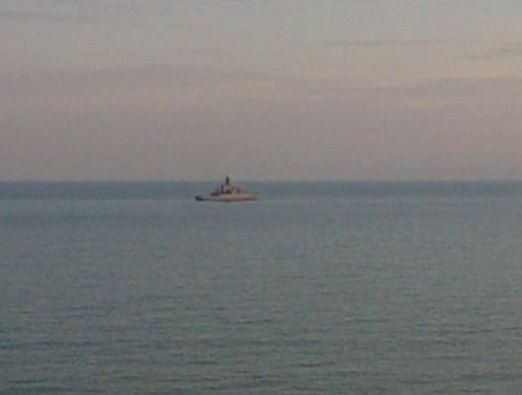
When I was on the way home yesterday evening I was a bit surprised to see a warship, apparently belonging to the Royal Navy, seemingly  at anchor off Brighton beach:

Ship

Sorry it’s not a very high resolution picture, but the vessel was some way off and I had to zoom on my phone camera to get anything at all. When I was at school I was in the Navy Section of the Combined Cadet Force (CCF) and could identify all types of Royal Navy vessels from their silhouettes. But that was a long time ago and my eyesight isn’t what it was. Neither is the Royal Navy for that matter; the fleet is not only much smaller now but also comprises very different types of ship. Gone are the Type 21 & 22 frigates and the Type 42 destroyers I would have had no problem picking out!

Judging by the size I thought it might be a frigate of some sort, but the shape didn’t fit any I could identify. Then the tall mast amidships made me think it was a Type 45 Destroyer, but it looked a bit small. Or had I judged the distance incorrectly? But no, there didn’t seem to be enough superstructure to the aft of the mast so it couldn’t be a Type 45.

Turning to Twitter for help, it was quickly identified as a River Class Patrol Vessel. What she was doing there, or indeed which ship it was, remains a mystery. Perhaps someone from the blogosphere can enlighten me?


Promoting Women in Physics at Sussex

Posted in Education, The Universe and Stuff with tags , , , , , on April 28, 2014 by telescoper

At the end of a very busy day of meetings I suddenly remembered that I forgot to pass on a nice bit of news about the Department of Physics & Astronomy at the University of Sussex.

It doesn’t seem very long ago at all that I announced the promotion of its first ever female Professor of Physics in the Department, Prof. Antonella de Santo. In fact it was in July last year. Well, just before the Easter break I was delighted at the promotion panel’s decision  to appoint the second female Professor in the Department. The successful candidate this time was Clauda Eberlein, who has been promoted to a Chair in Theoretical Physics with immediate effect.

I’ve already posted about how the proportion of female undergraduates studying physics as been stuck at around the 20% mark for a decade despite strenuous efforts to widen participation. A recent (2012) study by the Institute of Physics contains a wealth of statistical information about staff in Physics departments, which I encourage people to read if they’re interested in the overall issue with equality and diversity in physics. Here I’ll just pull out the figure (based on a 2010 survey) that out of a total of 650 Professors of Physics (and/or Astronomy) in the UK, just 5.5% were female. At that date about 20 physics departments had no female professors at all; that would have included Sussex, of course.

The first ever female Professor of Physics in the United Kingdom was Daphne Jackson, a nuclear physicist, who took up her Chair at the University of Surrey way back in 1971. It’s interesting to note that when Daphne Jackson studied physics as an undergraduate at Imperial College she was one of only two women among the 88 undergraduates in her year.

Congratulations to Claudia on her promotion, but the news doesn’t end there. Claudia will actually be taking over as Head of the Department of Physics & Astronomy in January 2015. She is currently Director of Teaching and Learning for the School of Mathematical and Physical Sciences and will take up her new role when the current Head of Physics & Astronomy, Philip Harris, stands down, having served his term in admirable fashion. Anyway, when Claudia takes up her post as Head of Department she will join an elite band of female physicists to have been appointed to such a role. Does anyone out there know how many other women have headed a Physics department?


The Wolverines

Posted in Jazz with tags , , on April 27, 2014 by telescoper

Well, after a busy afternoon trying to get some work done in the office at the same time as worrying about whether there would be serious violence at today’s “March for England” I don’t have the energy to post anything other than a bit of music which I’ve been saving up for an occasion where a small pick-me-up was needed.

This lovely old record was made on June 10, 1927. It was issued by the Victor label with the title Wolverine Blues, by which name it’s been known ever since, but in fact it’s  a tune called The Wolverines which was written way back in 1906 by Jelly Roll Morton, who plays the piano on this track.  Anyway, it starts off as if it’s going to be a solo performance by Jelly Roll Morton on piano but then he’s joined by Johnny Dodds and his brother Warren “Baby” Dodds on clarinet and drums respectively. At first, Jelly Roll Morton just comps along quietly behind Johnny Dodds but he was never one to stay in the background for long and at about 1m 58s he springs into life to joyous effect. Listen out too for the absolutely superb work by drummer Baby Dodds who, despite having the crudest kit imaginable, lays down a carpet of infectious rhythms. Deep joy.