(Lack of) Diversity in STEM Subjects

Posted in Science Politics with tags , , , , , , on May 10, 2013 by telescoper

Among the things I learnt over the last few days was some interesting information about the diversity (or, rather, lack of diversity) of undergraduates taking undergraduate degrees in STEM subjects in the UK universities. For those of you not up on the lingo, `STEM’ is short for Science, Technology, Engineering and Mathematics. Last year the Institute of Physics produced a report that contains a wealth of statistical information about the demographics of the undergraduate population, from which the following numbers are only a small component.

Physics

Maths

Chemistry

Engineering

Female

21%

41%

44%

12%

BME

11%

24%

20%

30%

Socio-Economic

37%

42%

43%

51%

Non-EU

5%

12%

7%

32%

For completeness I should point out that these numbers refer to first-year undergraduates in 2010-11; I have no particular reason to suppose there has been a qualitative change since then. “BME” stands for “Black and Minority Ethnic”, and “Socio-Economic” refers to students whose with parents not employed in managerial or professional positions.

Overall, the figures here at the University of Sussex are roughly in line with, but slightly better than, these national statistics; the proportion of female students in our Physics intake for 2010/11, for example, was 27%.

There are some interesting (and rather disappointing) things to remark. First is that the proportion of Physics students who are female remains low; Physics scores very badly on ethnic diversity too. Mathematics on the other hand seems a much more attractive subject for female students.  Notice also how Physics and Chemistry attract a very small proportion of overseas students compared to Engineering.

In summary, therefore, we can see that Physics is a subject largely studied by white  middle-class European males. What are we doing wrong?

Despite considerable efforts to promote Physics to a more diverse constituency,  the proportion of, e.g., female physics students seems to have been bumping along at around 20% for ages.  Interestingly, all the anecdotal evidence suggests that those women who do Physics at University do disproportionately well, in the sense that female students constitute a  much larger fraction of First-class graduates than 20%. This strongly suggests that the problem lies at school level; some additional IOP information and discussion on this can be found here.

I’m just passing these figures on for information, as I’m quite often asked about them during, e.g., admissions-related activities. I don’t have any really compelling suggestions, but I would like to invite the blogosphere to comment and/or make suggestions as to promote diversity in STEM disciplines.

The Cosener’s House

Posted in Biographical, Science Politics with tags , , , on May 9, 2013 by telescoper

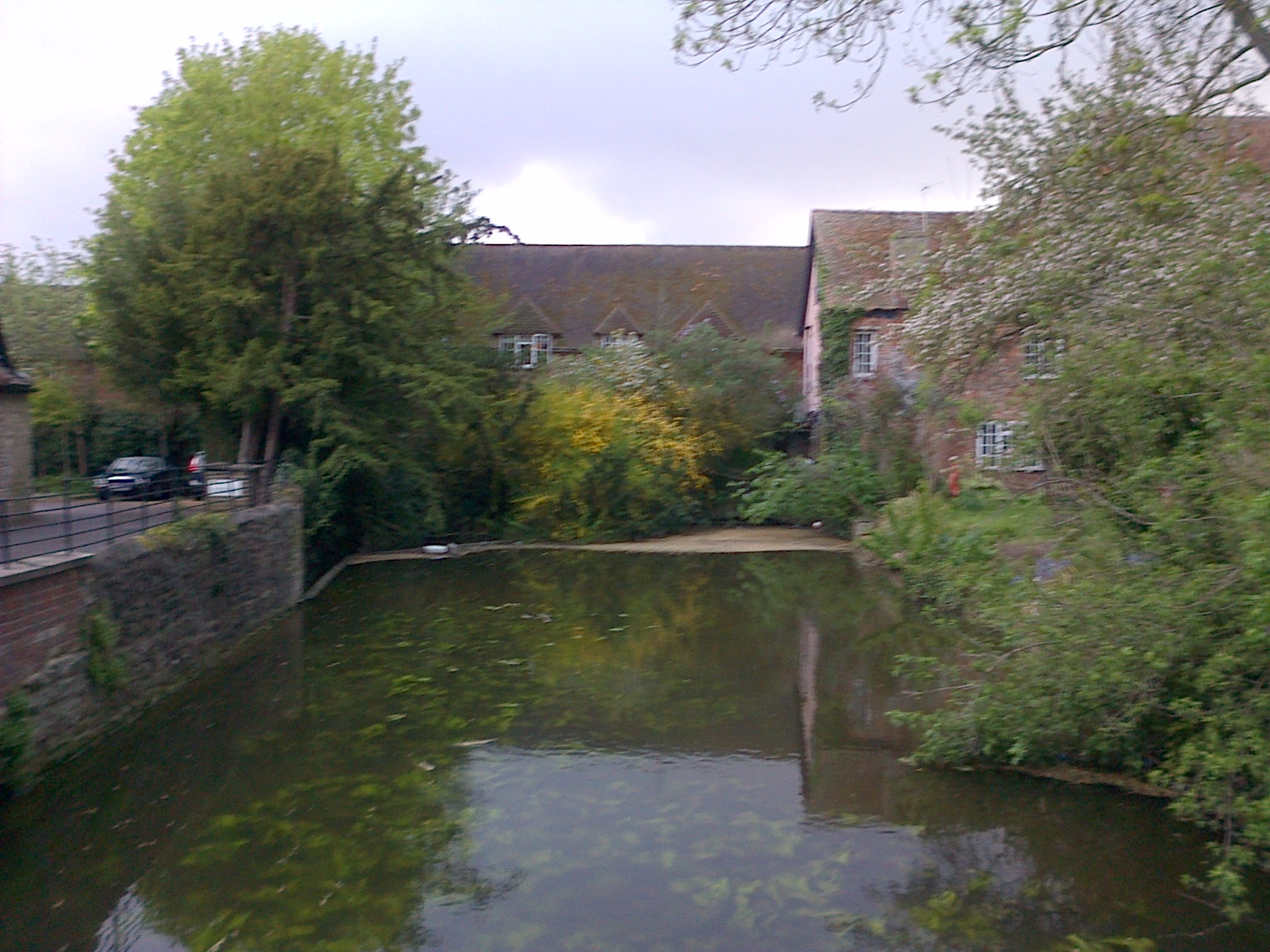
Back in Brighton after a busy but productive day-and-a-half in Abingdon discussing the future of SEPNET of which more soon. I just have time to post a few pictures of the place I was staying, The Cosener’s House.

Incidentally, being fascinated by words, I just looked up “cosener” on the online Oxford English Dictionary and found that it is a common variant of the word “cozener” which means a “deceiver, cheat or impostor”. I felt quite at home there

The place is right next to the River Thames, which runs along the bottom of the pleasant garden adjacent to the house. I hadn’t realized that the whole establishment is run by the Science and Technology Facilities Council and is much frequented by users of various large scientific facilities (such as ISIS and the Diamond Light Source) situated nearby at the Rutherford Appleton Laboratory (RAL).

The particle physicists among us were quite familiar with The Cosener’s House owing to the connection with RAL but although I’ve done quite a few STFC panels I’ve never been there before. Anyway, as you can see, it’s a pleasant enough location and it met with my particular strong approval because of the splendid black pudding available at breakfast!

IMG-20130508-00106

House and Garden

IMG-20130508-00108

This be the Thames…

IMG-20130508-00110

The Bridge at Twilight.

IMG-20130508-00109

Calm as a Millpond…

Vote Away Day

Posted in Biographical, Science Politics with tags , on May 8, 2013 by telescoper

Well, I’m up early today because no sooner do I get back to work when I have to leave for the South East Physics Network SEPNET “Awayday”. Actually it’s more than a day, more like a day and a half but it’s pointless quibbling about such things. Anyway, it’s going to be held at the Cosener’s House in Abingdon and will be my first visit to that august establishment.

Before departing into the wilds of Oxfordshire, however, I thought I’d just post a quick reminder to any Fellows of the Royal Astronomical Society who happen to be reading this blog that the deadline is approaching for votes in the election of a new President and new Members of Council.Electronic votes must be received by 12 noon on 9 May 2013, and paper votes by the start of the Annual General Meeting on 10 May 2013, so if you are eligible but haven’t voted yet please get your finger out.

In the interest of full disclosure I should make it clear that I am standing for election to Council…

Farewell, Ray Harryhausen..

Posted in Film with tags , on May 7, 2013 by telescoper

I was just about to go home when I heard the news via Twitter that special effects wizard Ray Harryhausen died today. Ray Harryhausen was most famous for creating a form of stop-motion animation called Dynamation. Although some of the effects he created appear very dated compared to modern techniques involving computer graphics, some of his creations have stood the test of time so well that they have become classics of the art. The film Jason and the Argonauts features a swordfight involving seven animated skeletons, which is rightly held up as a shining example of his technical mastery, but my favourite sequence from that film is the following excerpt, in which the stop-motion technique works superbly well at conveying the colossal scale and supernatural presence of the giant Talos. It certainly had me on the edge of my seat when I first saw it.

This clip is rendered even more evocative by the fact that the sound the metallic scraping sound the Talos makes is exactly the same as that generated by the turntable in my microwave oven when it goes round…

Manhã da Carnaval

Posted in Jazz, Music with tags , , on May 7, 2013 by telescoper

I travelled back to Brighton this morning and spent the afternoon in a series of meetings in my sweltering office. I now haven’t got the energy to post anything but some music, so here is some rare footage of Brazilian guitarist and pioneer of Latin Jazz Baden Powell (full name Baden Powell de Aquino) recorded in Germany in 1970. The lovely tune with a melancholy edge is called Manhã da Carnaval. He not only plays it beautifully but also displays admirable dexterity in holding his cigarette in right hand as he does so..

Bank Holiday in Bute Park

Posted in Uncategorized with tags , , , on May 6, 2013 by telescoper

Well, I’ve done next to nothing today. Just yesterday’s Azed crossword in which I found

All too public ‘diary’ left in the loo (4)

which clues what this is.

I also held my last ever project meeting with Cardiff student; hand-in dates are looming across the country, I suspect.

Other than that, I’ve just been strolling around, and otherwise enjoying, Bute Park in the sunshine along with half the population of Cardiff. It is a pity the Council don’t take better care of the grass, though..

General Paper

Posted in Education with tags on May 5, 2013 by telescoper

Rummaging through my drawers just now I found the General Paper I took in 1981 to get into Cambridge. I haven’t copied Section A, which involves writing a precis of a rather lengthy article about voting systems, but Sections B and C involve different forms of writing challenge.

I don’t remember which questions I answered, but most of the topics are still interesting and/or controversial enough to be topics for a blog post, at least. Which would you have chosen?

Incidentally, the whole paper was of 3 hours duration and all sections were equally weighted so you would be expected to spend about an hour on each question.

I think we should do much more to encourage science students to develop their writing skills nowadays. I think most present-day physics would find these exercises very difficult, simply because they don’t get enough practice at putting pen to paper (or even fingers to keyboard).

If you are feeling keen, and have an hour to spare, feel free to submit a piece through the comments box!

Time starts now…

Maurice of Montpelier Terrace

Posted in Uncategorized with tags , , on May 4, 2013 by telescoper

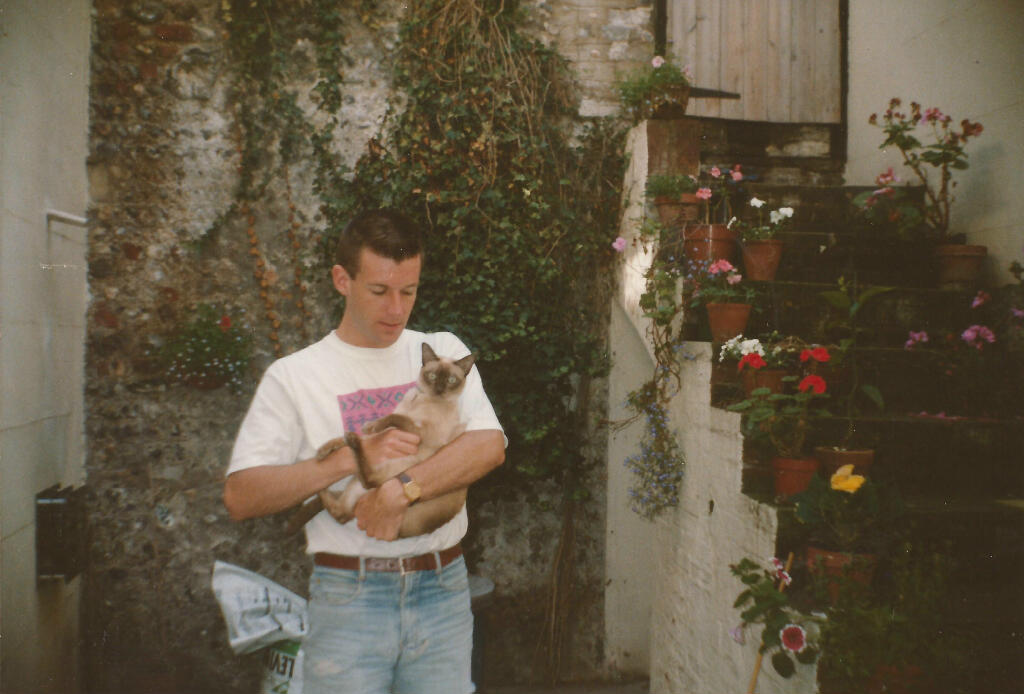
I chanced upon this old picture just now. It was taken in Brighton in 1989, and it shows me with Maurice, a gorgeous Burmese cat who was a resident of the basement flat in which I lodged for a while, in Montpelier Terrace. This photograph was taken in the little yard at the rear of the property, from which Maurice frequently tried to escape.

Burmese are wonderful cats, very talkative and full of personality, but their claws are like needles!

The Joy of Pepys

Posted in Biographical, History with tags , , , , on May 3, 2013 by telescoper

Twitter is much maligned by those who don’t use it, and I’d be the first to admit that it has several million downsides, but every now and again you come across something truly wonderful which makes it worthwhile putting up with the dross. Here’s an example. Some time ago, a nameless genius came up with the idea of tweeting excerpts from the Diaries of Samuel Pepys.  Those of you on Twitter can follow Samuel Pepys by clicking here:

For those of you not familiar with Twitter, its main characteristic is that messages posted on it (“tweets”) are limited to 140 characters. To outsiders this seems to imply that all tweets are banal and pointless, but this is far from the case. The strict length limit forces a form of creativity that is both rare and wonderful. The stroke of genius in this case was to realize that the Pepys Diaries could be tweeted in chunks of the right size, in a manner that almost suggests they were designed for the purpose!

Pepys was a high-ranking naval administrator and Member of Parliament so he had detailed knowledge of the momentous political events of his period. He’s currently tweeting from May 1660 (near the start of the diaries), giving a vivid insight into the background to the Restoration of the Monarchy. Parliament should be recalled in a few days time, on May 8th…

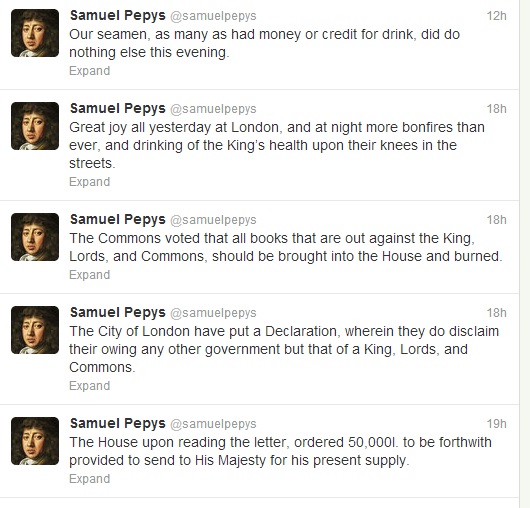
Here is a selection of recent examples:
peps

But it’s not just the fascinating political context that makes these tweets so interesting. They also give glimpses of everyday life in the 17th Century. Pepys was in poor health for much of his life, for example, and there are frequent references to various physicians and their quack remedies. He also manages to conjure up in just a few words the extraordinary atmosphere and energy of the London of the period, along with some of its excesses (especially drinking and fornication).

Following Pepys’ Twitter feed opens a window into 17th Century England, and what comes through it is both refreshing and illuminating. The reason I find this particularly delightful is something that I’ve blogged about before, so won’t repeat at length. I was a very late developer from an education point of view until I was helped with my reading and arithmetic by a wonderful old lady who lived next door. She encouraged me to read and, after a big struggle, I eventually got the hang of it. After a time I had caught up with the rest of the class in School and eventually managed to read just about every book the School had to offer, including the Diaries of Samuel Pepys which were for some reason on the shelves in Class 2 and which I was allowed to borrow. I don’t think anyone had read them before so nobody, including the teachers, knew how rude they were in places. The Restoration period was generally rather bawdy, and Pepys’ Diaries reflect that.

I had no idea at that time, of course, that less than ten years later I would be studying at Magdalene College, Cambridge, site of the Pepys Library where the orignal diaries are kept as well as the rest of Pepys’ own collection of rare books and music.

Cute Nuclear Physics Problem

Posted in Cute Problems, The Universe and Stuff with tags , , on May 2, 2013 by telescoper

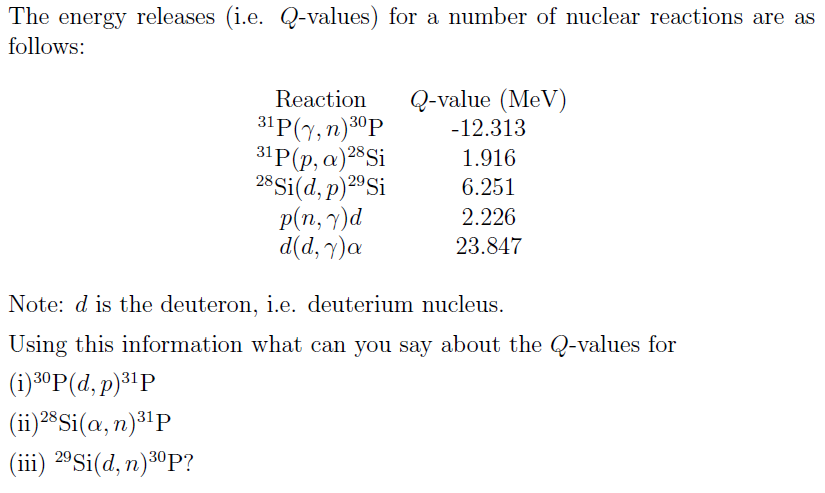
It’s been quite a while since I posted anything in the cute physics problems folder – mostly because the problems I’m generally dealing with these days are neither cute nor related to physics – but here’s one from an old course I used to teach on Nuclear and Particle Physics.

In the following the notation A(a,b)B means the reaction a+A→b+B and the you might want to look here for a definition of what a Q-value is. The Atomic Number of Phosphorus (P) is 15, and that of Silicon (Si) is 14. The question doesn’t require any complicated mathematics, or any knowledge of physics beyond A-level; the rest is up to your little grey cells!

nuclear