This song was playing on the radio in the Bridge Cafe just now when I went to get a cup of coffee, thus providing me with another time warp experience. The Communards’ version of Don’t Leave Me This Way was a big hit way back in 1986 and I remember dancing to it many times in various Brighton clubs and discos; I was here at the University of Sussex then as a research student. Can that really have been 27 years ago? Sigh…
Follow @telescoperDon’t Leave Me This Way
Posted in Biographical, Music with tags Don't Leave Me This Way, The Communards on May 2, 2013 by telescoperShould the passive voice be avoided?
Posted in Education with tags education, grammar, passive voice, Physics, reports, Science on May 1, 2013 by telescoperIt’s another very busy day (as well as another lovely one) so I thought instead of sitting indoors this lunchtime writing a typically verbose blog item I’d just pick something out of my back catalogue and give it another airing because it deals with something that’s come up a couple of times recently.
This is the time of year when final-year students are drafting their project reports. Yesterday I was back in Cardiff giving feedback on two such articles. I usually quite enjoy reading these things, in fact. They’re not too long and I’m usually pretty impressed with how the students have set about the (sometimes quite tricky) things I’ve asked them to do for their project work. I think the project report is quite a challenge for UK physics students because they generally haven’t had much practice in putting together a lengthy piece of writing before or during their university course, so haven’t developed a style that they feel comfortable with and are often unfamiliar with various conventions (such as reference style, punctuation of equations, etc). Some of these are explained in quite a lot of detail in the instructions the students are given, of course, but we all know that only girls read instructions….
The thing that strikes me most forcibly about the strange way students write project reports is that they are nearly always phrased entirely in the passive voice, e.g.
The experiment was calibrated using a phlogiston normalisation widget….
I accept that people disagree about whether the passive voice is good style or not. Some journals actively encourage the passive voice while others go the opposite way entirely . I’m not completely opposed to it, in fact, but I think it’s only useful either when the recipient of the action described in the sentence is more important than the agent, or when the agent is unknown or irrelevant. There’s nothing wrong with “My car has been stolen” (passive voice) since you would not be expected to know who stole it. On the other hand “My Hamster has been eaten by Freddy Starr” would not make a very good headline.
The point is that the construction of a statement in the passive voice in English is essentially periphrastic, in that it almost inevitably involves some form of circumlocution – either using more words than necessary to express the meaning or being deliberately evasive by introducing ambiguity. Both of these failings should be avoided in scientific writing.
Apparently, laboratory instructors generally tell students to write their reports in the passive voice as a matter of course. I think this is just wrong. In a laboratory report the student should describe what he or she did. Saying what “was done” often leaves the statement open to the interpretation that somebody else did it. The whole point of a laboratory report is surely for the students to describe their own actions. “We calibrated the experiment..” or “I calibrated the experiment…” are definitely to be preferred to the form I gave above.
That brings me to the choice of pronoun in the active voice. One danger is that it can appear very bombastic, but that’s not necessarily the case. I don’t find anything particularly wrong in saying, e.g.
We improve upon the technique of Jones et al. (1848) by introducing a variable doofer in the MacGuffin control, thereby removing gremlins from the thingummy process.
But the main issue is whether to use the singular or plural form. It can be irritating to keep encountering “I did this..” and “I did that..” all the way through a journal paper, and I certainly would feel uncomfortable writing a piece like that in the first person singular. I think it feels less egotistical to use “we”, even if there is only one author (which is increasingly rare in any case). If it’s good enough for the Queen it’s good enough for me! However, I just looked “we” up in Chambers dictionary and found
..used when speaking patronizingly, esp to children, to mean `you’.
which wasn’t at all what I had in mind!
However in the case of a student project that I’m assessing I actually want to know what the particular student writing the report did, not what was done by person or persons unspecified or by a group of uncertain composition. So I encourage my students to put, e.g.,
I wrote a computer program in 6502 Assembly Language to solve the Humdinger equation using the Dingbat-Schnitzelgruber algorithm.
I also (sometimes) like “we” when there’s, e.g., a complicated mathematical derivation. Going line by line through a lengthy piece or difficult technical argument seems friendlier if you imagine that the reader is trying to do the calculation along with you as you write it:
if we differentiate the right hand side of equation (8), use the expression for x obtained in equation (97), expand y in a power-series and take away the number we first thought of we find…
The “we” isn’t necessarily an author with delusions of grandeur (or schizophrenia), but instead denotes a joint operation between author and reader.
Anyway, to resume the thread, it seems to me that sometimes it is appropriate to use the passive voice because it is the correct grammatical construction in the circumstances. Sometimes also the text just seems to work better that way too. But having to read an entire document written in the passive voice drives me to distraction. It’s clumsy and dull.
In scientific papers, things are a little bit different but I still think using the active voice makes them easier to read and less likely to be ambiguous. In the introduction to a journal paper it’s quite acceptable to discuss the background to your work in the passive voice, e.g. “it is now generally accepted that…” but when describing what you and your co-authors have done it’s much better to use the active voice. “We observed ABC1234 using the Unfeasibly Large Telescope..” is, to my mind, much better than “Observations of ABC1234 were made using..”.
Reading back over this post I notice that I have jumped fairly freely between active and passive voice, thus demonstrating that I don’t have a dogmatic objection to its use. What I’m arguing is that it shouldn’t be the default, that’s all.
My guess is that a majority of experimental scientists won’t agree with this opinion, but a majority of astronomers and theoreticians will.
This guess will now be tested by reactivating an old poll..
Lines on the Death of Herschel
Posted in Poetry, The Universe and Stuff with tags Herschel Space Observatory on April 30, 2013 by telescoperSo farewell, then,
Herschel
Space
Observatory.
You were named after
William Herschel,
Who lived
During the reign of
George III.
The mad King
Who went blind,
Then died.
You went blind
Then died.
But there the
Similarity
Ends.
You ran out
Of Helium;
He had no
Need of He.
And he was neither
In Space
Nor an
Observatory,
So forget
It.
by Peter Coles (aged 49 11/12).
Follow @telescoperNever mind the table, look at the sample size!
Posted in Bad Statistics with tags League Tables, margin of error, statistics, Times Higher on April 29, 2013 by telescoperThis morning I was just thinking that it’s been a while since I’ve filed anything in the category marked bad statistics when I glanced at today’s copy of the Times Higher and found something that’s given me an excuse to rectify my lapse. Last week saw the publication of said organ’s new Student Experience Survey which ranks British Universities in order of the responses given by students to questions about various aspects of the teaching, social life and so on. I had a go at this table a few years ago, but they still keep trotting it out. Here are the main results, sorted in decreasing order:
| University | Score | Resp. | |
| 1 | University of East Anglia | 84.8 | 119 |
| 2 | University of Oxford | 84.2 | 259 |
| 3 | University of Sheffield | 83.9 | 192 |
| 3 | University of Cambridge | 83.9 | 245 |
| 5 | Loughborough University | 82.8 | 102 |
| 6 | University of Bath | 82.7 | 159 |
| 7 | University of Leeds | 82.5 | 219 |
| 8 | University of Dundee | 82.4 | 103 |
| 9 | York St John University | 81.2 | 88 |
| 10 | Lancaster University | 81.1 | 100 |
| 11 | University of Southampton | 80.9 | 191 |
| 11 | University of Birmingham | 80.9 | 198 |
| 11 | University of Nottingham | 80.9 | 270 |
| 14 | Cardiff University | 80.8 | 113 |
| 14 | Newcastle University | 80.8 | 125 |
| 16 | Durham University | 80.3 | 188 |
| 17 | University of Warwick | 80.2 | 205 |
| 18 | University of St Andrews | 79.8 | 109 |
| 18 | University of Glasgow | 79.8 | 131 |
| 20 | Queen’s University Belfast | 79.2 | 101 |
| 21 | University of Hull | 79.1 | 106 |
| 22 | University of Winchester | 79 | 106 |
| 23 | Northumbria University | 78.9 | 100 |
| 23 | University of Lincoln | 78.9 | 103 |
| 23 | University of Strathclyde | 78.9 | 107 |
| 26 | University of Surrey | 78.8 | 102 |
| 26 | University of Leicester | 78.8 | 105 |
| 26 | University of Exeter | 78.8 | 130 |
| 29 | University of Chester | 78.7 | 102 |
| 30 | Heriot-Watt University | 78.6 | 101 |
| 31 | Keele University | 78.5 | 102 |
| 32 | University of Kent | 78.4 | 110 |
| 33 | University of Reading | 78.1 | 101 |
| 33 | Bangor University | 78.1 | 101 |
| 35 | University of Huddersfield | 78 | 104 |
| 36 | University of Central Lancashire | 77.9 | 121 |
| 37 | Queen Mary, University of London | 77.8 | 103 |
| 37 | University of York | 77.8 | 106 |
| 39 | University of Edinburgh | 77.7 | 170 |
| 40 | University of Manchester | 77.4 | 252 |
| 41 | Imperial College London | 77.3 | 148 |
| 42 | Swansea University | 77.1 | 103 |
| 43 | Sheffield Hallam University | 77 | 102 |
| 43 | Teesside University | 77 | 103 |
| 45 | Brunel University | 76.6 | 110 |
| 46 | University of Portsmouth | 76.4 | 107 |
| 47 | University of Gloucestershire | 76.3 | 53 |
| 47 | Robert Gordon University | 76.3 | 103 |
| 47 | Aberystwyth University | 76.3 | 104 |
| 50 | University of Essex | 76 | 103 |
| 50 | University of Glamorgan | 76 | 108 |
| 50 | Plymouth University | 76 | 112 |
| 53 | University of Sunderland | 75.9 | 100 |
| 54 | Canterbury Christ Church University | 75.8 | 102 |
| 55 | De Montfort University | 75.7 | 103 |
| 56 | University of Bradford | 75.5 | 52 |
| 56 | University of Sussex | 75.5 | 102 |
| 58 | Nottingham Trent University | 75.4 | 103 |
| 59 | University of Roehampton | 75.1 | 102 |
| 60 | University of Ulster | 75 | 101 |
| 60 | Staffordshire University | 75 | 102 |
| 62 | Royal Veterinary College | 74.8 | 50 |
| 62 | Liverpool John Moores University | 74.8 | 102 |
| 64 | University of Bristol | 74.7 | 137 |
| 65 | University of Worcester | 74.4 | 101 |
| 66 | University of Derby | 74.2 | 101 |
| 67 | University College London | 74.1 | 102 |
| 68 | University of Aberdeen | 73.9 | 105 |
| 69 | University of the West of England | 73.8 | 101 |
| 69 | Coventry University | 73.8 | 102 |
| 71 | University of Hertfordshire | 73.7 | 105 |
| 72 | London School of Economics | 73.5 | 51 |
| 73 | Royal Holloway, University of London | 73.4 | 104 |
| 74 | University of Stirling | 73.3 | 54 |
| 75 | King’s College London | 73.2 | 105 |
| 76 | Bournemouth University | 73.1 | 103 |
| 77 | Southampton Solent University | 72.7 | 102 |
| 78 | Goldsmiths, University of London | 72.5 | 52 |
| 78 | Leeds Metropolitan University | 72.5 | 106 |
| 80 | Manchester Metropolitan University | 72.2 | 104 |
| 81 | University of Liverpool | 72 | 104 |
| 82 | Birmingham City University | 71.8 | 101 |
| 83 | Anglia Ruskin University | 71.7 | 102 |
| 84 | Glasgow Caledonian University | 71.1 | 100 |
| 84 | Kingston University | 71.1 | 102 |
| 86 | Aston University | 71 | 52 |
| 86 | University of Brighton | 71 | 106 |
| 88 | University of Wolverhampton | 70.9 | 103 |
| 89 | Oxford Brookes University | 70.5 | 106 |
| 90 | University of Salford | 70.2 | 102 |
| 91 | University of Cumbria | 69.2 | 51 |
| 92 | Napier University | 68.8 | 101 |
| 93 | University of Greenwich | 68.5 | 102 |
| 94 | University of Westminster | 68.1 | 101 |
| 95 | University of Bedfordshire | 67.9 | 100 |
| 96 | University of the Arts London | 66 | 54 |
| 97 | City University London | 65.4 | 102 |
| 97 | London Metropolitan University | 65.4 | 103 |
| 97 | The University of the West of Scotland | 65.4 | 103 |
| 100 | Middlesex University | 65.1 | 104 |
| 101 | University of East London | 61.7 | 51 |
| 102 | London South Bank University | 61.2 | 50 |
| Average scores | 75.5 | 11459 | |
| YouthSight is the source of the data that have been used to compile the table of results for the Times Higher Education Student Experience Survey, and it retains the ownership of those data. Each higher education institution’s score has been indexed to give a percentage of the maximum score attainable. For each of the 21 attributes, students were given a seven-point scale and asked how strongly they agreed or disagreed with a number of statements based on their university experience. | |||
My current employer, the University of Sussex, comes out right on the average (75.5) and is consequently in the middle in this league table. However, let’s look at this in a bit more detail. The number of students whose responses produced the score of 75.5 was just 102. That’s by no means the smallest sample in the survey, either. The University of Sussex has over 13,000 students. The score in this table is therefore obtained from less than 1% of the relevant student population. How representative can the results be, given that the sample is so incredibly small?
What is conspicuous by its absence from this table is any measure of the “margin-of-error” of the estimated score. What I mean by this is how much the sample score would change for Sussex if a different set of 102 students were involved. Unless every Sussex student scores exactly 75.5 then the score will vary from sample to sample. The smaller the sample, the larger the resulting uncertainty.
Given a survey of this type it should be quite straightforward to calculate the spread of scores from student to student within a sample from a given University in terms of the standard deviation, σ, as well as the mean score. Unfortunately, this survey does not include this information. However, lets suppose for the sake of argument that the standard deviation for Cardiff is quite small, say 10% of the mean value, i.e. 7.55. I imagine that it’s much larger than that, in fact, but this is just meant to be by way of an illustration.
If you have a sample size of N then the standard error of the mean is going to be roughly (σ⁄√N) which, for Sussex, is about 0.75. Assuming everything has a normal distribution, this would mean that the “true” score for the full population of Sussex students has a 95% chance of being within two standard errors of the mean, i.e. between 74 and 77. This means Sussex could really be as high as 43rd place or as low as 67th, and that’s making very conservative assumptions about how much one student differs from another within each institution.
That example is just for illustration, and the figures may well be wrong, but my main gripe is that I don’t understand how these guys can get away with publishing results like this without listing the margin of error at all. Perhaps its because that would make it obvious how unreliable the rankings are? Whatever the reason we’d never get away with publishing results without errors in a serious scientific journal.
This sampling uncertainty almost certainly accounts for the big changes from year to year in these tables. For instance, the University of Lincoln is 23rd in this year’s table, but last year was way down in 66th place. Has something dramatic happened there to account for this meteoric rise? I doubt it. It’s more likely to be just a sampling fluctuation.
In fact I seriously doubt whether any of the scores in this table is significantly different from the mean score; the range from top to bottom is only 61 to 85 showing a considerable uniformity across all 102 institutions listed. What a statistically literate person should take from this table is that (a) it’s a complete waste of time and (b) wherever you go to University you’ll probably have a good experience!
Follow @telescoperDesperate Publishers
Posted in Open Access with tags academic publishing, Academic Publishing Racket, Conference Proceedings, Elsevier, Open Access on April 28, 2013 by telescoperI’m on campus to get some work done but before that I thought I do a quick postette as I eat my lunch. A good topic for a short contribution is a story I heard last week from one of my colleagues in the Department of Physics & Astronomy here at the University of Sussex. It seems he gave a talk at a conference a while ago. As is far from unusual in such circumstances he was asked to write up his contribution for a special edition of a journal.
Before I go on I’ll just digress a bit to mention a less well-known aspect of the Academic Publishing Racket, the Conference Proceedings Volume. For a long time you couldn’t attend a conference in astrophysics without having to contribute an article to one of these books. Although usually produced on the cheap, using camera-ready copy, and with minimal editorial oversight, these were sold to participants and (more lucratively) to university libraries at enormously inflated prices, often over £100 a go. It wasn’t unusual for funding agencies to insist that a conference talk be followed up with a publication, so this racket flourished for a while. I’ve actually got a shelf full of such volumes accumulated over the years, although I don’t really know why I kept them as it is in their nature that they date very quickly.
Anyway, as time passed, and the internet expanded and improved, most conference organizers began to realize that it was much better just to keep their own record of the conference: putting summaries, and even full presentations, on the web for interested persons to download gratis. No doubt it is still de rigueur in some subjects to produce books of this type, but most in astrophysics don’t bother any more. Quite rightly, in my opinion. I think they’re a waste of time, money and shelf space.
The original thread of this post, however, isn’t about standalone books of conference proceedings but special editions of a regular academic journal; for an example of one such see here. Note the unsubtle and entirely gratuitous link to one of my own papers! I’ve always thought this format was just as bad as putting them in a book, with the additional disadvantage that people might misinterpret the journal reference as meaning that the paper had been refereed. The paper I linked to above was not refereed, for instance. In any case they’re a bit of a chore to write, and are just as likely to be of ephemeral interest, but if one is invited to give a talk one generally feels obliged to play ball and deliver the article requested.
Which all brings me back to my colleague here at Sussex. He did his talk and wrote up the obligatory article for the special journal edition of the conference proceedings. But times have changed. When he tried to submit his article via the web upload facility he was directed to a screen asking whether his work was funded by the Science and Technology Facilities Council. When he answered “yes” he was told he was obliged to pay $3000 for the privilege of publishing his paper in Gold Open Access mode….
When he asked me if the School of Mathematical and Physical Sciences would pay the $3000 I nearly had a seizure. It’s bad enough getting landed with a hefty bill for writing an article as a favour to the conference organizers, but it’s even worse than that. The publisher was deliberately and disgracefully misleading the author about the RCUK policy on open access in order to take money from them. There is no requirement for researchers to pay for Gold OA in such a case. Sharp practice is too polite a phrase to describe the actions of this publisher. And of course nobody mentioned the $3000 fee when he signed up to give a talk at the conference.
Unfortunately, I think this sort of questionable business practice is bound to proliferate as publishers seek to maximize their revenue from Gold Open Access before the academic community rumbles the scam and cuts them out all together. So let this post be a warning. Do not trust academic publishers who try to charge you up front. Check the rules very carefully before committing yourself or, preferably, declining to publish with them. There are sharks out there and they’re after your funding.
Oh, and the name of the publisher involved in the scam I just described? I’m sure you can guess it before clicking this link to check.
Follow @telescoperSola, Perduta, Abbandonata
Posted in Opera with tags Manon Lescaut, Maria Callas, Puccini, Sola Perduta Abbandonata on April 27, 2013 by telescoperHosts, Guests, and Parasites
Posted in Literature with tags Court, etymology, host, J. Hillis Miller, Sara Crangle, University of Sussex on April 26, 2013 by telescoperI just returned from my first experience of Court, at least in the sense of that word that applies to the University of Sussex. It was quite different to what I had imagined, especially because it included three research talks. One of them, by Dr Sara Crangle of the School of English was about the Engagement Diaries of Virginia Woolf (many of which have been acquired by the University). This talk began with a fascinating preamble focussed on a short quote from The Critic as Host by J. Hillis Miller. This revolved around the curious shared etymology of “host” and “guest” and their common relationship to “hostia” the latin word meaning a sacrifice or a victim. Being fascinated by the origin and evolution of words I thought I’d have a look for a bit more of the context so here is an extended discussion.
“Parasite” is one of those words which calls up its apparent “opposite.” It has no meaning without that counterpart. There is no parasite without its host. At the same time both word and counterword subdivide and reveal themselves each to be fissured already within themselves and to be, like Unheimlich, unheimlich, an example of a double antithetical word. Words in “para,” like words in “ana” have this as an intrinsic property, capability, or tendency. “Para” as a prefix in English (sometimes “par”) indicates alongside, near or beside, to the side of, alongside, beyond, wrongfully, harmfully, unfavorably, and among. The words in “para” form one branch of the tangled labyrinth of words using some form of the Indo-European root per, which is the “base of prepositions and pre-verbs with the basic meaning of ‘forward,’ ‘through,’ and a wide range of extended senses such as ‘in front of ,’ ‘before,’ ‘early,’ ‘first,’ ‘chief,’ ‘toward,’ ‘against,’ ‘near,’ ‘at,’ ‘around.’”
I said words in “para” are one branch of the labyrinth of “pers,” but it is easy to see that the branch is itself a miniature labyrinth. “Para” is an “uncanny” double antithetical prefix signifying at once proximity and distance, similarity and difference, interiority and exteriority, something at once inside a domestic economy and outside it, something simultaneously this side of the boundary line, threshold, or margin, and at the same time beyond it, equivalent in status and at the same time secondary or subsidiary, submissive, as of guest to host, slave to master. A thing in “para” is, moreover, not only simultaneously on both sides of the boundary line between inside and outside. It is also the boundary itself, the screen which is at once a permeable membrane connecting inside and outside, confusing them with one another, allowing the outside in, making the inside out, dividing them but also forming an ambiguous transition between one and the other. Though any given word in “para” may seem to choose unequivocally or univocally one of these possibilities, the other meanings are always there as a shimmering or wavering in the word which makes it refuse to stay still in a sentence, like a slightly alien guest within the syntactical closure where all the words are family friends together. Words in “para” include: parachute, paradigm, parasol, the French paravent (screen protecting against the wind), and parapluie (umbrella), paragon, paradox, parapet, parataxis, parapraxis, parabasis, paraphrase, paragraph, paraph, paralysis, paranoia, paraphernalia, parallel, parallax, parameter, parable, paresthesia, paramnesia, paregoric, parergon, paramorph, paramecium, Paraclete, paramedical, paralegal–and parasite.
“Parasite” comes from the Greek, parasitos, etymologically: “beside the grain,” para, beside (in this case) plus sitos, grain, food. “Sitology” is the science of foods, nutrition, and diet. “Parasite” was originally something positive, a fellow guest, someone sharing the food with you, there with you beside the grain. Later on, “parasite” came to mean a professional dinner guest, someone expert at cadging invitations without ever giving dinners in return. From this developed the two main modern meanings in English, the biological and the social. A parasite is (1) “Any organism that grows, feeds, and is sheltered on or in a different organism while contributing nothing to the survival of its host”; (2) “A person who habitually takes advantage of the generosity of others without making any useful return.” To call a kind of criticism “parasitical” is, in either case, strong language.
A curious system of thought, or of language, or of social organization (in fact all three at once) is implicit in the word parasite. There is no parasite without a host. The host and the somewhat sinister or subversive parasite are fellow guests beside the food, sharing it. On the other hand, the host is himself the food, his substance consumed without recompense, as when one says, “He is eating me out of house and home.” The host may then become the host in another sense, not etymologically connected. The word “Host” is of course the name for the consecrated bread or wafer of the Eucharist, from Middle English oste, from Old French oiste, from Latin hostia, sacrifice, victim.
If the host is both eater and eaten, he also contains in himself the double antithetical relation of host and guest, guest in the bifold sense of friendly presence and alien invader. The words “host” and “guest” go back in fact to the same etymological root: ghos-ti, stranger, guest, host, properly “someone with whom one has reciprocal duties of hospitality.” The modern English word “host” in this alternative sense comes from the Middle English (h)oste, from Old French, host, guest, from Latin hospes (stem hospit-), guest, host, stranger. The “pes” or “pit” in the Latin words and in such modern English words as “hospital” and “hospitality” is from another root, pot, meaning “master.” The compound or bifurcated root ghos-pot meant “master of guests,” “ one who symbolizes the relationship of reciprocal hospitality,” as in the Slavic gospodic, Lord, sir, master. “Guest,” on the other hand, is from Middle English gest, from Old Norse gestr, from ghos-ti, the same root for “host.” A host is a host. The relation of household master offering hospitality to a guest and the guest receiving it, of host and parasite in the original sense of “fellow guest,” is inclosed within the word “host” itself. A host in the sense of a guest, moreover, is both a friendly visitor in the house and at the same time an alien presence who turns the home into a hotel, a neutral territory. Perhaps he is the first emissary of a host of enemies (from Latin hostis [stranger, enemy]), the first foot in the door, to be followed by a swarm of hostile strangers, to be met only by our own host, as the Christian deity is the Lord God of Hosts. The uncanny antithetical relation exists not only between pairs of words in this system, host and parasite, host and guest, but within each word in itself. It reforms itself in each polar opposite when that opposite is separated out, and it subverts or nullifies the apparently unequivocal relation of polarity which seems the conceptual scheme appropriate for thinking through the system. Each word in itself becomes separated by the strange logic of the “para,” membrane which divides inside from outside and yet joins them in a hymeneal bond, or allows an osmotic mixing, making the strangers friends, the distant near, the dissimilar similar, the Unheimlich heimlich, the homely homey, without, for all its closeness and similarity, ceasing to be strange, distant, dissimilar.
Interesting!
Spring Cleaning
Posted in Jazz with tags Fats Waller, Spring Cleaning on April 26, 2013 by telescoperWe’re nearly at the end of a long week and I’ve got neither the time nor the energy for a lengthy post, so here’s a bit of a pick-me-up in the form of a classic bit of Fats Waller. Thomas Wright Waller was born in 1904 and died (of pneumonia) on a train travelling across the United States in 1943. Although he’s usually thought of as an entertainer who specialized in comic versions of popular songs, he was undoubtedly a brilliant jazz musician and an especially accomplished exponent of Harlem Stride piano. Anyway, I heard a bit of this track on a TV advert last night and it seemed both fun and topical so I thought I’d share it and see if people enjoy it as much as I did; in the famous words of Mr Waller “One never knows, do one?”….
Follow @telescoperBreaking down a breakdown
Posted in Biographical, The Universe and Stuff with tags Dean Burnett, Nervous Breakdown, neuroscience, Panic Disorder, Physics, reductionism on April 25, 2013 by telescoperA blog piece by Dean Burnett I read on on the Grauniad website yesterday set me thinking about whether I should post a personal comment in reaction to it. I never know what is the appropriate way to draw the line between the private and the public on In the Dark but since having a blog is clearly an exercise in self-indulgence anyway I thought I’d go ahead and write a piece.
Dean’s piece is about nervous breakdowns, but it’s really about why “nervous breakdown” is not a very good name for what it purports to describe. Regular readers of this blog (both of them) will know that I went through one last year, and one thing I do remember is the disapproval that the term “nervous breakdown” provoked when I used it during my subsequent course of therapy. Apparently it’s a bit frowned-upon among professionals in the field.
Here is Dean (who is a neuroscientist in his day job) on the subject:
The term nervous breakdown is actually surprisingly old, and stems from a time when both “nervous” and “breakdown” arguably had different meanings to their modern ones. It seems the “breakdown” element refers to a breakdown in the same way that cars or other machines can break down. And nervous just refers to the nervous tissue. So originally it meant a fault or error in the nervous tissue that controls the body. And suddenly my interpretation doesn’t seem so literal.
But this doesn’t mean it’s an invalid term, it’s just more of a rule-of-thumb or generalisation used to refer to what happens when someone becomes psychologically unable to function as normal. In the simplest sense it could be said that, mentally speaking, a nervous breakdown occurs when an individual finds that the number of things that they are able to cope with is lower than the number of things that they have to cope with.
That seems to me to sum up very sensibly why the term is not very useful for an expert: it’s too vague, in that there are so many quite different things that might cause a person to become “psychologically unable to function as normal”. But it also explains quite well why its usage persists in popular language, in that the state of being “”psychologically unable to function as normal” is not as uncommon you might think. Anyway, if someone says they’ve had a nervous breakdown it gives at least a general idea of what they’ve experienced, although the specifics vary widely from individual to individual.
I hope you’ll bear with me if I illustrate this with some personal observations in the light of my own experiences.
I’ve suffered from a form of panic disorder for many years. Actually even that term has a very broad definition, so that different individuals experience different forms of panic attacks and they can also take very different forms for the same individual. For me, a “typical” panic episode begins with a fairly generalized feeling of apprehension or dread. Sometimes that’s as far as it goes. However, more often, there follows a period of increasingly heightened awareness of things moving in my peripheral vision that I can’t keep track of. This leads to a sense of being surrounded by threats of various kinds and panic ensues. Usually, at that point, I run.
A typical panic episode lasts only a few minutes, but that’s not the end of it. For a considerable period (hours) afterwards I find myself in a state of hypervigilance during which I’m such a bundle of nerves that the slightest sound or movement can trigger a repeat.
I tend to think of these episodes as being a bit like earthquakes. The milder ones happen fairly frequently, but they’re quite easy to cope with. I have altered my behaviour to avoid places likely to trigger them (see below) and to be aware of appropriate exit strategies. The more severe episodes are much harder to deal with, though, and when one starts there’s nothing I can do apart from try to find somewhere that feels safe, wait for it to pass and then just get through the aftermath, hoping for no aftershocks.
In Dean’s piece he writes about the different stressors that can trigger a breakdown. In my case it was a bit more complicated than that. Thinking about the milder attacks I find it very difficult to identify specific triggers – they seem to occur more-or-less randomly. However, I can cope with this low-level “noise” pretty well. I’ve had plenty of time to get used to it, at least. The more severe attacks seem more likely to be triggered by specific places, especially if they’re crowded with people moving around – although I don’t always have a problem in places like that. To give an example, crossing the main concourse at Victoria Station is, for me, like descending into the abyss; I simply can’t do it, and have to go outside the station to get between the trains and the underground station. Paddington Station, on the other hand, is fine. Weird.
I think the probability of one of these episodes is also influenced by background levels of stress arising from other independent things. Anyway, last year I got into a state in which I was experiencing multiple episodes per day. I couldn’t sleep or eat for over a week, and couldn’t leave the house for fear of experiencing another major problem. I think “nervous breakdown” is a pretty apt description for that period, but my breakdown was caused not by a new problem, but the amplification of an old problem to completely intolerable levels.
The reason for writing about the anatomy of my breakdown in this context is twofold. One part is just to reinforce Dean’s point that a “nervous breakdown” can be triggered by many different circumstances and conditions. Mine is probably an unusual example, but I think everybody else’s is too.
The other reason is to confess how frustrating it is to be a physicist who has experienced a thing like that. It seems natural that having experienced such an episode I should want or need to try to make sense of it, but I’ve struggled to do that. The way we’re used to thinking about things in physics is to make simple models that capture the relatively simple cause-and-effect relationships between relatively few variables, usually based on the objective analysis of data controlled experiments and/or systematic observations. This all involves trying to break down a phenomenon into its component parts so as to look at their separate action and thus establish the simple rules (if there are any) that govern the overall behaviour.
The trouble with this analytic approach is that the human brain and its interactions with the external world are far too complicated and non-linear to be approached in the simple-minded way we physicists usually do things. Even if you accept that the brain is basically a collection of atoms communicating with each other using electrical impulses, that doesn’t mean that it’s useful to try to describe its action using atomic physics and electromagnetic theory.
On top of all that, there’s the issue that neuroscience is a subject I know very little about at a technical level. There’s only room in my feeble little brain for my own specialism, so I lack the knowledge needed even to understand the literature.
So although I got over my breakdown, it has left me with a huge number of questions I don’t even know how to begin to answer. What is happening in my brain when a panic episode begins? What is going on with my peripheral vision when it goes awry like it does? Why do some particular places or circumstances trigger an attack but other, apparently similar, ones don’t?
I don’t suppose anyone out to answer these questions, but if any neuroscientists out there happen to read this piece I would be grateful if they could recommend appropriate literature, as long as it’s simple enough for an astrophysicist to read…
Follow @telescoperHFLS3: the earliest Starburst yet!
Posted in The Universe and Stuff with tags galaxy evolution, Hermes Survey, Herschel Atlas, Herschel Space Observatory, Starburst Galaxy on April 24, 2013 by telescoperOnce again I’ve spent all day engaged in the enjoyable but exhausting task of interview for new faculty positions, which means that I haven’t really got time for a proper blog today. What I can do, however, is shamelessly rip off a nice press release produced by the good folks here at the University of Sussex about a discovery that has been attracting a lot of press coverage since it was published last week in Nature; the paper is also available on the arXiv. If you’ve followed this blog for a while you will know than when I was at Cardiff I got interested in a large project called the Herschel Atlas survey, which is a large area galaxy survey carried out using the Herschel Space Observatory. This result is not from Herschel ATLAS but from a complementary deeper survey called Hermes, also performed using the Herschel Space Observatory and it is of a very distant and very bright starburst galaxy (a type of galaxy which, as its name suggests, in which stars are forming at a much higher rate than a “normal” galaxy).
Incidentally, although Herschel is now extremely short of the Helium it needs to keep itself cool, it is still making observations running on empty, as it were.
Anyway, that’s all I’ve got time to write. The rest is just copied from the press release I mentioned…
–o–
University of Sussex astronomers using the Herschel Space Observatory are part of an international team that has discovered a distant star-forming galaxy that challenges the current theories of galaxy evolution.
Seen when the Universe was less than a billion years old (880 million years) the galaxy, known only as “HFLS3”, is forming stars at a much faster rate than should be possible according to existing predictions. In the infant Universe, galaxies should have been forming stars at a much slower rate than is observed in HFLS3.
HFLS3 is so distant that the light we see from it has taken 13 billion years to get to Earth.
The Herschel observatory1 has been surveying the distant cosmos and finding hundreds of thousands of distant galaxies. Images produced by Herschel show how fast these distant galaxies are forming stars.
By determining the ages of the galaxies, astronomers have been building up a cosmic timeline of star formation, searching for when the first massive galaxies started churning out stars.
University of Sussex PhD student Peter Hurley, Dr Isaac Roseboom, Dr Anthony Smith, Dr Lingyu Wang and Professor Seb Oliver, who leads the HerMES2 survey that found the galaxy, analysed data from Herschel and built the HFLS3 galaxy as a computer model to discover what conditions are like in the galaxy.
Peter says: “The stars being born in HFLS3 heat up the surrounding material within the galaxy. This material contains gas molecules such as carbon monoxide and water, which emit their own unique signatures when heated. By comparing the telescope observations with models, we can gain a better understanding of the conditions within this extreme galaxy.”
The galaxy “HFLS3” was first seen as a small red dot in the Herschel images, and its colour is what first intrigued the team because red galaxies might be very distant.
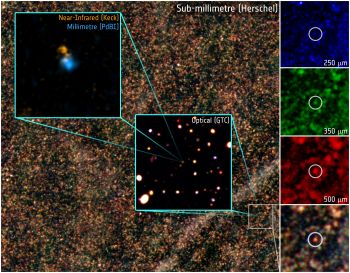
The galaxy HFLS3 as revealed by Herschel and further ground-based telescope observations. Images: ESA/Herschel/HerMES/IRAM/GTC/W.M. Keck Observatory
Further investigations using optical and near-infrared telescopes the Gran Telescopio Canarias in the Canary Islands and the Keck Telescope in Hawaii helped to rule out any other effects that might cause the HFLS3 galaxy to look so bright.
It was observations with radio and millimetre-wave telescopes, such as the Plateau de Bure Interferometer in the French Alps, which determined that this tiny galaxy, only around one twentieth the size of our Milky Way, is seen at such an immense distance. These additional observations also showed that HFLS3 is incredibly rich in carbon, nitrogen and oxygen, forming compounds such as carbon monoxide, water and ammonia. These compounds reveal the physical processes at work in this distant galaxy.
Combined with the Herschel observations, these measurements allow the astronomers to deduce that this tiny star factory is producing stars around two thousand times faster than our own Milky Way, making it a type of galaxy known as a “starburst”. Environments like this do not exist on galaxy-wide scales in the Universe today.
Professor Oliver says: “We’ve shown that Herschel data can find these extreme examples. “The next step is to sift through the Herschel data more carefully, and try to deduce just how common such galaxies were in the early Universe. I am also very pleased that a Sussex PhD student has been able to make an important contribution to this work.”
Jamie Bock (Caltech, USA), who co-leads the HerMES survey with Professor Oliver, says: “This galaxy is just one spectacular example, but it’s telling us that early star formation like this is possible,” explains Jamie Bock, Caltech, and one of the leaders.
Dominik Riechers (Cornell University, USA), who led the HFLS3 study, says: “Looking for the first examples of these massive star factories is like searching for a needle in a haystack. We were hoping to find a galaxy at such vast distances, but we could not expect that they even existed that early on in the Universe.”
Follow @telescoper
 In the Dark