Orion Nebula (Herschel, after Turner)

Posted in Art, The Universe and Stuff with tags , , , on September 6, 2013 by telescoper

I stumbled across this wonderful image (and associated description) yesterday and thought I’d share it. It’s a region of the Orion Nebula (which is located in the  Midlands region of Orion’s “sword”, i.e. the long thing hanging down below his belt).  It’s a turbulent region of dust and gas in which stars are forming. This image was taken in the far-infrared part of the spectrum by the Herschel Space Observatory, which is now defunct but much data remains to be analysed. Because the image was taken at wavelengths much longer than optical light, the colours are obviously “false”. I don’t work on star formation so I tend to see images like this just as beautiful things to be enjoyed for themselves rather than as a subject for scientific research. In fact, I have no difficulty at all in describing this picture as a work of art, slightly reminiscent of the cloudscapes and seascapes of  J.M.W Turner in that it is, at the same time, both a representation of a natural phenomenon and  an abstract creation that transcends it. You can click on the image to make it larger…

Orion_A

UPDATE: I see that someone else has thought of the parallel with Turner!

Widening Participation – Outreach versus Bursaries

Posted in Biographical, Education, Finance with tags , , , , , on September 5, 2013 by telescoper

This morning I came across a University of Sussex News Item which explains that Sussex has made the shortlist, published today (Thursday 5 September), for Widening Participation or Outreach Initiative of the Year in the Times Higher Education Awards 2013.  This piece reminded me of a discussion I had a while ago about the whole approach to widening participation in University education, an issue made all the more serious by the introduction of £9K a year tuition fees. In particular

The University has increased spending on widening participation activities to £8.1 million a year, with over half of this spent on the innovative First Generation Scholars scheme, which supports students who are from low-income backgrounds or who are the first in their family to go to university.

Before commenting on this in any detail I should put my cards on the table. When I went to University in 1982 I was the first in my family ever to go to university. I’m also, at least as far as my immediate family goes, the last. However, in those days there was no need for a First Generation Scholars scheme: there were no tuition fees and, because I don’t come from a wealthy background, I qualified for a full maintenance grant. Life (in Cambridge) as an undergraduate student was fairly comfortable.

Times have changed a lot. Many more people go to university nowadays, but the price is that support for those who don’t have access to family funds is now spread very thinly.  There are no full maintenance grants, and the fees are very high. Looking back, though, I don’t think it would have been the tuition fees that might have deterred me from going to university. After all, they don’t have to be paid back until after graduation, and when one’s income exceeds a certain level. What would have made a difference would have been the withdrawal of maintenance. Without the grant, I simply wouldn’t have been able to study without getting a job. Apart from the amount of work involved in doing my degree, the recession of the early 1980s meant that jobs were very hard to come by.

To get back to the news item I mentioned earlier, I have always thought there is a tricky calculation to be made when it comes to designing programmes intended to encourage students from as wide a range of backgrounds as possible to come to university, whether that be to do with socio-economic considerations, gender, ethnicity, age or anything else. The question is whether pumping money into bursaries is actually effective. I can imagine that a large bursary, perhaps equivalent in money terms to the old maintenance grant, would genuinely influence the decision of a prospective student, but if the pot is shared out among very many people the resulting bursaries are fairly modest. How much does a bursary have to be to make a difference? Answers on a postcard.

The other side of the debate is what the balance should be between bursaries and outreach. In a subject like Physics one of the principal obstacles faced by pupils from the state sector is the dire shortage of physics teachers as well as the lack of laboratory facilities in schools. Here in the Department of Physics & Astronomy at Sussex we have a very large (and growing) outreach programme which includes giving kids from local schools the chance to come into our building and do specially designed experiments in a laboratory set aside for the purpose.  This kind of activity is intended to get those of school age thinking about doing Physics or Astronomy, which they might not otherwise do.

I don’t see bursaries and outreach as mutually exclusive approaches to  the goal of widening participation. It’s more a question of the balance. How do we decide how to allocate resources? Is there research on the effectiveness of different programmes?

As always, comments are welcome via the box below!


Brighton Bondage Brides

Posted in Brighton with tags , on September 4, 2013 by telescoper

I saw this on the way into work this morning, and just couldn’t resist. For those of you interested in the actual story, you can find it here.

Wedding

The Welsh University Funding Debacle

Posted in Education, Finance, Politics with tags , , , , on September 4, 2013 by telescoper

Although I no longer work in Wales, I still try to keep up with developments in the Welsh Higher Education sector as they might affect friends and former colleagues who do. That’s why my eye was drawn this morning to a news item on the BBC website about the effect of the Welsh Government’s policy of giving Welsh students bursaries to study at English universities. The gist of the argument is that:

For every Welsh student that goes to university across the border it costs the Welsh government around £4,500.

It means this year’s 7,370 first-year students from Wales who study in other parts of the UK could take more than £33m with them. Including last year’s students, the total figure is over £50m.

I did in fact make exactly the same point over three years ago on this blog, when former Welsh Education Minister Leighton Andrews announced that students domiciled in Wales would be protected from then (then) impending tuition fee rises by a new system of grants. In effect the Welsh Assembly Government would pick up the tab for Welsh students; they would still have to pay the existing fee level of £3290 per annum, but the WAG would pay the extra £6K. I wrote in May 2010:

This is good news for the students of course, but the grants will be available to Welsh students not just for Welsh universities but wherever they choose to study. Since about 16,000 Welsh students are currently at university in England, this means that the WAG is handing over a great big chunk (at least 16,000 × £3000 = £48 million) of its hard-earned budget straight back to England. It’s a very strange thing to do when the WAG is constantly complaining that the Barnett formula doesn’t give them enough money in the first place.

What’s more, the Welsh Assembly grants for Welsh students will be paid for by top-slicing the teaching grants that HECFW makes to Welsh universities. So further funding cuts for universities in Wales are going to be imposed precisely in order to subsidise English universities. This is hardly in the spirit of devolution either!

English students wanting to study in Wales will have to pay full whack, but will be paying to attend universities whose overall level of state funding is even lower than in England (at least for STEM subjects whose subsidy is protected in England). Currently about 25,000 English students study in Wales compared with the 16,000 Welsh students who study in England. If the new measures go ahead I can see fewer English students coming to Wales, and more Welsh students going to England. This will have deeply damaging consequences for the Welsh Higher Education system.

It’s very surprising that the Welsh Nationalists, Plaid Cymru, who form part of the governing coalition in the Welsh Assembly, have gone along with this strange move. It’s good for Welsh students, but not good for Welsh universities. I would have thought that the best plan for Welsh students would be to keep up the bursaries but apply them only for study in Wales. That way both students and institutions will benefit and the Welsh Assembly’s budget will actually be spent in Wales, which is surely what is supposed to happen…

Well, the changes did go ahead, and now the consequences are becoming depressingly clear.

The figures in the BBC story suggest something that I’ve also worried about, which is that the WAG policy might actually increase the number of Welsh students deciding to study in England, while also decreasing the number of other students deciding to study in Wales. Why would this happen? Well, it’s because, at least in STEM subjects, the tuition fee paid in England attracts additional central funding from HEFCE. This additional resource is nowhere near as much as it should be, but is still better than in Wales. Indeed it was precisely by cutting the central teaching grant that the Welsh Government was able to fund its bursaries in the first place. So why should an English student decide to forego additional government support by choosing to study in Wales, and why should a Welsh student decide to do likewise by not going to England?

I really hope the Welsh Government decides to change its policy. There didn’t seem to be any chance of a U-turn while Leighton Andrews remained in charge, but now that he’s gone perhaps there’s hope.

Old Emus for Physics

Posted in Education, The Universe and Stuff with tags , on September 3, 2013 by telescoper

It is time to reveal just a part of  the series of innovations I have been introducing to the curriculum here in the School of Mathematical and Physical Sciences at the University of Sussex, since I became head earlier this year.

In order to develop further the problem-solving skills of students in the Department of Physics & Astronomy, I have decided that  all modules OLD EMUS will henceforth be referred to by anagrams of their actual titles. For example, in the forthcoming Semester I will be teaching second-year students MONSTER DELICACY.

Among the other old emus to be taken by Year 2 students of SHY PICS are:

MANIAC MUNCH QUEST

UNFITTING COMIC SPICE

SPIN HISS SLICKLY

A TINSMITH’S DEPTH, SARCASTICALLY

ASTHMATIC MODE HALTED for SPICY SHITS

and for options there are

TRANSPLANTED ASS (compulsory for those into RACY SOPHISTS)

ATHEIST PSYCHIC LORE

This list does not include the compulsory A RICH SORT’S PLAYBOY.

I hope this clarifies the situation.

Black Hole Firewalls, etc.

Posted in Biographical, The Universe and Stuff with tags , , on September 2, 2013 by telescoper

Well, just back to the office after taking a restful weekend in Cardiff to recover from the trials and tribulations of the meeting of the Astronomy Grants Panel of the Science and Technology Facilities Council in Swindon last week. I’ve got a lot to catch up on, so I’ll just post this video which explains all about the issue of Black Hole Paywalls Fire Sales Firewalls about which there’s a not inconsiderable to-do and hoo-ha going on in the world of Physics. Pity they couldn’t put a firewall around Swindon, that’s all I can say…

Lines on the Death of David Frost

Posted in Poetry with tags , , on September 1, 2013 by telescoper

So farewell, then,
Sir David Frost.

Now that you have
Died, I thought
I would write
A silly poem about
You.

And, no doubt, soon
There’ll also be
One in the Eye.

Keith’s Mum says
She used to like
Breakfast with Frost.

But I’ve never been
All that keen
On Frosties.

by Peter Coles (aged 50 ¼).

Mid-term Break

Posted in Poetry with tags , on August 31, 2013 by telescoper

I sat all morning in the college sick bay
Counting bells knelling classes to a close.
At two o’clock our neighbors drove me home.

In the porch I met my father crying–
He had always taken funerals in his stride–
And Big Jim Evans saying it was a hard blow.

The baby cooed and laughed and rocked the pram
When I came in, and I was embarrassed
By old men standing up to shake my hand

And tell me they were ‘sorry for my trouble,’
Whispers informed strangers I was the eldest,
Away at school, as my mother held my hand

In hers and coughed out angry tearless sighs.
At ten o’clock the ambulance arrived
With the corpse, stanched and bandaged by the nurses.

Next morning I went up into the room. Snowdrops
And candles soothed the bedside; I saw him
For the first time in six weeks. Paler now,

Wearing a poppy bruise on his left temple,
He lay in the four foot box as in his cot.
No gaudy scars, the bumper knocked him clear.

A four foot box, a foot for every year.

by Seamus Heaney (1939–2013)

Good Morning Swindon

Posted in Biographical, Science Politics with tags , , on August 28, 2013 by telescoper

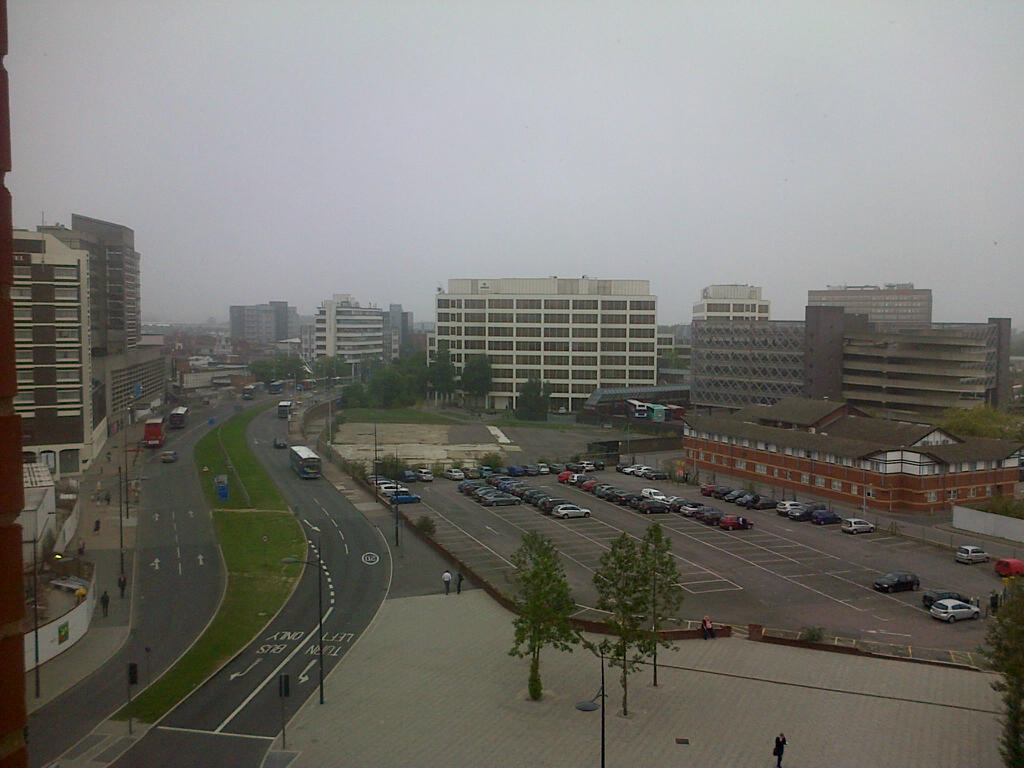
So here I am again, in the picturesque town of Swindon (Wilts) for the three-day festival of fun and frivolity that is the Astronomy Grants Panel. I probably won’t get much time to blog, so I thought I’d post a photograph of the idyllic view from my hotel window, in case any of you think I’m here enjoying myself…


GCSE and A level results: Three steps to make things better

Posted in Education on August 27, 2013 by telescoper

Too busy for a proper post today so I’m going to reblog this interesting reflection on recent examination results from Protons for Breakfast. I had a croissant myself.


Michael de Podesta's avatarProtons for Breakfast

As my own children approach the year in which they will sit GCSE and A level exams, the annual brouhaha  over exam results feels a bit more personal. And my anger over the betrayal of students and the governments abnegation of responsibility in this field grows more intense.

“It wasn’t like this when I were a lad ..”. No really: it wasn’t. Back in the 60’s and 70’s, the results were always the same: for example the top 7.5% (I think that was the number) received an A, the next n% received a B and so on. This approach served to discriminate amongst the candidates. But it didn’t register whether students knew more or less than in previous years.

Then exams were changed in many ways simultaneously. Syllabuses were reduced, continuous assessment introduced, exam boards became wholly-owned by book publishers, and ‘absolute’ marking became the norm. The result…

View original post 377 more words