Insomnia

Posted in Poetry with tags , , on September 3, 2012 by telescoper

Now you hear what the house has to say.
Pipes clanking, water running in the dark,
the mortgaged walls shifting in discomfort,
and voices mounting in an endless drone
of small complaints like the sounds of a family
that year by year you’ve learned how to ignore.

But now you must listen to the things you own,
all that you’ve worked for these past years,
the murmur of property, of things in disrepair,
the moving parts about to come undone,
and twisting in the sheets remember all
the faces you could not bring yourself to love.

How many voices have escaped you until now,
the venting furnace, the floorboards underfoot,
the steady accusations of the clock
numbering the minutes no one will mark.
The terrible clarity this moment brings,
the useless insight, the unbroken dark.

by Dana Gioia (b. 1950).

A-level Chemistry Examination (Paper 2) from 1981

Posted in Education with tags , , , on September 2, 2012 by telescoper

A few days ago I posted Paper 1 of the Chemistry A-level examination I took way back in 1981. Judging by the blog stats, that seemed to attract a bit of interest so I thought I’d follow it up with Paper 2 which, in contrast to the multiple-choice style of Paper 1, consists of longer questions and perhaps gives a better idea of whether anything has changed between then and now.

Anyway, as usual,  any comments from people who’ve done A-level Chemistry more recently would be very welcome through the Comments Box, e.g. is there anything  in this paper that you wouldn’t expect to see nowadays? Is it easier, harder, or about the same as current A-level Chemistry papers?

The Return of Professor Who

Posted in Biographical, Music, Television, The Universe and Stuff with tags , , , , , on September 1, 2012 by telescoper

Since the new series of Doctor Who is to start this evening on BBC1, I thought I’d mark the occasion by posting this old blog item again:

–0–

As a Professor of Astrophysics I am often asked “Why on Earth did you take up such a crazy subject?”

I guess many astronomers, physicists and other scientists have to answer this sort of question. For many of them there is probably a romantic reason, such as seeing the rings of Saturn or the majesty of the Milky Way on a dark night. Others will probably have been inspired by TV documentary series such as The Sky at Night, Carl Sagan’s Cosmos or even Horizon which, believe it or not, actually used to be quite good but which is nowadays uniformly dire. Or it could have been something a bit more mundane but no less stimulating such as a very good science teacher at school.

When I’m asked this question I’d love to be able to put my hand on my heart and give an answer of that sort but the truth is really quite a long way from those possibilities. The thing that probably did more than anything else to get me interested in science was a Science Fiction TV series or rather not exactly the series but the opening titles.

The first episode of Doctor Who was broadcast in the year of my birth, so I don’t remember it at all, but I do remember the astonishing effect the credits had on my imagination when I saw later episodes as a small child. Here is the  opening title sequence as it appeared in the very first series featuring William Hartnell as the first Doctor.

To a younger audience it probably all seems quite tame, but I think there’s a haunting, unearthly beauty to the shapes conjured up by Bernard Lodge. Having virtually no budget for graphics, he experimented in a darkened studio with an old-fashioned TV camera and a piece of black card with Doctor Who written on it in white. He created the spooky kaleidoscopic patterns you see by simply pointing the camera so it could see into its own monitor, thus producing a sort of electronic hall of mirrors.

What is so fascinating to me is how a relatively simple underlying concept could produce a rich assortment of patterns, particularly how they seem to take on an almost organic aspect as they merge and transform. I’ve continued to be struck by the idea that complexity could be produced by relatively simple natural laws which is one of the essential features of astrophysics and cosmology. As a practical demonstration of the universality of physics this sequence takes some beating.

As well as these strange and wonderful images, the titles also featured a pioneering piece of electronic music. Officially the composer was Ron Grainer, but he wasn’t very interested in the commission and simply scribbled the theme down and left it to the BBC to turn it into something useable. In stepped the wonderful Delia Derbyshire, unsung heroine of the BBC Radiophonic Workshop who, with only the crudest electronic equipment available, turned it into a little masterpiece. Ethereal yet propulsive, the original theme from Doctor Who is definitely one of my absolute favourite pieces of music and I’m glad to see that Delia Derbyshire is now receiving the acclaim she deserves from serious music critics.

It’s ironic that I’ve now moved to Cardiff where new programmes of Doctor Who and its spin-off, the anagrammatic Torchwood, are made. One of the great things about the early episodes of Doctor Who was that the technology simply didn’t exist to do very good special effects. The scripts were consequently very careful to let the viewers’ imagination do all the work. That’s what made it so good. I’m pleased that the more recent incarnations of this show also don’t go overboard on the visuals. Perhaps thats a conscious attempt to appeal to people who saw the old ones as well as those too young to have done so. It’s just a pity the modern opening title music is so bad…

Anyway, I still love Doctor Who after all these years. It must sound daft to say that it inspired me to take up astrophysics, but it’s truer than any other explanation I can think of. Of course the career path is slightly different from a Timelord, but only slightly.

At any rate I think The Doctor is overdue for promotion. How about Professor Who?

The Crisis of Secularism – There isn’t enough of it!

Posted in Politics with tags , , , on September 1, 2012 by telescoper

I found this provocative video via the National Secular Society. The speaker is Pat Condell. He makes some excellent points, although I think he spoils it a bit with some cheap gibes. You can respect others’ religious beliefs and still be a secularist.

Here are some links relating to the comments he makes:

Evangelical leaders see secularism as a greater threat than Islam
http://www.voanews.com/english/news/religion/Evangelical-Leaders-See-Seculari…

Ten Commandments Judge Roy Moore: Secularism leads to sharia law
http://www.rawstory.com/rs/2012/05/29/ten-commandments-judge-roy-moore-secula…

Pope warns bishops about secularism
http://www.voxy.co.nz/national/pope-speaks-nz-bishops-about-impact-secularism…

Pope: New evangelisation needed to counter crisis of secularism
http://www.catholicculture.org/news/headlines/index.cfm?storyid=10494

Cardinal warns of ‘aggressive secularism’
http://www.guardian.co.uk/world/2011/apr/24/cardinal-keith-obrien-aggressive-…

Short but sweet – Higgs (1964)

Posted in The Universe and Stuff with tags , , , , on August 31, 2012 by telescoper

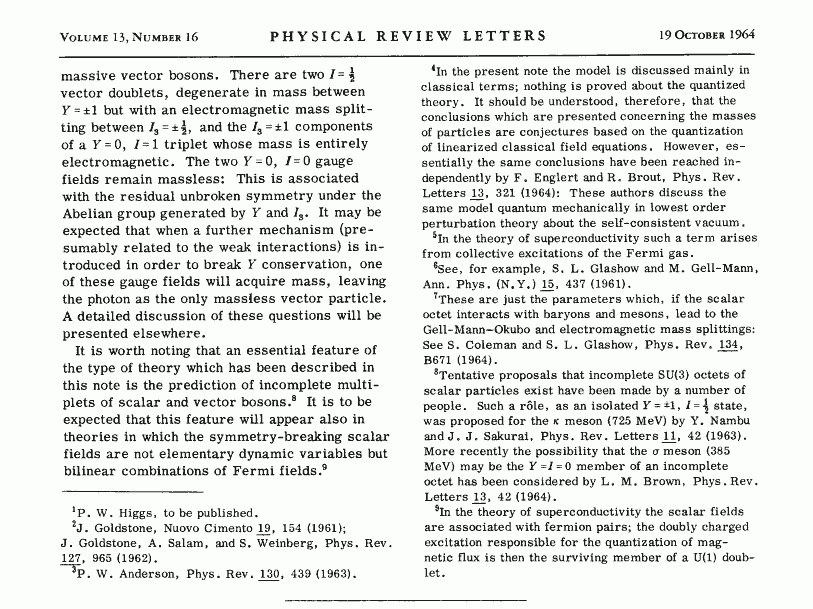
In the light of all this Malarkey about the (claimed) discovery of the Higgs Boson at the Large Hadron Collider, I thought you might be interested to see the original paper by Higgs (1964) in its entirety. As you can see, it’s surprisingly small. The paper, I mean, not the boson…

p.s. The paper is freely available to download from the American Physical Society website; no breach of copyright is intended.

p.p.s. The manuscript was received by Physical Review Letters on 31st August 1964, i.e. 48 years ago today.

Cosmogony

Posted in Music with tags , , on August 31, 2012 by telescoper

And now for something completely different, from the extraordinary whirlwind of creativity actually named   Björk Guðmundsdóttir, but known throughout the Universe simply as Björk.

Laura

Posted in Film, Jazz with tags , , , on August 30, 2012 by telescoper

Last week’s post about Vincent Price reminded me of the film that really established him as a movie actor, the classic film noir Laurain which he played the parasitic boyfriend of the eponymous heroine. If you’ve never seen the film, you should because in my opinion it hasn’t dated at all even though it was made in 1944. A song with the same name written for the film in 1945 (after the filming was completed) became a popular hit at the time as well as a favourite for jazz musicians, spawning numerous cover versions including one by the great Charlie Parker. Those of you who associate Bird with jagged bebop tunes played at a frenetic pace might be surprised to hear his take on this romantic ballad, particularly as it involves him playing with strings. The Charlie Parker with Strings session recorded in 1950 received mixed reviews from the critics, primarily because many of the arrangements are a bit bland, but while  I don’t like all these tracks, I do think Parker’s version of  Laura is a gem in which he  reveals a sensitive side to his music-making that isn’t often appreciated.

A-level Chemistry Examination Paper, Vintage 1981

Posted in Education with tags , , , on August 29, 2012 by telescoper

I don’t know how many followers of this blog are interested in Chemistry, but I thought I’d continue my irregular series of postings of old examination papers with my Chemistry A-level. This particular Paper was Paper 1 of 2 (although I did also take the “special” Paper 3). As you can see Paper 1 was of multiple-choice format, with 40 questions to answer in 75 minutes, which seems a bit stiff! Looking over the exam just now I can’t believe that there was a time when I actually knew this stuff. Nowadays I can only really do the first few questions – because they’re really physics – and I don’t even remember what most of the words mean in the other questions!

Anyway, as usual,  any comments from people who’ve done A-level Chemistry more recently would be very welcome through the Comments Box, e.g. is there anything  in this paper that you wouldn’t expect to see nowadays? Is it easier, harder, or about the same as current A-level Chemistry papers?

The Importance of Being Homogeneous

Posted in The Universe and Stuff with tags , , , , , , , , on August 29, 2012 by telescoper

A recent article in New Scientist reminded me that I never completed the story I started with a couple of earlier posts (here and there), so while I wait for the rain to stop I thought I’d make myself useful by posting something now. It’s all about a paper available on the arXiv by Scrimgeour et al. concerning the transition to homogeneity of galaxy clustering in the WiggleZ galaxy survey, the abstract of which reads:

We have made the largest-volume measurement to date of the transition to large-scale homogeneity in the distribution of galaxies. We use the WiggleZ survey, a spectroscopic survey of over 200,000 blue galaxies in a cosmic volume of ~1 (Gpc/h)^3. A new method of defining the ‘homogeneity scale’ is presented, which is more robust than methods previously used in the literature, and which can be easily compared between different surveys. Due to the large cosmic depth of WiggleZ (up to z=1) we are able to make the first measurement of the transition to homogeneity over a range of cosmic epochs. The mean number of galaxies N(<r) in spheres of comoving radius r is proportional to r^3 within 1%, or equivalently the fractal dimension of the sample is within 1% of D_2=3, at radii larger than 71 \pm 8 Mpc/h at z~0.2, 70 \pm 5 Mpc/h at z~0.4, 81 \pm 5 Mpc/h at z~0.6, and 75 \pm 4 Mpc/h at z~0.8. We demonstrate the robustness of our results against selection function effects, using a LCDM N-body simulation and a suite of inhomogeneous fractal distributions. The results are in excellent agreement with both the LCDM N-body simulation and an analytical LCDM prediction. We can exclude a fractal distribution with fractal dimension below D_2=2.97 on scales from ~80 Mpc/h up to the largest scales probed by our measurement, ~300 Mpc/h, at 99.99% confidence.

To paraphrase, the conclusion of this study is that while galaxies are strongly clustered on small scales – in a complex `cosmic web’ of clumps, knots, sheets and filaments –  on sufficiently large scales, the Universe appears to be smooth. This is much like a bowl of porridge which contains many lumps, but (usually) none as large as the bowl it’s put in.

Our standard cosmological model is based on the Cosmological Principle, which asserts that the Universe is, in a broad-brush sense, homogeneous (is the same in every place) and isotropic (looks the same in all directions). But the question that has troubled cosmologists for many years is what is meant by large scales? How broad does the broad brush have to be?

I blogged some time ago about that the idea that the  Universe might have structure on all scales, as would be the case if it were described in terms of a fractal set characterized by a fractal dimension D. In a fractal set, the mean number of neighbours of a given galaxy within a spherical volume of radius R is proportional to R^D. If galaxies are distributed uniformly (homogeneously) then D = 3, as the number of neighbours simply depends on the volume of the sphere, i.e. as R^3, and the average number-density of galaxies. A value of D < 3 indicates that the galaxies do not fill space in a homogeneous fashion: D = 1, for example, would indicate that galaxies were distributed in roughly linear structures (filaments); the mass of material distributed along a filament enclosed within a sphere grows linear with the radius of the sphere, i.e. as R^1, not as its volume; galaxies distributed in sheets would have D=2, and so on.

We know that D \simeq 1.2 on small scales (in cosmological terms, still several Megaparsecs), but the evidence for a turnover to D=3 has not been so strong, at least not until recently. It’s just just that measuring D from a survey is actually rather tricky, but also that when we cosmologists adopt the Cosmological Principle we apply it not to the distribution of galaxies in space, but to space itself. We assume that space is homogeneous so that its geometry can be described by the Friedmann-Lemaitre-Robertson-Walker metric.

According to Einstein’s  theory of general relativity, clumps in the matter distribution would cause distortions in the metric which are roughly related to fluctuations in the Newtonian gravitational potential \delta\Phi by \delta\Phi/c^2 \sim \left(\lambda/ct \right)^{2} \left(\delta \rho/\rho\right), give or take a factor of a few, so that a large fluctuation in the density of matter wouldn’t necessarily cause a large fluctuation of the metric unless it were on a scale \lambda reasonably large relative to the cosmological horizon \sim ct. Galaxies correspond to a large \delta \rho/\rho \sim 10^6 but don’t violate the Cosmological Principle because they are too small in scale \lambda to perturb the background metric significantly.

The discussion of a fractal universe is one I’m overdue to return to. In my previous post  I left the story as it stood about 15 years ago, and there have been numerous developments since then, not all of them consistent with each other. I will do a full “Part 2” to that post eventually, but in the mean time I’ll just comment that this particularly one does seem to be consistent with a Universe that possesses the property of large-scale homogeneity. If that conclusion survives the next generation of even larger galaxy redshift surveys then it will come as an immense relief to cosmologists.

The reason for that is that the equations of general relativity are very hard to solve in cases where there isn’t a lot of symmetry; there are just too many equations to solve for a general solution to be obtained.  If the cosmological principle applies, however, the equations simplify enormously (both in number and form) and we can get results we can work with on the back of an envelope. Small fluctuations about the smooth background solution can be handled (approximately but robustly) using a technique called perturbation theory. If the fluctuations are large, however, these methods don’t work. What we need to do instead is construct exact inhomogeneous model, and that is very very hard. It’s of course a different question as to why the Universe is so smooth on large scales, but as a working cosmologist the real importance of it being that way is that it makes our job so much easier than it would otherwise be.

P.S. And I might add that the importance of the Scrimgeour et al paper to me personally is greatly amplified by the fact that it cites a number of my own articles on this theme!

Sonnet of the Sweet Complaint

Posted in Poetry with tags , , , on August 28, 2012 by telescoper

Never let me lose the marvel 
of your statue-like eyes, or the accent 
the solitary rose of your breath 
places on my cheek at night.
I am afraid of being, on this shore, 
a branchless trunk, and what I most regret 
is having no flower, pulp, or clay 
for the worm of my despair.
If you are my hidden treasure, 
if you are my cross, my dampened pain, 
if I am a dog, and you alone my master,
never let me lose what I have gained, 
and adorn the branches of your river 
with leaves of my estranged Autumn.

by Federico Garcia Lorca (1898-1936).

This poem is from a collection called Sonetos del amor oscuro (“Sonnets of Dark Love”), which contains the last verses ever written by Lorca. They were written to a young man, with whom the poet had a secret love affair, whose identity remained unknown until earlier this year (2012) when letters and other documents were found which revealed him to be the (then) 19-year old Juan Ramírez de Lucas.
