Kettles, pots and metonymic shifts….

Posted in Uncategorized on December 17, 2012 by telescoper

As our Departmental Christmas lunch is looming I only have time for a brief reblog of this nice discussion of boiling water in pots. It might strike you as as a bit obsessive to write about the physics of such an everyday phenomenon, but I think a bit of an obsession about physics is a very good thing indeed.

P.S. As a fully paid-up member of Pedants Anonymous I couldn’t resist drawing attention to the metonymic shift involved in the title “Watching pots boil”. Of course the pot doesn’t boil – the water in it does….

Michael de Podesta's avatarProtons for Breakfast

My previous article about kettles left me wondering: Can gas hobs really waste more than half of the calorific energy in the gas? I decided to try a few more experiments and finally I think I have an answer: ‘Yes’. Gas hobs really do fail to transfer a great deal of the calorific energy in the gas to the pan or kettle they are heating.

Experiment#1 Rather than measuring the total time to reach 100 °C, I measured the rate of temperature rise. Because the heat capacity of water is well known, this allowed me to estimate how much thermal power was entering the water. So I spent a happy hour or so heating up various amounts of water: first 200g, then 400 g, 600g and finally 800g and I measured the temperature every 20 seconds.

I knew the burner power was 1.75 kW, and after a little jiggery pokery with a…

View original post 639 more words

Another Refusal to Mourn

Posted in Poetry with tags , , , , on December 17, 2012 by telescoper

I posted this poem after the terrible events in Norway last year. Sadly the awful killings in Newton, Connecticut make it relevant again.

The full title is A Refusal to Mourn the Death by Fire of a Child in London  and it was written  by Dylan Thomas. Published just after the end of the Second World War, it was written some time earlier when Thomas heard news of a young girl who had burned to death when the house she was in was set on fire during an air raid. Here is the poet himself reading it.

The idea behind the poem is complex, and its message double-edged,  but Thomas finds a perfect balance between horror and sadness, and between indignation and heartbreak. Children shouldn’t have to die, and neither should anyone else whose life is cut short by another’s hand, but we have to accept that they can and do.  There’s no consolation to be found in mourning  and in any case it’s hypocritical to favour one death with elegies, when suffering is so widespread. The best we can do is allow the dead some dignity and their families and loved ones some time to grieve.

Never until the mankind making
Bird beast and flower
Fathering and all humbling darkness
Tells with silence the last light breaking
And the still hour
Is come of the sea tumbling in harness

And I must enter again the round
Zion of the water bead
And the synagogue of the ear of corn
Shall I let pray the shadow of a sound
Or sow my salt seed
In the least valley of sackcloth to mourn

The majesty and burning of the child’s death.
I shall not murder
The mankind of her going with a grave truth
Nor blaspheme down the stations of the breath
With any further
Elegy of innocence and youth.

Deep with the first dead lies London’s daughter,
Robed in the long friends,
The grains beyond age, the dark veins of her mother,
Secret by the unmourning water
Of the riding Thames.
After the first death, there is no other.

God sent the shooter….

Posted in Uncategorized with tags on December 16, 2012 by telescoper

Sometimes I just despair. Watch this and weep. If this is your God, I weep for you too.

Elsevierballs

Posted in Open Access with tags , , on December 16, 2012 by telescoper

Have you heard all the stories about the carefully-managed system of peer review that justifies the exorbitant cost of Elsevier journals? Then read this…

Ivan Oransky's avatarRetraction Watch

elsevierFor several months now, we’ve been reporting on variations on a theme: Authors submitting fake email addresses for potential peer reviewers, to ensure positive reviews. In August, for example, we broke the story of a Hyung-In Moon, who has now retracted 24 papers published by Informa because he managed to do his own peer review.

Now, Retraction Watch has learned that the Elsevier Editorial System (EES) was hacked sometime last month, leading to faked peer reviews and retractions — although the submitting authors don’t seem to have been at fault. As of now, eleven papers by authors in China, India, Iran, and Turkey have been retracted from three journals.

Here’s one of two identical notices that have just run in Optics & Laser Technology, for two unconnectedpapers:

View original post 556 more words

Astronomy Look-alikes, No. 80

Posted in Astronomy Lookalikes with tags , on December 16, 2012 by telescoper

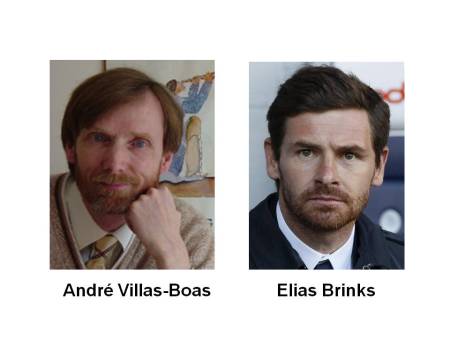
Apparently, while I was away, Elias Brinks, the manager of Tottenham Hotspur (which seems to be some sort of football team), came to Cardiff to examine a PhD thesis scouting for new players to sign. One of the locals was struck by his resemblance to Andre Villas-Boas, the well-known astrophysicist from the University of Hertfordshire. I wonder if by any chance they might be related?

Lookalikes

Back to “Civilization”….

Posted in Biographical with tags , , , on December 15, 2012 by telescoper

Time for a quick post this evening now that I’m back in Blighty. I’ve spent the last week in Passo del Tornale in the Italian Alps giving some lectures at the 2012 Transregio Winter School in Cosmology, of which (perhaps) more anon. I was in fact a day late getting home because British Airways decided to cancel the flight on which I was booked (from Verona to London Gatwick) yesterday. I’m not sure whether it was to do with the fact that it was snowing pretty heavily, or that the flight was under-booked and they couldn’t be bothered. Anyway, BA at least sent a text message while I was still on the train from Trento to Verona and I was able to re-book to 10.30am today straight away by phone. Rather than get grumpy about being delayed for a day I decided to make the best of it, there being many worse places in the world than Verona to be stranded after all. So, having found a nice hotel, I went off with two others from the meeting who had been similarly inconvenienced for a stroll around the city, which looked very atmospheric in the slush that was developing as the snow turned to rain. Here is the famous Arena di Verona as I snapped it with my Blackberry:

IMG-20121214-00011

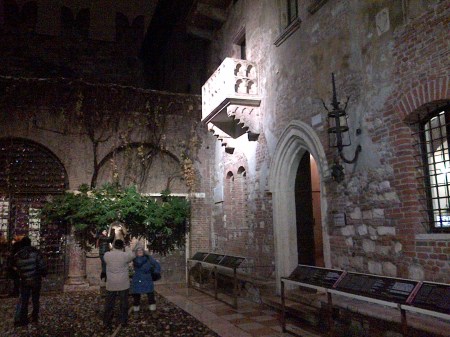
And here is the even more famous, at least for people who’ve heard of Shakespeare, but somewhat less impressive Casa di Giulietta.

IMG-20121214-00012

What light from yonder window breaks? Actually it’s a floodlamp.

After that we had a warming glass of vin brulé (mulled wine) in the Piazza delle Erbe before finding a rather posh Trattoria and having a sumptuous meal, accompanied by a bottle of excellent (and rather expensive) Amarone. What the hell, it’s Christmas, and anyway when in Rome….

Anyway, a good night’s sleep followed and the second attempt to get home worked out very well: flight on time, train connections fine, no problems with the house when I got home (apart from the fact that my cable TV seems to have packed in), and it’s a lot warmer here than it was where I’ve been for the past week. Buying today’s Independent at Reading station, in between trains, I discovered that I’ve won the crossword prize again. Dictionary No. 10 should be here before Xmas.

It’s nice to be home.

Interlude

Posted in Uncategorized on December 8, 2012 by telescoper

Well, dear readers, I have to go away for a week or so, and the place I’m going doesn’t offer internet access, so I’m going to have to suspend blogging activities until I return. Normal service will be resumed as soon as possible, but in the meantime here’s one of those old BBC Interlude films to keep you entertained…

My Last Cardiff Lecture

Posted in Biographical, Education, The Universe and Stuff with tags , , on December 7, 2012 by telescoper

Hey ho.

This morning, as usual for a Friday, the alarm went off at 6am and I started the slow process of getting my brain in gear for a two-hour 9am lecture. As usual, by the start of the lecture I was still trying to wake up, but I at least managed to get through the performance  making only  finite number of errors.

The topic for day was Fourier series, and especially how to use them to solve interesting partial differential equations. The one I chose to illustrate the general method of separation of variables was the heat conduction equation, appropriately enough because Joseph Fourier, the man himself, developed the idea of using   trigonometric functions to represent other functions in order to solve that equation; he presented the method in his book Théorie analytique de la chaleur way back in 1822.

During the lecture I also had to distribute another bunch of questionnaires to the students to allow them to give constructive feedback vent their spleen at my incompetence and lack of organization. We already had one set of questionnaires halfway through the term, so I’m not sure why we need another one. Perhaps the students gave the wrong answers to the questions last time, so this is like a resit?

When it was all over, and I returned to my office to recover,  I suddenly realised that it was my last Cardiff lecture ever. (There is in fact another week remaining before the Christmas break, but I’m away next week and a colleague will fill in for me. ) In fact, it might have been my last undergraduate lecture ever, as I’m not sure how much time I’ll get for actual teaching when I move to my new job in the New Year. I think I’ll miss it, actually, but I’m not sure the students will!

Still, at least I get to set my alarm to a more sensible time from now on.

Society Counts, and so do Astronomers!

Posted in Bad Statistics, Science Politics with tags , , , , , on December 6, 2012 by telescoper

The other day I received an email from the British Academy (for Humanities and Social Sciences) announcing a new position statement on what they call Quantitative Skills.  The complete text of this statement, which is entitled Society Counts and which is well worth reading,  is now  available on the British Academy website.

Here’s an excerpt from the letter accompanying the document:

The UK has a serious deficit in quantitative skills in the social sciences and humanities, according to a statement issued today (18 October 2012) by the British Academy. This deficit threatens the overall competitiveness of the UK’s economy, the effectiveness of public policy-making, and the UK’s status as a world leader in research and higher education.

The statement, Society Counts, raises particular concerns about the impact of this skills deficit on the employability of young people. It also points to serious consequences for society generally. Quantitative skills enable people to understand what is happening to poverty, crime, the global recession, or simply when making decisions about personal investment or pensions.

Citing a recent survey of MPs by the Royal Statistical Society’s getstats campaign – in which only 17% of Conservative and 30% of Labour MPs thought politicians use official statistics and figures accurately when talking about their policies – Professor Sir Adam Roberts, President of the British Academy, said: “Complex statistical and analytical work on large and complex data now underpins much of the UK’s research, political and business worlds. Without the right skills to analyse this data properly, government professionals, politicians, businesses and most of all the public are vulnerable to misinterpretation and wrong decision-making.”

The statement clearly identifies a major problem, not just in the Humanities and Social Sciences but throughout academia and wider society. I even think the British Academy might be a little harsh on its own constituency because, with a few notable exceptions,  statistics and other quantitative data analysis methods are taught very poorly to science students too.  Just the other day I was talking to an undergraduate student who is thinking about doing a PhD in physics about what that’s likely to entail. I told him that the one thing he could be pretty sure he’d have to cope with is analysing data statistically. Like most physics departments, however, we don’t run any modules on statistical techniques and only the bare minimum is involved in the laboratory session. Why? I think it’s because there are too few staff who would be able to teach such material competently (because they don’t really understand it themselves).

Here’s a paragraph from the British Association statement:

There is also a dearth of academic staff able to teach quantitative methods in ways that are relevant and exciting to students in the social sciences and humanities. As few as one in ten university social science lecturers have the skills necessary to teach a basic quantitative methods course, according to the report. Insufficient curriculum time is devoted to methodology in many degree programmes.

Change “social sciences and humanities” to “physics” and I think that statement would still be correct. In fact I think “one in ten” would be an overestimate.

The point is that although  physics is an example of a quantitative discipline, that doesn’t mean that the training in undergraduate programmes is adequate for the task. The upshot is that there is actually a great deal of dodgy statistical analysis going on across a huge number of disciplines.

So what is to be done? I think the British Academy identifies only part of the required solution. Of course better training in basic numeracy at school level is needed, but it shouldn’t stop there. I think there also needs to a wider exchange of knowledge and ideas across disciplines and a greater involvement of expert consultants. I think this is more likely to succeed than getting more social scientists to run standard statistical analysis packages. In my experience, most bogus statistical analyses do not result from using the method wrong, but from using the wrong method…

A great deal of astronomical research is based on inferences drawn from large and often complex data sets, so astronomy is a discipline with a fairly enlightened attitude to statistical data analysis. Indeed, many important contributions to the development of statistics were made by astronomers. In the future I think we’ll  see many more of the astronomers working on big data engage with the wider academic community by developing collaborations or acting as consultants in various ways.

We astronomers are always being challenged to find applications of their work outside the purely academic sphere, and this is one that could be developed much further than it has so far. It disappoints me that we always seem to think of this exclusively in terms of technological spin-offs, while the importance of transferable expertise is often neglected. Whether you’re a social scientist or a physicist, if you’ve got problems analysing your data, why not ask an astronomer?

The Winter Palace

Posted in Poetry with tags , , on December 5, 2012 by telescoper

Most people know more as they get older:
I give all that the cold shoulder.

I spent my second quarter-century
Losing what I had learnt at university.

And refusing to take in what had happened since.
Now I know none of the names in the public prints,

And am starting to give offence by forgetting faces
And swearing I’ve never been in certain places.

It will be worth it, if in the end I manage
To blank out whatever it is that is doing the damage.

Then there will be nothing I know.
My mind will fold into itself, like fields, like snow.

by Philip Larkin (1922-1985)