Passenger Action

Posted in Biographical with tags , on December 4, 2012 by telescoper

I made it  to Brighton last night, safe and well and in good time. It seems the flooding was finally fixed early yesterday morning and my train was neither delayed nor re-routed. I even got here in time for dinner. Having a look at facebook while I was on the train I saw a friend of mine had posted a story from the Independent about suicides on the railways, which are sadly on the increase, and the cold and unsympathetic response they often receive from the travelling public.

A few years ago when I was external examiner, I was on a train from Nottingham to Cambridge going to an examiners meeting at the University of Cambridge. I had a window seat near the front of the carriage on the right hand side. Just outside Peterborough, the train was on a curved stretch of track so I could see the line in front of us. There was a level crossing with the barriers down and cars waiting either side. I could see quite clearly a female figure standing in the middle of the crossing but as the train got closer to her she vanished from view, obscured by the train. I heard the train’s warning signal and, seconds later, the driver shouted out “Oh No..”.

There was a horrible thump and the train lurched as it travelled over something that had gone underneath. The gruesome sound of a human body being sliced apart by metal wheels is something I’ll never forget. The train came to a halt, and the driver opened the door to his compartment. I could see that blood had sprayed over the front window. The poor driver looked like a ghost. He sat down, shocked. He said that when he sounded the alarm the lady had turned and walked along the track towards the train. She looked directly into his eyes as the train hit her.

Eventually, perhaps an hour later, transport police and an ambulance arrived at the scene and a replacement driver was brought to us; train drivers can never carry on after such an event.  Some even have to quit the job. A police chaplain came too. The police and ambulance people collected the remains, made measurements, interviewed various people who had seen what happened and declared it a suicide. We moved to the next station, March, and got off onto the platform, the front of the train quickly hidden from us by a large piece of white canvas.

There had been time for the transport policemen to talk to the passengers who were all, like me, rattled by the experience. They (the police) had been through this all before, they said. That particular level crossing was  a place people came to specifically for that reason. Nobody could say why there and not somewhere else. Apparently it’s the same on the London Underground. Some stations have many suicides of people jumping in front of trains, others virtually none. Who can say why.

Suicides are not as rare as you might think. In the United Kingdom each year about one person in ten thousand takes their own life; we’re actually quite a long way down the league table for suicide rates. Men are about three times as likely to do it as women. My cousin Gary did it a few years ago. There are several per week just at railway stations or on railway lines across the United Kingdom, adding up to over 200 per year.

When I was told these facts I was completely shocked. It has never crossed my mind to take my own life, especially not in a way that seems designed to cause other people suffering too. And I’m not talking about the inconvenience of being delayed. Meetings can always be rearranged, plans can be altered. I mean the anguish such events cause to people who care about their fellow human beings, even strangers. Nobody really understands another person’s pain, but that doesn’t mean we shouldn’t try. If we don’t then do we really have the right to call ourselves human?

Taken at the flood

Posted in Biographical with tags , , , on December 3, 2012 by telescoper

I find myself in the unusual situation of having lunch at home on a working Monday. This is because I have to travel down to Brighton this evening for some Sussex business tomorrow. Not wanting to carry all my stuff into work and thence to the station I decided to plan on coming home for a bite to eat before setting out on the journey.

Normally the journey from Cardiff to Brighton would be expected to take about four hours via London, but there’s been a lot of disruption to the trains recently owing to flooding that occurred after a period of heavy rain about 10 days ago. In fact the area, between Bristol Parkway and Swindon, that flooded this time seems to do so regularly, each time catching Network Rail Notwork Fail completely by surprise. Why has this localised flooding taken so long to fix? I have no idea. I’m no engineer, but I would have thought it should be possible to do something about a problem so well known. But that never seems to happen, and the system is thrown into chaos nearly every time it rains, with trains having to be re-routed or cancelled in shambolic fashion. We are however getting a bigger station at Reading, which apparently means that more trains can be run into and out of London. Until the line floods again.

Anyway, I’m taking no chances and setting out early. If I am to endure a scenic diversion via Bath at least I’ll have plenty to do: coursework to mark, stuff to read, and papers to revise. Wish me luck. I think I’ll need it.

The Lord is listenin’ to ya, Hallelujah!

Posted in Jazz with tags , , , , , , , on December 2, 2012 by telescoper

It’s a cold and dreary Sunday and I’m definitely in need of a pick-me-up, so I thought I’d share this you. It was recorded live in 1981 by the Carla Bley Band and can be found on a superb album called, appropriately enough, Carla Bley Live! When this record came out I was an avid listener to Humphrey Lyttelton’s radio show The Best of Jazz and he chose this magnificent track featuring the trombonist Gary Valente as a taster for the album. It became one of the all-time favourites on his show and he played it a number of times over the years.  It’s also one of the most-played tracks on my iPod, as I find it very uplifting on long and wearisome train journeys.

The trombone is usually described as a brass instrument, but Gary Valente makes  his sound more like it’s made of wrought iron; Humph described the sound as as “like that of a wounded bison”. Anyway, ignore the rather dull pictures of churches used in the video, and just listen to one of the  most overwhelming performances in all of Jazz; the immensity of Valente’s trombone sound is at times almost terrifying. And if you’re one of those people who dislikes Jazz that’s stylistically dated later than about 1945, give this a hearing because it’s absolutely drenched in the Blues and Gospel traditions. I’ll even let you call it awesome…

P.S. No, I haven’t gone religious, but this track disproves the old theory that the devil has the best music…

Urgent Announcement from the AGP

Posted in Science Politics with tags , , , on December 1, 2012 by telescoper

As the festive season approaches, the UK government has decided  to make immediate changes to the  procedures to be followed for the allocation and distribution of yuletide gifts. In previous years, such awards have been made  directly by the agency involved, e.g. proposals within the STFC  remit have been directly Sent To Father Christmas, often in hand-written format. However, to cut costs improve the quality of service, it has been decided to extend the operations of the Shared Services Centre to cover such applications, which will henceforth be administered by a Shared Santa Claus (SSC), after being uploaded to the JES system (in Word 95 format only). They will then be sent to relevant experts for peer review, i.e. the Advent Gift Panel (AGP).

In preparing submissions, Applicants should note the following  important revisions to AGP guidelines.

Proposals must include:

  1. The aims and scope of the presents requested and any interrelation between them, where appropriate.
  2. The areas in which the Applicants have a proven track-record in the general area of not being naughty, including (where appropriate) highlights of particularly good behaviour within the last three years.
  3. The support  already provided to the Applicants with particular emphasis on recent investments that are relevant to the gifts requested.
  4. How the Applicants will be advanced as a result of the proposed present.
  5. How the  requested present  fits within the international context, i.e. is it of comparable quality to the best gifts available overseas?
  6. The likely impact of the present (e.g. when thrown around the living room).
  7. How you expect the present to evolve over the next three years, e.g. is it likely to break or need repair?
  8. The level of resources needed to supply the present.
  9. How the gift will contribute to the UK economy over the next thirty years.

The following supplementary rules also apply:

  1. Consumables will be allocated using a formula based on the number of FTE awarded, to include (per FTE): one Bernard Matthews Turkey Twizzler, three sprouts, 2 potatoes (including one roast if the case justifies such extravagance), and one small carrot/parsnip. Gravy is expected to be provided from local resources.
  2. Christmas puddings and/or mince pies are covered by a different  programme (overseen by the Hefty Pudding Committee, HPC)  and will require a separate application; a Cheese Board may also be convened if there is sufficient demand.
  3. Requests for crackers are welcomed, as long as the proposal is not entirely crackers.
  4. Travel expenses will be limited to the cost of one sleigh ride (weather permitting).
  5. Batteries will not be included.
  6. Under no circumstances will funding be allocated for the purchase of paperweights.
  7. Each proposal  must be accompanied by a Knowledge Exchange case, explaining the impact of the proposal outside the STFC remit.
  8. Each proposal must be accompanied by an Outreach case outlining any public activities,  such as carol singing.

The deadline for applications is Friday 14th December 2012. In line with normal shambolically inefficient SSC practice, awards are expected to be made sometime in April (2014).

I hope this clarifies the situation.

Sonnet No. 97

Posted in Poetry with tags , , , on December 1, 2012 by telescoper


How like a winter hath my absence been
From thee, the pleasure of the fleeting year!
What freezings have I felt, what dark days seen!
What old December’s bareness every where!
And yet this time remov’d was summer’s time;
The teeming autumn, big with rich increase,
Bearing the wanton burden of the prime,
Like widow’d wombs after their lords’ decease:
Yet this abundant issue seem’d to me
But hope of orphans and unfather’d fruit;
For summer and his pleasures wait on thee,
And, thou away, the very birds are mute:
Or, if they sing, ’tis with so dull a cheer,
That leaves look pale, dreading the winter’s near.

Sonnet No.97 , by William Shakespeare (1564-1616)

SPT and the CMB

Posted in The Universe and Stuff with tags , , , , , , , , , on November 30, 2012 by telescoper

I’ve been remiss in not yet passing on news  from the South Pole Telescope, which has recently produced a number of breakthrough scientific results, including:  improved cosmological constraints from the SPT-SZ cluster survey (preprint here); a new catalogue of 224 SZ-selected cluster candidates from the first 720 square-degrees of the survey (preprint here); the first measurement of galaxy bias from the gravitational lensing of the CMB (preprint here); the first CMB-based constraint on the evolution of the ionized fraction during the epoch of reionization (preprint here); the most-significant detection of non-Gaussianity induced from the gravitational lensing of the CMB (preprint here); and the most precise measurement of the CMB damping tail and improved constraints on models of Inflation (preprint here).

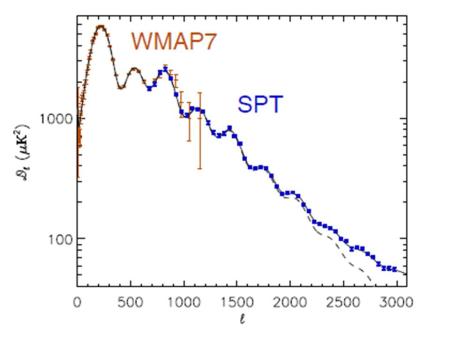
Here’s the graph that drew my eye (from this paper). It shows the (angular) power spectrum of the cosmic microwave for very high (angular) frequency spherical harmonics; the resolution of SPT allows it to probe finer details of the spectrum that WMAP (also shown, at lower l).

Slide1

This is an amazing graph, especially for oldies like me who remember being so impressed by the emergence of the first “acoustic peak” at around l=200 way back in the days of Boomerang and Maxima and gobsmacked by WMAP’s revelation of the second and third. Now there are at least six acoustic peaks, although of progressively lower amplitude. The attenuation of the CMB fluctuations at high frequencies is the result of diffusion damping – similar to the way high-frequency sound waves are attenuated when they pass through a diffusive medium (e.g. a gas).  The phenomenon in this case is usually called Silk Damping, as it was first worked out back in the 1960s by Joe Damping Silk.

Anyway, there’ll be a lot more CMB news early (?) next year from Planck which will demonstrate yet again that cosmic microwave background physics has certainly come a long way from pigeon shit…

Simulations and False Assumptions

Posted in The Universe and Stuff with tags , , , , on November 29, 2012 by telescoper

Just time for an afternoon quickie!

I saw this abstract by Smith et al. on the arXiv today:

Future large-scale structure surveys of the Universe will aim to constrain the cosmological model and the true nature of dark energy with unprecedented accuracy. In order for these surveys to achieve their designed goals, they will require predictions for the nonlinear matter power spectrum to sub-percent accuracy. Through the use of a large ensemble of cosmological N-body simulations, we demonstrate that if we do not understand the uncertainties associated with simulating structure formation, i.e. knowledge of the `true’ simulation parameters, and simply seek to marginalize over them, then the constraining power of such future surveys can be significantly reduced. However, for the parameters {n_s, h, Om_b, Om_m}, this effect can be largely mitigated by adding the information from a CMB experiment, like Planck. In contrast, for the amplitude of fluctuations sigma8 and the time-evolving equation of state of dark energy {w_0, w_a}, the mitigation is mild. On marginalizing over the simulation parameters, we find that the dark-energy figure of merit can be degraded by ~2. This is likely an optimistic assessment, since we do not take into account other important simulation parameters. A caveat is our assumption that the Hessian of the likelihood function does not vary significantly when moving from our adopted to the ‘true’ simulation parameter set. This paper therefore provides strong motivation for rigorous convergence testing of N-body codes to meet the future challenges of precision cosmology.

This paper asks an important question which I could paraphrase as “Do we trust N-body simulations too much?”.  The use of numerical codes in cosmology is widespread and there’s no question that they have driven the subject forward in many ways, not least because they can generate “mock” galaxy catalogues in order to help plan survey strategies. However, I’ve always worried that there is a tendency to trust these calculations too much. On the one hand there’s the question of small-scale resolution and on the other there’s the finite size of the computational volume. And there are other complications in between too. In other words, simulations are approximate. To some extent our ability to extract information from surveys will therefore be limited by the inaccuracy of our calculation of  the theoretical predictions.

Anyway,  the paper gives us quite a few things to think about and I think it might provoke a bit of discussion, which is why I mentioned it here – i.e. to encourage folk to read and give their opinions.

The use of the word “simulation” always makes me smile. Being a crossword nut I spend far too much time looking in dictionaries but one often finds quite amusing things there. This is how the Oxford English Dictionary defines SIMULATION:

1.

a. The action or practice of simulating, with intent to deceive; false pretence, deceitful profession.

b. Tendency to assume a form resembling that of something else; unconscious imitation.

2. A false assumption or display, a surface resemblance or imitation, of something.

3. The technique of imitating the behaviour of some situation or process (whether economic, military, mechanical, etc.) by means of a suitably analogous situation or apparatus, esp. for the purpose of study or personnel training.

So it’s only the third entry that gives the intended meaning. This is worth bearing in mind if you prefer old-fashioned analytical theory!

In football, of course, you can even get sent off for simulation…

Three Astronomy Jobs at Sussex – The Deadline Approaches!

Posted in The Universe and Stuff with tags , , , on November 29, 2012 by telescoper

I’m taking the liberty of repeating this advertisement in case anybody out there missed it. Here is an announcement of three (new, permanent) jobs in Astronomy at the University of Sussex. You can also find an advertisment in the November AAS Jobs Register. In fact this is it. The deadline is 30th November, i.e. tomorrow, so if you want to apply then you had better get your skates on!

Full details of the positions are in the above links, but the gist is that applications are invited for 3 permanent, full-time faculty positions within the Astronomy Centre.

The 8 existing faculty have research interests that span the observation, modelling/simulation and theory of extragalactic astronomy and cosmology.  We are seeking talented and ambitious colleagues whose research interests complement and extend our current activity.

I’ll be interested to see how many people apply as a result of seeing this here announcement, so if you do fill in an application form  be sure to answer the question “Where did you see this post advertised” with “In the Dark”!

Open Day and Subject Fair

Posted in Education with tags , , , , , on November 28, 2012 by telescoper

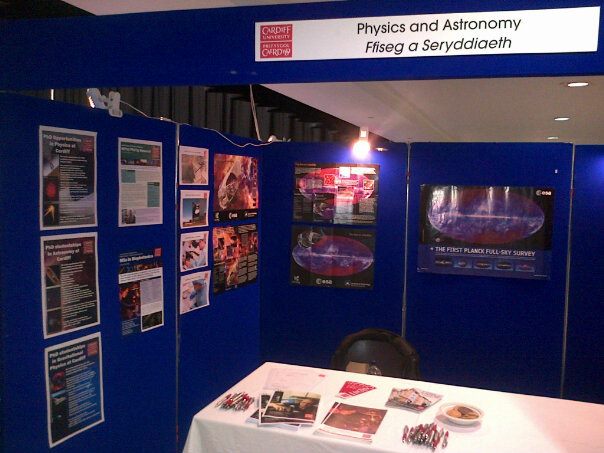
Today was the Postgraduate Open Day for Cardiff University, so I trooped off at lunchtime to man person the School of Physics & Astronomy stand in the Great Hall of the Students in the Students’ Union for the Subject Fair. It’s the first time I’ve ever been in the Great Hall, in fact, for no other reason than it’s for the students not the staff. Anyway, I have to say it didn’t look all that great, although at least it was warm. There’s no heating in my office right now, you see. And they provided coffee and biscuits.

Other than that it was just me, some leaflets and an uncountable infinity of Herschel Space Observatory souvenir pens sitting there for two hours. And there was lousy mobile coverage so I couldn’t even tweet. I got a bit bored, actually. I wish I’d taken my knitting. I did take a picture though…

It has to be said that a general Postgraduate Open Day like this isn’t a very effective method of recruiting postgraduate students, not in Physics and Astronomy at least. Most potential applicants come to apply by looking at web pages and/or listening to advice from people in the department where they are doing or did their first degree. People have already decided between Physics and, say, Astronomy and certainly between either of those and Sociology, so the idea of stalls competing for custom is a bit absurd.

Still, as Director of Postgraduate Studies I decided that it was good for Physics and Astronomy to show willing by maintaining a presence at such events, and if as a bonus we recruit even one promising PhD student then it’s probably worth the investment in time. The additional complication with this now is that I’m soon leaving to go to Sussex University, so I was tempted to tell visitors about opportunities there. I didn’t though. Mainly because I hardly spoke to anyone all afternoon…

The moral of this tale – if there is one – is that recruitment in different subjects is very different, so the “one size fits all” centralised approach isn’t always the right way to proceed. Schools and departments know their market better than anyone, so they need to be allowed to do their own thing at least part of the time.

I suspect this is an argument I’ll shortly be making elsewhere.

Diamond Lights

Posted in Football, Music, Science Politics with tags , , , on November 27, 2012 by telescoper

Apparently there’s been a posh do this evening at the Royal Society to celebrate the 10th Anniversary of the Diamond Light Source. In fact the Diamond Light Source has its own anniversary blog that’s been posting celebratory things for a while; the actual anniversary being celebrated was the signing of the agreement to set up the Diamond Light Source, which happened on March 27th 2002. Actual operations didn’t commence until 2007, at a total cost of £260m, which is when STFC was created and told to pick up the tab for running the facility which, together with a few other things, precipitated a financial crisis from which UK particle physics and astronomy are only just starting to recover.

I don’t be churlish about the good science the Diamond Light Sources is undoubtedly doing so I thought I’d mark the anniversary here. The blog I mentioned above has a video page but it sadly doesn’t contain the video I most expected to see. This, Diamond Lights, was released – or did it escape? – in 1987 and it “stars” Glen Hoddle and Chris Waddle who, as singers, were both excellent footballers. I’m surprised STFC Chief Executive John Womersley didn’t record a cover version of this as part of the anniversary celebrations…