I’m taking the liberty of repeating this advertisement in case anybody out there missed it. Here is an announcement of three (new, permanent) jobs in Astronomy at the University of Sussex. You can also find an advertisment in the November AAS Jobs Register. In fact this is it. The deadline is 30th November, i.e. tomorrow, so if you want to apply then you had better get your skates on!
Full details of the positions are in the above links, but the gist is that applications are invited for 3 permanent, full-time faculty positions within the Astronomy Centre.
The 8 existing faculty have research interests that span the observation, modelling/simulation and theory of extragalactic astronomy and cosmology. We are seeking talented and ambitious colleagues whose research interests complement and extend our current activity.
I’ll be interested to see how many people apply as a result of seeing this here announcement, so if you do fill in an application form be sure to answer the question “Where did you see this post advertised” with “In the Dark”!
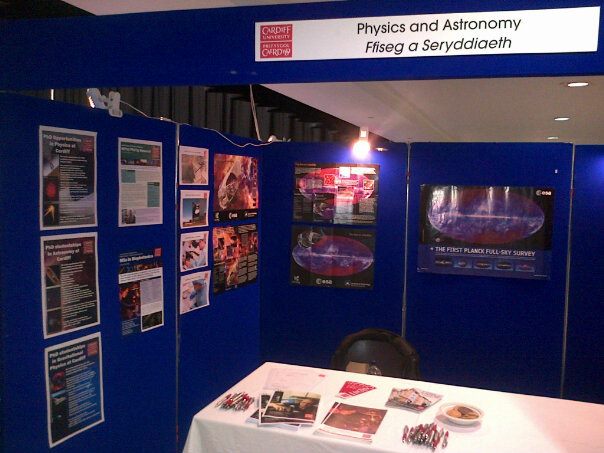
Today was the Postgraduate Open Day for Cardiff University, so I trooped off at lunchtime to man person the School of Physics & Astronomy stand in the Great Hall of the Students in the Students’ Union for the Subject Fair. It’s the first time I’ve ever been in the Great Hall, in fact, for no other reason than it’s for the students not the staff. Anyway, I have to say it didn’t look all that great, although at least it was warm. There’s no heating in my office right now, you see. And they provided coffee and biscuits.
Other than that it was just me, some leaflets and an uncountable infinity of Herschel Space Observatory souvenir pens sitting there for two hours. And there was lousy mobile coverage so I couldn’t even tweet. I got a bit bored, actually. I wish I’d taken my knitting. I did take a picture though…
It has to be said that a general Postgraduate Open Day like this isn’t a very effective method of recruiting postgraduate students, not in Physics and Astronomy at least. Most potential applicants come to apply by looking at web pages and/or listening to advice from people in the department where they are doing or did their first degree. People have already decided between Physics and, say, Astronomy and certainly between either of those and Sociology, so the idea of stalls competing for custom is a bit absurd.
Still, as Director of Postgraduate Studies I decided that it was good for Physics and Astronomy to show willing by maintaining a presence at such events, and if as a bonus we recruit even one promising PhD student then it’s probably worth the investment in time. The additional complication with this now is that I’m soon leaving to go to Sussex University, so I was tempted to tell visitors about opportunities there. I didn’t though. Mainly because I hardly spoke to anyone all afternoon…
The moral of this tale – if there is one – is that recruitment in different subjects is very different, so the “one size fits all” centralised approach isn’t always the right way to proceed. Schools and departments know their market better than anyone, so they need to be allowed to do their own thing at least part of the time.
I suspect this is an argument I’ll shortly be making elsewhere.
Apparently there’s been a posh do this evening at the Royal Society to celebrate the 10th Anniversary of the Diamond Light Source. In fact the Diamond Light Source has its own anniversary blog that’s been posting celebratory things for a while; the actual anniversary being celebrated was the signing of the agreement to set up the Diamond Light Source, which happened on March 27th 2002. Actual operations didn’t commence until 2007, at a total cost of £260m, which is when STFC was created and told to pick up the tab for running the facility which, together with a few other things, precipitated a financial crisis from which UK particle physics and astronomy are only just starting to recover.
I don’t be churlish about the good science the Diamond Light Sources is undoubtedly doing so I thought I’d mark the anniversary here. The blog I mentioned above has a video page but it sadly doesn’t contain the video I most expected to see. This, Diamond Lights, was released – or did it escape? – in 1987 and it “stars” Glen Hoddle and Chris Waddle who, as singers, were both excellent footballers. I’m surprised STFC Chief Executive John Womersley didn’t record a cover version of this as part of the anniversary celebrations…
Too busy today (again) for anything else so I’m going to resort (again) to the Cavendish Problems in Classical Physics. I think I’ll eschew the multiple-choice format for this one, but will say that there is a small hint in the fact that the question is split into two parts:
The Eiffel Tower is 300m high and is situated at a latitude 49° N. What are the magnitude and direction of the deflection caused by the Earth’s rotation to:
the bob of a plumb-line hung from the top of the Tower;
the point of impact of a body dropped from the top?
Please give your answers, with reasons, through the comments box below. For legal reasons I should make it clear that you are not expected to perform either experiment.
So. Today I finally finished a stack of things I should have done weeks ago, including compiling the teaching timetable for next semester (when I won’t even be here) Anyway, that means I can now move onto the next stack of things that I should also have done weeks ago, after I’ve finished marking the batch of 100 second-year coursework scripts sitting on my desk. There’s no rest for the <insert appropriate adjective>.
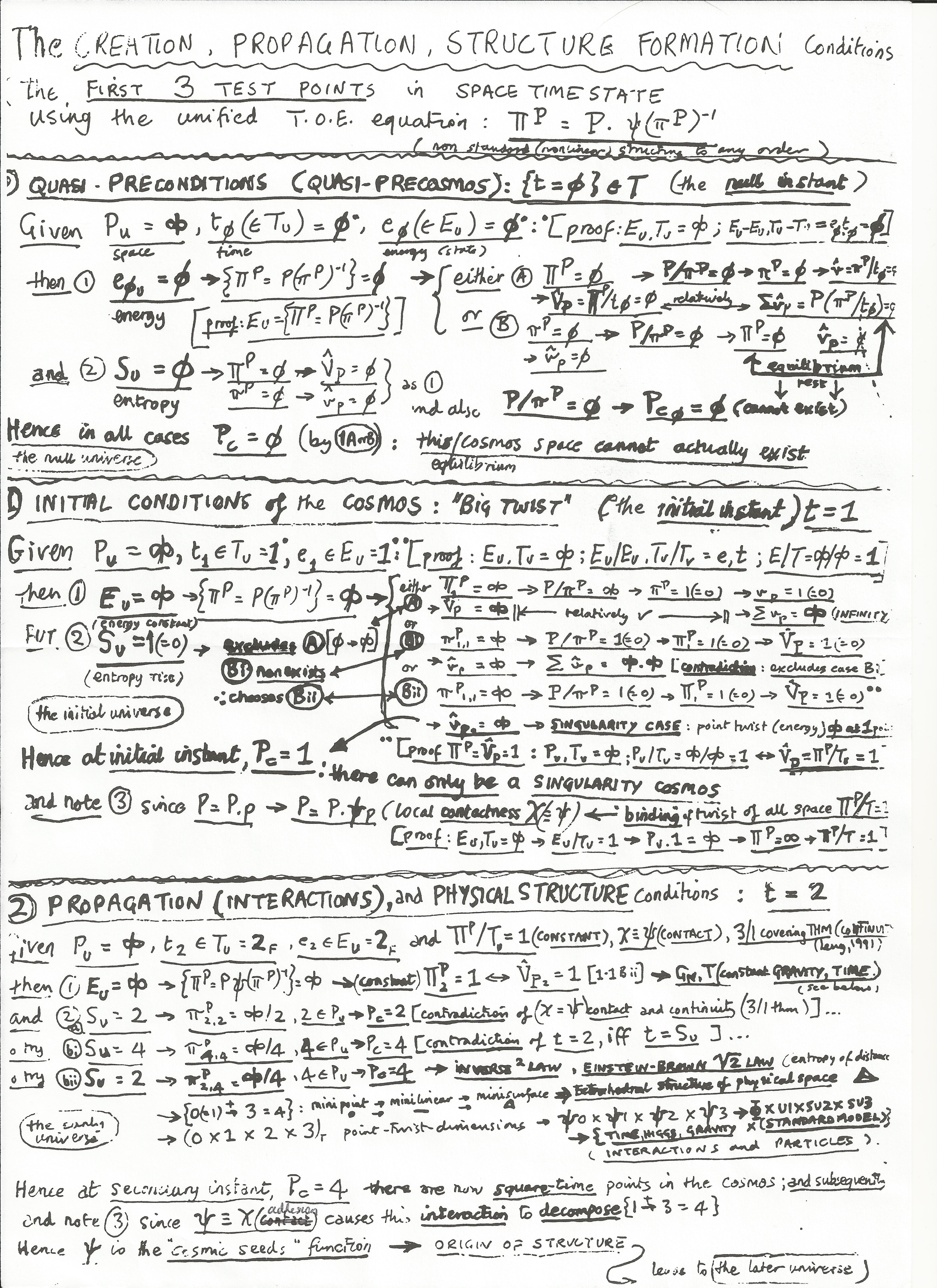
Anyway, it’s now just a couple of months before I shuffle off the coil of Cardiff, and the enormity of the impending move becomes more apparent every time I go into my office and observe the quantity of books and papers filling the groaning shelves. Today, however, I made a decision that will make moving simpler: I decided to ditch all the drawer-loads of correspondence marked “Other”, i.e. all the unsolicited letters and manuscripts I’ve accumulated over the years about “alternative” theories of cosmology and whatnot. Here’s an example:
I can’t really make head nor tail of this one, but sometimes have a vague feeling that it might just be a sort of cosmic Rosetta Stone, offering up the Secrets of the Universe in diverse languages. Sadly, however, it’s more likely that the languages involved are Balderdash, Gibberish and Gobbledegook.
I regret to announce, therefore, that the plethora of papers telling me why Einstein was wrong, how the Universe is really in the shape of a spiral, how the Great Pyramid of Giza explains the Higgs Boson, and why the Big Bang couldn’t have happened, will have to go to the Great Shredder in the Sky (if that’s where it is).
Anyway, to all my correspondents all I can say is that I’ve enjoyed reading your letters – you must be very fond of your old typewriters – and I’m grateful for the time you took to draw the diagrams by hand in so many lovely colours. And I’m impressed by your qualifications as Electrical Engineers. Really. I’m sorry I didn’t reply to you all individually, but I just didn’t have the time. And now it pains me to realise I don’t have the space either…
It’s a dark and wet Monday morning in November and I’m up early again for my nine o’clock lecture. Before I go however I couldn’t resist a quick post to mark the England cricket team’s splendid victory in the 2nd Test Match in Mumbai, India. It’s an especially good result because it comes after a weak performance in the First Test in which they were comprehensively beaten.
I know I wasn’t alone in thinking that it was madness to have gone into the First Test with Graham Swann as their only spinner. That, some inaccurate bowling by the other bowlers, and poor fielding led to England conceding over 500 runs in India’s First Innings. I was relieved, therefore, that the selectors saw sense this time and put Monty Panesar in the team. He bowled beautifully, achieving exceptional bounce and turn from Day 1. Here you can see a few examples of his bowling in India’s First Innings.
I’ve always liked Monty, actually. It’s not just that he’s a fine spin bowler, and I always enjoy watching a good spinner. Nor is it his infectious, almost child-like, enthusiasm. Most of all it’s the fact that he’s clearly by no means a natural athlete; he’s a man who has had to work very hard at his game to get where he is. We’ve always known he could bowl, but when he started out he was a truly hopeless fielder. He subsequently put long hours in during practice and is now at least competent. As for a his batting, he’s a genuine No. 11 but he tries hard at that too. And of course there was that memorable day in Cardiff in 2009 when he and Jimmy Anderson held on (somehow) to save the First Ashes Test against Australia.
So from a cold and gloomy morning in Wales, here’s a heartfelt “thank you” to the England team, and especially to Monty Panesar, for bringing us a bit of sunshine from the sub-continent. Now I’m looking forward to the remaining two test matches in what is already a fascinating series.
P.S. Apologies if you thought this post was going to be about jazz clarinettist Monty Sunshine.
The rain and the wind, the wind and the rain —
They are with us like a disease:
They worry the heart, they work the brain,
As they shoulder and clutch at the shrieking pane,
And savage the helpless trees.
What does it profit a man to know These tattered and tumbling skies A million stately stars will show, And the ruining grace of the after-glow And the rush of the wild sunrise?
Ever the rain — the rain and the wind! Come, hunch with me over the fire, Dream of the dreams that leered and grinned, Ere the blood of the Year got chilled and thinned, And the death came on desire!
It’s Sunday and once again I have to go into the office in order to get next week’s teaching sorted out, so no time for one of my long boring weekend specials. However, I thought I’d continue the theme of yesterday’s offering (?) with this clip of Jackson Jeffrey Jackson demonstrating his unique trumpet style after a short interview with the great Louis Balfour. Nice. Don’t ask me what the tune is though. After all, this is Jazz!
Yesterday we hosted a seminar by João Magueijo from Imperial College. It was a really interesting talk but the visit also a number of staff and students, including myself, the chance to chat to João about various things. In my case that primarily meant catching up on one another’s news, since we haven’t talked since early summer and a lot has happened since then. Then we had drinks, more drinks, dinner, drinks and then cocktails, finishing about 2am. A fairly standard night out with João, actually.
Among the topics discussed in the course of an increasingly drunken conversation was the fact that physicist Stephon Alexander had recently moved to Dartmouth College, a prestigious Ivy League institution in New Hampshire. I don’t know Stephon very well at all as I don’t really work in the same area as him. In fact, we’ve only ever met once – at a Cosmology School in Morocco (in 1996 or thereabouts); he was a graduate student and I was giving some lectures. On the left you can see a snap of him I took at that time. Can that really have been so long ago?
Anyway, I’ll resist the temptation to bemoan the passage of time and all that and get back to the point which is the connection that formed in my head between Stephon, yesterday’s post about the trials and tribulations facing prospective PhD students, and an older post of mine about the importance of not forgetting to live a life while you do a PhD.
The point is that although there are many things that may deter or prevent an undergraduate from taking the plunge into graduate studies, one thing shouldn’t put you off and that is the belief that doing a PhD is like joining a monastery in that it requires you to give up a lot of other things and retreat from the outside world. Frankly, that’s bollocks. If I’m permitted to quote myself:
I had plenty of outside interests (including music, sport and nightlife) and took time out regularly to indulge them. I didn’t – and still don’t – feel any guilt about doing that. I’m not a robot. And neither are you.
In other words, doing a PhD does not require you to give up the things that make life worth living. Actually, if you’re doing a physics PhD then physics itself should be one of the things that make life worth living for you, so I should rephrase that as “giving up any of the other things that make life worth living”.
Having a wide range of experiences and interests to draw on can even help with your research:
In fact, I can think of many times during my graduate studies when I was completely stuck on a problem – to the extent that it was seriously bothering me. On such occasions I learned to take a break. I often found that going for a walk, doing a crossword, or just trying to think about something else for a while, allowed me to return to the problem fresher and with new ideas. I think the brain gets into a rut if you try to make it work in one mode all the time.
I’d say that to be a good research student by no means requires you to be a monomaniac. And this is where Stephon comes in. As well as being a Professor of Theoretical Physics, Stephon is an extremely talented Jazz musician. He’s even had saxophone lessons from the great Ornette Coleman. I have to admit he has a few technical problems with his instrument in this clip, but I’m using him as an example here because I also love Jazz and, although I have a negligible amount of talent as a musician, have rudimentary knowledge of how to play the saxophone. In fact, I remember chatting to him in a bar in Casablanca way back in ’96 and music was the sole topic of conversation.
Anyway, in the following clip Stephon talks about how music actually helped him solve a research problem. It’s basically an extended riff on the opening notes of the John Coltrane classic Giant Steps which, incidentally, I posted about here.
The views presented here are personal and not necessarily those of my employer (or anyone else for that matter).
Feel free to comment on any of the posts on this blog but comments may be moderated; anonymous comments and any considered by me to be vexatious and/or abusive and/or defamatory will not be accepted. I do not necessarily endorse, support, sanction, encourage, verify or agree with the opinions or statements of any information or other content in the comments on this site and do not in any way guarantee their accuracy or reliability.