The Problem of the Charged Bubble

Posted in Cute Problems with tags , , , on November 21, 2012 by telescoper

Fun physics problem time. I like problems that combine different concepts, so here’s one such from Ye Olde Booke of Cavendish Problems, in a multiple-choice format. It’s not particularly hard, but I like it anyway…

A soap bubble – the film may be taken to be a conductor – of radius 10 mm and surface tension 0.02 N/m is charged by momentarily connecting it to an electrode at 6 kV. How does the radius of the bubble change?

PS. Americans, please note the correct usage of “momentarily”…

Probing the Higgs-like Particle

Posted in The Universe and Stuff with tags , , on November 21, 2012 by telescoper

After my little dabble in particle physics yesterdays I thought I’d reblog this from a proper particle physicist – it’s a long and rather technical post about the Higgs-like Boson recently discovered at the LHC. Enjoy.

Michael Schmitt's avatarCollider Blog

We are in the process of ascertaining the properties of the Higgs-like particle discovered by CMS and ATLAS last July 4th. It must be a boson because it decays to pairs of bosons. Since it decays to a pair of massless photons, it cannot be spin-1. The relative rates of decays to WW and ZZ on the one hand, and γγ on the other, are close to what is expected for spin-0 boson and not what is expected for a spin-2 graviton. John Ellis, Veronica Sanz and Tevong You wrote a nice paper about this earlier this week (arXiv:1211.3068, 13-Nov).

So let’s assume that the new particle X(126) is a Higgs boson (and I will use the symbol “H” for it). If it is the standard model Higgs boson, then its CP eigenvalue must be +1. If it is a member of a two-Higgs-doublet model, then its CP…

View original post 1,086 more words

Time will say nothing but I told you so…

Posted in The Universe and Stuff with tags , , , , , , , , , , , on November 20, 2012 by telescoper

A blog post at Nature News just convinced me that it’s time to post something about science for a change.

The paper (just published in Physical Review Letters) that inspired the Nature piece is entitled Observation of Time-Reversal Violation in the B0 Meson System and its publication gave me an excuse find the answer to a question that I’d wondered about for a while.

Although I’m not a real particle physicist, I have in the past been called upon to teach courses on particle theory (first at Nottingham and then here in Cardiff). One of the things I’ve emphasized in lectures on this subject is the importance of symmetries in particle physics and, perhaps even more important, the idea that symmetries you might think would hold in theory might actually be violated in the real world.

A good starting point is to think about parity. A parity transformation involves flipping the sign of all the spatial coordinates used to define a system; this operation involves the reflection of a system through the origin of the coordinate system so is connected with the notion of “handedness”. In quantum mechanics, an eigenstate of the parity operator P has two possible eigenvalues: +1 (even) or -1 (odd). One might expect this to be a “good”  quantum number in the sense that it is a quantity that is conserved during particle interactions. This is the case in many situations, but turns out not to be true in weak interactions; parity violation has been known about since the 1950s, in fact.

Another interesting symmetry relates to the operator C which represents charge conjugation. The charge-conjugation operation involves changing particles into anti-particles, e.g. inverting the electrical charge on the electron to make a positron.  Since the electron and positron seem to be identical apart from the different charge one suspects a general symmetry might apply here too. However, weak interactions are also known to violate C-symmetry (for example because under the action of C on a left-handed neutrino would turn into a left-handed anti-neutrino, which doesn’t exist in the standard model).

So if C and P aren’t conserved separately could the combined operation (CP)  represent a symmetry? CP acting on a left-handed neutrino would create a right-handed anti-neutrino, which does exist in the standard model so this seems a promising possibility. But no. CP is also violated in certain weak interactions. It’s always the weak interactions that mess things up, actually. Very irritating of them.

Now we come to the crux. In any model of particle interactions based on quantum field theory, the combination CPT has to be an exact symmetry. In this composite operator T represents time-reversal, so if you change particles into antiparticles, perform a parity flip, and run the clock backwards everything should look exactly the same. A corollary of this, since we know that CP is not an exact symmetry is that T can’t be either (otherwise it couldn’t restore the violation caused by CP). But how to test whether T is violated?

In fact, in lecturing on this topic I’ve always ended there and moved onto something else.  I’ve often wondered how one might test for T-violation but never arrived at an answer.  You can’t know everything.

Anyway, the answer is explained nicely in an explanatory article published with the paper. The B-mesons discussed in the paper are electrically neutral particles, but they can nevertheless exist as distinct particles and antiparticles. In this respect they are similar to their (lighter) cousins the neutral Kaons which played an important role in establishing CP violation back in the 60s.

Mesons comprise  a quark and an anti-quark bound together by the strong force. The neutral Kaon comprises a down quark and an anti-strange quark (or, if you prefer, a strange antiquark) whereas the anti-Kaon is an anti-down and a strange. Although these combinations have the same electrical charge (zero) they carry different overall quark flavour numbers and are therefore discernibly different. The B-mesons involve the bottom anti-quark and a down quark (and vice-versa for the anti-B).

The experiment analysed here, called BaBar and situated at the Stanford Linear Accelerator facility, detected B-mesons initially created as entangled pairs of B and anti-B each of which subsequently decays into either a CP-eigenstate or a pure flavour eigenstate.  To study T reversal, the physicists selected just those events in which  one meson decayed into a flavour state and the other  into a CP eigenstate.  These decays can happen in either order, but if T symmetry were to hold, then the decay rate of the second particle should not depend on whether the first particle decayed into a CP-eigenstate or a pure flavour state.  The experiment showed that there is a difference in these rates and therefore T-symmetry is broken. A time machine is not needed after all; the direction of time is supplied by the particles’ own spontaneous decays.

This isn’t an unexpected result. I reckon most particle physicists were pretty sure proof of T-violation would be found at some point. But it’s certainly a very clever experiment and it goes down as another success for the standard model of particle physics.

The Art of the Abstract

Posted in Open Access with tags , , , , , on November 19, 2012 by telescoper

I’m one of those old-fashioned types who still gets an email from the arXiv every morning notifying me of the latest contributions and listing their abstracts. I still prefer to get my daily update that way than via logging onto the website, although I suspect that’s really force of habit more than anything. The emails are longer these days than they used to be, of course, so now I only manage a quick skim but it’s still a worthwhile exercise.

I have noticed over the twenty-odd years that I’ve been subscribing to this service that as well as being more numerous now, abstracts are also unquestionably longer (at least on astro-ph), to the extent that one sees the dreaded “[abridged]”, indicating that the (approximately 20-line) length limit has been exceeded, much more frequently now than in the past.

Without criticising individual papers, it does seem to me that excessively long and ponderous abstracts are likely to be counter-productive. The whole point of an abstract is that it is a sort of executive summary of the paper which is supposed to convince the reader that the whole paper is worth reading. Given the number of papers there are flying around, a short pithy abstract with a high density of key ideas and results is much more likely to get people reading further than one that waffles on and on about “discussing” and “constraining” this that or the other. Abstracts should be about answering questions, not merely addressing them.

Another mistake that some abstract writers make is to write the abstract as if it were the introduction, which isn’t the point at all. The first few sentences of the abstract should establish why the topic is interesting, but that doesn’t mean it’s meant to be a mini-literature review. References in the abstracts are best avoided altogether, in my opinion.

When so many experienced professional scientists write poor abstracts it’s hardly surprising that our students also struggle to compose good ones for, e.g., project reports. The best advice I can offer is always write the abstract last of all, when you know exactly what is in the rest of the paper. Incidentally, it is often a good idea to write the conclusions first…

Once you have finished everything else then set yourself the task of making your abstract as brief as possible but ensure that it answers the following questions (in no more than a couple of sentences each):

  1. Why is the topic of the paper interesting? What is the question you’re answering? Summarize the background.
  2. What did you do? What techniques/data did you use? Summarize the method.
  3. What were your results? Summarize the key results.
  4. What are the wider implications of your results? In particular, how do they answer the questions in 1?

If your abstract comes out more than 20 lines long then cut it. If one of the four sections is much longer than the others then chop it mercilessly to restore the balance. The shorter the abstract the better it is, in my view, although perhaps you don’t have to go this far…

Come the revolution, when all papers will be available online, the abstract will be even more important in getting your work recognized. Digital open access publishing will increase the amount of stuff “out there”, and a good abstract is going to be essential to raise your paper’s signal above the noise level.

Abstracts no doubt play different roles in different fields. I understand that in some disciplines abstracts are even actually the primary mode of publication. I think the guidelines above are pretty good for astrophysics, physics generally, and perhaps even most physical sciences. I’d be interested to hear from folk working in other disciplines how they might be modified to suit their requirements, so please feel free to comment below.

Comments will not be abridged.

To Hype or Not to Hype?

Posted in Uncategorized with tags , , , on November 18, 2012 by telescoper

Like many bloggers on this site, I have set up my WordPress account to send a tweet every time I publish a new post. I did have it set up to post to Facebook too, but that mechanism seems no longer to work so I usually post my offerings there by hand. I joined Google+ some time ago, and did likewise, but found it to be a complete waste of time so haven’t logged on for months. Sometimes if a topic comes up that I’ve covered in an old post, I’ll tweet it again, but that’s the extent to which I “pimp” my blog.

However, I have noticed that over the last few months my Twitter feed is increasingly clogged up with multiple copies of blog advertisements from people I follow, often with requests like “Please Retweet”.  I have to say I don’t like this at all. It seems very tacky to me to be constantly screaming for attention in this manner. If people want to retweet or link to my posts then I’m very chuffed, of course, but I don’t think I’d feel the same way if I touted for traffic. Anyone who blogs already runs the risk of being labelled an attention-seeker. That doesn’t bother me, as in my case it’s probably true. But there are limits…

These thoughts came into my head when I stumbled across a couple of posts about self-promotion (here  and here). The author of the first item says:

Whenever I write a blogpost, the extent of my self-promotion is this: tweet my blog-link about 3 or 4 times in the same day it’s published…

I think even that is excessive. I’m very unlikely to read a blog post that’s been rammed down my neck on Twitter four times in a single day, very unlikely to retweet said link,  and indeed very unlikely to read anything further from an author who indulges in such a practice. Call me old-fashioned, but I struggle to keep up with Twitter anyway and I only follow about 100 people. I can do without this unseemly conduct. It’s nearly as bad as the “promoted tweets” (i.e. SPAM) that also plague the Twittersphere. More importantly, people don’t seem to realise that there is such a thing as too much publicity.

The answer is simple. Write interesting stuff, put it out there and people will be interested in it. It’s the same with scientific papers, actually. Write good papers and people will find them and cite them. Simples.

I realise my attitude in this regard is quite unusual and shaped by my own experiences and circumstances. I don’t make any money from this blog – it’s really more of a hobby than anything else – and I don’t particular care how many people read the items I post. If I did I wouldn’t put up things about Jazz or Poetry or Opera, as these have very little popular appeal. I just enjoy writing about such things, and sharing things I come across. I’m not denying that I like it when posts prove popular and/or provoke discussion, of course. But I don’t get upset when others sink without trace, as many do.

Moreover, having more blog hits isn’t going to advance my career one jot. Possibly quite the opposite, actually. I know there are plenty of important and influential people out there who think having a blog is some sort of aberration and in order to keep it going I must be neglecting my duties as an academic (which, incidentally, I don’t), so if anything it probably has a negative overall effect.

I realise that, as an amateur blogger, my attitudes are probably very different from the majority of those who actually earn money from this activity. The Guardian science bloggers, for example, get paid according to the number of page hits they generate. Unfortunately the result is that the Guardian itself repeatedly tweets links to every new post, as does every individual author. The resulting deluge of tedious advertising no doubt generates traffic that helps increase revenue, but its effect on me is that I no longer read any of the posts there.

There. I’ve said it. No doubt there’ll be angry reactions from fellow bloggers. If this post has offended anyone then I’m sorry, but  please remember to retweet it, share on Facebook, Google+, etc.

Leonids over us

Posted in Poetry, The Universe and Stuff with tags , , , on November 17, 2012 by telescoper

The sky is streaked with them
burning hole in black space —
like fireworks, someone says
all friendly in the dark chill
of Newcomb Hollow in November,
friends known only by voices.

We lie on the cold sand and it
embraces us, this beach
where locals never go in summer
and boast of their absence. Now
we lie eyes open to the flowers
of white ice that blaze over us

and seem to imprint directly
on our brains. I feel the earth,
rolling beneath as we face out
into the endlessness we usually
ignore. Past the evanescent
meteors, infinity pulls hard.

by Marge Piercy (b. 1936)

P.S. In case you didn’t know, the Leonids is an often prolific meteor shower that has its radiant in the constellation of Leo and which peaks at about this time of year.

LHC Lights up NBI

Posted in Art, Biographical, The Universe and Stuff with tags , , , on November 16, 2012 by telescoper

Well, first things first. Congratulations to Dr Sabir Ramazanov on his successful thesis defence today! I’ll perhaps write a bit more about the process in due course.

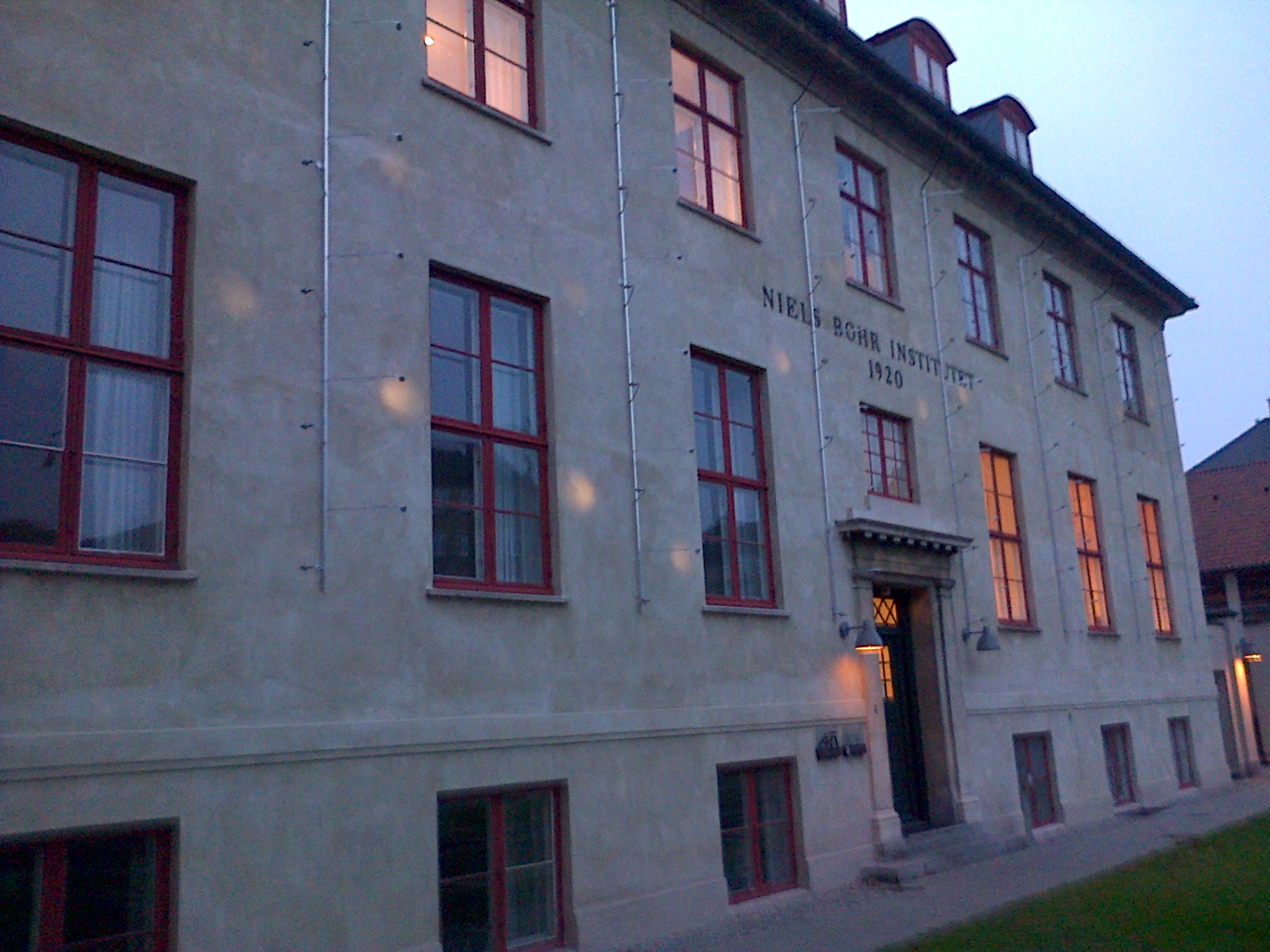
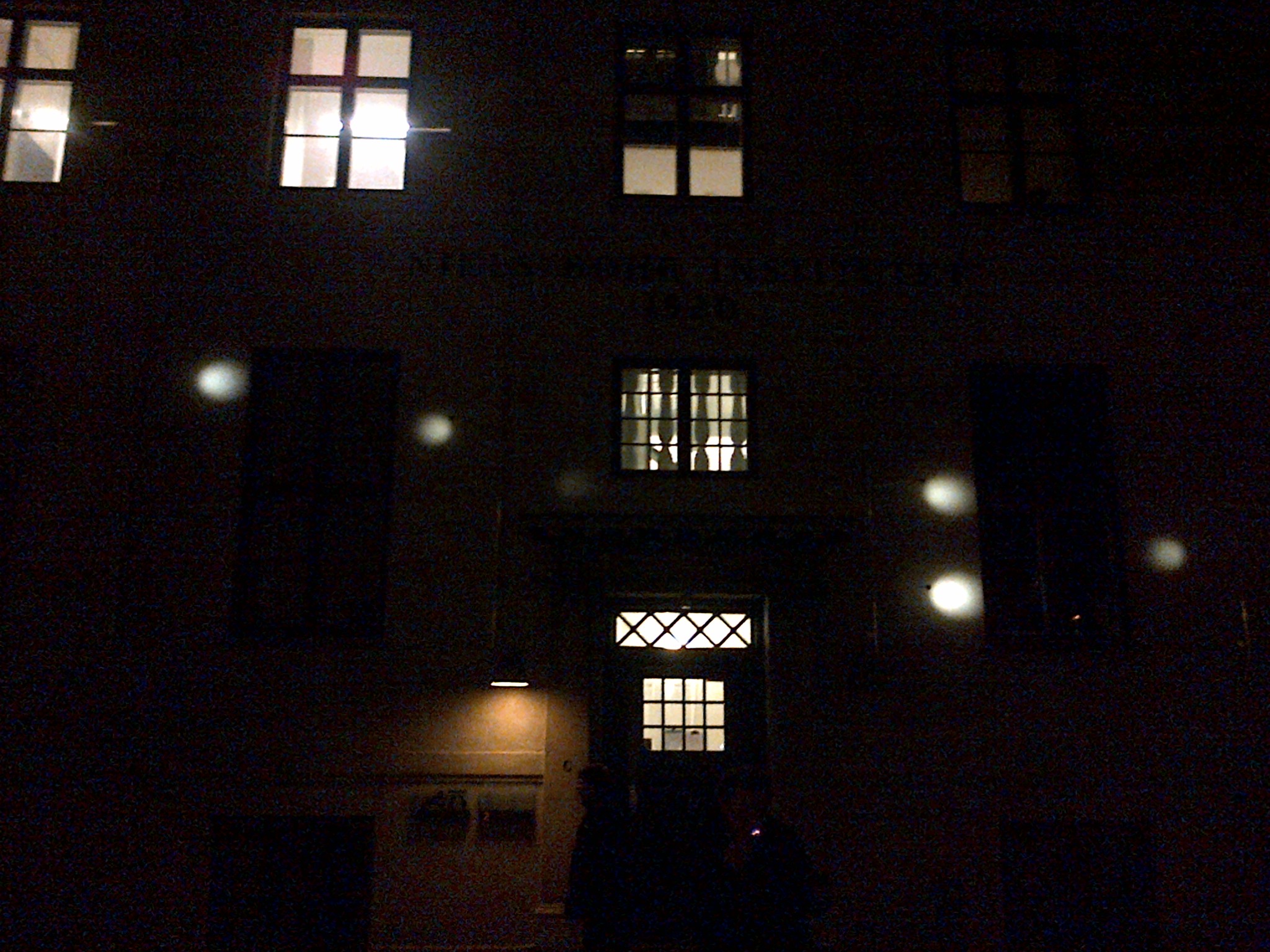
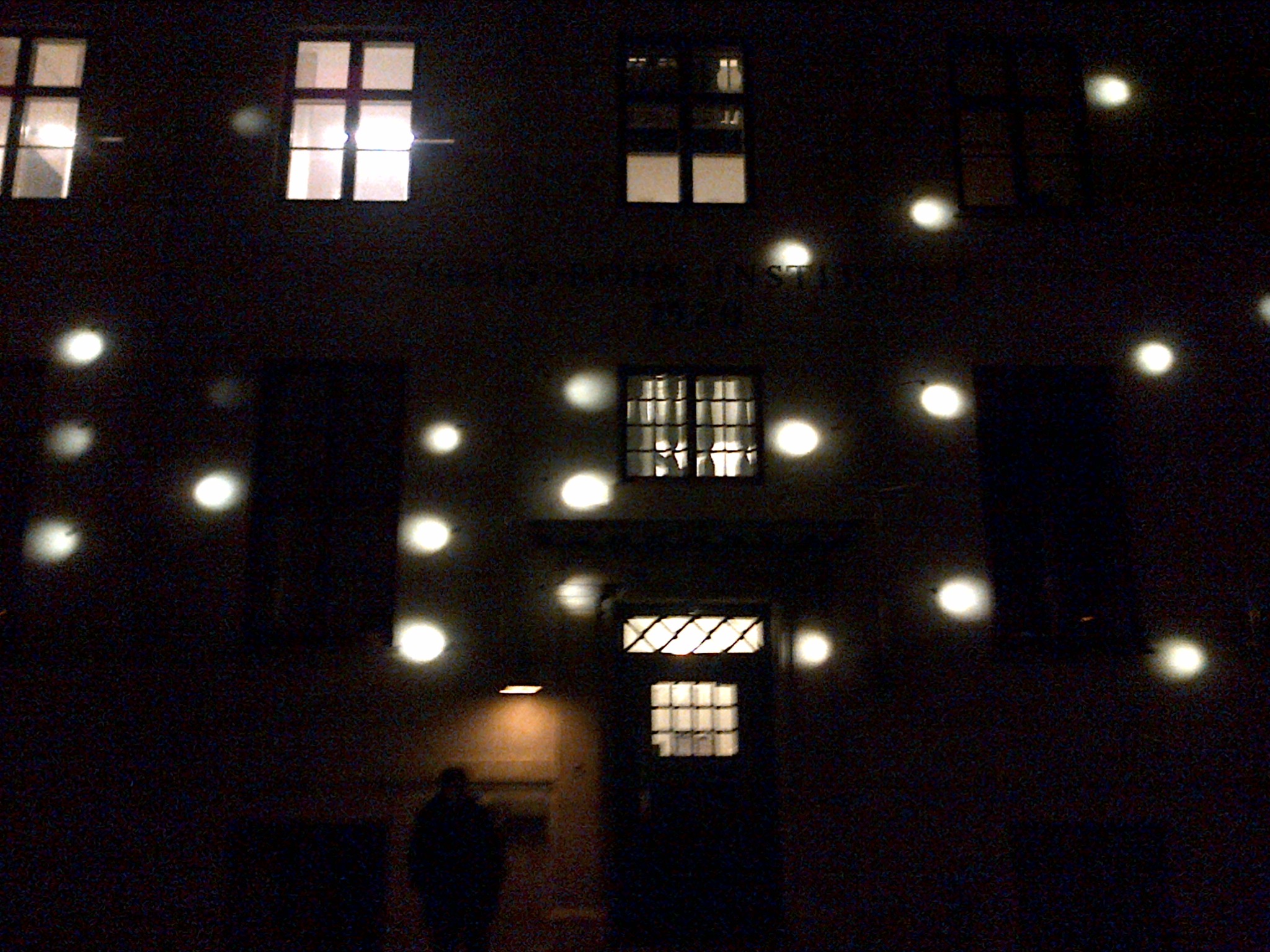
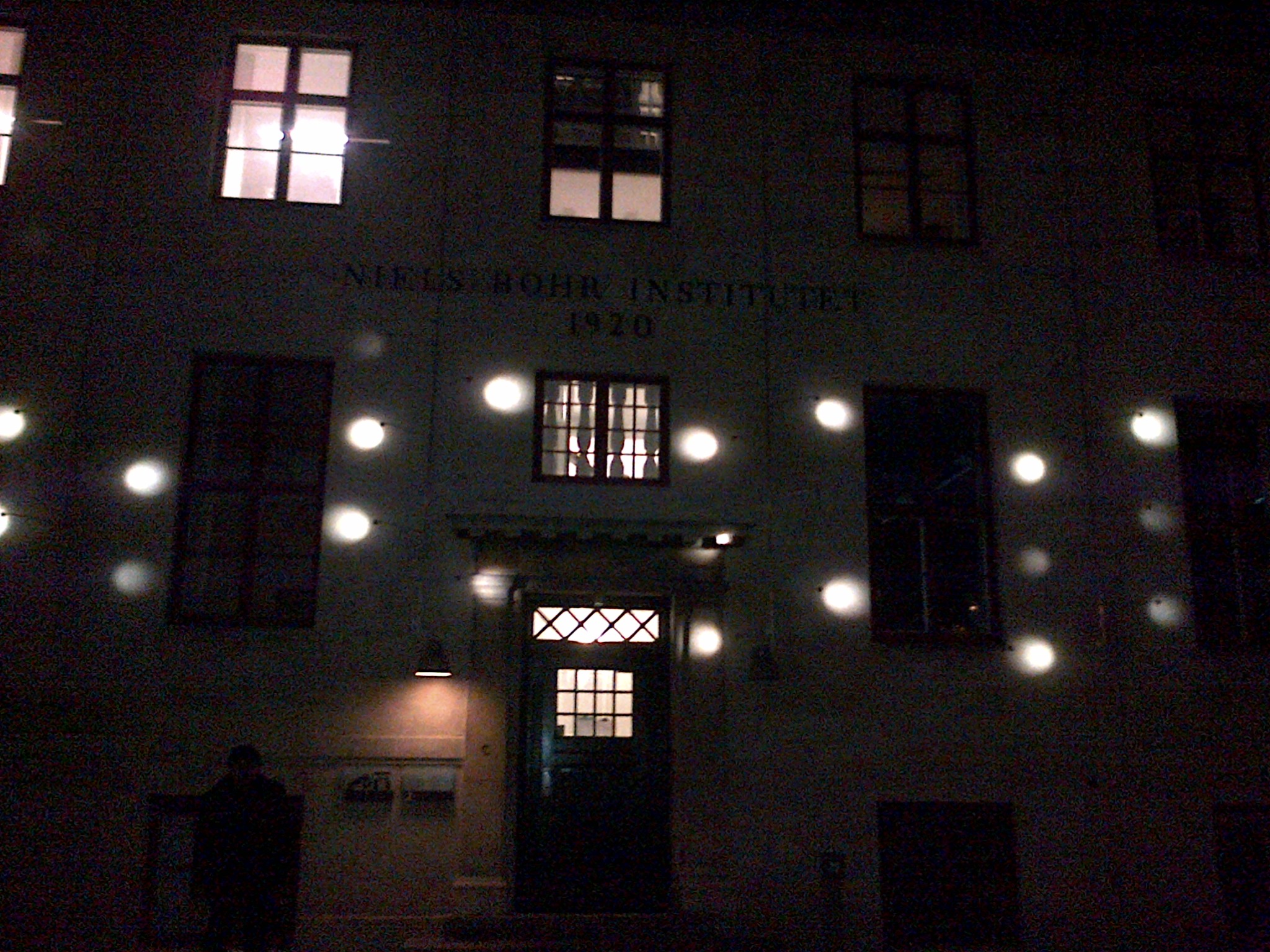
After the formalities were concluded, however, the committee took a breath of fresh air outside the Niels Bohr Institute where, in the fading November twilight, we were treated to a peculiar light show; a set of small spotlights on the front wall of the NBI building is hooked up directly to the ATLAS experiment on the Large Hadron Collider at CERN so that every time an event registers in Geneva it is displayed almost immediately in public here in Copenhagen. Quite appropriate for a place so steeped in physics history. The resolution of the particle tracks is of course not marvellous, but it’s actually quite a remarkable thing to see, although not all that easy to catch it on camera, especially if you’ve had a couple of glasses of wine!

A Psychological Tip

Posted in Biographical, Poetry with tags , , , , on November 16, 2012 by telescoper

So here I am, then, in Copenhagen. Yesterday evening, as far as I’m concerned, at least, my wavefunction collapsed along with the rest of me into a definite location. Ibsen’s Hotel, in fact. I had a pleasantly uneventful journey to Heathrow by train. The plane thence arrived in Copenhagen twenty minutes ahead of time, and then I had the chance to marvel at wonderful Copenhagen’s wonderfully efficient public transport in the form of the Metro that took me to about 100 metres from my hotel. All very relaxed and stress-free.

This morning I got up bright and early, determined to avoid the queues at breakfast, but was inevitably foiled by dozens of uber-efficient Germans who were already there at 7am when it opened. Fortunately I managed to find a quiet place in the corner to drink my coffee while they basked in their own smugness and barked orders at the waitresses.

Anyway, it’s still pretty dark outside so I thought I’d post something before walking to the Niels Bohr Institute for the day’s business. Since I’m in Denmark I thought I’d put up one of the wonderfully witty little poems written by Danish mathematician Piet Hein. He called each of these verses a “grook” (or actually, in Danish, the word is gruk) and he wrote thousands of them over his long life. Many, like this one, are utterly brilliant.

Whenever you’re called on to make up your mind,
and you’re hampered by not having any,
the best way to solve the dilemma, you’ll find,
is simply by spinning a penny.

No – not so that chance shall decide the affair
while you’re passively standing there moping;
but the moment the penny is up in the air,
you suddenly know what you’re hoping.

by Piet Hein (1905-1996).

Flying Visit

Posted in Biographical, Education, Politics, The Universe and Stuff with tags , , on November 15, 2012 by telescoper

I’m still at home at 10am on a weekday, which is unusual, but that’s because I’m soon going to be doing the familiar schlepp to Heathrow airport in order to get a flight to Copenhagen. The purpose of this little trip is to participate in a PhD examination at the Niels Bohr Institute. I’ve never taken part in a Thesis Defence in the Danish system before, although I’ve done many equivalent examinations elsewhere, so I’m quite looking forward to finding out how it works. Will it be much different from the system we have in the UK? Probably, as it is a much more public occasion. Will that necessarily make it better? I don’t know. I was reading the thesis last night, actually, and it’s very interesting which is another reason to look forward to the occasion. I might even get time for some shopping too.

Anyway, before going to the airport I am going to pop along to the local polling station. Today is the day for the Election of the Police and Crime Commissioner for the South Wales Police Area. I’m going to the polling station not because I have a burning desire to vote – the list of candidates is extremely uninspiring – but because I feel I should register a protest at this farcical waste of public money at what is supposed to be a time of austerity. The political class in this country has never been held in lower esteem than at present and the last thing we need is more politicians, helping themselves to six-figure salaries at taxpayers’ expense.  More politicians does not mean more democracy. We already have local council elections, Welsh Assembly elections, General (Parliamentary) Elections and European Parliament Elections. We don’t need any more! This Election is a complete waste of time and money.

I intend, therefore, to visit the polling station and, instead of putting a cross in a box, write a strongly (but politely) worded message voicing my opinion on the matter thus spoiling my ballot paper. It will be the first time I’ve ever done such a thing, but this is the first time we’ve had such a stupid election.

Skepsis Revived

Posted in Politics, The Universe and Stuff with tags , , , , , , , , on November 14, 2012 by telescoper

I appear to be in recycling mode this week, so I thought I’d carry on with a rehash of an old post about skepticism.  The excuse for this was an item in one of the Guardian science blogs about the distinction between Skeptic and sceptic. I must say I always thought they were simply alternative spellings, the “k” being closer to the original Greek and “c” being Latinised (via French). The Oxford English dictionary merely states that “sceptic” is more widespread in the UK and Commonwealth whereas “skeptic” prevails in North America. Somehow, however, this distinction has morphed into one variant meaning a person who has a questioning attitude to or is simply unconvinced by what claims to be knowledge in a particular area, and another meaning a “denier”, the latter being an “anti-sceptic” who believes wholeheartedly and often without evidence in whatever is contrary to received wisdom. A scientists should, I think, be the former, but the latter represents a distinctly unscientific attitude.

Anyway, yesterday I blogged a little bit about dark energy as, according to the standard model, this accounts for about 75% of the energy budget of the Universe. It’s also something we don’t understand very well at all. To make a point, take a look at the following picture (credit to the High-z supernova search team).

 What is plotted is the redshift of each supernova (along the x-axis), which relates to the factor by which the universe has expanded since light set out from it. A redshift of 0.5 means the universe was compressed by a factor 1.5 in all dimensions at the time when that particular supernova went bang. The y-axis shows the really hard bit to get right. It’s the estimated distance (in terms of distance modulus) of the supernovae. In effect, this is a measure of how faint the sources are. The theoretical curves show the faintness expected of a standard source observed at a given redshift in various cosmological models. The bottom panel shows these plotted with a reference curve taken out so the trend is easier to see. Actually, this is quite an old plot and there are many more points now but this is the version that convinced most cosmologists when it came out about a decade ago, which is why I show it here.

The argument drawn from these data is that the high redshift supernovae are fainter than one would expect in models without dark energy (represented by the \Omega_{\Lambda}  in the diagram. If this is true then it means the luminosity distance of these sources is greater than it would be in a decelerating universe. Their observed properties can be accounted for, however, if the universe’s expansion rate has been accelerating since light set out from the supernovae. In the bog standard cosmological models we all like to work with, acceleration requires that \rho + 3p/c^2 be negative. The “vacuum” equation of state p=-\rho c^2 provides a simple way of achieving this but there are many other forms of energy that could do it also, and we don’t know which one is present or why…

This plot contains the principal evidence that has led to most cosmologists accepting that the Universe is accelerating.  However, when I show it to first-year undergraduates (or even to members of the public at popular talks), they tend to stare in disbelief. The errors are huge, they say, and there are so  few data points. It just doesn’t look all that convincing. Moreover, there are other possible explanations. Maybe supernovae were different beasties back when the universe was young. Maybe something has absorbed their light making them look fainter rather than being further away. Maybe we’ve got the cosmological models wrong.

The reason I have shown this diagram is precisely because it isn’t superficially convincing. When they see it, students probably form the opinion that all cosmologists are gullible idiots. I’m actually pleased by that.  In fact, it’s the responsibility of scientists to be skeptical about new discoveries. However, it’s not good enough just to say “it’s not convincing so I think it’s rubbish”. What you have to do is test it, combine it with other evidence, seek alternative explanations and test those. In short you subject it to rigorous scrutiny and debate. It’s called the scientific method.

Some of my colleagues express doubts about me talking as I do about dark energy in first-year lectures when the students haven’t learned general relativity. But I stick to my guns. Too many people think science has to be taught as great stacks of received wisdom, of theories that are unquestionably “right”. Frontier sciences such as cosmology give us the chance to demonstrate the process by which we find out about the answers to big questions, not by believing everything we’re told but by questioning it.

My attitude to dark energy is that, given our limited understanding of the constituents of the universe and the laws of matter, it’s the best explanation we have of what’s going on. There is corroborating evidence of missing energy, from the cosmic microwave background and measurements of galaxy clustering, so it does have explanatory power. I’d say it was quite reasonable to believe in dark energy on the basis of what we know (or think we know) about the Universe.  In other words, as a good Bayesian, I’d say it was the most probable explanation. However, just because it’s the best explanation we have now doesn’t mean it’s a fact. It’s a credible hypothesis that deserves further work, but I wouldn’t bet much against it turning out to be wrong when we learn more.

I have to say that too many cosmologists seem to accept the reality of dark energy  with the unquestioning fervour of a religious zealot.  Influential gurus have turned the dark energy business into an industrial-sized bandwagon that sometimes makes it difficult, especially for younger scientists, to develop independent theories. On the other hand, it is clearly a question of fundamental importance to physics, so I’m not arguing that such projects should be axed. I just wish the culture of skepticism ran a little deeper.

Another context in which the word “skeptic” crops up frequently nowadays is  in connection with climate change although it has come to mean “denier” rather than “doubter”. I’m not an expert on climate change, so I’m not going to pretend that I understand all the details. However, there is an interesting point to be made in comparing climate change with cosmology. To make the point, here’s another figure.

There’s obviously a lot of noise and it’s only the relatively few points at the far right that show a clear increase (just as in the first Figure, in fact). However, looking at the graph I’d say that, assuming the historical data points are accurate,  it looks very convincing that the global mean temperature is rising with alarming rapidity. Modelling the Earth’s climate is very difficult and we have to leave it to the experts to assess the effects of human activity on this curve. There is a strong consensus from scientific experts, as monitored by the Intergovernmental Panel on Climate Change, that it is “very likely” that the increasing temperatures are due to increased atmospheric concentrations of greenhouse gas emissions.

There is, of course, a bandwagon effect going on in the field of climatology, just as there is in cosmology. This tends to stifle debate, make things difficult for dissenting views to be heard and evaluated rationally,  and generally hinders the proper progress of science. It also leads to accusations of – and no doubt temptations leading to – fiddling of the data to fit the prevailing paradigm. In both fields, though, the general consensus has been established by an honest and rational evaluation of data and theory.

I would say that any scientist worthy of the name should be skeptical about the human-based interpretation of these data and that, as in cosmology (or any scientific discipline), alternative theories should be developed and additional measurements made. However, this situation in climatology is very different to cosmology in one important respect. The Universe will still be here in 100 years time. We might not.

The big issue relating to climate change is not just whether we understand what’s going on in the Earth’s atmosphere, it’s the risk to our civilisation of not doing anything about it. This is a great example where the probability of being right isn’t the sole factor in making a decision. Sure, there’s a chance that humans aren’t responsible for global warming. But if we carry on as we are for decades until we prove conclusively that we are, then it will be too late. The penalty for being wrong will be unbearable. On the other hand, if we tackle climate change by adopting greener technologies, burning less fossil fuels, wasting less energy and so on, these changes may cost us a bit of money in the short term but  frankly we’ll be better off anyway whether we did it for the right reasons or not. Of course those whose personal livelihoods depend on the status quo are the ones who challenge the scientific consensus most vociferously. They would, wouldn’t they?

This is a good example of a decision that can be made on the basis of a  judgement of the probability of being right. In that respect , the issue of how likely it is that the scientists are correct on this one is almost irrelevant. Even if you’re a complete disbeliever in science you should know  how to respond to this issue, following the logic of Blaise Pascal. He argued that there’s no rational argument for the existence or non-existence of God but that the consequences of not believing if God does exist (eternal damnation) were much worse than those of behaving as if you believe in God when he doesn’t. For “God” read “climate change” and let Pascal’s wager be your guide….