No worst, there is none

Posted in Poetry with tags , , on July 23, 2012 by telescoper

No worst, there is none. Pitched past pitch of grief,
More pangs will, schooled at forepangs, wilder wring.
Comforter, where, where is your comforting?
Mary, mother of us, where is your relief?
My cries heave, herds-long; huddle in a main, a chief
Woe, world-sorrow; on an age-old anvil wince and sing –
Then lull, then leave off. Fury had shrieked ‘No ling-
-ering! Let me be fell: force I must be brief’.

O the mind, mind has mountains; cliffs of fall
Frightful, sheer, no-man-fathomed. Hold them cheap
May who ne’er hung there. Nor does long our small
Durance deal with that steep or deep. Here! creep,
Wretch, under a comfort serves in a whirlwind: all
Life death does end and each day dies with sleep.

by Gerald Manley Hopkins (1844-89).

Parks and Prizes

Posted in Bute Park on July 22, 2012 by telescoper

It being a nice day I took myself off for a stroll through Bute Park this afternoon. It was actually a bit warmer than I’d expected so I confined myself to the shady tree-lined bits. It was nice to see so many people enjoying the open air, sitting on the grass, picnicking, playing sports and even just strolling around like me. Walking along by the river bank I saw this guy practising a tightrope walk.
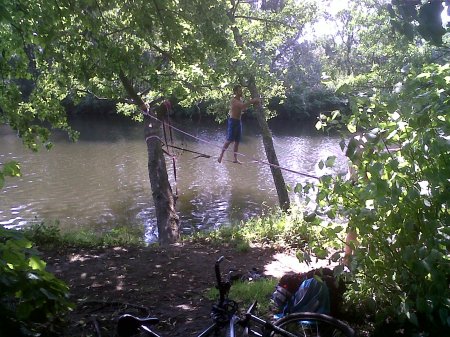
That’s something you don’t see every day. Well done, that man.

Anyway, when I got home I checked my email and found an angry message complaining about Cardiff City Council’s ongoing campaign to win itself an award for what is known as the Bute Park Restoration Project. The link invites people to “vote” for the project, but gives no option to vote against it. One wonders how many Cardiff City Council employees have been busy hitting the vote button over the last few weeks.

I’ve added a few comments to the page, pointing out that the Bute Park Restoration Project has not involved restoration as much as over-development and exploitation. The loveliest parts of the Park, those I wandered around today, haven’t been touched by the Restoration and are all the better for it. What has happened elsewhere are new buildings and roads that are both unnecessary and damaging. I accept that the restoration of the animal wall is a positive move, but the damage to the rest of the park, especially Coopers’ Fields, caused by excessive deployment of heavy vehicles and temporary buildings far outweighs the benefit.

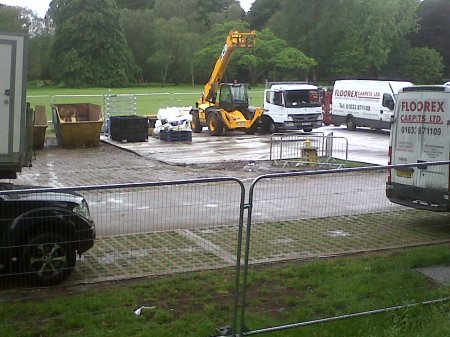
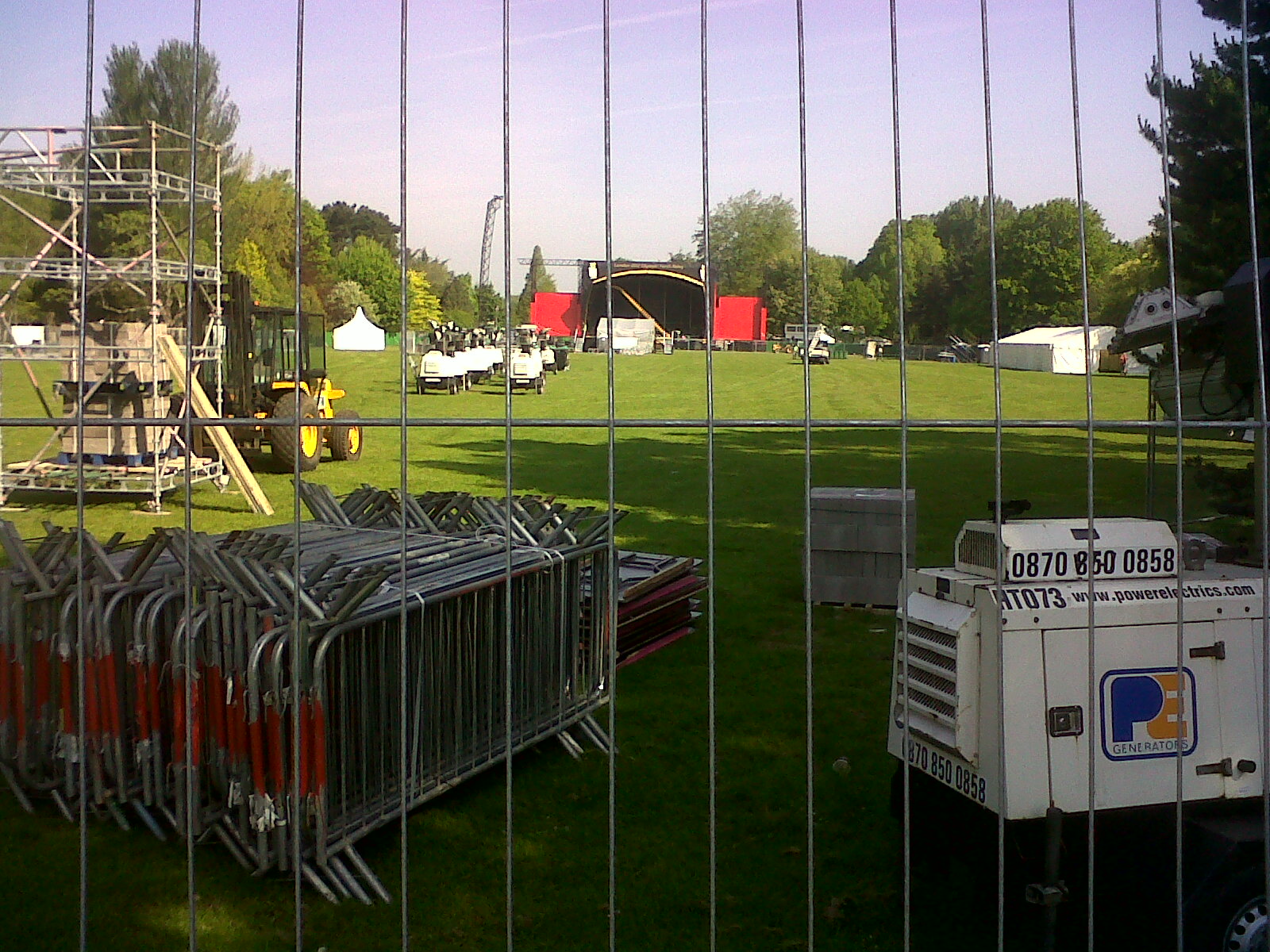
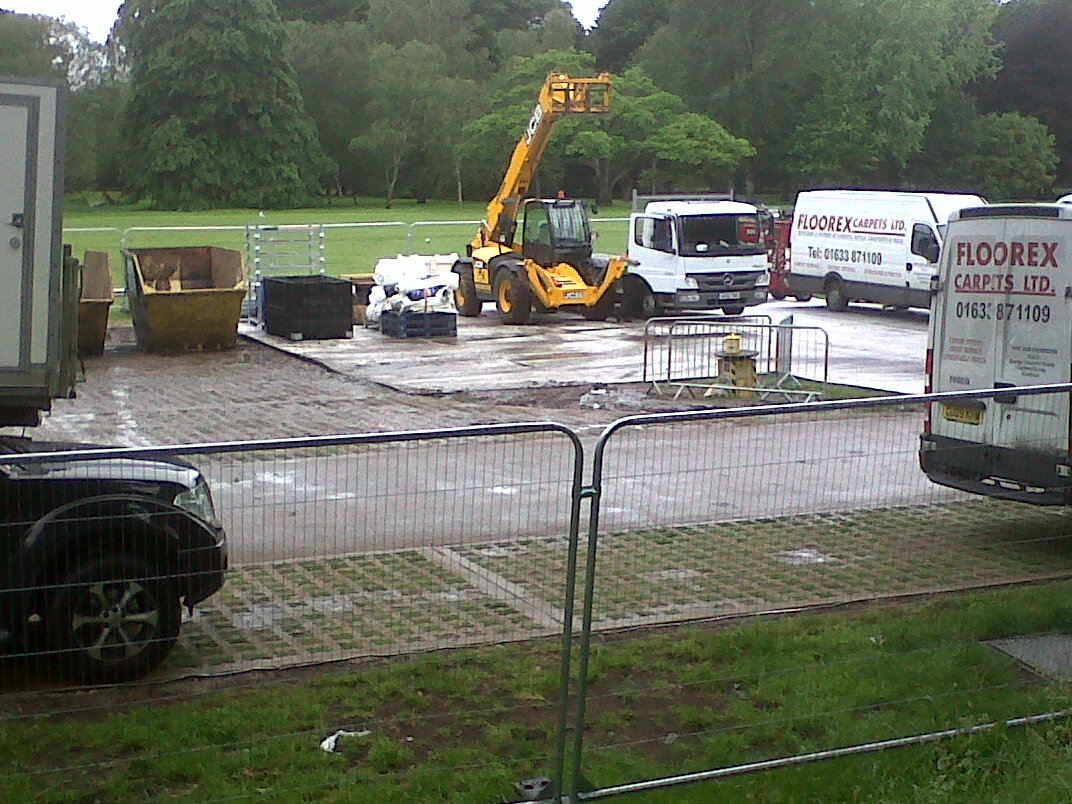
For much of the summer large parts of the park have been inaccessible to the general public, and the paths overrun with heavy vehicles:

Bute Park is beautiful, but it’s beautiful despite the Restoration Project and not because of it. It will be scandalous if it wins an award.

Still, at least it’s not as bad as London. A couple of weeks ago I travelled to London to participate in an event at the Royal Society. It was a nice day so I decided to walk from Paddington, an easy route through Hyde Park and down past Buckingham Palace. Unfortunately, I found Hyde Park almost entirely blocked by temporary buildings and maximum security fences owing to something to do with the Olympics. Later on, after negotiating a way through the resulting maze, I discovered that The Mall was also closed off to make way – believe it or not – for the beach volleyball. Whatever that is. Finding a route around all that added almost an hour to my journey. I wonder how long it will take them to reopen everything after the Olympics?

I wonder if next year the Hyde Park Restoration Project will be in line for an award?

Summer Time

Posted in Jazz with tags , on July 22, 2012 by telescoper

Well, summer seems to have made it to Cardiff – and elsewhere in the UK judging by the news – so what better excuse to post this solo version of George Gershwin’s classic Summertime by the great Sidney Bechet. This isn’t the classic Blue Note recording of 1939 I have posted already but a live version which I think is even better. Enjoy that unmistakeably gorgeous tone on the soprano saxophone…

Posing

Posted in Biographical on July 21, 2012 by telescoper

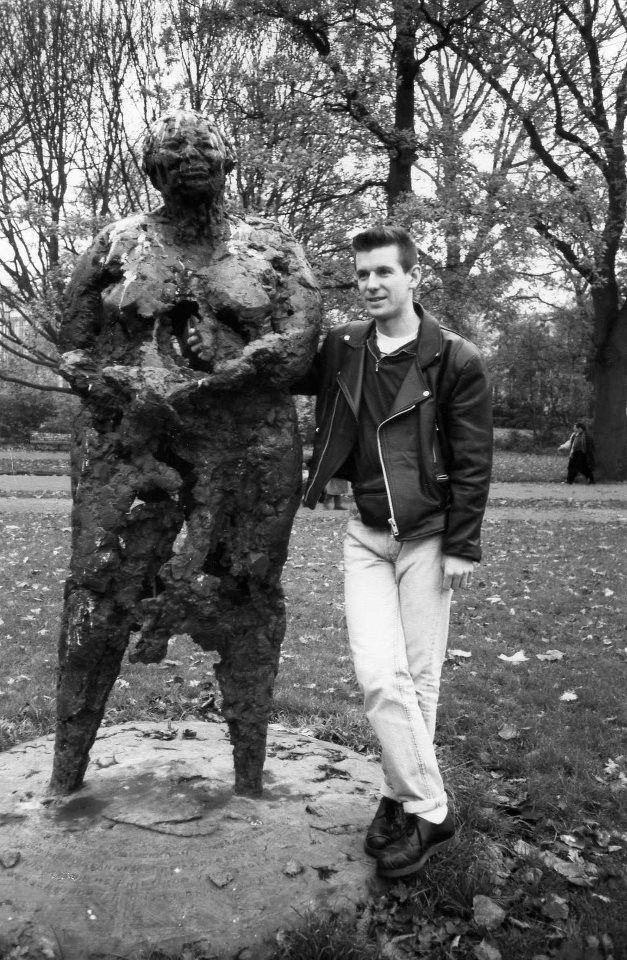
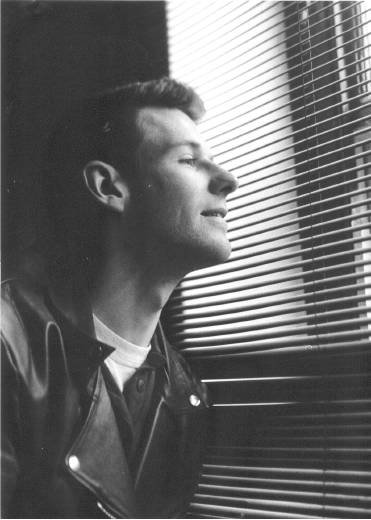
I’ve been spending some time over the last few days indulging in a bit of nostalgia therapy, scanning and uploading old photographs onto Facebook (and sometimes trying to remember when and where they were taken). The good thing about doing this is you get the chance to choose the ones which are flattering (i.e. misleading). So here are a few (obviously very old) pictures of me when I was young and svelte – appropriately enough, in black and white…

Solitude

Posted in Jazz with tags , on July 21, 2012 by telescoper

A Grand Design Challenge

Posted in Astrohype, The Universe and Stuff with tags , , , , , on July 20, 2012 by telescoper

While I’m incarcerated at home I thought I might as well make myself useful by passing on an interesting news item I found on the BBC website. This relates to a paper in the latest edition of Nature that reports the discovery of what appears to be a classic “Grand Design” spiral galaxy at a redshift of 2.18. According to the standard big bang cosmology this means that the light we are seeing set out from this object over 10 billion years ago, so the object formed about 3 billion years after the big bang.

I found this image of the object – known to its friends as BX442 – and was blown away by it..

..until I saw the dreaded words “artist’s rendering”. The actual image is somewhat less impressive.

But what’s really interesting about the study reported in Nature are the questions it asks about how this object first into our understanding of spiral galaxy formation. According to the prevailing paradigm, galaxies form hierarchically by progressively merging smaller clumps into bigger ones. The general expectation is that at high redshift – corresponding to earlier stages of the formation process – galaxies are rather clumpy and disturbed; the spiral structure we see in nearby galaxies is rather flimsy and easily disturbed, so it’s quite surprising to see this one. Does BX442 live in an especially quiet environment? Have we seen few high-redshift spirals because they are rare, or because they are hard to find? Answers to these and other questions will only be found by doing systematic surveys to establish the frequency and distribution of objects like this, as well as the details of their internal kinematics.

Quite Interesting.

Astronomy Look-alikes, No. 77

Posted in Astronomy Lookalikes with tags , on July 20, 2012 by telescoper

It’s been a while, but here’s one for you.

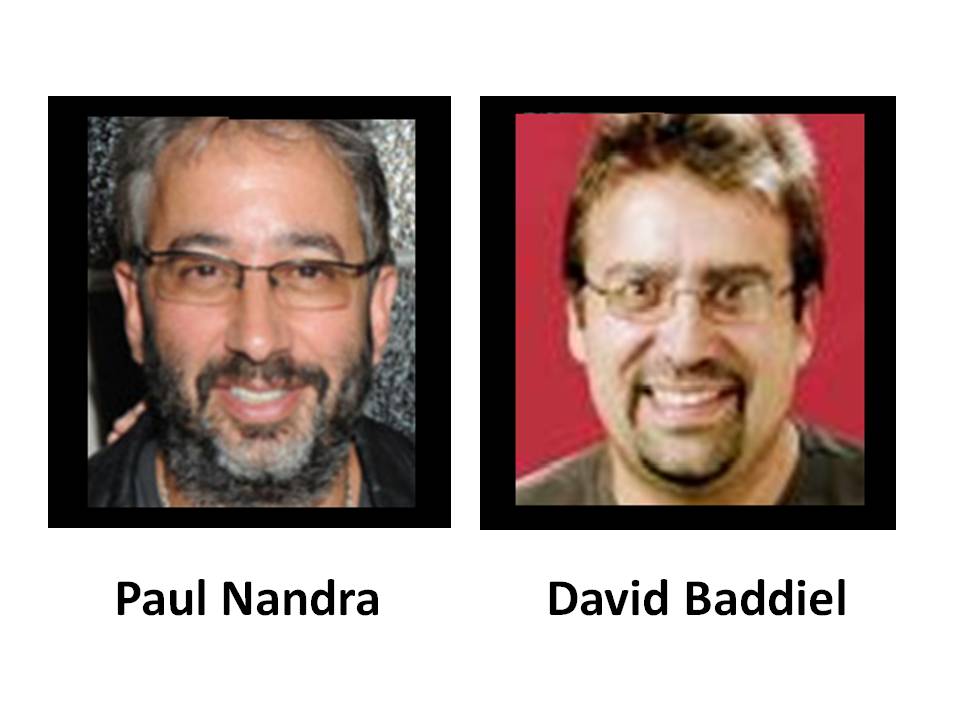
Has anyone else noticed the remarkable resemblance between the well-known X-ray astronomer David Baddiel (formerly of Imperial College London and now at the Max Planck Institute in Munich) and the popular comedic entertainer and novelist Paul Nandra. I wonder if by any chance they might be related?

Solitude

Posted in Jazz with tags , , on July 19, 2012 by telescoper

Santa Sangre

Posted in Biographical, Film with tags , , on July 18, 2012 by telescoper

Having spent most of this morning talking about the past (to someone who at least is paid to listen to such boring stuff), I dozed off this afternoon and had a peculiar kind of dream which featured sequences of a film I saw way back in 1990. Strange how the unconscious brain plays with such connections. When I woke up I even thought for a few moments that I was back in 1990 again. Most unnerving.

Anyway the film in question is a neglected masterpiece called Santa Sangre (“Holy Blood”), directed by Chilean-French director Alejandro Jodorowsky. I’m amused that the wikipedia page for this movie is prefaced by a suggestion that the “plot summary may be too long or excessively detailed”, because the plot is so bizarre and convoluted that it would take pages of explanation to do it justice. Anyway, Santa Sangre, set in Mexico, and made on a budget of less than $800,000, is a kind of surrealist horror film, with a complex flash-back then flash-forward narrative structure, that revolves around the life of a young man called Fenix who grows up in a circus. Among a number of traumatic experiences he encounters in his childhood is that his mother has both her arms cut off. Later, in adulthood, Fenix and his mother perform a stage act in which he stands behind her and pretends that his arms are hers. It’s a moving and shocking image, just one of many in a film which is in turns bizarre, disturbing, offensive, violent, horrifying, funny, beautiful and utterly utterly brilliant. Why it’s not more widely celebrated I’ll never know.

Blowing Smoke

Posted in Education, The Universe and Stuff with tags , , , , on July 18, 2012 by telescoper

I’ve been trying to make myself useful over the last few days thinking about the new module I’m supposed to start teaching in October. I’m a bit daunted by it to be honest. The title is The Physics of Fields and Flows and it will be taken by students when they return to start their second year after the summer break.  It’s twice the size of our usual modules, which means a lot of teaching and it’s all new for me, which means a lot of preparation.

The idea behind introducing this module was to teach a number of things together which previously had been taught in separate modules, specifically electromagnetism and vector calculus, or not at all, e.g. fluid mechanics. I’m not sure when or why classical fluid mechanics dropped out the syllabus, but I think it’s an essential part of a physics curriculum in its own right and also helps develop a physical understanding of the mathematics used to describe electric and magnetic fields. It’s one of the unhappy side-effects of modular teaching that it hides the important underlying connections between apparently disparate phenomena which are the essence of what physics is about.

Another thing I reckon we don’t do enough of these days is use lecture demonstrations. That’s harder to do these days because we tend to use pooled lecture theatres that don’t have the specialist equipment that they might have if they were dedicated to physics lectures only.  Practical demonstrations are now usually given second-hand, by using video clips.  That’s fine, but not as good as the real thing.

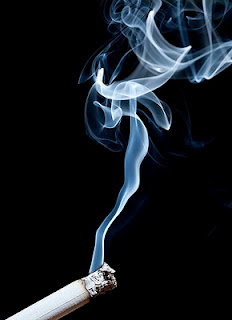
Anyway, it struck me that it would be quite easy to arrange a demonstration of the transition between laminar and turbulent flow using the simple and relatively inexpensive equipment shown in the rather beautiful image. Unfortunately, however, demonstrating this sort of thing isn’t allowed on University premises even for scientific purposes…