Has anyone noticed the remarkable similarity between the crazy star of the Ladbrokes TV commercial , Italian football commentator
Tiziano Crudeli, and Italian physicist and advocate of inhomogeneous cosmological models, Luciano Pietronero? I wonder what odds Ladbrokes are offering against a fractal Universe? Game on!
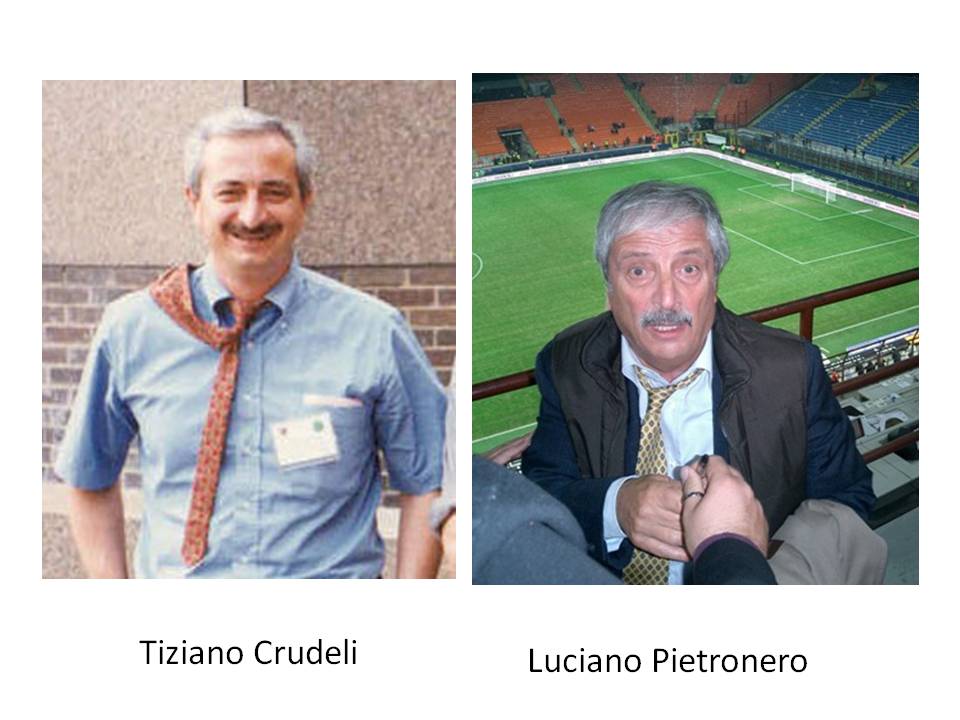
Astronomy Look-alikes, No. 79
Posted in Astronomy Lookalikes with tags Astronomy Look-alikes, Ladbrokes TV commercial, Luciano Pietronero, Tiziano Crudeli on October 7, 2012 by telescoperPart IB Maths for Natural Sciences, from 1984
Posted in Biographical, Education with tags group theory, Laplace transforms, mathematics, Part IB Mathematics for Natural Sciences, University of Cambridge on October 7, 2012 by telescoperI’ve been rummaging through my old second-year undergraduate notes and papers trying to compare what I did when I was a student with what we’re asking current second-year undergraduates to do. Since I’m now teaching a fairly mathematical second-year course, it is interesting to look at how the content compares with the Mathematics papers I took way back in 1984.
Looking at these two examinations it’s clear that some of the content is similar (e.g. vector calculus, Fourier transforms) but some big things are entirely missing from our second-year syllabus, specifically Laplace transforms and group theory. The absence of the latter is a matter of particular regret because it’s such a beautiful subject that I think leads onto a deeper understanding of physics than a lot of the other things we make the students learn.
The other striking thing is that the marks for different bits of the questions are not given. That was standard in my day, but nowadays we usually indicate how many marks are available for each part. Moreover, the style of examination is such that even the number of correct answers needed for full marks isn’t given; it just says “You are advised to answer complete questions rather than fragments”.
Anyway, as usual, I’d be interested in comments on the content and difficulty especially from current students in the unlikely event that they have nothing better to do on a Sunday afternoon than have a look at it! For my part, I’ll be in the department getting next week’s lecture materials sorted. Heigh-ho.
Follow @telescoperWhen you are old
Posted in Poetry with tags W.B. Yeats, When you are old on October 6, 2012 by telescoperWhen you are old and grey and full of sleep,
And nodding by the fire, take down this book,
And slowly read, and dream of the soft look
Your eyes had once, and of their shadows deep;
How many loved your moments of glad grace,
And loved your beauty with love false or true,
But one man loved the pilgrim soul in you,
And loved the sorrows of your changing face;
And bending down beside the glowing bars,
Murmur, a little sadly, how Love fled
And paced upon the mountains overhead
And hid his face amid a crowd of stars.
by William Butler Yeats (1865-1939)
Follow @telescoperThe Week’s Ending
Posted in Biographical, Education, The Universe and Stuff with tags Anupam Mazumdar, Cardiff University, Pedro Ferreira on October 6, 2012 by telescoperA later post than usual for a weekend. I’ve been feeling a bit fragile all day after a very late night last night “playing Bridge” (i.e. drinking and gossiping into the early hours of the morning, with the occasional hand of cards thrown in for good measure). My broadband connection has also been playing up nearly as badly as the connections in my brain, although I don’t think there’s a causal relationship between the two. Anyway, just time for a round-up of, and some reflections on, the events of the past seven days.
This has been the first week of term, so has naturally been extremely busy. I got my first week’s second-year lectures, examples sheets and handouts together last Sunday for a 9am start on Monday morning. There were 104 students on the register, and I was delighted to find that 100 of them actually showed up bright and early for the first session. The lecture wasn’t brilliant unfortunately – I misjudged how many worked examples I could fit into an hour and got a bit rushed as a consequence. Still, at least nobody threw anything at me, and I survived. At the end of the week the students were asked to hand in solutions to some problems, which most of them seem to have done. Unfortunately, however, I neglected to ask for the key to the box in which they are posted before the support staff went home at 5pm, so the scripts are still all in the box. At least that gives me an excuse for not having started to mark them yet.
I gave another lecture this week to the 4-th year Cardiff students taking the Quantum Field Theory lectures from Swansea, to try and fill in a bit of background our lot won’t have learned in other lectures on relativistic quantum mechanics, chiefly the Dirac equation. I really love that sort of stuff, so didn’t mind stepping up to do an impromptu class on it. They seemed to find it reasonably useful, although I went on a bit longer than I should.
Two other events this week in the School were a colloquium by Dr Anupam Mazumdar from Lancaster on Wednesday and a seminar by Prof. Pedro Ferreira from Oxford yesterday (Friday), both of which were related to alternative theories of gravity (i.e. modifications of Einstein’s theory of general relativity). Pedro has co-authored a comprehensive review article on such things if anyone is interested in following up the details. The basic point, however, is that standard cosmology almost all develops from the assumption that gravity and space-time are described by general relativity. That theory is well tested on solar-system scales, but independent tests on the much larger scales involved in cosmology are hard to come by. It’s clearly therefore an important goal to work towards testing alternative theories, as is the case in any scientific discipline.
As well as these specific events there was a steady stream of problems and irritations to do with the teaching timetable: rooms too small, clashes, and so on. This is part of my responsibility as Director of Teaching and Learning in the School of Physics and Astronomy, and I don’t mind telling you that it’s a royal pain in the derrière. However, I think all the bugs have been ironed out and we can hopefully now carry on with a settled teaching programme into the new year.
Looking back on the week I can see so many things I would not long ago have found unbearably stressful, even going to the pub after Friday’s seminar. Such victories, however insignificant they may seem to others, have given me the confidence to face the greater challenges that I know the future has in store.
Follow @telescoperJephtha
Posted in Opera with tags Book of Judges, Fflur Wyn, Handel, Jephtha, Opera, Welsh National Opera on October 5, 2012 by telescoperI took time out from a busy week yesterday evening for a performance by Welsh National Opera of Jephtha by George Frideric Handel. Based on a biblical story (from the Book of Judges), Jephtha was written late in Handel’s life (indeed it was the last major work Handel wrote) as an oratorio rather than an opera, and was first performed as such in 1752.
Last night’s production brought movement, scenery and costumes to Handel’s lovely music in an attempt to turn it into an opera. It was only partially successful in doing that. Owing to the nature of the piece, it appeared as a series of rather static tableaux rather than a compelling music drama. It did however, feature excellent music and singing, and very imaginative use of a rather simple set, an interior of faded and battered opulence, complete with broken plaster and bullet holes, and costumes that evoke the period leading up to World War II.
You can get a good idea of the look of the performance in the following WNO trailer:
The story revolves around the character Jephtha who is called upon to lead the people of Gilead in battle against Ammon. He takes up the challenge, and when he proves victorious he rashly (and cruelly) vows to make a sacrifice of the first human being to greet him when he returns home. That turns out to be his daughter, Iphis. Will he carry out his pledge and turn Iphis into a burnt offering? Will an Angel of the Lord intervene and spare her? I won’t spoil the plot, except that that the operatorio does not end in the same way as the bible story seems to…
As for the singers, I thought Fflur Wyn (Iphis) was the pick – her voice beautifully conveyed the innocence and fragility of the young daughter. Robin Blaze as Hamor (Iphis’ betrothed) was also excellent in the counter-tenor role. I wasn’t so keen on Robert Murray as Jephtha, whose voice was rather thin and undistinguished especially early on in the performance. But it was really Handel’s music that took centre stage. Although the performance contained much to savour, I’m not convinced that staging Jephtha as an opera was really worth it. I would probably have enjoyed it just as much if it had been performed as an oratorio, like Messiah.
Follow @telescoperSonnet No. 25 (for National Poetry Day)
Posted in Poetry with tags Let those who are in favour with their stars, National Poetry Day, sonnet No. 25, William Shakespeare on October 4, 2012 by telescoperI’m a bit ashamed that being very busy I forgot that today, Thursday 4th October, is National Poetry Day the theme of which this year is “stars”. I wish I’d remembered and would have posted something appropriate to mark the occasion, but this will have to do…
Let those who are in favour with their stars
Of public honour and proud titles boast,
Whilst I, whom fortune of such triumph bars,
Unlook’d for joy in that I honour most.
Great princes’ favourites their fair leaves spread
But as the marigold at the sun’s eye,
And in themselves their pride lies buried,
For at a frown they in their glory die.
The painful warrior famoused for fight,
After a thousand victories once foil’d,
Is from the book of honour razed quite,
And all the rest forgot for which he toil’d:
Then happy I, that love and am beloved
Where I may not remove nor be removed.
Sonnet No.25 , by William Shakespeare (1564-1616)
Follow @telescoperPseud’s Council
Posted in Uncategorized with tags EPSRC, Private Eye, Pseud's Corner on October 4, 2012 by telescoperNo time for a proper post today – busy busy busy with Week 1 business – but I couldn’t resist passing on the news that the Engineering and Physical Sciences Research Council has finally made the headlines in a positive way – by appearing in the esteemed column Pseud’s Corner of the high-impact academic journal Private Eye.
This honour arose as a result of the following advertisement:
The Engineering and Physical Sciences Research Council invites expressions of interest from eligible individuals to attend a five-day interactive sandpit on the theme of digital personhood.
I would have applied had I seen it in time but although I’m a bachelor there’s a strong possibility I wouldn’t have been eligible.
Follow @telescoper
Lover Man
Posted in Jazz, Literature with tags Billie Holiday, Jack Kerouac, Lover Man, On the Road on October 3, 2012 by telescoperFollow @telescoperI huddled in the cold, rainy wind and watched everything across the sad vineyards of October in the valley. My mind was filled with that great song “Lover Man” as Billie Holiday sings it; I had my own concert in the bushes. “Someday we’ll meet, and you’ll dry all my tears, and whisper sweet, little things in my ear, hugging and a-kissing, oh what we’ve been missing, Lover Man, oh where can you be …” It’s not the words so much as their great harmonic tune and the way Billie sings it, like a woman stroking her man’s hair in soft lamplight.
Lectures by Video
Posted in Education, The Universe and Stuff with tags Cardiff University, David Tong, Perimeter, quantum field theory, Swansea University on October 2, 2012 by telescoperI spent a short while this morning sitting in on a lecture from one of our fourth-year modules, on Quantum Field Theory. Nothing obviously remarkable about that, except that the lecture was in fact delivered by Prof. Graham Shore of Swansea University and I was sitting in the School of Physics & Astronomy at Cardiff University with a group of twenty or so Cardiff undergraduates.
This was the first lecture our students have received from Swansea as part of an arrangement to share some teaching. There was a plan to do it last year, but it fell apart owing to technical problems. When I took over as Director of Teaching and Learning earlier this year I was determined to make it work. I have long felt that many of our 4th-year students were losing out on some advanced topics, especially in particle physics, owing to the lack of expertise in that area here. Indeed, the lack of expertise in particle physics here in Cardiff is so extreme that our students have had to put up with being taught by me! Likewise Swansea’s undergraduates have missed out a bit on some topics we do here, especially astrophysics and gravitational physics. This division of labour dates back to the old federal University of Wales where it was decided for strategic reasons not to compete in these two areas of “big science” but to allow Cardiff to do astronomy, astrophysics and gravitational physics and Swansea the particle stuff. It was a sensible decision from a research point of view, but it meant that the two relatively small physics departments here in South Wales could offer their undergraduates more restricted choices of advanced topics than at bigger universities.
Not for the first time, the web has furnished a solution. After a few technical problems – not entirely sorted out, to be honest – we’ve finally established a video link. The initial setup is temporary, but we will (hopefully by next week) have a permanent, high quality videoconferencing suite for future use. It will probably take some time for lecturers and students on both sides to get used to it, but sitting in this morning I found it more than satisfactory from the point of view of audibility and legibility. The only problem really is that the static camera shot makes it a bit claustrophobic. I’m not sure whether there’s a way around that without spending a fortune on multiple cameras.
Anyway, to mark this historic occasion I thought I post another video lecture on Quantum Field Theory just to give you a flavour of the content and the experience. This is by David Tong of Cambridge University as seen in a lecture recorded by the Perimeter Institute in Canada.
Anyway, in the spirit of openness, and because I couldn’t stay for the whole session, I’d be interested to hear what any Cardiff students thought of the experience either in private or through the comments box..
Follow @telescoperWhither the Learned Societies?
Posted in Open Access with tags Gold Open Access, Green Open Access, Institute of Physics, Open Access, Royal Astronomical Society on October 1, 2012 by telescoperAn interesting aspect of the ongoing debate about Open Access publishing is the extent to which “learned societies”, such as the Royal Astronomical Society and the Institute of Physics, rely for their financial security upon the revenues generated by publishing traditional journals.
IOP Publishing is a wholly-owned subsidiary of the Institute of Physics that generates annual income in the region of £40M from books and journals. This is the largest source of the revenue that the IoP needs to run its numerous activities relating to the promotion of physics. A similar situation pertains to the Royal Astronomical Society, although on a smaller scale, as it relies for much of its income from Monthly Notices of the Royal Astronomical Society, in which as a matter of fact I publish quite regularly.
Not surprisingly, these and other learned societies are keen to protect their main source of cash. When I criticized the exploitative behaviour of IoP Publishing in a recent blog post, I drew a stern response from the Chief Executive of the Institute of Physics, Paul Hardaker. That comment seems to admit that the high prices charged by IOP Publishing for access to its journals is nothing to do with the cost of disseminating scientific knowledge but is instead a means of generating income to allow the IoP to pursue its noble aim of “promoting Physics”. This explains why such organizations have lobbied very hard for the “Gold” Open Access that is being foisted on the research community, rather than the “Green” Open Access that it really wants.
I recently came across another blog post, pointing out that other learned societies around the world are also opposing Green Open Access:
There is also great incentive for the people who manage and run these organisations to defend their cartel. For example, the American Chemical Society, a huge opponent to open access, pays many of its employees, as reported in their 990 tax return, over six figures. These salaries range from $304,528 to $1,084,417 in 2010.
I don’t know the salary of the Chief Executive of the IoP.
The problem with the learned societies behaving this way is twofold. First, I consider it to be inevitable that the traditional journal industry will very soon be completely bypassed in favour of Green Open Access. The internet has changed the entire landscape of scientific publication. It’s now so cheap and so easy to disseminate knowledge that journals are already redundant, especially in my field of astrophysics. The comfortable income stream that has been used by the IoP to “promote Physics”, as well as to furnish its spacious buildings in Portland Place and pay the no doubt “competitive” salaries of its officers, will therefore surely dry up in the near future. The “Gold” OA favoured by such organizations is unjustifiable and unsustainable and it won’t last. The IoP, RAS et al need to find another way of funding their activities pronto, or downsize accordingly.
The other problematic aspect of this approach is that I think it is fundamentally dishonest. University and institutional libraries are provided with funds to provide access to published research, not to provide a backdoor subsidy for a range of extraneous activities that have nothing to do with disseminating research. The learned societies do many good things – and some are indeed oustandingly good – but that does not give them the right to syphon off funds from their constituents in this way. Institutional affiliation, paid for by fee, would be a much fairer way of funding these activities.
I should point out that, as a FRAS and a FInstP, I pay annual subscriptions to both the RAS and the IoP. I am happy to do so, as I feel comfortable spending some of my own money supporting astronomy and physics. What I don’t agree with is my department having to fork out huge amounts of money from an ever-dwindling budget for access to scientific research that should be in the public domain because it has already been funded by the taxpayer.
Some time ago I had occasion to visit the London offices of a well-known charitable organization which shall remain nameless. The property they occupied was glitzy, palatial and obviously very expensive. I couldn’t help wondering how they could square the opulence of their headquarters with the quoted desire to spend as much as possible on their good works. Being old and cynical, I came to the conclusion that, although charities might start out with the noblest intentions, there is a grave danger that they simply become self-serving, viewing their own existence in itself as more important than what they do for others.
The academic publishing industry has definitely gone that way. It arose because of the need to review, edit, collate, publish and disseminate the fruits of academic labour. Then the ease with which profits could be made led it astray. It now fulfils little or no useful purpose, but simply consumes financial resources that could be put to much better effect actually doing science. Fortunately, I think the scientific community knows this and the parasite will die a natural death.
But I wonder if the learned societies will go the same way. Is there a financial model according to which they can enjoy a stable and sustainable future? Are they actually needed? After all, if we can publish our own physics, why can’t we ourselves also promote it?
Follow @telescoper

