Saving Time Again

Posted in Biographical, Maynooth with tags , , , on October 27, 2024 by telescoper

It’s Sunday 27th October 2024 and in the early hours of this morning the clocks went back, bidding goodbye to Summer Time. You can tell I’m an oldie because I have quite a lot of time-keeping devices around the house that need to be set by hand. My computer updates itself, of course, but I’m not sure if WordPress does. I’ll find out when I publish this post!

I’ve written before about the silly business of moving the clocks backwards and forwards (e.g. here) so I won’t repeat it all again. I will mention, however, that some time ago, before the Covid-19 Pandemic, the European Parliament approved a directive that would abolish `Daylight Saving Time’.  Unfortunately that plan has been ‘paused’ and there’s no sign of it happening for the foreseeable future.  I’ve long felt that the annual ritual of putting the clocks forward in the Spring and back again in the Autumn was a waste of time effort, so I’ll be glad when this silly practice is terminated. It would be far better in my view to stick with a single Mean Time throughout the year. I’m disappointed that this hasn’t already happened.

Anyway, talking of time, we have now completed five weeks of teaching in Semester 1 at Maynooth University. Tomorrow (Monday 28th October) is the October Bank Holiday and next week is Study Week so there are no lectures or tutorials. When I took the train into Dublin on Friday evening I noticed it was much less busy than during term-time. I think most students had already left for the week.
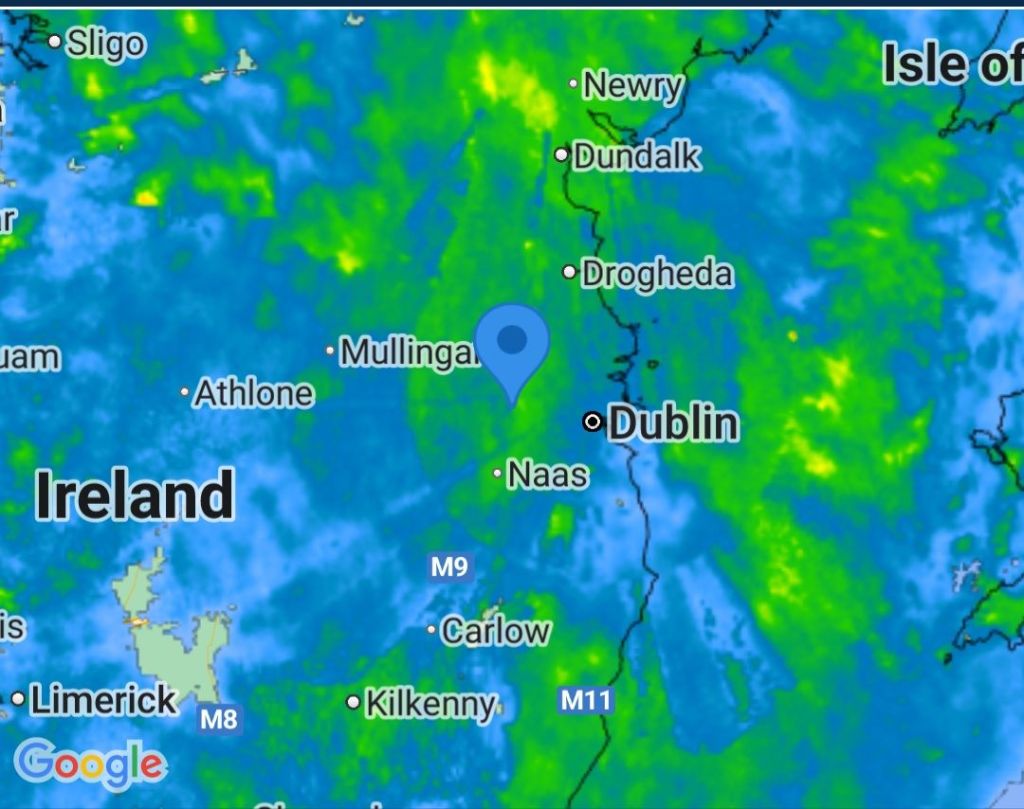
Bank Holiday Weekend Weather..

Normally Study Break comes halfway through the 12-week teaching term but this year it splits 5-7. Since I’m teaching two new modules this term I am not unhappy to have an earlier break to allow me a bit more time for preparation and to catch up on some correcting, but I am conscious that this is going to make for a longer run-in to the Christmas holiday. We are supposed to teach up until Friday 20th December, on which day I do have a lecture scheduled, though I suspect attendance will be low!

I’m not sure how much studying the students do during Study Week, but it’s not a holiday for academic staff even though there is no undergraduate teaching. Among other things we have examinations to write for the January examination period, which must be checked and printed well in advance. The break from teaching will also allow me a bit of time to work on my retirement plans and figure out how much Time I can afford buy with my Savings…
Puccini 100 at the National Concert Hall

Posted in Music with tags , , , , , , , , on October 26, 2024 by telescoper

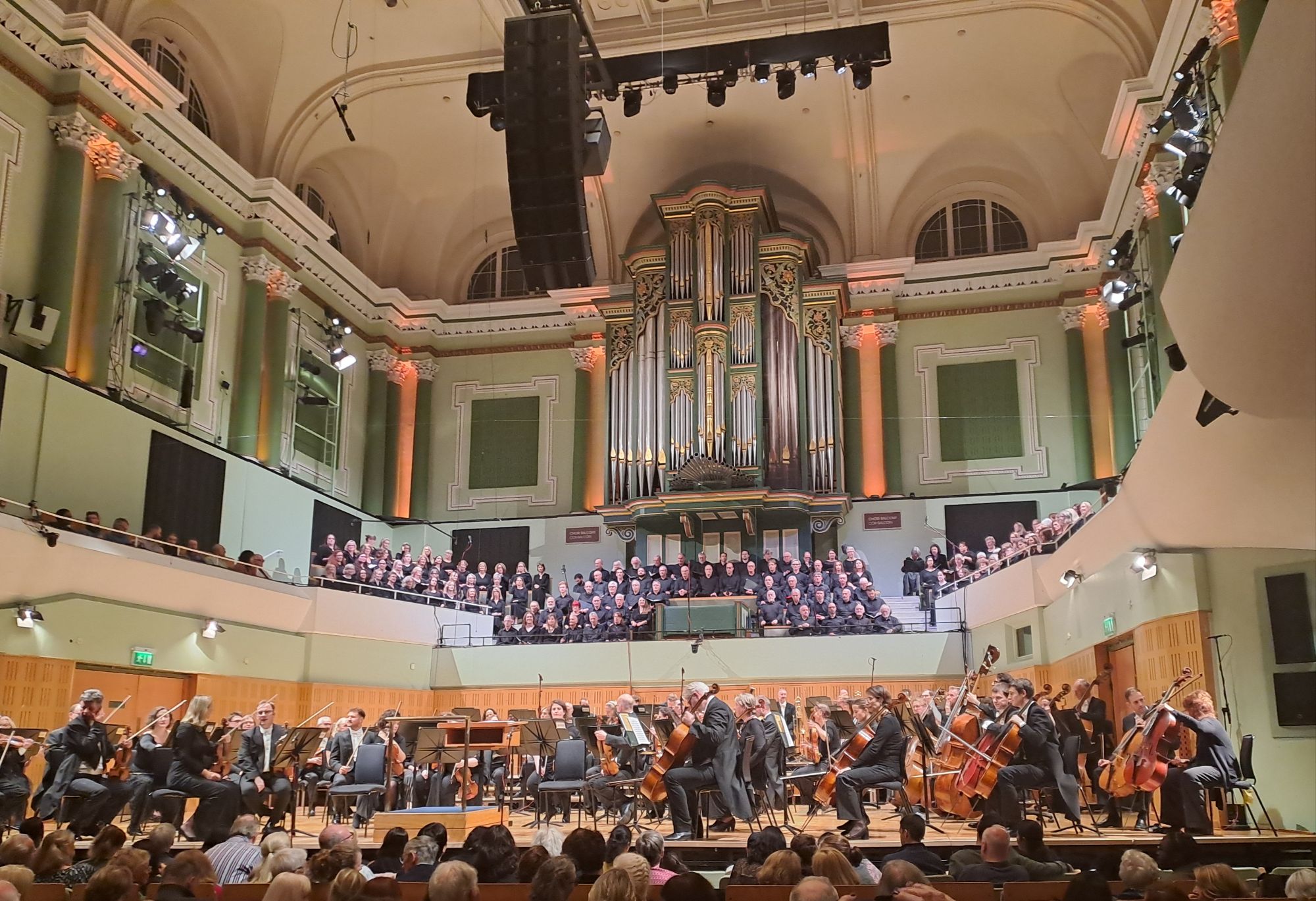
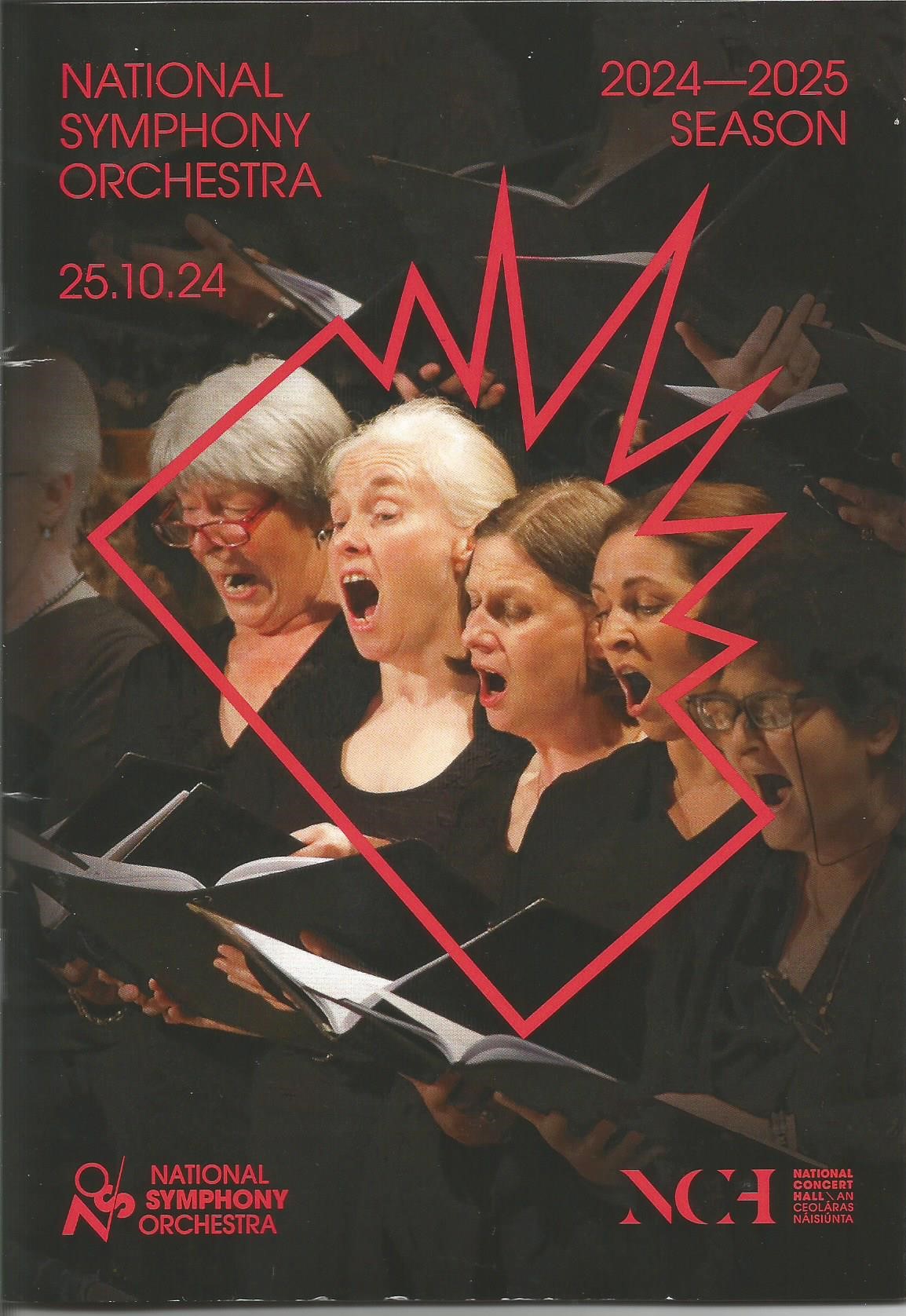
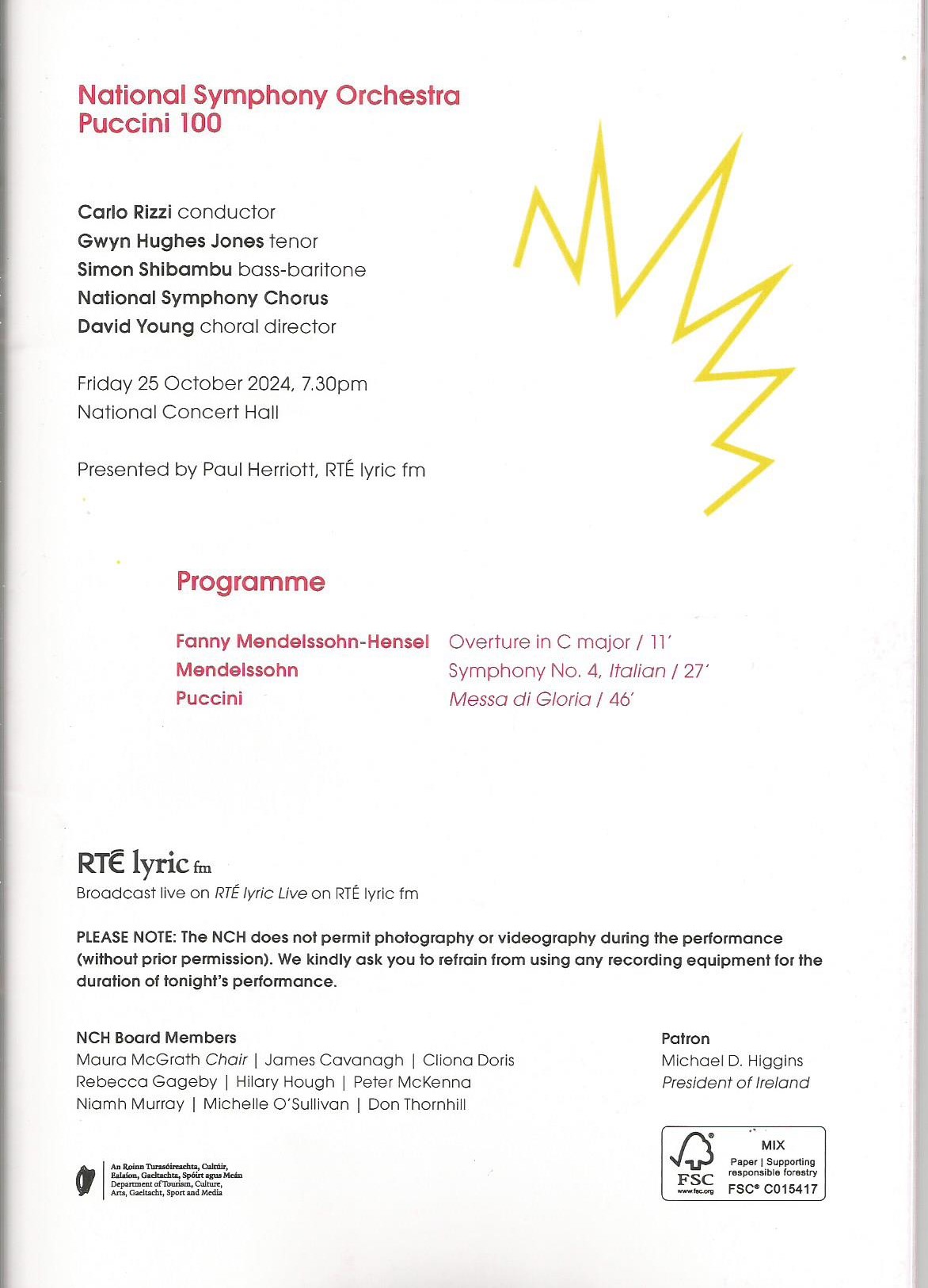
Last night’s Concert at the National Concert Hall in Dublin was billed as Puccini 100 as it was primarily intended to mark the centenary of the death of Giacomo Puccini. Guest conductor Carlo Rizzi had a long association with Welsh National Opera and is well-versed in Puccini’s operatic repertoire but this concert featured a rare treasure in the form of the Messa di Gloria, a large-scale work for choir, two soloists and orchestra Puccini wrote as a graduation piece when he was still a music student in Milan. Contrary to what you might infer from the title, it’s actually a full setting of the Latin Mass. Although written when the composer was only 20, the piece was never officially published until 1952, long after Puccini’s death. He did, however, recycle some pieces from it during his career as a composer of operas, chiefly in Manon Lescaut.

Before the Messa..

Although I’m a fan of Puccini’s operas I had never heard the Messa before and didn’t really know what to expect. It was turned out to be quite a revelation. As you might have anticipated it does sound more “operatic” than you might expect of a religious work and that dramatic certainly heightens the impact of the performance. I’m told that the National Symphony Chorus worked like crazy last week in rehearsals for this concert, and it certainly showed. The choir sounded absolutely amazing. Congratulations to choral director David Young! The two soloists were Welsh tenor Gwyn Hughes Jones and South African bass-baritone Simon Shibambu, both of whom were in fine voice. I particularly enjoyed the duet between them in the final Agnus Dei that brings the piece to a surprisingly gentle conclusion.

I really enjoy concerts that feature compositions I’ve never heard before, and this was a great example of that. I’m really glad that the Messa was chosen to mark Puccini 100. I must get a recording of it…

But the Puccini was only half the concert. Before the wine break we heard a very nice orchestral overture in C Major by Fanny Mendelssohn and then the evergreen 4th Symphony (“The Italian”) written by her kid brother, Felix, as a celebration of the time he spent in Italy on a Grand Tour. It was interesting to hear the two pieces played together as there is so much in common between the styles of composition, but so many subtle differences in voice. It’s a great pity that the sexism of the day prevented Fanny Mendelssohn from fulfilling her potential as a composer.

Two New Publications at the Open Journal of Astrophysics

Posted in OJAp Papers, Open Access, The Universe and Stuff with tags , , , , , , , , , , on October 26, 2024 by telescoper

It’s Saturday morning again so here’s another report on activity at the  Open Journal of Astrophysics.  Since the last update we have published two more papers, taking  the count in Volume 7 (2024) up to 95 and the total published by OJAp up to 210.  We’ve still got a few in the pipeline waiting for the final versions to appear on arXiv so I expect we’ll reach the 100 mark for 2024 in the next couple of weeks.

The first paper of the most recent pair, published on October 22 2024,  and in the folder marked Astrophysics of Galaxies, is “Cloud Collision Signatures in the Central Molecular Zone”  by Rees A. Barnes and Felix D. Priestley (Cardiff University, UK) .  This paper presents an analysis of combined hydrodynamical, chemical and radiative transfer simulations of cloud collisions in the Galactic disk and Central Molecular Zone (CMZ).

Here is a screen grab of the overlay which includes the abstract:


You can click on the image of the overlay to make it larger should you wish to do so.  You can find the officially accepted version of this paper on the arXiv here.

The second paper has the title “Partition function approach to non-Gaussian likelihoods: macrocanonical partitions and replicating Markov-chains” and was published October 25th 2024. The authors are Maximilian Philipp Herzog, Heinrich von Campe, Rebecca Maria Kuntz, Lennart Röver and Björn Malte Schäfe (all of Heidelberg University, Germany). This paper, which is in  the folder marked Cosmology and NonGalactic Astrophysics, describes a method of macrocanonical sampling for Bayesian statistical inference, based on the macrocanonical partition function, with applications to cosmology.

Here is a screen grab of the overlay which includes the abstract:


You can click on the image of the overlay to make it larger should you wish to do so. You can find the officially accepted version of the paper on the arXiv here.

That concludes this week’s update. More  next week!

Edgeworth Connections

Posted in History, The Universe and Stuff with tags , , , , , on October 25, 2024 by telescoper

It’s a small world.

This year I am supervising an undergraduate project student who is looking at approximations to probability distribution functions. This project was inspired by a nice paper on the arXiv by Elena Sellentin, Andrew Jaffe and Alan Heavens about the use of the Edgeworth series which I blogged about here.

It turns out that the student who picked this project hails from a place very close to Edgeworthstown in County Longford. I’ve been through there on the train going to and from Sligo, but I never thought much about the possible connection, assuming the name was a coincidence. When I met my project student yesterday for our weekly discussion, however, he told me he had looked into it and the results are very interesting.

The Edgeworth series was invented by Francis Ysidro Edgeworth (1845-1926) who was a political economist and philosopher was born in Edgeworthstown. He was the grandson of the Richard Lovell Edgeworth (1744-1817) who had no fewer than 22 children (including the novelist Maria Edgeworth) and was a founder member of the Royal Irish Academy. In a manner not untypical of the Anglo-Irish landed gentry, the Edgeworths renamed the local town from Meathas Troim (anglicized form Mostrim), c.f. Parsonstown.

There is a directly astronomical connection with the Edgeworth family too. Kenneth Edgeworth (1880-1972) was another member of the Edgeworth dynasty, `one of ‘the archetypal gentleman literary and scientific families’ who had sufficient private income to be able to pursue a diverse range of interests. Kenneth Edgeworth was an independent theoretical astronomer, best known for proposing the existence of a disc of bodies beyond the orbit of Neptune in the 1930s. Observations later confirmed the existence of this structure, often called the Kuiper belt or, especially in Irish circles, the Edgeworth-Kuiper belt.

Here’s the front page of one of his astronomical publications:

Anyway, what’s the probability that a student would randomly pick a project involving a method invented a person born just a few miles away from his family home?

Pastamarkers: astronomy meets gastronomy

Posted in The Universe and Stuff with tags , , , , on October 24, 2024 by telescoper

It’s time to share a paper on arXiv at the interface between astronomy and gastronomy. Here is the abstract:

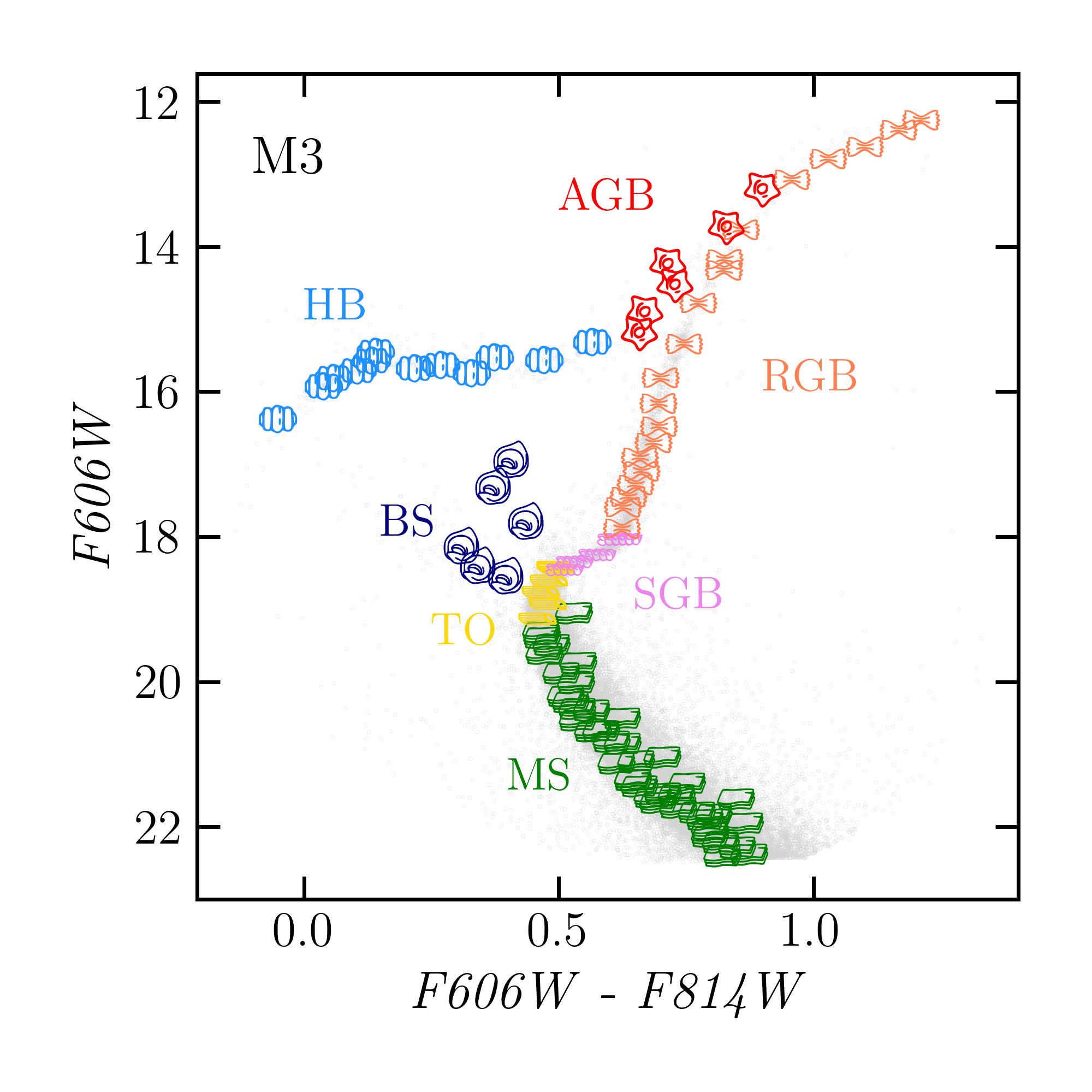
We aim at facilitating the visualization of astrophysical data for several tasks, such as uncovering patterns, presenting results to the community, and facilitating the understanding of complex physical relationships to the public. We present pastamarkers, a customized Python package fully compatible with matplotlib, that contains unique pasta-shaped markers meant to enhance the visualization of astrophysical data. We prove that using different pasta types as markers can improve the clarity of astrophysical plots by reproducing some of the most famous plots in the literature.

arXiv:2403.20314

Here’s an example of a colour-magnitude diagram plotted with pasta markers, with the main sequence as Lasagne, etc.

You can download the pastamarkers package here.

Krapp’s Last Tape

Posted in Theatre with tags , , , on October 23, 2024 by telescoper

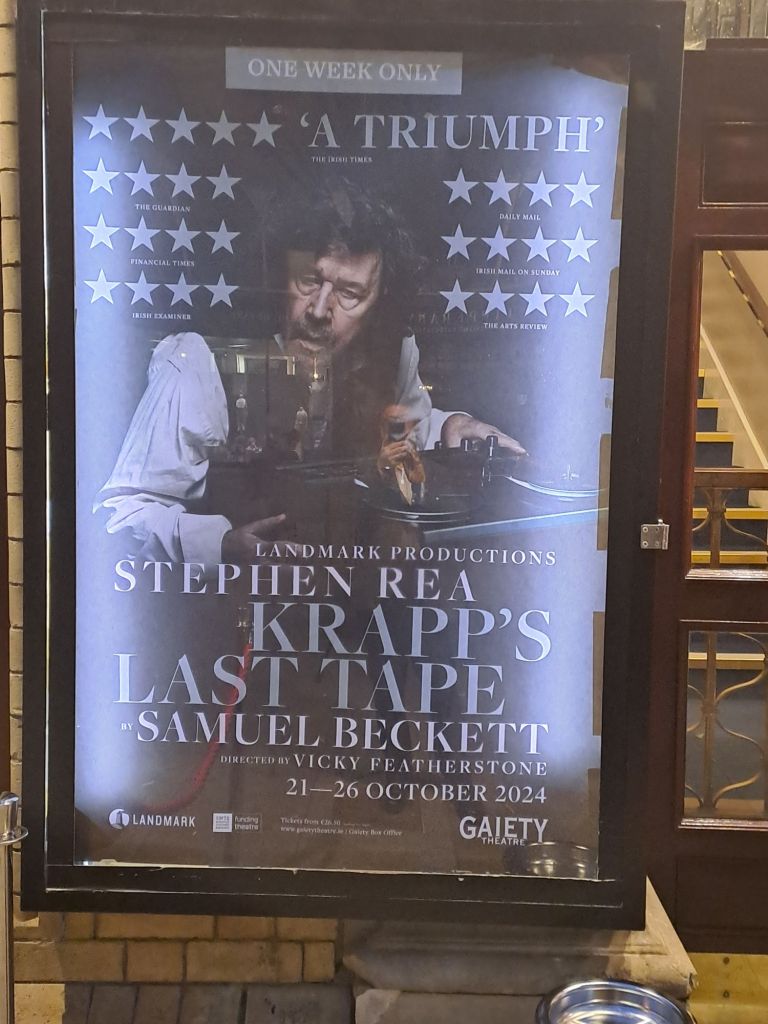
Unusually for me on a school night, this evening I travelled into Dublin not to the National Concert Hall but to the Gaiety Theatre for a performance of Samuel Beckett’s one-act play Krapp’s Last Tape.

The only character on stage for the performance is the eponymous Krapp played in this production by the inestimable Stephen Rea.

Krapp is listening to tape recordings he made as a younger man, apparently with the intention of recording another now he is an old man. It turns into a sort of dialogue between his present and past selves. Finally he gives up trying to make a new tape in favour of his memories. It’s a very poignant statement about ageing and the nature of memory.

Stephen Rea actually recorded the earlier tape about 12 years ago on the off-chance he would get to play the part, and the clear contrast in his voice makes the back-and-forth very convincing.

I’m very glad I got the chance to see this fine production of a modern masterpiece. Go and see it if you can!

P.S. Not a lot of people know that Samuel Beckett played first-class cricket.

Open Access Week 2024: Community over Commercialization

Posted in Open Access with tags , , , , , on October 22, 2024 by telescoper

This week is Open Access Week 2024, the theme of which is Community over Commercialization. In light of this, among with some other journal editors I was contacted by Scholastica to provide some comments for their blog, Scholastica being the provider of the platform used by The Open Journal of Astrophysics. I was happy to respond to a couple of questions about how to build engaged communities.

Here are the comments of mine that they used in the blog post:

We started with a small editorial board basically formed from people who read various blog posts I’d written about the idea of the journal and followed its germination. We were lucky to have an initial group of high-profile scientists based all around the globe, including the USA. We started to get some papers from very well-known authors from leading institutes, and large international consortia. Some of these papers have generated large numbers of citations and have attracted coverage in the mainstream media, which also helped raise our profile.

Last year I was on sabbatical, which gave me the opportunity to travel and give invited talks about open access publishing in astrophysics at institutions in France, Spain, the UK, and Australia, and to audiences around the world via the Internet. Other members of the editorial board have also done their bit in promoting the journal. Our submission rate increased only slowly at first but is now more than doubling each year and we are currently receiving several submissions a day.  It has taken a while to establish the reputation of the Open Journal of Astrophysics this way, (i.e., mainly by word of mouth), but that has been good for us because it has enabled us to scale up our processes without becoming overwhelmed by a deluge.

My advice to others trying to set up a new journal would be to have a strong editorial board and clear policies, and above all to be patient. It takes a while — in our case more than 5 years — to establish a reputation in the academic community. These days there are too many people talking about this sort of publishing and not enough actually doing it. It’s time for researchers and research institutions to claim back the original purpose of academic publishing, the free dissemination of research for the public good.

You can read comments from three other editors of open access journals in the original Scholastica blog post.

“Optimized” Beer Glass Shapes

Posted in The Universe and Stuff with tags , , , on October 21, 2024 by telescoper

I couldn’t resist sharing a piece of fundamental research I found in an article on the arXiv withthe abstract:

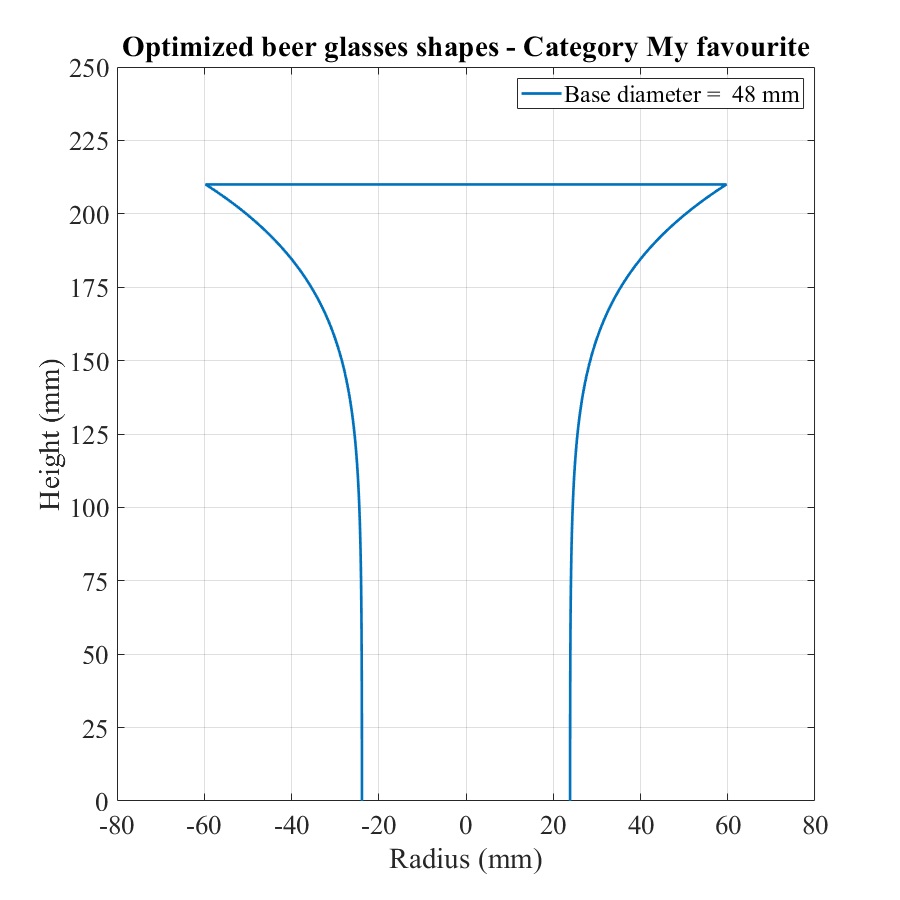
This paper addresses the problem of determining the optimum shape for a beer glass that minimizes the heat transfer while the liquid is consumed, thereby keeping it cold for as long as possible. The proposed solution avoids the use of insulating materials. The glass is modeled as a body of revolution generated by a smooth curve, constructed from a material with negligible thermal resistance, but insulated at the base. The ordinary differential equation describing the problem is derived from the first law of Thermodynamics applied to a control volume encompassing the liquid. This is an inverse optimization problem, aiming to find the shape of the glass (represented by curve S) that minimizes the heat transfer rate. In contrast, the direct problem aims to determine the heat transfer rate for a given geometry. The solution obtained here is analytic, and the resulting function describing the relation between height ans radius of the glass, is in closed form, providing a family of optimal glass shapes that can be manufactured by conventional methods. Special attention is payed to the dimensions and the capacity of the resulting shapes.

arXiv:2410.12043v1

The author’s favourite shape is this:

Of course those of us who are used to proper beer don’t really want it to be cold in the first place, but I hope this doesn’t sound bitter. My main reservation about the conclusion of the paper is that it doesn’t seem to take into account how easy it is to drink from the glass. In that respect, I’m not convinced by the shape above!

Storm Ashley

Posted in Biographical with tags , on October 20, 2024 by telescoper

Storm season has arrived in Ireland!

Storm Ashley has been battering the West of the country today. It’s not been as bad here in the sheltered environs of Maynooth, though we have had gusts up to 80 km/h which has left my garden in disarray with leaves and twigs all over the place.

The Mark Brake Scandal, 15 years on…

Posted in Cardiff, Education with tags , , , , on October 20, 2024 by telescoper

This blog has been going for over 16 years now. Those readers who have been following it all that time will remember that in October 2009, 15 years ago, I posted an item about Mark Brake, a Professor at the University of Glamorgan who falsely claimed on a funding application that he had a PhD from Cardiff University. I thought for old times’ sake I would post the article again…

P.S. This story was responsible for me being threatened with a libel action. My response was to pass on the name and address of my solicitor with the message “Go ahead. Make my day” (or words to that effect). I never heard back.

P.P.S. The University of Glamorgan no longer exists as such, as in April 2013 it merged with University of Wales, Newport, to form the University of South Wales