Here’s a nice blog peace giving the case for JUICE (The Jupiter Icy Moon Explorer recently selected by the European Space Agency for its next L-class mission).
There’s been a lot of chatter in astronomy circles about the negative consequences of ESA’s latest L-class (i.e. large) space mission selection. JUICE (The JUpiter Icy moon Explorer) was selected over two rival missions – the New Gravitational wave Observatory (NGO), and the Advanced Telescope for High ENergy Astrophysics (ATHENA). In the current age of global austerity, one group’s win is several groups’ losses, and understandably the X-Ray and gravitational wave communities are upset at the choice. Indeed, reading the comments section on astro blogs might make planetary scientists go a little pale. Not least the fact that ATHENA supporters have already delivered a 1450 signature petition demanding a rethink. The fact that the decision making process has been somewhat cloudy doesn’t help matters.
It does indeed suck that this is a zero-sum game (in fact, probably…
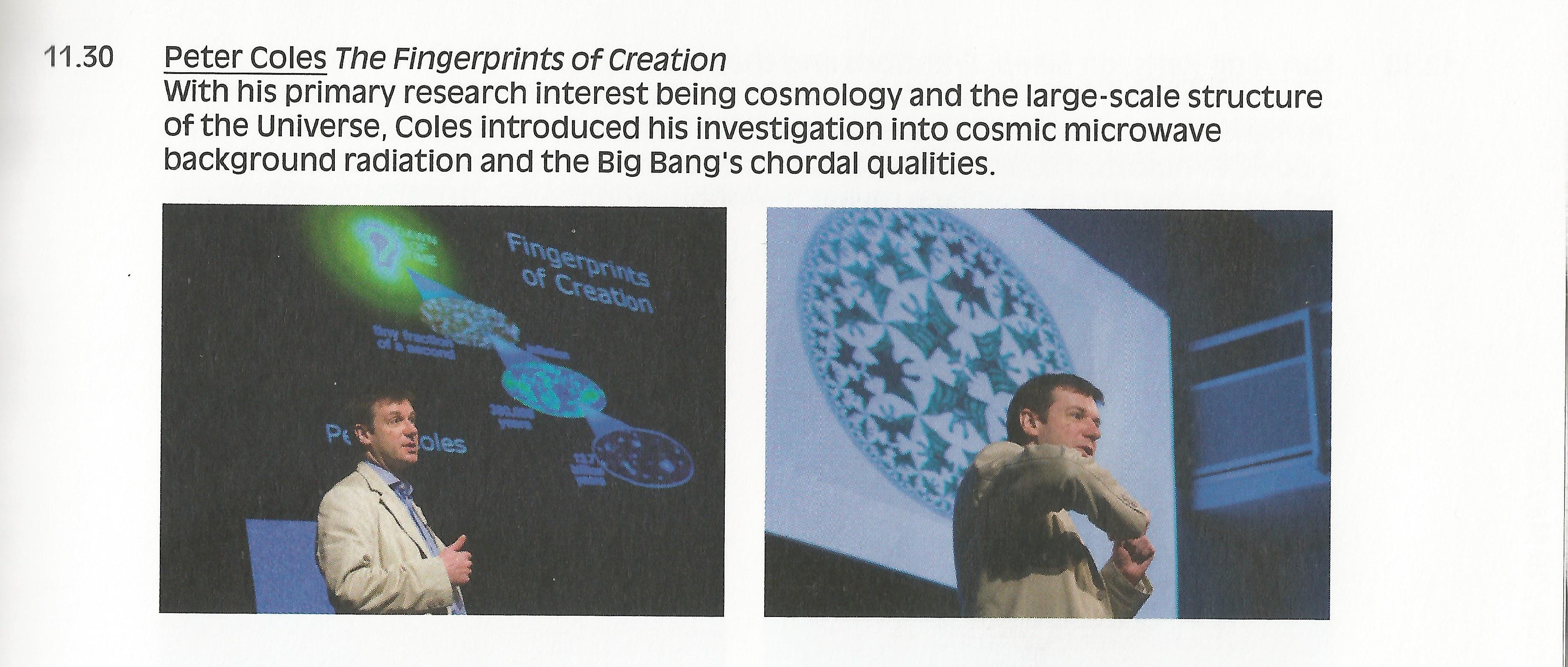
A while ago I blogged about an event I attended, called Experimental Marathon, which was held in Reykjavik Art Museum in May 2008. I was reminded about this for various reasons recently and managed to dig up a couple of pictures of my presentation, which appeared in the glossy book of the event that was produced later on.
As you can probably infer, I gave a talk which was basically about the cosmic microwave background. My “experiment” was a television set that wasn’t tuned properly producing a screenful of static. I pointed out that some (actually not that much) of the buzz was coming from the beginning of the universe. Pretty unoriginal and gimmicky, I know, but it seemed to go down quite well with the audience and I had some nice questions and comments at the end of my 20 minutes.
During the three days of the event I also got to meet quite a few artists, scientists and other luminaries whose names are on the list here.:
You can find one of the numerous reviews of this event here, which also includes quite a few pictures of various experiments including one that some might consider to be NSFW …
Well it’s a Bank Holiday (hooray!) so naturally it’s raining (boo!). Nice to have a lie-in on a Monday morning for a change, but will probably spend the afternoon working anyway. We’ve just finished formal teaching term, and now we have a “Guided Study Week” of revision lectures etc before examinations start next week.
By way of a diversion I thought I’d mention that on my recent trip to South Africa I got a chance the see the film version of John le Carré’s superb novel Tinker, Tailor Soldier, Spy. It was much as I’d expected, actually. Well acted and directed in itself, but rather difficult to enjoy if you’ve either read the book or seen the seven-part 1979 BBC TV dramatisation which, centred around a flawlessly understated performance by Alec Guinness as George Smiley, is surely one of the finest TV drama series ever made, although the sequel Smiley’s People is perhaps even better.
The point is that the original plot by John le Carré is just too complicated to fit in the usual duration of a feature film, so if one knows the full story one can’t fail but be conscious of the alterations and huge chunks completely missing from the movie. Nevertheless, given the constraints, it’s a good film in its own right. I’m glad I watched it, though that was mainly because it reminded me how good the TV version was.
Incidentally, parts of the film were apparently shot at Imperial College. I didn’t actually spot this when watching it, but was told about it afterwards.
Anyway I found this clip on Youtube of the very start of the TV series Tinker, Tailor, Soldier, Spy , a sceneplacedbefore the opening titles rolled. Although it doesn’t correspond to anything in the book, I think it epitomizes what was so good about the television version. It features the four characters who belong to the Witchraft “Magic Circle” responsible for running Source Merlin, a Soviet agent who is supposed to be working as double-agent for British Intelligence (called “The Circus” because of its headquarters in Cambridge Circus). Of course it turns out everything is actually the other way round, and Source Merlin is Moscow Centre’s contact with a mole inside the Circus (codename “Gerald”) who is handing over British secrets. Gerald must be one of the four who have regular contact with Source Merlin, but which one?
I think this scene is brilliant because nobody says a word for most of it, but it immediately establishes the different characters of the respective protagonists. The pompous and punctilious pipe-smoking Percy Alleline (“Tinker”) brings a huge dossier of papers to the meeting, evidently enjoying his role as Head Boy. Flamboyant Bill Haydon (“Tailor”) displays his studied eccentricity by bringing only a cup of tea, with the saucer on top, and a biscuit. Haydon’s expression as Percy starts the meeting is priceless. Dishevelled chain-smoking Roy Bland (“Soldier”) seems entirely preoccupied with other things. Snappily dressed Toby Esterhase (“Poor Man”) betrays his status as a junior member of the club by arriving early – no doubt to impress – and closing the door that Haydon carelessly left open.
By way of reminding myself for future reference I thought I’d do a quick post about the results of Thursday’s local elections.
I live in the Riverside ward within the area administered by Cardiff City Council. When I moved here in 2008 there were three Plaid Cymru (Welsh Nationalist) councillors. That was just after an election in which the Welsh Labour party had done badly, and also to some extent reflected the particular nature of the Pontcanna area which is within Riverside ward, in that it has a sizeable Welsh-speaking population many of whom work for the media, especially the BBC.
Last year we had a by-election, won by Iona Gordon for Labour, so going into this year’s elections there were two Plaid councillors and one Labour. The result of the 2012 vote was very bad for Plaid, who lost their two remaining candidates to Labour. So in four years I’ve gone from living in a Plaid Cymru stronghold to a Labour stronghold.
The pattern in Riverside ward was repeated across Cardiff, so that Labour achieved a sizeable overall majority, with the Conservatives, Liberal Democrats and Plaid Cymru all losing seats:
Before the elections the Council was run by a LibDem/Plaid Coalition and such was the swing against these parties that Council Leader Rodney Berman lost his seat, although in apparent desperation to cling onto his salary he demanded two recounts before giving up. Afterwards he spoke to the press claiming that the result in Cardiff was down to Westminster politics rather than local issues.
I don’t think so.
I certainly voted on local issues and so did many of the people I talked to. The former administration of the Council was awful in many respects, including proven maladministration over the decision to build a waste incinerator. I’m not the only person to have remarked on the plethora of pointless roadworks going on in the city, including narrowing the busiest thoroughfares, and of course the ongoing over-development of Bute Park.
No, Mr Berman. You were voted out because you did a lousy job.
There’s no guarantee, of course, that Labour will do any better but I very much doubt they can do any worse. I hope I’m not proved wrong.
Here’s another take on the Academic Publication racket that I found through a trackback to one of my posts. It misses the point in a number of places, but is well worth a read.
You have to go back to the 1950s – before even I was born – for the last time my own team won the FA Cup, but they did win it three times in that decade, including in 1952 when they were watched at Wembley by the new Queen Elizabeth II. Sixty years on we’re approaching the Queen’s Diamond Jubilee, but I don’t think Her Majesty is watching. Neither am I, in fact, because the FA moved back the kick-off to 5.15 from the traditional 3pm. Sacrilege.
P.S. The score in the 1955 FA Cup Final was Newcastle United 3 Manchester City 1. Fans of Manchester United will be hoping that there’s a similar result in tomorrow’s Premiership match between the same two clubs!
I just found out this morning that this weekend sees the official opening of the Wales Coastal Path. This means that it’s now possible – if you have the time, the energy and sensible shoes – to walk the entire length of the Welsh coast. There’s a nice article here that picks out five particularly interesting stretches. One, around the Llyn Peninsula, is of particular interest to me because it includes this picture of ancient church of Saint Hywyn, which is almost on the beach in Aberdaron. The great Welsh poet R.S. Thomas was vicar here for a number of years.
Anyway, here’s a promotional video about the Wales Coastal Path, which gives an idea of some of the stunning views at various points around this beautiful country.
The paper, to appear in due course in Monthly Notices of the Royal Astronomical Society, describes a study of the positions and velocities of small satellite galaxies and other object around the Milky Way, which suggest the existence of a flattened structure orientated at right angles to the Galactic plane. They call this the “Vast Polar Structure”. There’s even a nifty video showing this arrangement:
They argue that this is is evidence that these structures have a tidal origin, having been thrown out in the collision between two smaller galaxies during the formation of the Milky Way. One would naively expect a much more isotropic distribution of material around our Galaxy if matter had fallen into it in the relatively quiescent way envisaged by more standard theoretical models.
Definitely Quite Interesting.
However, I was rather taken aback by this quotation by one of the authors, Pavel Kroupa, which ends the press release.
Our model appears to rule out the presence of dark matter in the universe, threatening a central pillar of current cosmological theory. We see this as the beginning of a paradigm shift, one that will ultimately lead us to a new understanding of the universe we inhabit.
Hang on a minute!
One would infer from this rather bold statement that the paper concerned contained a systematic comparison between the observations – allowing for selection effects, such as incomplete sky coverage – and detailed theoretical calculations of what is predicted in the standard theory of galaxy formation involving dark matter.
But it doesn’t.
What it does contain is a simple statistical calculation of the probability that the observed distribution of satellite galaxies would have arisen in an exactly isotropic distribution function, which they conclude to be around 0.2 per cent.
However, we already know that galaxies like the Milky Way are not exactly isotropic, so this isn’t really a test of the dark matter hypothesis. It’s a test of an idealised unrealistic model. And even if it were a more general test of the dark matter hypothesis, the probability of this hypothesis being correct is not what has been calculated. The probability of a model given the data is not the same as the probability of the data given the model. To get that you need Bayes’ theorem.
What needs to be done is to calculate the degree of anisotropy expected in the dark matter theory and in the tidal theory and then do a proper (i.e. Bayesian) comparison with the observations to see which model gives the better account of the data. This is not any easy thing to do because it necessitates doing detailed dynamical calculations at very high resolution of what galaxy like the Milky Way should look like according to both theories.
Until that’s done, these observations by no means “rule out” the dark matter theory.
I’ve always wanted to be at a live performance of the legendary 40 part motet Spem in Alium by Thomas Tallis, not only because it’s a gorgeous piece of music but also because I’ve always wondered what the conductor is supposed to do with his hands when there are so many independent parts. It’s such a complicated and demanding work, however, that opportunities to hear it live are rather limited. Last night’s concert at St David’s Hall by the Tallis Scholars (supplemented by a local choir; the Tallis Scholars number only ten singers) actually involved two performances of Tallis’ most famous work, first at the beginning and then again right at the end.
If you’ve never heard Spem in Alium before, then you really should make the effort. It’s an extraordinary piece of music in many different ways. Most writers focus on its complexity, but that shouldn’t make you think Tallis was just showing off when he wrote it, or distract you from the fact that it’s so very beautiful to listen to. The forty parts involved are divided into eight choirs, each of five voices. The piece starts with one voice from the first choir, and slowly evolves to incorporate all forty voices, waving each individual vocal line into a gorgeous musical tapestry. At times all the voices seem to be acting independently within the overall harmonic framework, at others the choirs act as the basic unit; there’s a wonderful passage, for example, when choirs throw phrases backwards and forwards between them. There are also moments when all the evolving parts come back into phase so that all voices sing the same words at the same time. The effect of this is indescribable; it sent cold shivers down my spine.
There is so much going on in this piece that it’s difficult to understand how Tallis managed to stop the different parts interfering destructively with each other, but Spem in Alium never dissolves into a shapeless melisma. As the piece unfolds, the various patterns that appear and disappear are always held in sharp focus. It’s a masterpiece, and although the large space of St David’s Hall probably isn’t ideal for performing a work like this, my long wait to hear a live performance of this masterpiece was well worth it.
The concert wasn’t just about Spem in Alium. The Tallis Scholars performed a number of other works on their own, including pieces by Tallis’ old mate William Byrd and part of one of my other favourite Tallis works, The Lamentations of Jeremiah. The programme called for various combinations of the singers drawn from the ten in the basic line-up, producing a wide range of texture and colour.
It was all extremely enjoyable, but my lasting memory will be the piece that started and ended the show. There’s so much to discover listening to Spem in Alium that the second performance of it that ended the concert made me want to hear a third straight away.
PS. One of the other pieces performed during the concert was Tallis’ Miserere, which aptly described Cardiff City’s performance at home to West Ham in their play-off semi-final which was being played at the same time as the concert!
Not unexpectedly, the European Space Agency announced yesterday that it’s next large mission will be the Jupiter Icy Moon Explorer (aka JUICE). There’s a piece in Physics World about the selection – and rejection of the other two contenders, NGO and ATHENA. Andy Lawrence has commented already on his own blog and is also quoted extensively in the Physics World article.
A lot of allegations are flying around about how the selection process was conducted, specifically relating to conflicts of interest. I don’t know any details, so I won’t comment on whether this is justified outrage or simply sour grapes.
Anyway, for what it’s worth, I think I agree with what Andy Lawrence says in the Physics World story in that the final decision was pretty inevitable after NASA’s decisions in the areas of gravitational waves and X-ray astronomy pulled the rug out from under the other contenders. I’ll also add that, although it’s far from my own specialism, I think JUICE looks like a very exciting mission. I wish it every success.
It just remains to be seen how long the recriminations will rumble on.
The views presented here are personal and not necessarily those of my employer (or anyone else for that matter).
Feel free to comment on any of the posts on this blog but comments may be moderated; anonymous comments and any considered by me to be vexatious and/or abusive and/or defamatory will not be accepted. I do not necessarily endorse, support, sanction, encourage, verify or agree with the opinions or statements of any information or other content in the comments on this site and do not in any way guarantee their accuracy or reliability.



 In the Dark