Flying at Night

Posted in Poetry with tags , , on April 2, 2012 by telescoper

This may be a bit premature, but it’s certainly apt as I’m just about to head off to the airport and hopefully will be airborne this evening. I expect to be online again tomorrow, after I reach my destination…

Above us, stars. Beneath us, constellations.
Five billion miles away, a galaxy dies
like a snowflake falling on water. Below us,
some farmer, feeling the chill of that distant death,
snaps on his yard light, drawing his sheds and barn
back into the little system of his care.
All night, the cities, like shimmering novas,
tug with bright streets at lonely lights like his.

by Ted Kooser (b. 1939)


The Name of Love

Posted in Uncategorized with tags , on April 1, 2012 by telescoper

A comment on a recent post pointed out that the ancient Greeks had four distinct name for different aspects of what in English is called, simply, “love”.

Here’s what wikipedia says on the matter:

There are several Greek words for love, as the Greek language distinguishes how the word is used. Ancient Greek has four distinct words for loveagápeérosphilía, and storgē. However, as with other languages, it has been historically difficult to separate the meanings of these words. Nonetheless, the senses in which these words were generally used are given below.

  • Agápe (ἀγάπη agápē[1]) means “love” (unconditional love) in modern day Greek, such as in the term s’agapo (Σ’αγαπώ), which means “I love you”. In Ancient Greek, it often refers to a general affection or deeper sense of “true love” rather than the attraction suggested by “eros“. Agape is used in the biblical passage known as the “love chapter”, 1 Corinthians 13, and is described there and throughout the New Testament as sacrificial love. Agape is also used in ancient texts to denote feelings for one’s children and the feelings for a spouse, and it was also used to refer to a love feast. It can also be described as the feeling of being content or holding one in high regard. Agape was appropriated by Christians for use to express the unconditional love of God.[citation needed] Before agape love there was no other word to express such great love.[citation needed]
  • Éros (ἔρως érōs[2]) is passionate love, with sensual desire and longing. The Modern Greek word “erotas” means “intimate love;” however, eros does not have to be sexual in nature.Eros can be interpreted as a love for someone whom you love more than the philia, love of friendship. It can also apply to dating relationships as well as marriage. Plato refined his own definition: Although eros is initially felt for a person, with contemplation it becomes an appreciation of the beauty within that person, or even becomes appreciation of beauty itself. Plato does not talk of physical attraction as a necessary part of love, hence the use of the word platonic to mean, “without physical attraction.” In the Symposium, the most famous ancient work on the subject, Plato has the middle-aged Athenian philosopher, Socrates argue to aristocratic intellectuals and a young male acolyte in sexual pursuit of him, that eroshelps the soul recall knowledge of beauty, and contributes to an understanding of spiritual truth, the ideal “Form” of youthful beauty that leads us humans to feel erotic desire — thus suggesting that even that sensually-based love aspires to the non-corporeal, spiritual plane of existence; that is, finding its truth, just like finding any truth, leads to transcendence. Lovers and philosophers are all inspired to seek truth through the means of eros.”
  • Philia (φιλία philía[3]) means friendship or affectionate love in modern Greek. It is a dispassionate virtuous love, a concept developed by Aristotle. It includes loyalty to friends, family, and community, and requires virtue, equality and familiarity. In ancient texts, philos denoted a general type of love, used for love between family, between friends, a desire or enjoyment of an activity, as well as between lovers.
  • Storge (στοργή storgē[4]) means “affection” in ancient and modern Greek. It is natural affection, like that felt by parents for offspring. Rarely used in ancient works, and then almost exclusively as a descriptor of relationships within the family. It is also known to express mere acceptance or putting up with situations, as in “loving” the tyrant.

I’m by no means an expert on love, but it seems to me that even with this expanded set of basis states it’s still the case that one’s emotions aren’t described fully by just one. Perhaps love is like quantum mechanics, in which the general state is a superposition?

Anyway, this all reminded me of “the love that dare not speak its name” which most take to refer to homosexual desire. In fact it’s not as simple as that. The phrase was coined by Oscar Wilde in the following excerpt taken from the transcript of his criminal trial for gross indecency in 1895:

‘The love that dare not speak its name’, in this century, is such a great affection of an elder for a younger man as there was between David and Johnathan. Such as Plato made the very basis of his philosophy, and such as you may find in the sonnets of Michelangelo or Shakespeare. It is, in this century, misunderstood. So much misunderstood that it may be described as ‘the love that dare not speak its name’, and on account of it I am placed where I am now. It is beautiful. It is fine. It is the noblest form of affection. There is nothing unnatural about it. It is intellectual. And it repeatedly exists between an elder and a younger man when the elder has intellect and the younger man has all the joy, hope and glamour of life before him. That it should be so, the world does not understand. The world mocks at it and sometimes puts someone in the pillory for it.

This looks to me like it fits in the wider definition of Eros, not necessarily of a sexual nature. It’s a very moving speech, or at least I think so,  but it didn’t do him much good. He was eventually convicted and sentenced to two years’ hard labour. And, over a century later, it’s still “misunderstood”…


News from the BOSS

Posted in The Universe and Stuff with tags , , , on April 1, 2012 by telescoper

No April Fool’s from me today I’m afraid!

New results from the Baryon Oscillation Spectroscopic Survey (known to its friends as BOSS) were one of the highlights of the National Astronomy Meeting last week (which I wasn’t at) and they’ve received quite a lot of press attention over the past few days. Rather than repeat what’s been said I thought I’d reblog this lengthy piece, which gives a lot of detail and is also written by an insider!

Rita's avatarwe are all in the gutter

I wrote the following post yesterday, but I fell asleep before I could do anything with it. It’s about the first set of results from the Baryon Oscillation Spectroscopic Survey (BOSS), part of Sloan Digital Sky Survey-III project, which we announced to the science community and to the press yesterday. How this whole project was picked up by the press in a way I hadn’t anticipated is the matter for another post. What really matters is the science, and the science – if you don’t mind my exceedingly biased opinion – is just excellent.

============================

I’m now making my way back home from this year’s National Astronomy Meeting (NAM) 2012 in Manchester. I love NAM. It’s always a chance to see old friends and listen to good science, to catch up on gossip and long-promised pints. This year, I did almost none of these things. The reason is that one…

View original post 2,265 more words

Web Life

Posted in Biographical, Books, Talks and Reviews with tags , , on March 31, 2012 by telescoper

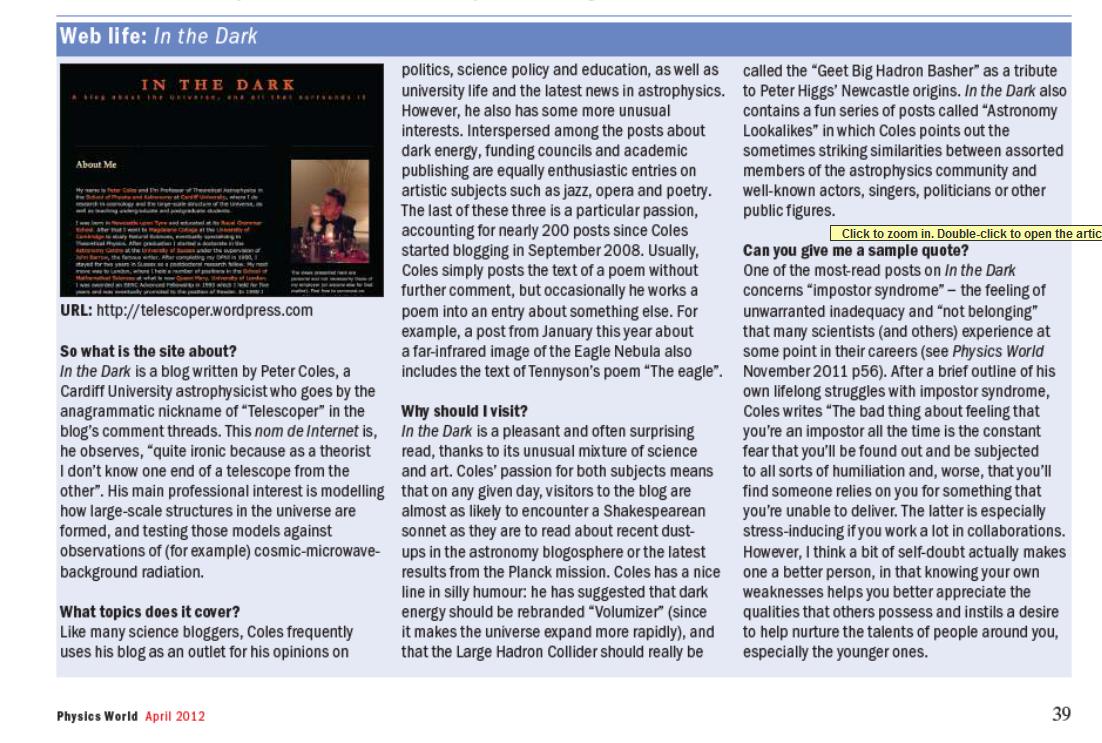
Pure vanity drove me to post this screenshot of a nice write-up of this blog that appears in this month’s Physics World. You can read the whole edition online here if you have a subscription, but if you click on the image it’s more-or-less legible. They’ve written very nice things about In the Dark,  so hope I don’t get into trouble with their copyright enforcers by posting this…

Cement Mixer

Posted in Jazz with tags , , on March 31, 2012 by telescoper

Well, term is over and, inevitably, there are signs that the weather is on the turn. Time, I think, for a bit of inspired silliness by the great Slim Gaillard. I’ve posted about Slim before, but for completeness Slim Gaillard was a truly remarkable character who led a remarkable life, as his wikipedia page makes clear. He was a superbly talented musician in his own right, but also a wonderful comedian and storyteller. He’s most famous for the novelty jazz acts he formed with musicians such as Slam Stewart and, later, Bam Brown; their stream-of-consciousness vocals ranged far afield from the original lyrics along with wild interpolations of nonsense syllables such as MacVoutie and O-reeney; one such performance figures in the 1957 novel On the Road by Jack Kerouac.

In later life Slim Gaillard travelled a lot in Europe – he could speak 8 languages in addition to English – and spent long periods living in London. He died there, in fact, in 1991, aged 75. I saw him a few times myself when I used to go regularly to Ronnie Scott’s Club. A tall, gangly man with a straggly white beard and wonderful gleam in his eye, he cut an unmistakeable figure in the bars and streets of Soho. He rarely had to buy himself a drink as he was so well known and such an entertaining fellow that a group always formed around him, just in order to enjoy his company,  whenever he went into a pub or club. You never quite knew what he was going to do next, in fact. I once saw him sit down and play a piano with his palms facing upwards, striking the notes with the backs of his fingers as he does in this clip, wherein he interpolates an upside-down but nevertheless very accurate version of the opening passages of Debussy’s Claire de Lune.  I’m posting this primarily because it’s such a hoot, but I think it also demonstrates what a marvellous musician he was both on piano – check out the size of his hands! – and on guitar, playing a medley of his hit Cement Mixer to accompany his own gloriously daft vocal.

Other random things worth mentioning are that Slim Gaillard’s daughter was married to Marvin Gaye and it is generally accepted that the word “groovy” was coined by him (Slim). I know it’s a cliché, but he really was a larger-than-life character and a truly remarkable human being. As one of the commenters on Youtube aptly put it “To Slim Gaillard, the whole world was just one big O-roonie”. Enjoy!

End of Term

Posted in Biographical, Education with tags , , , on March 30, 2012 by telescoper

So here we are, then. The last day of term has finally arrived.  Many of our students will be out partying tonight before they start a three-week break with little to disturb their relaxation but project reports, assignments and examination revision. Probably not all that relaxing at all then, especially for the final-year students.

For various reasons I’ve found this term very heavy going and am  looking forward to spending some time away over the next couple of weeks.  More about that in due course, assuming I have internet access…

The curious thing about the academic year is that since most UK universities switched to a semester system we’ve had to cope with the fact that Easter isn’t on a fixed calendar date. Last year, Easter was rather late so we managed to squeeze in a full 11 weeks teaching in before the vacation started. This year we’ve only got time for 9 weeks, so we resume teaching in three weeks’ time for another two weeks, followed by a revision week and the examination period. I think most students probably agree with me that this hiatus is extremely annoying.

This year Good Friday is on 6th April (a week today) and Easter Monday on 9th April; both are statutory (“bank”) holidays in the UK. Most universities have felt obliged to move their recess so that these two holidays occur outside term-time.

If I had my way we would have fixed semester dates so this nonsense of a 9+2 week teaching semester wouldn’t happen. Last year’s 11-week uninterrupted run was a slog, but I much prefer it over the stop-start affair we’re having this year.

I was a visiting professor at an American university over one Easter period many years ago. Given the fact that the Christian lobby is far more powerful over there than it is here I was quite surprised by the fact that there’s no real interruption for Easter. Lectures were held on Good Friday and there’s no Easter Monday holiday. Easter Sunday was definitely observed, but that had no effect on teaching.

The two Bank Holidays are a bit of a problem, of course, especially because they are followed by two more in May. However, when I was an undergraduate at Cambridge, we had lectures as normal on bank holidays.  I’m not sure whether that practice was restricted to Oxbridge colleges – where term dates are different to elsewhere anyway – or some other Universities did the same. I don’t even know if Oxbridge still carries on over bank holidays today…

A better solution would be to distribute the statutory holidays more evenly through the year so they weren’t concentrated so inconveniently in Spring. There would be  nothing to stop Christians taking a day’s leave in order to observe Good Friday, of course.

But since only a minority of British people are practising Christians, why are the rest of us forced to arrange our calendars according to archaic and irrelevant rituals?  Far better, in my opinion,  to give us all a day off for the start of the cricket season…

Grumble over, it just remains for me to wish my loyal readers (Sid and Doris Bonkers) all the best for the recess, and I hope it’s a good night at the Student Ball tonight!

Is this the “Squeezed Middle”?

Posted in Education, Finance with tags , , on March 29, 2012 by telescoper

As reported in the Times Higher , the Higher Education Funding Council for England (HEFCE) has announced its allocations to English Higher Education Institutions for 2012/13. As expected, many universities are receiving substantial cuts next year. Here is a table of the biggest losers:

The Times Higher article describes this as the “Squeezed Middle”. It looks more like the “Squeezed Bottom” to me, but then I suppose that would have made an inappropriate headline.

Is there really a University of Sunderland?

Anyways, this allows me the chance to congratulate the former Director of Learning and Teaching in the School of Physics & Astronomy at Cardiff University on his move to the University of Central Lancashire, currently riding high at Number 7 in the above table…


Behind the Scenes at the School Management Group

Posted in Uncategorized on March 29, 2012 by telescoper

At a Staff Meeting yesterday it was officially announced that I’ve been “promoted” to Deputy Head of School, with responsibility for Teaching and Learning. Actually,  it’s not so much a promotion as a battlefield commission, as the current holder of this prestigious position is shortly moving to pastures new. People have asking me if anything is going to be re-organized in the new regime. I’m going to suggest quite a few things, in fact, but the main idea I’ve come up with is to separate the administration of the “Teaching” part entirely from that of the “Learning” in order to reflect the fact that there’s absolutely no connection between the two activities. If we then appoint a Director of Teaching and a Director of Learning, I can leave them to do everything while I go down the pub.

As Deputy Head of School, I will be joining the all-powerful Management Group, the School’s elite Politburo which has only four members. One of my aims is to make this organization less secretive and more open. In this spirit, I can reveal this exclusive behind-the-scenes footage taken at the last Management Group meeting. I’m sure the members of the School will sleep more easily in their offices knowing that they’re managed by four such capable individuals.

A Walk in Bute Park

Posted in Uncategorized with tags , on March 28, 2012 by telescoper

Yesterday evening as I walked home through Bute Park I thought I’d take a few pictures with my phone to remind myself at a future date what beautiful weather we’re having and how splendid the trees and flowers are looking. It’s great to see so many people enjoying this beautiful park these days; fortunately the Council seems to have suspended the regular traffic of heavy vehicles along the paths, at least for the time being.

Unfortunately at around the time I took these pictures, something much less pleasant was happening a few hundred yards away near Cardiff Station. I’ve no idea what went on, but thankfully it looks like nobody received life-threatening injuries…

Anyway, neither Cherry nor May Blossom lasts very long – the Magnolias are already dropping their flowers – so let’s make the most of them while we can!

Cardiff Castle behind the trees

Even the Weeping Willow looks happy...although it's a bit of a concern that the water level in the Taff is so low...

Now here’s a question. Is it just me, or is the May Blossom appearing earlier nowadays than it used to? It’s definitely out now and it’s not even April yet…

Joy Spring

Posted in Jazz with tags , , , on March 28, 2012 by telescoper

Having an early morning cup of tea in the garden just now, as the fine weather continues, I suddenly remembered this classic from 1954. Fortunately someone has put it on Youtube so I can share it right away. This piece will forever be associated with the late great  Clifford Brown who plays trumpet and leads the band, but the real star of the show for me is the arranger, Jack Montrose, who wove a rich  texture around the melody of Joy Spring, with more than a hint of the West Coast “Cool”  that was to dominate the US jazz scene  in later years.