Astronomy in Darkness

Posted in The Universe and Stuff with tags , , , , , , , , on January 14, 2012 by telescoper

Yesterday, being the second Friday of the month, was the day for the Ordinary Meeting of the Royal Astronomical Society (followed by dinner at the Athenaeum for members of the RAS Club). Living and working in Cardiff it’s difficult for me to get the specialist RAS Meetings earlier in the day, but if I get myself sufficiently organized I can usually get to Burlington House in time for the 4pm start of the Ordinary Meeting, which is open to the public.

The distressing news we learnt on Thursday about the events of Wednesday night cast a shadow over the proceedings. Given that I was going to dinner afterwards, for which a jacket and tie are obligatory, I went through my collection of (rarely worn) ties, and decided that a black one would be appropriate. When I arrived at Burlington House I was just in time to hear a warm tribute paid by a clearly upset Professor Roger Davies, President of the RAS and Oxford colleague of the late Steve Rawlings. There then followed a minute’s silence in his memory.

The principal reaction to this news amongst the astronomers present was one of disbelief and/or incomprehension. Some  friends and colleagues of Steve clearly knew much more about what had happened than has so far appeared in the press, but I don’t think it’s appropriate for me to make these public at this stage. We will know the facts soon enough. A colleague also pointed out to me that Steve had spent most of his recent working life as a central figure in the project to build the Square Kilometre Array, which will be the world’s largest radio telescope. He has died just a matter of days before the announcement will be made of where the SKA will actually be built. It’s sobering to think that one can spend so many years working on a project, only for something wholly unforeseen to prevent one seeing it through to completion.

Anyway, the meeting included an interesting talk by Tom Kitching of the University of Edinburgh who talked about recent results from the Canada-France-Hawaii Telescope Lensing Survey (CHFTLenS). The same project was the subject of a press release because the results were presented earlier in the week at the American Astronomical Society meeting in Austin, Texas. I haven’t got time to go into the technicalities of this study – which exploits the phenomenon of weak gravitational lensing to reconstruct the distribution of unseen (dark) matter in the Universe through its gravitational effect on light from background sources – but Tom Kitching actually contributed a guest post to this blog some time ago which will give you some background.

In the talk he presented one of the first dark matter maps obtained from this survey, in which the bright colours represent regions of high dark matter density

Getting maps like this is no easy process, so this is mightily impressive work, but what struck me is that it doesn’t look very filamentary. In other words, the dark matter appears to reside predominantly in isolated blobs with not much hint of the complicated network of filaments we call the Cosmic Web. That’s a very subjective judgement, of course, and it will be necessary to study the properties of maps like this in considerable detail in order to see whether they really match the predictions of cosmological theory.

After the meeting, and a glass of wine in Burlington House, I toddled off to the Athenaeum for an extremely nice dinner. It being the Parish meeting of the RAS Club, afterwards we went through a number of items of Club business, including the election of four new members.

Life  goes on, as does astronomy, even in darkness.

When Death Comes

Posted in Poetry with tags , , on January 13, 2012 by telescoper

When death comes
like the hungry bear in autumn;
when death comes and takes all the bright coins from his purse

to buy me, and snaps the purse shut;
when death comes
like the measle-pox:

when death comes
like an iceberg between the shoulder blades,

I want to step through the door full of curiosity, wondering
what is it going to be like, that cottage of darkness?

And therefore I look upon everything
as a brotherhood and a sisterhood,
and I look upon time as no more than an idea,
and I consider eternity as another possibility,

and I think of each life as a flower, as common
as a field daisy, and as singular,

and each name a comfortable music in the mouth,
tending, as all music does, toward silence,

and each body a lion of courage, and something
precious to the earth.

When it’s over, I want to say: all my life
I was a bride married to amazement.
I was the bridegroom, taking the world into my arms.

When it’s over, I don’t want to wonder
if I have made of my life something particular, and real.
I don’t want to find myself sighing and frightened,
or full of argument.

I don’t want to end up simply having visited this world.

by Mary Oliver (b. 1935)

Just a closer walk with thee

Posted in Music, Television, The Universe and Stuff with tags , , , on January 12, 2012 by telescoper

I saw this clip a few days ago, and had it in mind to post it at an appropriate time. Unfortunately when I got home today I learned some news that makes today seem all too appropriate. A distinguished and respected colleague, Prof. Steve Rawlings, of Oxford University was found dead last night. This is shocking and desperately sad news. I have no idea what happened but apparently the Oxfordshire police have arrested a 49-year old man on suspicion of murder. No doubt more information will emerge in due course.

The connection between this sombre piece of news and the clip I  intended to post should become obvious when I tell you that it depicts a funeral. Indeed the music featured, the hymn or spiritual Just a Closer Walk with Thee, was the main music chosen for the service when my father died,  just over four years ago. It’s a lovely old traditional tune that often  plays a central role in New Orleans style funerals, as shown here, and is a melody that, for me, has a deep associattion with loss and bereavement.

The clip is taken from the US TV series Treme. I haven’t seen Treme -if it has been shown on UK TV I missed it – but it’s set in New Orleans in the aftermath of the near destruction of the city by Hurricane Katrina in 2005. Not knowing anything about the TV series I only watched the clip because of the music, but I was mightily impressed by the way the scene was photographed and how careful the producers had been in getting the details just right, because a funeral in New Orleans is unlike any other.

The sashes, parasols, and exaggerated, swaying slow march seen in the film are in some sense almost comical, but  they are also at the same time solemn and immensely dignified. Defiant, even. I don’t think it’s just because I am a jazz fan that I find this video so moving. Perhaps it’s really because, faced with the awesome finality of death, every action we take in life is comical anyway, just as every word is ultimately banal. However, if a farce is what  it’s going to be, let’s just make sure it’s done the way we like it – especially at the end.

One of the commenters on Youtube put it thus:

it aint my time yet .but when it is thats the way i wanna go home

Amen to that. I don’t think Steve Rawlings was a jazz fan, but this is the best way I can think of to pay my respects.

Away to Swansea

Posted in The Universe and Stuff with tags , , , , on January 11, 2012 by telescoper

Just time for a quick post this evening, primarily to make a note of an enjoyable event that took place this afternoon. I long since gave up keeping a proper journal so the old blog will have to play that role.

Today a small group of cosmologists from the School of Physics & Astronomy at Cardiff University made the short trip to Swansea to meet with members of the Physics department there. The idea of the meeting was to explore the possibilites of future research collaboration. For historical reasons there is a pretty strong separation in Wales between research in Particle Physics and Astronomy/Astrophysics; Swansea does the former and Cardiff does the latter. However, cosmology is an area in which there are possible overlaps between some of the – primarily theoretical – research going on at Swansea into, e.g., Quantum Gravity and what we do in Cardiff, e.g. inflationary cosmology.

Anyway we decided to get together for an afternoon of talks by members of both departments to see if anything emerged as potential research topics. In fact, a couple of interesting ideas were discussed and although the main focus of research differs substantially in the two institutions we’re definitely going to get together again to follow up these ideas.

Although I’ve been in Cardiff since 2007, I’d never visited Swansea University before which, considering that it’s only an hour away by train, is admittedly a bit pathetic. In fact I think it’s quite weird the two departments don’t collaborate more in other areas too. I’m certainly very keen to see more joint activities than we have now, so hopefully this is a move in that direction.

Anyway, I’d like to thank Graham Shore at Swansea for hosting us this afternoon and I very much look forward to the planned return leg which will be held in Cardiff in a couple of months.

The Messenger

Posted in Poetry with tags , , on January 11, 2012 by telescoper

The thing, he said, would come in the night at three
From the old churchyard on the hill below;
But crouching by an oak fire’s wholesome glow,
I tried to tell myself it could not be.

Surely, I mused, it was pleasantry
Devised by one who did not truly know
The Elder Sign, bequeathed from long ago,
That sets the fumbling forms of darkness free.

He had not meant it – no – but still I lit
Another lamp as starry Leo climbed
Out of the Seekonk, and a steeple chimed
Three – and the firelight faded, bit by bit.

Then at the door that cautious rattling came –
And the mad truth devoured me like a flame!

by Howard Phillips Lovecraft (1890-1937).


In a Physicist’s Mailbag…

Posted in Biographical, The Universe and Stuff with tags , , on January 10, 2012 by telescoper

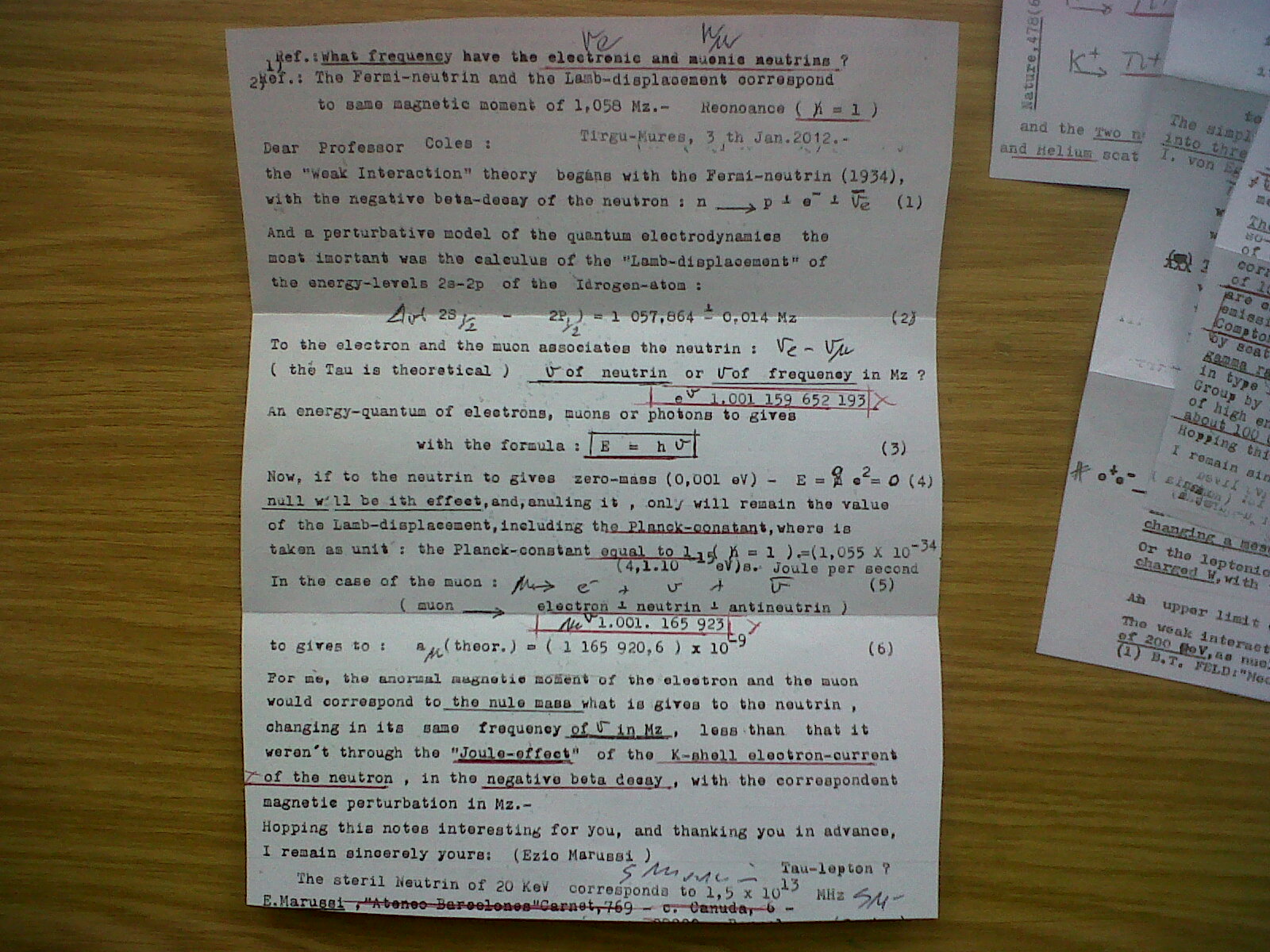
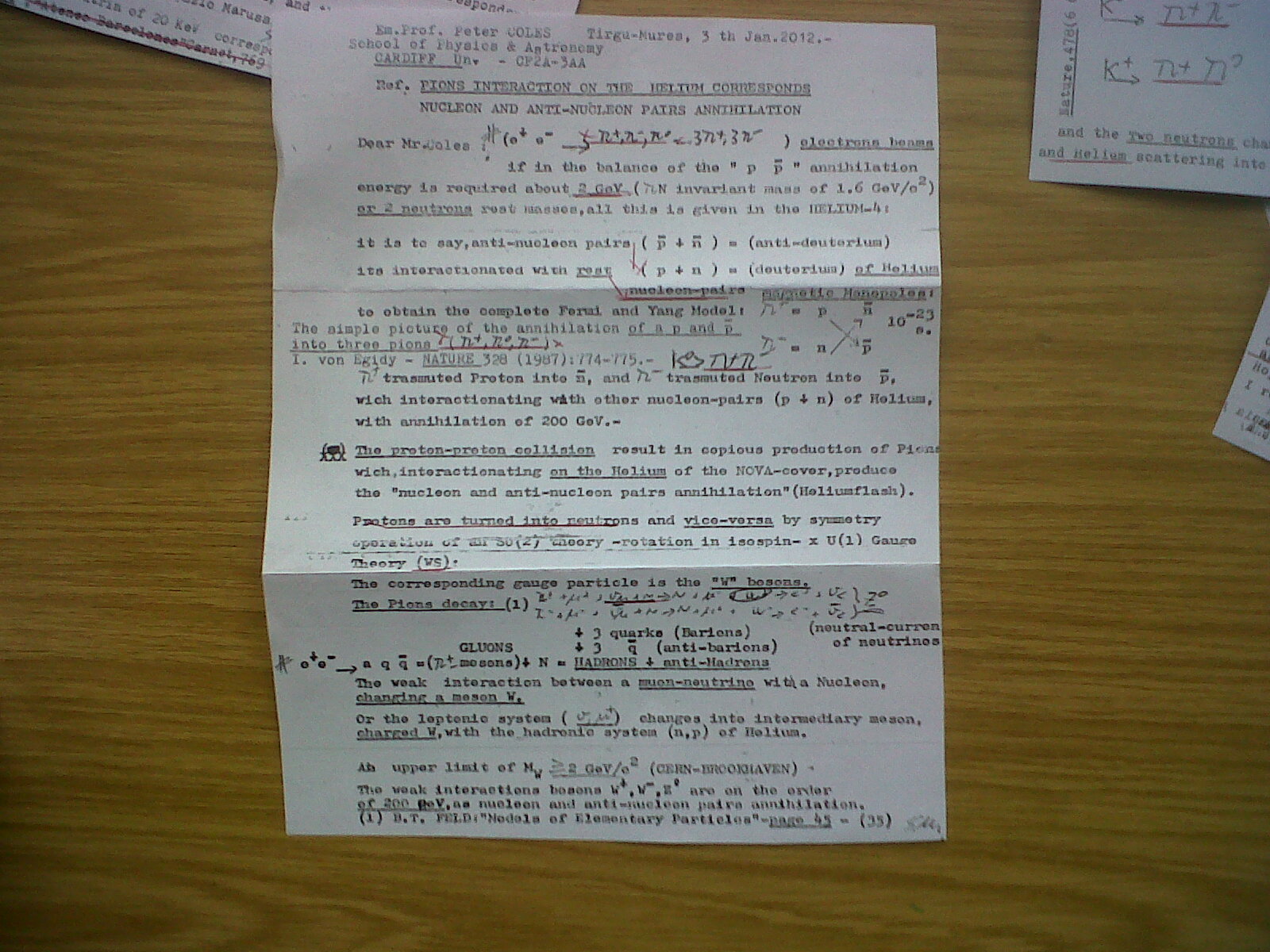
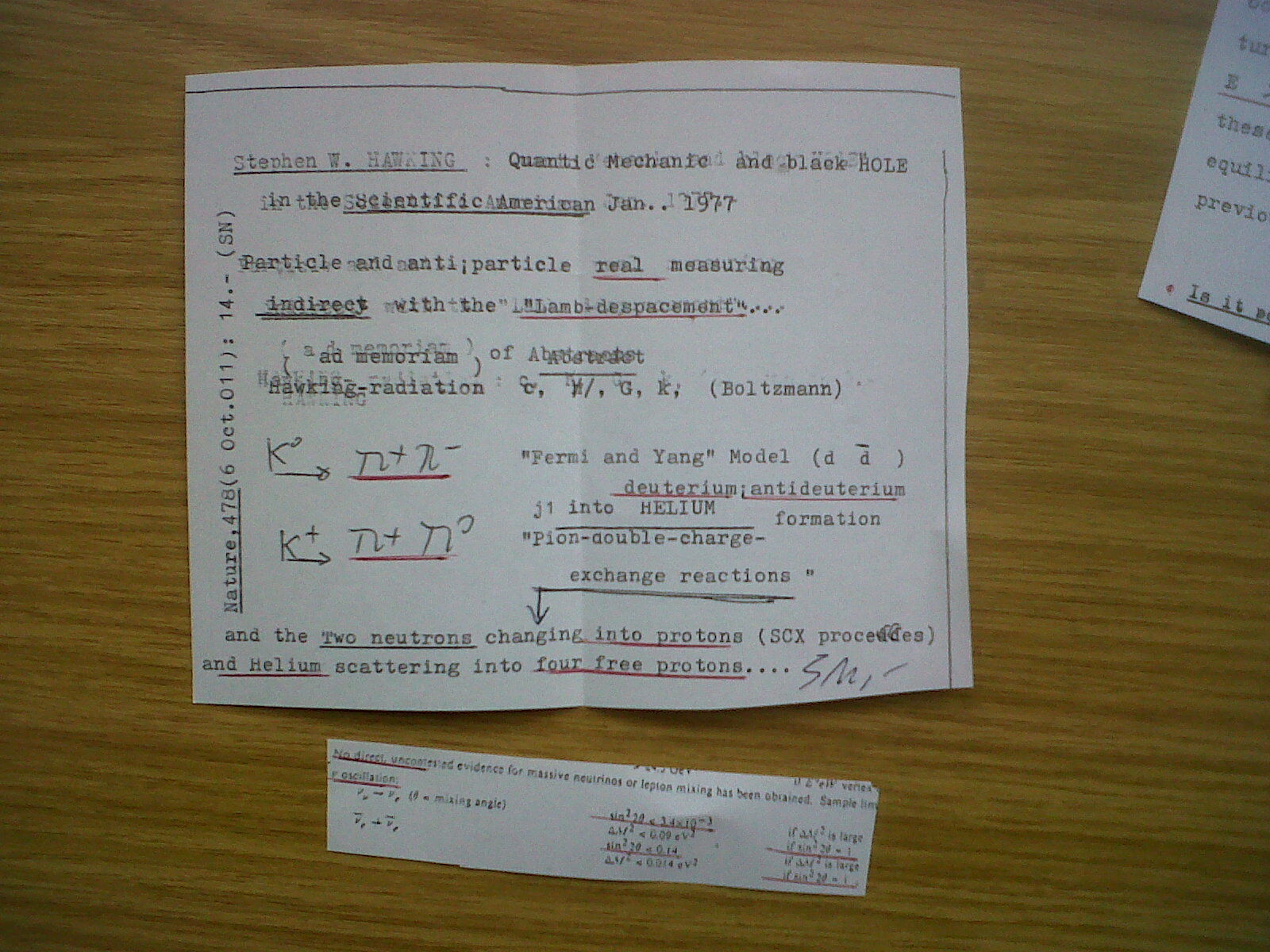
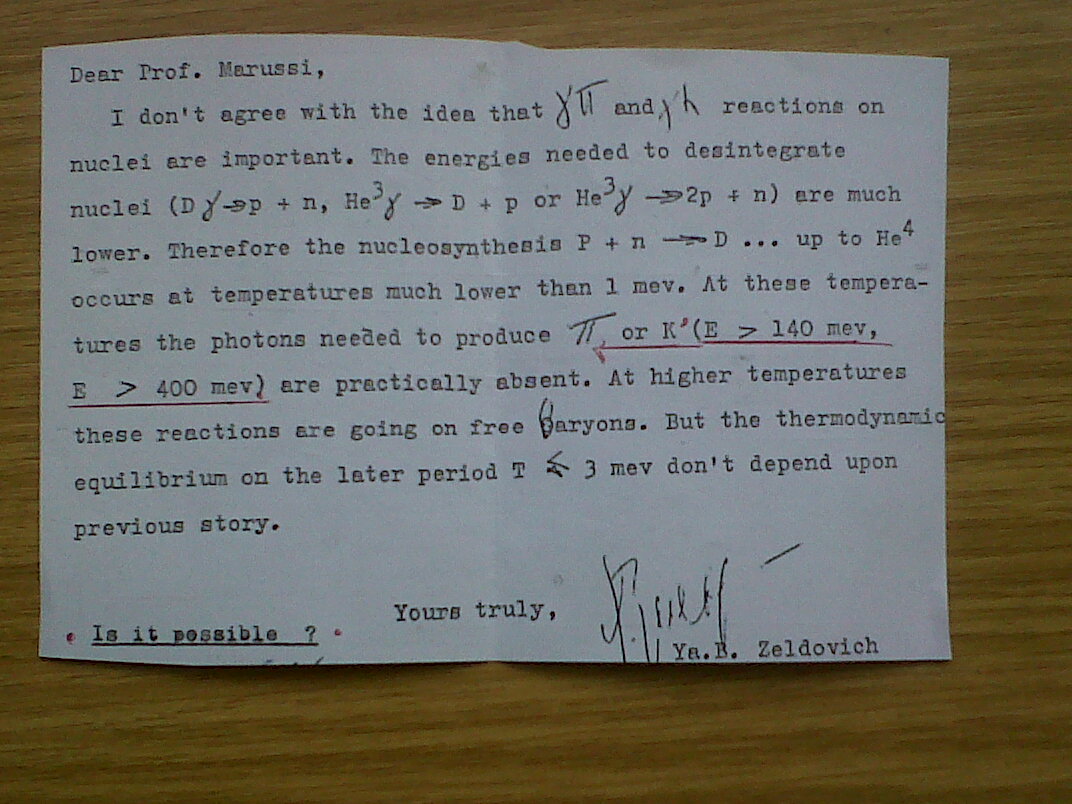
Among the delights (?) of being a scientist are those priceless pieces of unsolicited mail from members of the public. When I went to collect my mail this morning I found a prime example waiting in my pigeonhole. I knew what it was going to be like before I even opened it because the envelope was addressed (rather inaccurately) using an old-fashioned typewriter. Only a certain kind of person uses a typewriter these days.

I particularly enjoyed the “Emeritus Prof. ” bit. And Cardiff isn’t in “Engand”, by the way. Or even “England”.

Inside were six pieces of paper – all of different sizes – on which fascinating things had been typed and later highlighted with red and black pens in order to enhance both their scientific and artistic impact.

I’m in the middle of a load  of project vivas today so haven’t had time to scan this masterpiece neatly, but it’s such a wonderful piece of correspondence that I couldn’t resist taking a few pictures of various elements for the edification of my vast readership. I think if you click on the images you might be able to read them more clearly but, if you do, I will not accept liability for the consequences.

Unfortunately I’m not sure whether I have them in the right order, as the logic that connects them together escapes me.

I have  a large collection of similar missives but, despite some obvious deficiencie, such as a lack of drawings,  this letter is one of the best and will now take pride of place in the bottom drawer of my filing cabinet. Perhaps one day I’ll write a book about them…

Holmes for the Bewildered

Posted in Literature, Television with tags , , , , on January 9, 2012 by telescoper

Being back to work full-time, now that the new teaching term has started, I find myself in a position to do quick lunchtime blog post while I eat my sandwich. I was going to blog about this topic last week, but thought I’d wait a week in case anything happened to change my negative opinion on this issue. I’m aware that I’m in a small minority and didn’t want to expose myself to public disapproval without due care and attention. Well, last night my opinion certainly changed, only it got even more negative. So now I’m going to take a deep breath, gird my loins, and state for the record my honestly-held opinion that the new BBC TV Series Sherlock is complete and utter tripe.

It’s not that I object to the idea of  placing Sir Arthur Conan Doyle’s great stories in a contemporary setting. Not at all. Sherlock Holmes is one of the most memorable creations in all of fiction and the plots – at least most of them – are so well constructed that the stories should be translatable into a contemporary setting quite easily. There have been so many “traditional” versions of  Sherlock Holmes that I welcome the attempt to do something different with the character.

Neither is it that I object to Sherlock Holmes being played for laughs. The character does indeed possess a great deal of comic potential, which  a number of other interpretations have exploited with a greater or lesser degree of success.

What has happened in this series, however, is that the original plots have been butchered to the point where they make no sense at all. Instead we just have a series of thinly related comedy sketches, with only feeble attempts to link them to a viable mystery story, like a duff combination of the worst bits of Jonathan Creek and The Fast Show.

Last night’s puerile Hound of the Baskervilles was especially dire in this respect. The original story – a full-length novel rather than a short story – is a genuinely intriguing mystery-thriller, laced with undertones of the supernatural, and full of memorable characters, including of course the fearsome Hound itself.

For reasons best known to themselves Forced to squeeze it into one hour, the producers of last night’s version of this classic tale abandoned most of the original plot and introduced a load of silly nonsense about werewolves and hallucinogenic fog and the CIA. The Holmes-Watson double-act was quite amusing – and some of the dialogue very witty – but the plot was so thin it just reminded me of Abbott and Costello meet the Wolfman and other such films I watched when I was a kid. I thought the first episode –  A Scandal in Belgravia – was bad enough, but last night’s episode was truly excruciating. I won’t be watching any more.

It’s a mystery to me why so many people seem to think this tosh is so good, but then I’m used to being in a minority of one. Perhaps if you watch a lot of TV your expectations are lowered so much by the constant stream of drivel that anything that even tries to be original – which Sherlock admittedly does – sends you into raptures?

No, dear critics, I don’t think Sherlock is “great TV” at all. In fact I think it’s dreadful.

There. I’ve said it.

She is what she is….

Posted in Music with tags , on January 8, 2012 by telescoper

..and, incredibly, she is 75 today!

Happy Birthday, Dame Shirley Bassey!

And on the basis that you can have too much of a good thing, here she is in 1966 singing Leonard Bernstein’s  lovely song Somewhere from West Side Story.

Hawking at 70

Posted in Books, Talks and Reviews, The Universe and Stuff with tags , , , , on January 8, 2012 by telescoper

Today is the 70th Birthday of renowned British theoretical physicist Stephen Hawking. His  immense contributions to physics, including but not restricted to cosmology, are remarkable in their own right, but  made even more emarkable that has done so much after having been stricken by such a debilitating disease when he was only in his twenties. Hawking’s is undoubtedly a brilliant and inspirational mind, but his courage and physical endurance in the face of difficulties that  others might have found unbearable provide inspiration far behond physics. I’d therefore like to add a genuine Many Happy Returns to Professor Stephen Hawking, and I hope he’s enjoying the celebratory conference and other events that have been laid on to mark this special occasion.

I have in the past gone on record, both on television and in print, as being not entirely positive about the “cult” that surrounds Stephen Hawking. I think a number of my colleagues find things I have said disrespectful and/or churlish. I do, however, stand by everything I’ve said. I do have enormous respect for Hawking the physicist, as well as deep admiration for his tenacity and fortitude, and have never said otherwise. I don’t, however, agree that Hawking is in the same category of revolutionary thinkers as Newton or Einstein, which is how he is often portrayed.

In fact  a poll of 100 theoretical physicists in 1999 came to exactly the same conclusion. The top ten in that list were:

  1.  Albert Einstein
  2. Isaac Newton
  3. James Clerk Maxwell
  4. Niels Bohr
  5. Werner Heisenberg
  6. Galileo Galilei
  7. Richard Feynman
  8. Paul Dirac
  9. Erwin Schrödinger
  10. Ernest Rutherford

The idea of a league table like this is of course a bit silly, but it does at least give some insight into the way physicists regard prominent figures in their subject. Hawking came way down the list, in fact, in 300th (equal) place. I don’t think it is disrespectful to Hawking to point this out. I’m not saying he isn’t a brilliant physicist. I’m just saying that there are a great many other brilliant physicists that no one outside physics has ever heard of.

It is interesting to speculate what would have happened if the list had been restricted to living physicists. I’d guess Hawking would be in the top ten, but I’m not at all sure where…

And before I get accused of jealousy about Stephen Hawking’s fame, let me make it absolutely clear that if Hawking is like a top Premiership footballer (which I think is an appropriate analogy), then I am definitely like someone kicking a ball around for a pub team on a Sunday morning (with a hangover). This gulf does not make me envious; it just makes me admire his ability all the more, just as trying to play football makes one realise exactly how good the top players really are.

Anyway, I had better wind this up because that sporting metaphor has just reminded me that there are some FA Cup ties on the TV this afternoon. I’ll therefore switch to a slightly different kind of hawking, i.e. trying to peddle a few copies of my book  Hawking and the Mind of God, which was published in 2000. Excuse the blatant self-promotion, but these are hard times!

Here is the jacket blurb:

Stephen Hawking has achieved a unique position in contemporary culture, combining eminence in the rarefied world of theoretical physics with the popular fame usually reserved for film stars and rock musicians. Yet Hawking’s technical work is so challenging, both in its conceptual scope and in its mathematical detail, that proper understanding of its significance lies beyond the grasp of all but a few specialists. How, then, did Hawking-the-scientist become Hawking-the-icon? Hawking’s theories often take him into the intellectual territory that has traditionally been the province of religion rather than science. He acknowledges this explicitly in the closing sentence of his bestseller, “A Brief History of Time”, where he says that his ultimate aim is the “know the Mind of God”. “Hawking and the Mind of God” examines the pseudo-religious connotations of some of the key themes in Hawking’s work, and how these shed light not only on the Hawking cult itself, but also on the wider issue of how scientists represent themselves in the media.

And you can take a peek at the inside here:

I’m your Man

Posted in Music with tags , on January 7, 2012 by telescoper