All You Who Sleep Tonight

Posted in Poetry with tags , on November 26, 2011 by telescoper

All you who sleep tonight
Far from the ones you love,
No hand to left or right
And emptiness above –

Know that you aren’t alone
The whole world shares your tears,
Some for two nights or one,
And some for all their years.

by Vikram Seth.


The Unprofessional Professors

Posted in Education with tags , , , on November 26, 2011 by telescoper

I’ve been so preoccupied with other things over the past week or so that I haven’t had time until now to comment on an article I saw in last week’s  Times Higher about the role of a Professor in a modern university; there’s also an accompanying editorial in the same issue although, as is usual for editorials in the Times Higher, it doesn’t actually say anything that adds to the original piece.

People outside academia probably wonder what makes a Professor different from a Lecturer or Reader, apart from being older and getting paid a bit more. Undergraduate students probably wonder even more because they don’t see any obvious evidence that Prof. X is any better at teaching than plain Dr. Y. Quite possibly the reverse, in fact.

If you look at the contract of a Professor you won’t find that helps much either. Mine just says words to the effect that I should do whatever the Head of School asks me to do. In my case I have no complaints. I do teaching (lecturing, project supervision, tutorials, exercise classes), administration (various committees, and Director of Postgraduate Studies) and research (including supervising PhD students and a PDRA, publishing papers, etc) and I also do a few things outside the University such as STFC panels. I’m not complaining at all about this workload, for which  consider myself to be quite well paid. What I find difficult is swapping between so many different tasks even during the course of a single day, and I am all too aware that things  do sometimes fall through the cracks.

The criteria for promotion to the rank of Professor (i.e. to a “Chair”)  operated by most universities generally state that a professor must excel at teaching, administration and research. This provides for even greater mystification when you look around the average department because you’ll find many – probably even a majority – who couldn’t administer the skin on a rice pudding, and who make only derisory attempts to teach. These are the ones who have done it all on research, which in reality easily trumps the other two. To paraphrase Paul’s letter to the Corinthians: there are teaching, administration and research but the greatest of these is research. In fact the others don’t matter much at all.

The point is, at least in physics, that current levels of funding for undergraduate teaching mean that departments are financially unviable if they rely on undergraduate teaching as their primary source of income. It’s therefore inevitable that the primary criterion for appointing and retaining staff is their ability to win research grants and be a star performer in the REF. Indeed, many promotions to Chair happen when a member of staff threatens to leave, and take  their research grants and publication statistics with them. Furious negotiations then take place, a promotion to Chair ensues, and more likely than not a reduced teaching and administration load for the newly minted Prof.  Of course this means the load for someone  else has to go up. And if they are given management tasks to do, the Prof will manage the workload by simply not doing it, letting everything fall to bits until the job is allocated to someone else. Likewise with teaching: if you do it so badly that the students fail their exams or complain that you’re useless, you’ll just find your courses are given to someone else and you have more time to indulge your research interests. Studied incompetence is the ally of selfishness. It actually pays to be bad.

This is such a successful strategy that many departments now have as many professors as other teaching staff, if not more, a significant fraction of whom shirk their adminstrative duties and make little effort to teach well. Why should they? They know that as long as they hold onto their research grants they are indispensible, no matter how much strain they put on their colleagues. You might argue that this is unprofessional conduct, but there’s no question that it works.

Given this state of affairs, it’s hardly surprising that junior staff complain that their professors don’t show sufficient leadership and don’t take an active role in mentoring younger staff.  Selfishness pays. How many leaders can a department sustain anyway? If 2/3 of the staff are professors can they all be leaders? Who will follow?

I’ll get into trouble if I name individuals in my department – they know who they are – but I’m sure people in other universities recognize the same thing in their own departments. The situation won’t change until a funding regime is put in place that requires departments to prove commitment to excellence in teaching in the same way that they do for research. Then promotions panels might actually start to follow  their own published criteria instead of doing what they do now, which is nothing short of systematic hypocrisy.

It’s Time

Posted in Uncategorized on November 25, 2011 by telescoper


Necrodelic Reverie

Posted in Art, The Universe and Stuff with tags , , , on November 25, 2011 by telescoper

Among the delights of having a blog are the friendly emails you get from complete strangers. I got one last week from an artist, who is quite new to me, called Tobias Collier, concerning an old post of mine about randomness. Looking at his website I can see why he was interested in that particular topic, and also found so many things  of interest myself that I decided to do a small showcase here.

According to one of the reviews on his website:

Tobias Collier’s work can be seen as an attempt to visually articulate a great epistemological challenge: that of the human mind encountering the intellectually imponderable. Encompassing elements of sculpture, installation, drawing, performance and video, Tobias Collier’s practice partly relies upon the translation of scientific research methodologies to the processes of art making. Using Art as their field of enquiry, the subsequent works function as mechanisms within the context of a research practice and present a unique combination of scientific processes with poetic artistry.

Playing with current ideas around Astronomy and Cosmology, Tobias Collier’s quotidian metaphors examine our cultural relationship to outer space, using objects of daily existence. They highlight the limitations and inadequacy of man-made processes such as logic (modelling, hypothesizing, inferring and inducing), analogies and metaphors when attempting to comprehend systems and structures that extend beyond our everyday experience.

You can find a host of fascinating things on his website, including sculptures that manage to be both whimsical and profound:

Predicting Random Events, 2011

My favourite pieces, however, admittedly based only on what I have viewed on the website, are the stunning “inductive dot”  drawings, done in ink on paper, and described in the following passage:

The revelation of science that our universe, governed by the second law of thermodynamics, is ultimately fated to a cold quiet ‘heat death’, becomes an unavoidable issue for the work of London based artist Tobias Collier. His response is to propose the pursuit of necrodelic reverie. Small, yet hugely ornate, pointillist drawings are produced as a result of hours of ritualised practice. Like moments in an ongoing process, or records of a timeless activity, the end results are un-human, naturalised, nebulous star-fields or perhaps cloudscapes. In his sculpture references to collapsing or eroded structures, chemical reactions and combustions abound. Conscious cosmic thought entropically linked to the arrow of time, reconciled to universal destiny.

Here’s an example

Necrodelic Reverie, 2010

And this one, reminiscent of cloud formations in a planetary atmosphere:

Untitled, 2010

I find it fascinating that so many contemporary artists take their inspiration, and sometimes their techniques, from the sciences but so few scientists take a reciprocal interest in contemporary art. Anyway, I hope at least a few readers of this blog will now go and have a look at the work of Tobias Collier!


Astronomy Look-alikes, No. 71

Posted in Astronomy Lookalikes with tags , on November 24, 2011 by telescoper

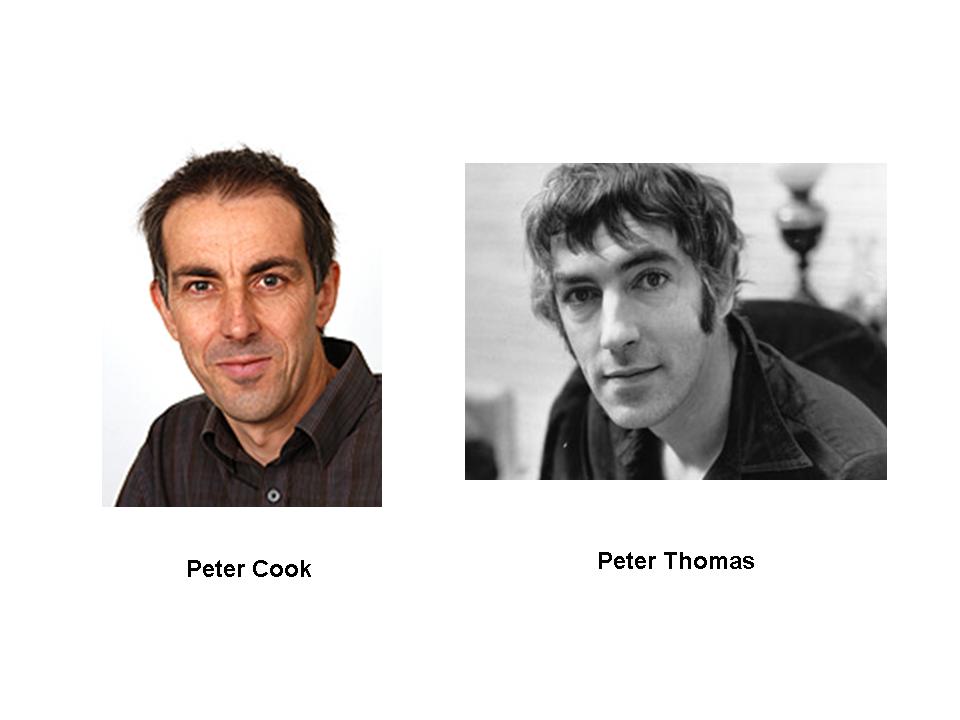
While sitting on a panel yesterday, I was struck by the similarity in visual appearance between astrophysicist Peter Thomas and comic genius Peter Cook. I wonder if by any chance they might be related?

I can’t be satisfied

Posted in Music with tags , on November 23, 2011 by telescoper

I’m up early, if not so bright, on this dark November morning in order to take an overpriced train to London for yet another  meeting of the STFC Astronomy Grants Panel, this one being the final “plenary” meeting of the current grant round at the Institute of Physics in London . Anyway, I won’t have time for a proper post as I travel hither and thither (or vice versa) so here’s one of them there blues to you to listen towhile I’m having fun (?). This is by the late and very great Big Bill Broonzy. And, yes, it is just him playing the guitar, although at times it sounds like at least two people playing…


Yet another cute physics problem

Posted in Cute Problems, The Universe and Stuff with tags , , on November 22, 2011 by telescoper

I’ve spent all day either teaching or writing draft grant applications and am consequently a bit knackered, so in lieu of one of my usual rambling dissertations here is another example from the file marked Cute Physics Problems, this time from thermodynamics. It’s quite straightforward. Or is it? Most people I’ve asked this question in private have got it wrong, so let’s see if the blogosphere is smarter:

Three identical bodies of constant  heat capacity are at temperatures of 300, 300 and 100 K. If no work is done on the system and no heat transferred to it from outside, what is the highest temperature to which any one of the bodies can be raised by the operation of heat engine(s)?

Thinking of Applying for a PhD in Physics or Astronomy?

Posted in Education with tags , , , , , , on November 21, 2011 by telescoper

This afternoon I gave a short talk to our final-year students about postgraduate research in which I passed on some, hopefully useful,  information about how to go about applying for PhDs  in Physics  and Astronomy. I am, for my sins, the Director of Postgraduate Studies within the School of Physics & Astronomy here at Cardiff University.

Although quite a lot of what I talked about was about our own arrangements in Cardiff, I thought I’d jot down here a few general remarks that might be useful to people elsewhere who are thinking of taking the plunge when they graduate. I’m aiming this primarily at UK students applying for places in the UK; special considerations apply for students wanting to do graduate research abroad.

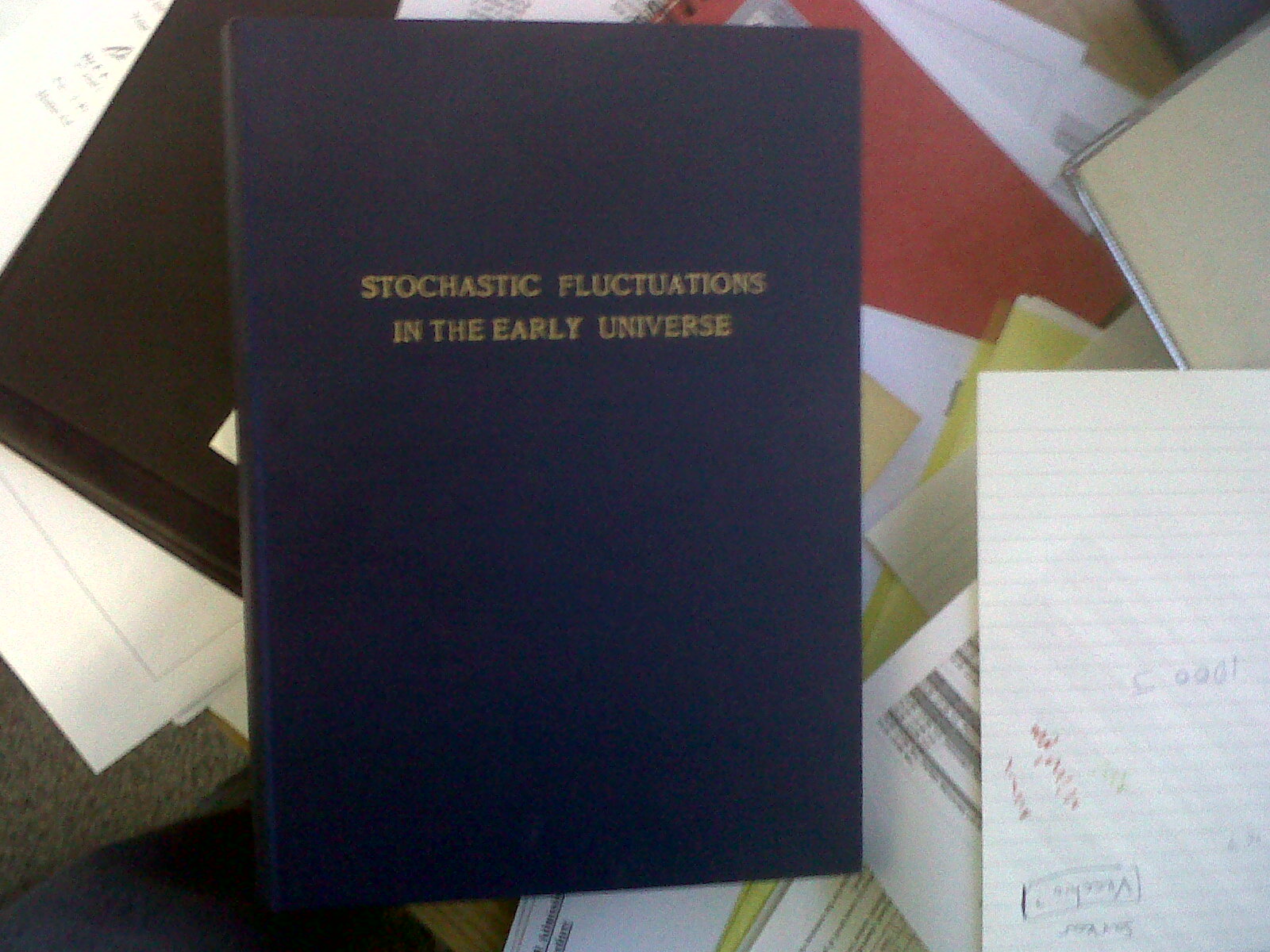
What is a PhD? The answer to that is relatively easy; it’s a postgraduate research degree. In order to obtain a PhD you have to present a thesis like that shown on the left (which happens to be mine, vintage 1988), typically in the range 100-250  pages long. A thesis has to satisfy two conditions for the award of the degree: it should contain original research, which is publishable in an academic journal; and it should present a coherent discussion of that original work within the context of ongoing work in the area of study. In Physics & Astronomy, the PhD is pretty much a prerequisite for any career in academic research, and it usually takes between 3 and 4 years to complete. After submission of the thesis you will have to undergo a viva voce examination conducted by two examiners, one internal and one external. This is quite a tough test, which  can last anywhere between about 2 and about 6 hours, during which you can be asked  detailed questions about your research and wide-ranging questions about the general area.

The Money Side. In the UK most PhDs are supported financially by the research councils, either EPSRC (most physics) or STFC (nuclear & particle physics, astronomy). These generally award quotas of studentships to departments who distribute them to students they admit. A studentship will cover your fees and pay a stipend, currently £13590 pa. That doesn’t sound like a lot, but you should at least remember that it is a stipend rather than a wage; it is therefore not taxed and there is no national insurance payable.

How do I choose a PhD? During the course of a postgraduate degree you are expected to become an expert in the area in which you specialize. In particular you should reach the point where you know more about that specific topic than your supervisor does. You will therefore have to work quite a lot on your own, which means you need determination, stamina and enthusiasm. In my view the most important criterion in your choice of PhD is not the institution where you might study but the project. You need to be genuinely excited by the topic in order to drive yourself to keep through the frustrations (of which there will be many). So, find an area that interests you and find the departments that do active research in that area by looking on the web. Check out the recent publications by staff in each department, to ensure that they are active and to have something to talk about at interview!

Qualifications. Most universities have a formal requirement that candidates for admission to the PhD should have a “good honours degree”, which basically means at least an Upper Second Class Honours degree. Some areas are more competitive than others, however, and in many disciplines you will find you are competing with a great many applicants with First Class degrees.

How to apply successfully. The application procedure at most universities is quite simple and can be done online. You will need to say something about the area in which you wish to do research (e.g. experiment/theory, and particular field, e.g. cosmology or star formation). You’ll also need a CV and a couple of references. Given the competition, it’s essential that you prepare. Give your curriculum vitae some attention, and get other people (e.g. your personal tutor) to help you improve it. It’s worth emphasizing particular skills (e.g. computing). If you get the chance, make use of your summer vacations by taking on an internship or other opportunity to get a taste of research; things like that will undoubtedly give your CV an edge.

The Interview. Good applicants will be invited for an interview, which is primarily to assess whether you have the necessary skills and determination, but also to match applicants to projects and supervisors. Prepare for your interview! You will almost certainly be asked to talk about your final-year project, so it will come across very badly if you’re not ready when they ask you. Most importantly, mug up about your chosen field. You will look really silly if you haven’t the vaguest idea of what’s going on in the area you claimed to be interested in when you wrote your  application!

Don’t be shy! There’s nothing at all wrong with being pro-active about this process. Contact academic staff at other universities by email and ask them about research, PhD opportunities. That will make a good impression. Also, don’t be afraid to ask for advice. Although we’re all keen to recruit good PhD students for our own departments, we academics are  conscious that it is also our job to give impartial advice. Ask your tutor’s opinion.

How many places should I apply for? Some research areas are more fashionable than others so the level of competition varies with field. As a general rule I would advise applying for about half-a-dozen places, chosen because they offer research in the right area. Apply to fewer than that and you might lose out to the competition. Apply to many more and you might not have time to attend the interviews.

What’s the timetable?  Most applications come in early in the new year for entry to the PhD in the following October. The Christmas break is therefore a pretty good time to get your applications sorted out. Interviews are normally held in February or March, and decisions made by late March. STFC runs a deadline system whereby departments can not force students to accept or decline offers before the end of March, so there should be ample time to visit all your prospective departments before having to make any decisions.

That’s all I can think of for now. I hope at least some of these comments are useful to undergraduates anywhere in the UK thinking of applying for a PhD. If there are any further questions, please feel free to ask through the comments box. Likewise if I’ve missed anything important, please feel free to suggest additions in the same manner…

Are Quantum States “Real”?

Posted in The Universe and Stuff with tags , , on November 20, 2011 by telescoper

Busy day today, despite it being a Sunday, so I’ve only got time for a quick post, by way of a diversion while I take a break for a cup of tea.

There’s been an attack of the hyperbolics this week arising from a paper entitled “The quantum state cannot be interpreted statistically”.  The abstract of the paper reads:

Quantum states are the key mathematical objects in quantum theory. It is therefore surprising that physicists have been unable to agree on what a quantum state represents. There are at least two opposing schools of thought, each almost as old as quantum theory itself. One is that a pure state is a physical property of system, much like position and momentum in classical mechanics. Another is that even a pure state has only a statistical significance, akin to a probability distribution in statistical mechanics. Here we show that, given only very mild assumptions, the statistical interpretation of the quantum state is inconsistent with the predictions of quantum theory. This result holds even in the presence of small amounts of experimental noise, and is therefore amenable to experimental test using present or near-future technology. If the predictions of quantum theory are confirmed, such a test would show that distinct quantum states must correspond to physically distinct states of reality.

According to a commentary published in the journal Nature, this paper could “rock quantum theory to the core” and a number of quantum physicists have reacted, e.g.:

“I don’t like to sound hyperbolic, but I think the word ‘seismic’ is likely to apply to this paper,” says Antony Valentini, a theoretical physicist specializing in quantum foundations at Clemson University in South Carolina.

I have to admit I haven’t had time to read the paper in detail yet, so I’m just passing this on as something fresh that may be of wider interest, rather than something I’ve got particularly strong views about. I have to admit, though, that I find the way quantum theorists use words, especially what is meant by “physically real” and what “states of reality” could be. Can a mathematical theorem ever prove itself to be applicable to the physical world anyway? You’ll see that ontology was never my strong suit.

However, if anyone out there in blogland has read this paper and would like to pass on their thoughts for the edification of me and my readers I’d be delighted. I might return to it in a longer post if and when I’ve been able to digest it fully.

Now, back to reality…


Goodbye Dolly

Posted in Cricket, Politics with tags , , on November 19, 2011 by telescoper

This is turning out to be a sad month for cricket fans, for today saw the death of legendary all-rounder Basil D’Oliveira. “Dolly”, as he was affectionately known, was born in South Africa but was unable to play first-class cricket there because of the apartheid regime’s policy of racial segregation; as a “Cape Coloured” he wasn’t allowed to play what was basically a whites-only game. He emigrated to England in 1960 and was subsequently picked to play for England and quickly established himself as an excellent player at Test level. Selected basically as a batting all-rounder, and usually coming in between 5 and 7 in the order,  his  average was over 40, and he scored 5 centuries in 44 Test matches in a career that lasted from 1966 to 1972. These are impressive figures, especially considering that his Test career didn’t even start until he was in his mid-thirties.

His selection (as a late replacement) for the England side that was to tour South Africa in 1968 precipitated the D’Oliveira Affair, which led to South Africa being ostracised from international cricket until the end of apartheid in the 1990s. Although this episode must have been personally distressing for him, D’Oliveira behaved with great courage and dignity throughout and won many admirers on and off the field, and the warmth of the tributes being paid in today’s media demonstrate the high regard in which he was held by cricketers, fans of the sport, and  by campaigners against racism.

Rest in peace, Basil D’Oliveira (1931-2011), one of the true gentlemen of cricket.